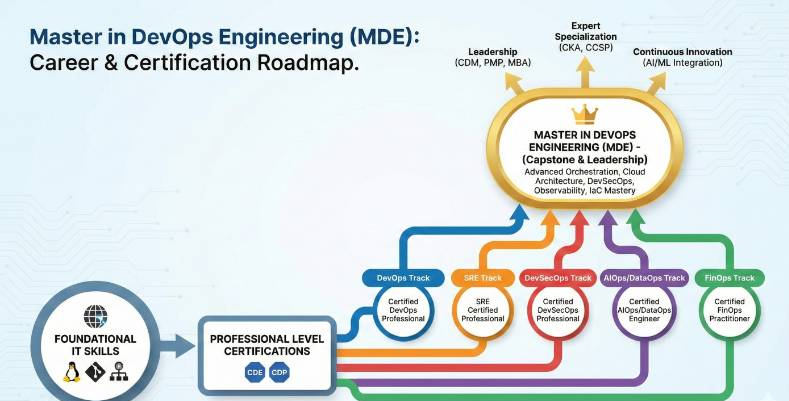
The technology landscape moves fast. Today, companies do not just want code written; they want it delivered securely, reliably, and efficiently. This demand has created a massive shift in how we build, deploy, and manage software.
You might be a working software engineer looking to level up. You might be an engineering manager trying to understand the skills your team needs. Either way, understanding the right training and certification paths is critical for your success.
This guide will break down the Master in DevOps Engineering (MDE) certification. We will look at what it takes to master this domain, the paths you can choose, and how to map your career goals to the right credentials. Let us dive in.
The Certification Landscape
To understand where the Master in DevOps Engineering fits, it helps to see the broader picture. Below is a breakdown of key certifications in this space to help you plan your journey.
| Certification Name | Track | Level | Who it’s for | Prerequisites | Skills covered | Recommended order |
| Master in DevOps Engineering (MDE) | DevOps | Master | Senior Engineers, Architects, Managers | Linux, Basic Cloud, Git | CI/CD, K8s, Cloud Architecture, Automation | 4 (After Professional level) |
| Certified DevOps Engineer (CDE) | DevOps | Foundation | Junior Engineers, System Admins | Basic IT knowledge | Git, Jenkins, Docker basics | 1 |
| Certified DevOps Professional (CDP) | DevOps | Professional | Mid-level Engineers | CDE or equivalent experience | Advanced CI/CD, Terraform, Kubernetes | 2 |
| Certified DevOps Architect (CDA) | DevOps | Advanced | Senior Engineers, Tech Leads | CDP or strong engineering background | System Design, Security, Enterprise Scaling | 3 |
| DevSecOps Certified Professional (DSOCP) | Security | Professional | Security Engineers, DevOps Engineers | DevOps basics, Security concepts | SAST, DAST, Compliance as Code | Optional / Parallel |
| SRE Certified Professional (SRECP) | Reliability | Professional | SREs, System Admins | Linux internals, Networking | Observability, Incident Management, SLIs/SLOs | Optional / Parallel |
Deep Dive: Master in DevOps Engineering (MDE)
The Master in DevOps Engineering (MDE) is a premium credential. It is designed for those who want to reach the pinnacle of software delivery and infrastructure management. Here is exactly what you need to know about this program.
Provider details
- Certification Name: Master in DevOps Engineering (MDE)
- Provider: DevOpsSchool
What it is
The Master in DevOps Engineering (MDE) is an elite, comprehensive certification program. It proves you can design, build, and govern complex, enterprise-grade software delivery pipelines from end to end. It bridges the gap between technical execution and strategic business goals.
Who should take it
This program is not for absolute beginners. It is tailored for experienced Software Engineers, Cloud Architects, and Technical Leads. Engineering Managers who want a deep, hands-on understanding of the systems their teams build will also highly benefit from this master-level training.
Skills you’ll gain
- Advanced infrastructure orchestration using Kubernetes and Docker.
- Mastery of Infrastructure as Code (IaC) using tools like Terraform and Ansible.
- Designing zero-downtime deployment strategies (blue-green, canary).
- Implementing robust observability and monitoring stacks for production systems.
- Automating security and compliance checks directly into the CI/CD pipeline.
- Managing enterprise-scale cloud resources and optimizing infrastructure costs.
- Leading complex migrations from legacy systems to modern microservices architectures.
Real-world projects you should be able to do after it
- Architect and deploy a highly available, multi-region Kubernetes cluster from scratch.
- Build a fully automated deployment pipeline with integrated vulnerability scanning and automated rollbacks.
- Migrate a monolithic legacy application into independent, containerized microservices.
- Set up an enterprise-wide central logging and alerting system using ELK or Prometheus/Grafana.
- Audit and refactor cloud infrastructure to reduce monthly cloud spending by implementing FinOps practices.
Preparation plan
7–14 Days: Fundamentals & Assessment
Audit your current knowledge. Review core Linux administration, advanced Git workflows, and basic networking concepts. Familiarize yourself with the MDE syllabus and set up your local lab environment (e.g., Minikube, AWS/GCP free tier).
30 Days: Core Tooling & Automation
Focus heavily on Infrastructure as Code and container orchestration. Spend these weeks writing Terraform scripts and building complex Kubernetes manifests. Practice creating end-to-end CI/CD pipelines using Jenkins or GitLab CI, ensuring you can pass code from commit to deployment automatically.
60 Days: Advanced Scenarios & Troubleshooting
Move into complex, real-world scenarios. Practice implementing security gates (DevSecOps integration). Intentionally break your local environments and practice disaster recovery. Study enterprise governance, compliance, and cost management. Take practice exams and review case studies of large-scale transformations.
Common mistakes
- Ignoring the fundamentals: Jumping straight into Kubernetes without a solid grasp of Linux networking and basic containerization.
- Reading instead of doing: DevOps is a hands-on discipline. Watching videos without executing the labs will lead to failure.
- Overcomplicating the toolchain: Trying to learn every tool in the market instead of mastering the standard, core tools required by the syllabus.
- Forgetting the culture: Focusing purely on the technology and ignoring the cultural, communication, and process improvements that are central to the DevOps philosophy.
- Skipping security: Treating security as an afterthought rather than integrating it natively into the build processes.
Best next certification after this
Once you achieve the MDE, you have reached a high level of technical mastery. Your next steps depend on your career goals. Based on industry data, here are the top recommendations:
- Same-track option: Executive IT Leadership Programs (focusing on organizational transformation rather than just technical implementation).
- Cross-track option: Certified DevSecOps Professional (DSOCP) or Site Reliability Engineering Certified Professional (SRECP) to deepen your expertise in security or uptime.
- Leadership option: Certified DevOps Manager (CDM) or general Engineering Management credentials to lead large engineering departments.
Choose Your Path: 6 Learning Tracks
The tech industry has evolved. DevOps has branched out into specialized domains. Depending on your interests and your company’s needs, you can choose a specific path.
1. The DevOps Path
This is the core track. It focuses on breaking down silos between development and operations. You will learn to automate software delivery, manage infrastructure efficiently, and ensure fast, reliable releases. This path is perfect for traditional software engineers and system administrators looking to modernize their skill sets.
2. The DevSecOps Path
Security can no longer wait until the end of the development cycle. The DevSecOps path teaches you how to shift security left. You will learn to embed automated security testing, vulnerability scanning, and compliance checks directly into the CI/CD pipeline. This is crucial for anyone working in finance, healthcare, or enterprise software.
3. The SRE (Site Reliability Engineering) Path
SRE applies a software engineering mindset to system administration topics. If you love solving complex scaling issues, managing incident response, and ensuring systems have 99.99% uptime, this is your path. You will focus heavily on observability, service level objectives (SLOs), and eliminating toil through automation.
4. The AIOps / MLOps Path
Artificial Intelligence and Machine Learning models are useless if they stay on a data scientist’s laptop. MLOps focuses on the lifecycle of machine learning models—training, deploying, and monitoring them in production. AIOps uses AI to automate and improve IT operations. This is the cutting edge of infrastructure management.
5. The DataOps Path
Data teams face the same bottleneck issues that software teams faced a decade ago. DataOps applies DevOps principles to data engineering. You will learn to build automated, secure, and observable data pipelines. This path ensures that data scientists and analysts get high-quality data quickly and reliably.
6. The FinOps Path
Cloud computing is powerful, but it can also be incredibly expensive if mismanaged. FinOps is the practice of bringing financial accountability to the variable spend model of the cloud. On this path, you will learn to optimize cloud architecture for cost, forecast spending, and align engineering decisions with business value.
| Current Role | Primary Certification | Secondary Certification |
| DevOps Engineer | Master in DevOps Engineering (MDE) | CKA (Kubernetes Administrator) |
| SRE | MDE | SRE Certified Professional |
| Platform Engineer | MDE | Terraform Associate |
| Cloud Engineer | MDE | AWS/Azure/GCP Architect |
| Security Engineer | DevSecOps Certified Professional | MDE (For context) |
| Data Engineer | DataOps Certified Professional | MDE (For pipelines) |
| FinOps Practitioner | FinOps Certified Practitioner | MDE (For technical understanding) |
| Engineering Manager | MDE | Certified DevOps Manager (CDM) |
Top Institutions for Training and Certification
When pursuing high-level credentials like the MDE, the quality of your training provider matters immensely. Here are the top institutions known for delivering robust, hands-on training in these domains.
DevOpsSchool
This is a premier global institute focusing heavily on real-world, hands-on learning. They are the official provider for the Master in DevOps Engineering (MDE) program. Their curriculum is highly aligned with current industry demands and enterprise tools.
Cotocus
Cotocus is highly respected for its consulting-driven approach to training. They bring actual enterprise challenges into the classroom. Their instructors are known for deep technical dives into complex cloud architectures and automation strategies.
Scmgalaxy
Scmgalaxy is a massive community and training hub that has been around since the early days of version control and build management. They offer excellent foundational and advanced courses with a strong emphasis on continuous integration and delivery pipelines.
BestDevOps
BestDevOps focuses on delivering streamlined, highly effective bootcamps. Their training is designed for working professionals who need to upskill quickly. They provide excellent lab environments and strong post-training support.
Devsecopsschool
As the name suggests, this institution specializes entirely in the intersection of development, operations, and security. If you are pursuing a DevSecOps path, they offer some of the most rigorous compliance and security automation training available.
Sreschool
Sreschool focuses on teaching the Google-born discipline of Site Reliability Engineering. Their courses cover everything from setting up advanced observability stacks to managing high-stress incident response simulations.
Aiopsschool
This is a niche, forward-looking institution focused on the future of operations. They teach engineers how to deploy machine learning models to production and how to use AI tools to automate complex infrastructure management tasks.
Dataopsschool
Dataopsschool fills a critical gap in the market by training data engineers in Agile and DevOps methodologies. Their programs teach you how to build robust, version-controlled, and automated data pipelines at scale.
Finopsschool
With cloud costs spiraling for many enterprises, Finopsschool provides essential training on cloud financial management. They teach engineers and managers how to architect for cost efficiency without sacrificing system performance.
Frequently Asked Questions (FAQs)
General Career & Certification FAQs
1. How difficult is it to transition from software engineering to DevOps?
It is a very natural transition. Software engineers already know how to code, which is a massive advantage when writing Infrastructure as Code. The main challenge is learning system administration and networking concepts.
2. How much time should I dedicate to studying for an advanced certification?
For an advanced credential, you should plan for 10 to 15 hours a week for about 8 to 12 weeks. This allows enough time for reading, but more importantly, for executing complex hands-on labs.
3. What are the mandatory prerequisites before starting a master-level program?
You must have a strong command of Linux terminal commands, an understanding of basic networking (DNS, TCP/IP, Load Balancing), and experience with Git. Without these, you will struggle.
4. Does the sequence of certifications matter?
Yes. It is highly recommended to start with a foundation or professional level (like CDE or CDP) to grasp the core tools before attempting architecture or master-level exams, which require designing complex systems.
5. Are these certifications globally recognized?
Yes. The principles of modern software delivery are universal. A strong certification from a reputable provider demonstrates your competency to employers globally, from startups to Fortune 500 enterprises.
6. What is the return on investment (ROI) for these certifications?
The ROI is typically very high. Engineers with verified skills in Kubernetes, cloud architecture, and automation frequently command premium salaries and are heavily recruited by top tech companies.
7. Should I focus on one cloud provider (AWS/GCP/Azure) or learn general tools?
Start with general, cloud-agnostic tools like Terraform, Docker, and Kubernetes. Once you understand the concepts, you can easily apply them to any specific cloud provider.
8. Is coding experience absolutely necessary?
While you do not need to build full web applications, you must be comfortable reading code, writing scripts (Bash, Python), and structuring configuration files (YAML, JSON).
9. How do these certifications impact career outcomes?
They serve as a powerful filter for recruiters. A master-level certification proves you have moved beyond basic tutorials and can handle the stress and complexity of enterprise production environments.
10. Do I need to renew these certifications?
Technology changes rapidly. While the core concepts remain, it is best practice to update your skills and potentially recertify or take upgrade exams every 2 to 3 years.
11. Can managers benefit from taking engineering certifications?
Absolutely. Managers who understand the technical details can make better architectural decisions, estimate project timelines more accurately, and earn deeper respect from their engineering teams.
12. What is the biggest challenge when taking these exams?
The biggest challenge is time management during practical lab assessments. You must be fast and confident on the command line to complete the complex scenarios within the time limit.
FAQs specific to Master in DevOps Engineering (MDE)
1. What makes the MDE different from a standard Professional certification?
A professional certification tests if you can use a tool. The MDE tests if you can architect a solution using multiple tools, secure it, scale it, and align it with business objectives. It is about design and leadership, not just execution.
2. Are there real-world projects included in the MDE training?
Yes. The MDE is heavily project-based. You will be required to build and deploy complex infrastructures that mimic real enterprise environments, not just simple ‘hello world’ tutorials.
3. Does the MDE cover security practices?
Yes. Security is treated as a first-class citizen in the MDE curriculum. You will learn to implement DevSecOps principles, integrating security checks directly into your automated pipelines.
4. How long is the MDE certification valid?
Like most high-level technical certifications, it is generally recognized for 2-3 years, after which continuing education or a recertification exam is recommended to stay current with new tools.
5. Do I need to know a specific programming language for the MDE?
No specific language is mandated for application code, but you must be highly proficient in scripting languages like Bash and Python, as well as data serialization languages like YAML for configuration.
6. How does the MDE help in salary negotiations?
The MDE serves as proof of elite capability. It shifts the conversation from “can you do the job?” to “how will you lead our infrastructure strategy?” which naturally commands a higher compensation bracket.
7. Can I take the MDE exam online?
Yes, the certification process, including the practical assessments and theoretical exams, can be completed online through a secure, proctored environment provided by the official institution.
8. What is the passing score for the MDE?
Because it is a master-level credential with rigorous practical components, the passing criteria are strict, often requiring a high degree of accuracy in both the architectural design and the hands-on execution phases.
Conclusion
The journey to becoming a Master in DevOps Engineering is not just about collecting certificates; it is about future-proofing your career. In a world where speed, security, and reliability are the currency of business, the skills you gain from the Master in DevOps Engineering (MDE) program are invaluable.
Whether you are an engineer tired of manual tasks or a manager striving to lead high-performing teams, this path offers a clear roadmap to excellence. You are not just learning tools like Docker or Kubernetes; you are learning how to build the engines that power the modern digital economy.
The road ahead may seem long, but every expert was once a beginner. The demand for skilled DevOps professionals is skyrocketing, and the gap between “knowing” and “mastering” is where the biggest opportunities lie.
Don’t wait for the industry to change around you. Take control of your professional destiny today. Start with your assessment, commit to the learning path, and build the future you want to see.
