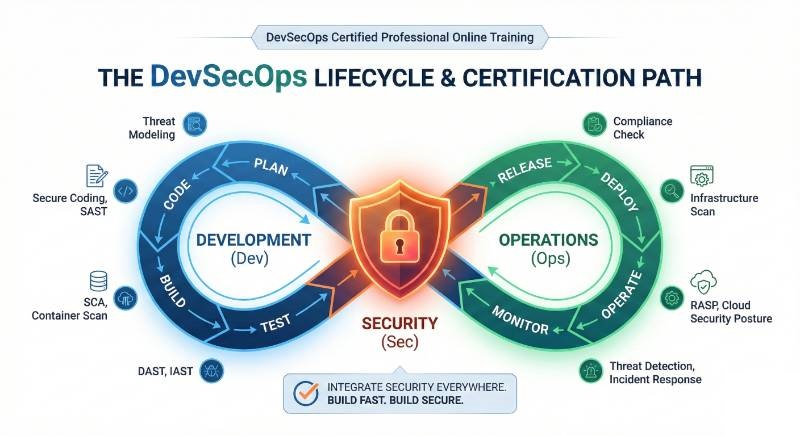
The bridge between “delivering fast” and “delivering safely” is where the future of software engineering lies. If you are reading this, you likely understand that security can no longer be an afterthought—it must be baked into the DNA of your development lifecycle.
Having mentored thousands of engineers over the last two decades, I have seen the industry shift from siloed security teams to integrated DevSecOps models. This guide is designed to cut through the noise and give you a clear, expert roadmap to the DevSecOps Certified Professional Online Training. whether you are a manager in Bangalore or a developer in Berlin, this guide is your blueprint.
At a Glance: The Certification
Below is the snapshot of the certification we are focusing on today. This program is designed to transform a standard DevOps practitioner into a security-conscious engineer.
| Certification | Track | Level | Who it’s for | Prerequisites | Skills covered | Recommended order |
| DevSecOps Certified Professional (DSOCP) | Security | Professional | DevOps Engineers, Security Engineers, QA, Developers | Basic DevOps & Linux knowledge | CI/CD Security, SCA, SAST, DAST, Container Security | Take after DevOps Fundamentals |
DevSecOps Certified Professional (DSOCP)
What it is
This is a hands-on, practitioner-focused certification that teaches you how to integrate security controls into a DevOps pipeline. It moves beyond theory to cover the actual implementation of “Security as Code” using modern tools.
Who should take it
- DevOps Engineers who need to implement security checks without slowing down deployment.
- Security Professionals wanting to understand modern CI/CD pipelines.
- Software Engineers looking to upskill in secure coding practices.
- QA Engineers shifting into security testing.
Skills you’ll gain
- Pipeline Security: Integrating SAST (Static Application Security Testing) and DAST (Dynamic Application Security Testing) tools like SonarQube and OWASP ZAP.
- Container Security: Scanning Docker images and securing Kubernetes clusters (using Trivy or similar tools).
- Secret Management: Managing credentials securely using HashiCorp Vault.
- Compliance as Code: Automating compliance checks.
- Threat Modeling: Identifying vulnerabilities in the design phase.
Real-world projects you should be able to do after it
- Secure CI/CD Implementation: Build a Jenkins pipeline that automatically fails the build if critical vulnerabilities are detected.
- Container Hardening: Create a secure Docker registry workflow that scans images before deployment.
- Automated Compliance Auditing: Write scripts to automatically check infrastructure against security benchmarks (CIS benchmarks).
Preparation plan
1. The Fast Track (7–14 Days)
- Who is this for? Senior DevOps Engineers or Security Leads who already use tools like Jenkins, Docker, and SonarQube daily.
- Goal: Bridge the gap between your practical knowledge and the specific exam curriculum.
- Strategy:
- Days 1-3: fast-read the official curriculum to identify terms or tools you don’t know.
- Days 4-7: Focus purely on the tools you haven’t used (e.g., if you know Jenkins but not GitLab CI, study GitLab).
- Days 8-10: Practice writing “Security as Code” scripts manually without Copy/Paste to test your muscle memory.
- Days 11-14: Review case studies and whitepapers on DevSecOps transformations.
2. The Standard Track (30 Days)
- Who is this for? Working professionals (DevOps Engineers, QA, Developers) who can dedicate 1–2 hours a day.
- Goal: Build a solid foundation and gain hands-on competence.
- Weekly Breakdown:
- Week 1 (Core Concepts): Understand the “Shift Left” philosophy. Study the SDLC and where security fits in. Learn the basics of Linux and Git if you are rusty.
- Week 2 (SAST & DAST): Focus on Application Security. Install SonarQube locally. Integrate it with a simple Java or Python code. Learn to read the error reports.
- Week 3 (Container Security): Dive into Docker. Learn to write secure Dockerfiles (e.g., non-root users). Use Trivy to scan images.
- Week 4 (Orchestration & Compliance): Basics of Kubernetes security. Learn how to manage secrets (passwords/API keys) using HashiCorp Vault.
3. The Mastery Track (60 Days)
- Who is this for? Freshers, Junior Developers, or Managers who want a deep, “zero-to-hero” understanding.
- Goal: Complete mastery with a fully functional portfolio project.
- Strategy:
- Month 1: Follow the “Standard Track” (above) but at a slower pace. Spend extra time troubleshooting errors—this is where real learning happens.
- Month 2 (Project Mode):
- Days 31-45: Build a complete CI/CD pipeline from scratch on a cloud provider (AWS/Azure free tier).
- Days 46-55: Intentionally introduce vulnerabilities into your code and watch your pipeline block them.
- Days 56-60: Documentation. Write a simple ReadMe or blog about what you built. This helps reinforce concepts for the exam.
Common mistakes
- Overloading the Pipeline: Adding too many heavy security scans that slow down the build, causing developer friction.
- Ignoring Culture: Thinking DevSecOps is just about buying tools, rather than changing how teams collaborate.
- Skipping Basics: Trying to secure Kubernetes without understanding basic Docker networking.
Best next certification after this
- Certified DevSecOps Architect: For those who want to design entire secure systems rather than just implement them.
Choose Your Path
The tech landscape is vast. While this guide focuses on DevSecOps, it is helpful to see where it fits in the broader ecosystem.
- DevOps Path: Focuses on speed and automation (Jenkins, Terraform, Docker).
- DevSecOps Path: Focuses on speed + security (Vault, SonarQube, Trivy).
- SRE Path: Focuses on reliability and uptime (Prometheus, Grafana, SLOs).
- AIOps/MLOps Path: Focuses on AI-driven operations and deploying ML models.
- DataOps Path: Focuses on the efficient flow of data through an organization.
- FinOps Path: Focuses on cloud cost management and optimization.
Role → Recommended Certifications
If you are currently in a specific role, here is what I recommend you target to advance your career.
| Current Role | Recommended Certifications |
| DevOps Engineer | DevSecOps Certified Professional (DSOCP), Certified Kubernetes Administrator (CKA) |
| SRE (Site Reliability Engineer) | Site Reliability Engineering Certified Professional (SRECP), Certified Kubernetes Security Specialist (CKS) |
| Platform Engineer | Certified DevOps Architect, Master in DevOps Engineering |
| Cloud Engineer | AWS/Azure DevOps Professional, DevSecOps Certified Professional (DSOCP) |
| Security Engineer | DevSecOps Certified Professional (DSOCP), Certified DevSecOps Architect |
| Data Engineer | DataOps Certified Professional, Big Data Architect |
| FinOps Practitioner | Certified FinOps Practitioner, AWS Cost Management |
| Engineering Manager | Certified DevOps Manager, Agile Master |
General FAQs
1. Is DevSecOps difficult to learn? It requires a broad set of skills (coding, operations, security), so it has a learning curve. However, if you already know DevOps basics, the transition is logical and manageable.
2. How long does it take to become a DevSecOps professional? For a working engineer, a dedicated 3-6 month period of study and practice is usually sufficient to reach a professional level.
3. Do I need to be a coder? You don’t need to be a developer, but you must be able to read code (Python, Bash, YAML) to understand scripts and automation.
4. What is the value of this certification? It proves you have practical, hands-on skills, which differentiates you from those who only know theory.
5. Is this recognized globally? Yes, the skills taught (tools and methodologies) are the global standard for modern software delivery.
6. Can I take this if I am a fresher? Yes, but you will need to work harder to understand the foundational DevOps concepts first.
7. What is the recommended sequence? Learn Linux -> Learn DevOps (CI/CD) -> Learn Cloud -> Learn DevSecOps.
8. Does it cover Cloud Security? Yes, it covers general principles of cloud security and specific tools that work in cloud environments.
9. Will this help me get a remote job? Absolutely. DevSecOps is one of the most in-demand remote roles globally.
10. What is the salary difference? DevSecOps engineers often command a 15-20% premium over standard DevOps roles due to the specialized security knowledge.
11. Is the exam multiple choice or practical? Most modern professional certifications, including this one, focus heavily on scenario-based or practical application of knowledge.
12. Can I self-study? You can, but structured training helps you avoid gaps in your knowledge and provides a lab environment for practice.
Next Certifications to Take
Once you have secured your DSOCP, look at these options to continue your growth (Reference: Gurukul Galaxy):
- Same Track (Expertise): Certified DevSecOps Architect. This will take your design and strategy skills to the next level.
- Cross-Track (Breadth): Certified Kubernetes Security Specialist (CKS). This is a deep dive specifically into container orchestration security.
- Leadership (Management): Certified DevOps Manager. Ideal if you want to lead teams and manage DevSecOps transformations.
Top Training Institutions for DevSecOps (DSOCP)
Here are the top institutions where you can find support, training, and certification resources for the DevSecOps Certified Professional.
- DevOpsSchool: A pioneer in the field, offering comprehensive, instructor-led training with a strong focus on real-time projects and community support. They are the official provider of the DSOCP.
- Cotocus: Known for their corporate training and consulting, they bring real-world industry scenarios into their training curriculum, making it highly relevant for working professionals.
- ScmGalaxy: An excellent community-driven platform that provides a wealth of tutorials, tools, and training resources for configuration management and DevOps.
- BestDevOps: Focuses on curating the best practices and tools in the industry, offering training that is aligned with current market demands.
- DevSecOpsSchool: As the name suggests, they specialize purely in the security aspect of DevOps, offering deep-dive courses into specific security tools and protocols.
- SRESchool: While focused on SRE, their training often overlaps with DevSecOps, particularly in the areas of monitoring, incident response, and reliable system design.
- AIOpsSchool: Provides training on the cutting edge of IT operations, teaching how to use AI to automate security responses and predict vulnerabilities.
- DataOpsSchool: Offers courses on securing data pipelines, which is a critical subset of DevSecOps for data-heavy organizations.
- FinOpsSchool: Focuses on the financial aspect, but their training includes governance and policy management which are key to a secure and compliant infrastructure.
FAQs: DevSecOps Certified Professional Online Training
1. What are the prerequisites for the DSOCP course? You should have a basic understanding of Linux command line, git, and the fundamental concepts of DevOps (CI/CD).
2. How much time should I dedicate daily? Spending 1-2 hours daily for about 4-6 weeks is the ideal pace to absorb the material and practice the labs.
3. Does the training include hands-on labs? Yes, the “DevSecOps Certified Professional” is designed to be highly practical. You will spend a significant amount of time configuring tools and pipelines.
4. What tools will I learn? You will typically learn Jenkins, Docker, Kubernetes, SonarQube, OWASP ZAP, Trivy, and HashiCorp Vault, among others.
5. Is coding experience mandatory? No, but you should be comfortable reading and editing configuration files (YAML, JSON) and basic scripts.
6. How does this help my career as a Manager? It helps you understand the technical challenges your team faces and allows you to make better decisions regarding security policies and tool selection.
7. Can I clear the exam without the training? It is difficult unless you have significant real-world experience setting up DevSecOps pipelines from scratch.
8. Is the certification valid for life? Certifications in this fast-changing field usually require renewal or earning continuing education credits every few years to stay current. Check the official page for the specific policy.
Conclusion
The “DevSecOps Certified Professional” is not just a badge; it is a signal to the market that you are a modern engineer who understands the full picture. By integrating security into the development process, you become a critical asset to any organization. Start your journey today, choose the right path, and remember that consistency in learning is your greatest tool.
