The world of IT has moved away from static servers. Today, everything is about speed and scale. If you work in software or infrastructure, you have likely seen how containers have taken over. Kubernetes is the engine that makes those containers run at scale. It is the most important tool for modern engineering teams.
For any engineer or manager, especially those working in India or for global firms, mastering Kubernetes is the best way to stay relevant. But just knowing the basics isn’t enough anymore. You need to prove you can manage a production environment. That is why the Certified Kubernetes Administrator (CKA) Certification Training Course is so highly valued.
In this guide, I want to share a different perspective. We won’t just look at how to pass an exam. We will look at how this certification changes your career path. I will show you how it fits into the bigger picture of DevOps, SRE, and Cloud Engineering.
Navigating the Modern Certification Landscape
Before we dive into the details of Kubernetes, we must understand where it sits in the industry. There are many paths you can take. Whether you are interested in security, data, or finance, there is a specialized track for you.
The following table shows the top certifications available today. It helps you see how the Certified Kubernetes Administrator (CKA) Certification Training Course relates to other professional goals.
Master Certification Comparison Table
| Track | Level | Who it’s for | Prerequisites | Skills Covered | Recommended Order |
| Kubernetes | Intermediate | SysAdmins, SREs | Linux Basics | Cluster Setup, Storage, Networking | Start here for K8s |
| DevOps | Professional | DevOps Engineers | Software Exp. | CI/CD, Automation, Infrastructure | After CKA |
| DevSecOps | Advanced | Security Leads | DevOps Basics | Security Auditing, Hardening | Post-DevOps |
| SRE | Professional | SREs, Ops | Ops Experience | Reliability, SLOs, Error Budgets | After CKA |
| AIOps | Advanced | ML Engineers | Python, ML | Model Scaling, AIOps Tools | Specialized |
| DataOps | Intermediate | Data Engineers | SQL, Pipelines | Data Agility, Warehousing | Specialized |
| FinOps | Management | FinOps Leads | Cloud Basics | Cloud Cost, Budgeting | For Managers |
The Core Focus: Certified Kubernetes Administrator (CKA)
The Certified Kubernetes Administrator (CKA) Certification Training Course is not like other exams. It doesn’t ask you to memorize definitions. It asks you to perform. When I look at a candidate’s profile, a CKA tells me they can handle pressure and solve real technical problems at the command line.
What it is
The Certified Kubernetes Administrator (CKA) Certification Training Course is a hands-on, performance-based test. You are given a terminal and a set of problems to fix in a live cluster. It proves you can install, configure, and manage production-ready Kubernetes environments. It is the industry standard for showing you are a capable administrator.
Who should take it
This course is perfect for anyone who handles the “Ops” side of software.
- Software Engineers: Who want to understand where their code actually lives.
- DevOps Engineers: Who need to automate deployments on Kubernetes.
- System Administrators: Who are moving away from traditional VM management.
- Engineering Managers: Who need to lead teams using cloud-native tools.
Skills you’ll gain
When you finish this training, you won’t just know “about” Kubernetes. You will know how to drive it. You will understand how all the moving parts—like the API server, scheduler, and etcd—work together to keep your applications running.
Key Professional Skills:
- Cluster Management: Knowing how to build a cluster from the ground up using
kubeadm. - Advanced Networking: Understanding how pods talk to each other and how services work.
- Security & Access: Setting up RBAC so the right people have the right access.
- Persistent Storage: Managing volumes so data stays safe even if a container restarts.
- Troubleshooting: Learning the “detective work” needed to fix a failing node or pod.
Real-world projects you should be able to do
After completing the Certified Kubernetes Administrator (CKA) Certification Training Course, you should be ready to work on high-impact tasks. Employers look for these specific abilities.
Project Examples:
- Build a High-Availability Cluster: Set up a cluster with multiple master nodes to ensure it never goes down.
- Implement Network Isolation: Create network policies that prevent different departments from accessing each other’s data.
- Set up Automated Backups: Design a system that regularly backs up the cluster state and tests restoration.
- Deploy Complex Apps: Manage stateful applications that require consistent storage and stable network IDs.
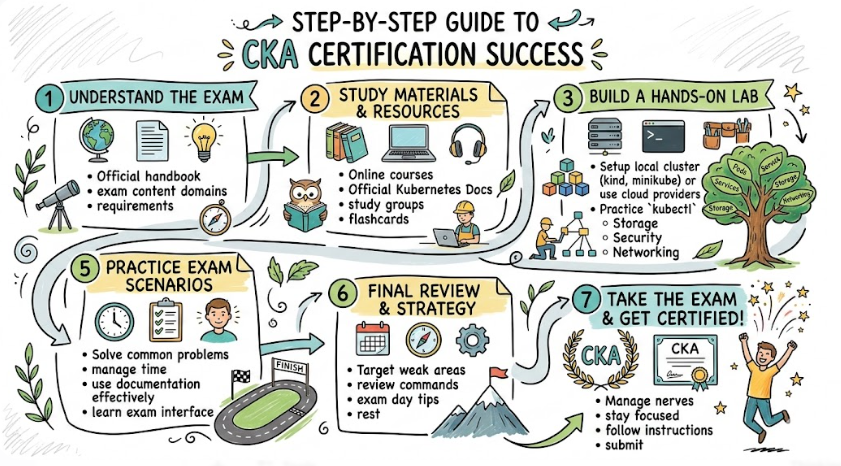
Preparation plan
7–14 Days (The Expert Sprint)
This is for people who use Kubernetes every day at work.
- Day 1-5: Review the curriculum and identify gaps in your knowledge.
- Day 6-10: Focus only on your weak spots (often networking or etcd).
- Day 11-14: Practice timed labs to ensure you are fast enough for the exam.
30 Days (The Standard Track)
This is for engineers who know Docker but are new to Kubernetes administration.
- Week 1: Master the basics of pods, deployments, and services.
- Week 2: Dive into storage, configmaps, and secrets.
- Week 3: Focus on cluster maintenance and troubleshooting.
- Week 4: Take mock exams and perfect your use of the documentation.
60 Days (The Deep Learning)
This is for beginners who need to learn Linux and Containers first.
- Month 1: Focus on Linux commands and how Docker containers work.
- Month 2: Follow the 30-day plan above, spending extra time on hands-on labs.
Common mistakes
Even the best engineers can fail if they aren’t careful. The exam is as much about speed as it is about knowledge.
- Writing YAML manually: This takes too long. Use
kubectlto generate your files. - Not checking the context: Always make sure you are in the right cluster before you run a command.
- Getting stuck: If a task is too hard, skip it and come back later. Don’t waste 20 minutes on one point.
- Over-searching documentation: You should know where the info is. You don’t have time to read entire pages during the test.
Planning Your Career Path
Getting your CKA is a great start, but it shouldn’t be the end. You need to think about where you want to go next. Based on data for top software engineers, you should look at certifications that complement your new skills.
Best next certification after this
- Same track (Technical Depth): Certified Kubernetes Security Specialist (CKS). Once you can run a cluster, you must learn how to protect it.
- Cross-track (Automation): Certified DevOps Engineer. This helps you connect Kubernetes to the rest of the software delivery pipeline.
- Leadership (Management): FinOps Certified Practitioner. This is for those moving into management who need to control cloud costs.
Choose your path: 6 Specializations
- DevOps Path: Focus on the speed of delivery and automation.
- DevSecOps Path: Make security a part of every step in the process.
- SRE Path: Focus on the uptime and reliability of the system.
- AIOps/MLOps Path: Learn how to run large AI models on Kubernetes.
- DataOps Path: Focus on the flow and quality of data.
- FinOps Path: Focus on the business and cost side of the cloud.
Role → Recommended certifications mapping
- DevOps Engineer: CKA, Certified DevOps Engineer, Terraform Associate.
- SRE: CKA, CKS, SRE Foundation.
- Platform Engineer: CKA, CKS, CKAD.
- Cloud Engineer: CKA, Cloud Solutions Architect.
- Security Engineer: CKS, DevSecOps Professional.
- Data Engineer: DataOps Professional, CKA.
- FinOps Practitioner: FinOps Practitioner, CKA.
- Engineering Manager: FinOps Practitioner, SRE Foundation.
Top Institutions for Training and Certification
Choosing the right place to learn is vital. You need a provider that gives you real labs and support. Here are the top institutions that help with the Certified Kubernetes Administrator (CKA) Certification Training Course.
- DevOpsSchool: A leader in technical training that offers deep-dive courses. They focus on practical skills and provide extensive lab environments to ensure you are ready for the real exam.
- Cotocus: Known for high-quality technical consulting and training. They offer expert-led sessions that cover complex enterprise scenarios, making them a great choice for working professionals.
- Scmgalaxy: This institution has a huge library of resources and a strong community. Their CKA training is built around the modern DevOps lifecycle and focuses on automation.
- BestDevOps: They provide clear, simple, and effective training modules. Their goal is to take you from a beginner level to a professional standard through structured learning.
- devsecopsschool: If you want to learn Kubernetes with a security mindset, this is the place. They integrate security best practices into every part of their administration training.
- sreschool: Their focus is on the reliability of systems. They teach you how to manage Kubernetes in a way that ensures maximum uptime and performance.
- aiopsschool: Perfect for those moving into the AI space. They show you how to use Kubernetes as a foundation for running complex machine learning workloads.
- dataopsschool: They specialize in data-driven infrastructure. Their CKA course includes insights into managing large-scale data processing on container platforms.
- finopsschool: Great for those interested in the financial side of technology. They help you understand how to manage Kubernetes while keeping cloud bills under control.
FAQs: Career and Strategy
1. Is the CKA certification worth it in today’s market?
Yes. It is one of the most respected certifications because it is hard to pass. It shows you have real practical skills.
2. How long does the CKA certification last?
It is valid for three years. This ensures that you stay up to date with the fast changes in Kubernetes.
3. Do I need to be a developer to pass the CKA?
No. This is an administration exam. You need to know Linux and infrastructure more than you need to know how to write code.
4. Can I take the exam from home?
Yes, the exam is proctored online. You just need a quiet room and a good internet connection.
5. How much does the CKA exam cost?
The standard price is around $395, but you can often find discounts or bundles through training providers.
6. What is the difference between CKA and CKAD?
CKA is for the people who manage the cluster itself. CKAD is for the developers who run their applications on the cluster.
7. Does CKA help with salary growth in India?
Absolutely. Engineers with CKA certifications often see a significant jump in their pay because the skill is in high demand.
8. Is there a specific sequence for these certifications?
Most people start with CKA because it gives you the best overall understanding of how Kubernetes works.
9. Can I use the documentation during the test?
Yes, you are allowed to open one tab for the official Kubernetes documentation.
10. What if I fail the first time?
Most exam vouchers include one free retake, so you can learn from your mistakes and try again.
11. How much hands-on experience do I need?
You should have at least a few months of working with the command line to feel comfortable during the exam.
12. Will this certification help me move into an SRE role?
Yes, CKA is a core requirement for almost every Site Reliability Engineering position today.
FAQs: Training and Exam Details
1. What version of Kubernetes does the exam use?
It usually uses the most recent stable version. Training providers keep their labs updated to match this.
2. What is the format of the CKA exam?
It is 100% practical. You will have about 15 to 20 tasks to complete in a live terminal.
3. How long is the CKA exam?
You have exactly two hours to complete all the tasks. This is why speed is so important.
4. What is a passing score for the CKA?
You need to score 66% or higher to earn your certification.
5. Are there multiple-choice questions?
No. There are zero multiple-choice questions. It is all about running the right commands.
6. Does the training cover etcd backup and restore?
Yes, this is a major part of the curriculum and a very common task in the actual exam.
7. Do I need to learn Helm for the CKA?
Basic knowledge of Helm is now part of the exam, so you should know how to install and manage packages.
8. Can I use my own notes during the exam?
No. You are only allowed to use the official documentation website. You cannot have any papers or notes on your desk.
Conclusion
The Certified Kubernetes Administrator (CKA) Certification Training Course is a life-changing step for any engineer. It marks the transition from being a technician to being a specialist who can handle the world’s most complex infrastructure. In my years of watching the industry evolve, I have seen many tools come and go, but Kubernetes has become the foundation of everything we do. By earning this certification, you aren’t just getting a piece of paper; you are gaining the confidence to manage global systems. It requires hard work, late nights in the lab, and a lot of practice, but the reward is a career that is both secure and exciting. Start your journey today, stay consistent with your labs, and you will see how many doors this expertise opens for you in the modern tech world.
