Introduction
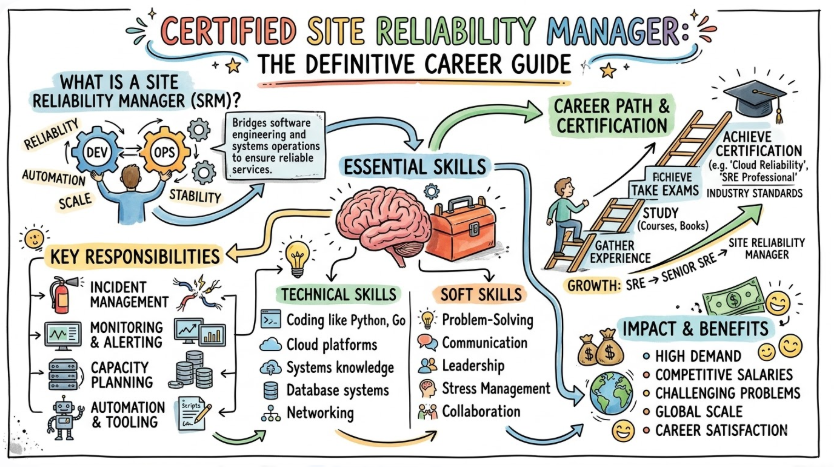
The Certified Site Reliability Manager is a professional designation designed for those bridging the gap between high-level engineering and strategic operations management. This guide is crafted for technical leads, aspiring managers, and seasoned SREs who need to move beyond managing individual servers to managing resilient ecosystems and high-performing teams. As cloud-native architectures become more complex, the industry requires leaders who understand both the code and the culture of reliability. By following this guide, professionals can evaluate how this certification aligns with their specific career trajectory in DevOps, SRE, or Platform Engineering and make an informed decision on their professional development. This program is hosted by SREschool, a platform dedicated to specialized reliability engineering education.
What is the Certified Site Reliability Manager?
The Certified Site Reliability Manager represents the evolution of operations leadership in a world dominated by distributed systems and microservices. It exists to codify the management practices necessary to sustain “five nines” of availability while maintaining a high velocity of feature delivery. Unlike theoretical management courses, this program emphasizes real-world production challenges, such as managing technical debt, negotiating Error Budgets with stakeholders, and orchestrating incident response at scale. It aligns perfectly with modern enterprise practices where the boundary between development and operations is blurred, focusing on the measurable outcomes of reliability.
Who Should Pursue Certified Site Reliability Manager?
This certification is primarily built for Senior DevOps Engineers, Lead SREs, and Cloud Architects who are transitioning into formal leadership or management roles. It is equally valuable for existing Engineering Managers who have a traditional background but need to modernize their approach to match cloud-native workflows. In the Indian market and globally, there is a massive talent gap for “Reliability Leaders” who can speak both the language of business risk and the language of kernel-level debugging. Whether you are a beginner looking for a roadmap to leadership or a veteran looking to validate your expertise, this track provides a structured path for growth.
Why Certified Site Reliability Manager is Valuable and Beyond
The demand for reliability management is growing because enterprises have realized that uptime is directly tied to revenue and brand reputation. As organizations adopt complex toolchains, the longevity of a professional depends not on knowing a specific tool, but on mastering the principles of systems thinking and risk management. This certification ensures that professionals stay relevant even as underlying technologies like Kubernetes or serverless evolve, because the core tenets of SRE management remain constant. The return on investment is seen in the ability to lead high-output teams that suffer from less burnout and deliver more stable software.
Certified Site Reliability Manager Certification Overview
The program is delivered via the official course page and is hosted on SREschool.com. It utilizes a practical assessment approach that moves beyond simple multiple-choice questions, focusing instead on how a manager handles simulated production crises and organizational bottlenecks. The ownership of the certification lies with a body of practitioners who prioritize current industry standards over static academic theories. The structure is broken down into modular levels, allowing candidates to progress from foundational concepts of reliability to advanced organizational strategy and financial oversight of cloud resources.
Certified Site Reliability Manager Certification Tracks & Levels
The certification is organized into three distinct tiers: Foundation, Professional, and Advanced. The Foundation level focuses on the vocabulary and core metrics of SRE, such as SLIs and SLOs. The Professional level shifts toward the implementation of these metrics and the management of “Toil” within an engineering team. Finally, the Advanced level is designed for directors and heads of platform who must align reliability goals with global business objectives and FinOps constraints. These levels align with a typical career progression from an individual contributor to a strategic leader.
Complete Certified Site Reliability Manager Certification Table
| Track | Level | Who it’s for | Prerequisites | Skills Covered | Recommended Order |
| Core Management | Foundation | Aspiring Leads | 2+ years Eng. | SLOs, SLIs, Toil reduction | 1 |
| Operations Lead | Professional | SRE Managers | 5+ years Eng. | Incident Command, Error Budgets | 2 |
| Strategic Director | Advanced | VPs of Engineering | 10+ years Exp. | Policy, FinOps, Org Culture | 3 |
Detailed Guide for Each Certified Site Reliability Manager Certification
What it is
This level validates a candidate’s understanding of the fundamental building blocks of Site Reliability Engineering from a managerial perspective. It ensures the leader can define and defend the basic metrics that govern system health and team focus.
Who should take it
Suitable for Senior Engineers or new Team Leads who want to transition from purely technical tasks to overseeing the reliability of a specific service or product module.
Skills you’ll gain
- Defining Service Level Objectives (SLOs) that reflect user experience.
- Identifying and measuring “Toil” within an engineering workflow.
- Basic understanding of the SRE vs. DevOps relationship.
- Managing a basic on-call rotation.
Real-world projects you should be able to do
- Audit an existing service and draft a realistic Service Level Agreement.
- Create a roadmap to automate one manual, repetitive task (Toil reduction).
Preparation plan
- 14 Days: Focus on the Google SRE Book and foundational whitepapers.
- 30 Days: Implement basic SLO monitoring in a lab environment.
- 60 Days: Review organizational case studies on SRE adoption.
Common mistakes
- Treating SLOs as rigid targets rather than communication tools.
- Failing to distinguish between a “metric” and a “user journey.”
Best next certification after this
- Same-track option: Certified Site Reliability Manager – Professional.
- Cross-track option: DevSecOps Professional.
- Leadership option: Platform Engineering Leadership.
Choose Your Learning Path
DevOps Path
The DevOps path focuses on the continuous integration and delivery pipeline. For a manager, this means ensuring that the path to production is secure, automated, and observable. You will learn how to integrate SRE principles into the existing CI/CD flow so that reliability is built-in rather than bolted-on. This path is ideal for those managing release engineering or developer experience teams.
DevSecOps Path
The DevSecOps path emphasizes the “Security as Code” philosophy. A manager in this track learns how to balance the speed of delivery and the stability of SRE with the rigorous requirements of security compliance. It involves managing vulnerability scanning, secret management, and automated auditing within the reliability framework. This is crucial for leaders in highly regulated industries like banking or healthcare.
SRE Path
The pure SRE path is the most direct application of this certification. It focuses on the infrastructure, the software that runs the infrastructure, and the operational rigor required to maintain it. Managers here focus on “Engineering their way out of a job” by prioritizing automation over manual intervention. It is the gold standard for those leading dedicated reliability or platform squads.
AIOps Path
The AIOps path explores how machine learning and artificial intelligence can assist in managing system reliability. Managers learn to oversee the implementation of automated root-cause analysis and predictive scaling. This path is for forward-thinking leaders who want to use data science to reduce the cognitive load on their on-call engineers.
MLOps Path
The MLOps path is specialized for those managing the reliability of machine learning models in production. Unlike standard software, models can “drift” and fail silently. A manager here applies SRE principles—like monitoring and alerting—specifically to data pipelines and model inference services. This is a high-growth area as more enterprises move AI into production.
DataOps Path
DataOps focuses on the reliability and quality of data pipelines. For a manager, this means ensuring that data is available, accurate, and timely for downstream consumers. You will apply SLOs to data latency and data freshness, ensuring that the “data warehouse” is treated with the same operational respect as a production database.
FinOps Path
The FinOps path centers on the financial accountability of cloud operations. A manager learns how to align reliability goals with cost-efficiency. This involves managing cloud budgets, rightsizing resources, and ensuring that the pursuit of “five nines” doesn’t lead to unnecessary cloud waste. It is essential for any modern engineering leader.
Role → Recommended Certified Site Reliability Manager Certifications
| Role | Recommended Certifications |
| DevOps Engineer | Certified Site Reliability Manager – Foundation |
| SRE | Certified Site Reliability Manager – Professional |
| Platform Engineer | Certified Site Reliability Manager – Professional |
| Cloud Engineer | Certified Site Reliability Manager – Foundation |
| Security Engineer | DevSecOps Specialist |
| Data Engineer | DataOps Professional |
| FinOps Practitioner | FinOps Certified Associate |
| Engineering Manager | Certified Site Reliability Manager – Advanced |
Next Certifications to Take After Certified Site Reliability Manager
Same Track Progression
Deep specialization within the Site Reliability track involves moving toward the Advanced or Director levels. This progression focuses on the “Human” side of systems, including organizational design, hiring strategies for SREs, and creating a cross-company culture of reliability. It prepares you to be the ultimate authority on system health in your organization.
Cross-Track Expansion
Skill broadening is essential for a well-rounded leader. After mastering reliability, moving into FinOps allows you to justify the costs of your infrastructure, while moving into DevSecOps ensures your reliable systems are also unshakeable from a security perspective. Broadening your skills makes you an indispensable “T-shaped” leader in the technology space.
Leadership & Management Track
Transitioning to executive leadership requires moving beyond technical execution and into business strategy. Certifications or training in executive management, combined with your technical SRE background, prepare you for roles like VP of Engineering or Chief Technology Officer (CTO). At this level, reliability is seen as a competitive business advantage.
Training & Certification Support Providers for Certified Site Reliability Manager
DevOpsSchool
This provider offers extensive resources for those looking to build a career in automation. They provide deep-dive sessions on the tools that support SRE managers, such as Terraform and Kubernetes, ensuring that the theoretical knowledge of the certification is backed by technical proficiency.
Cotocus
Cotocus focuses on hands-on, lab-based training. Their support for SRE managers includes simulated environments where candidates can practice incident response and performance tuning in a safe, controlled setting, which is vital for passing the professional levels of the certification.
Scmgalaxy
As a community-driven platform, Scmgalaxy provides a wealth of articles and peer-to-peer support. It is an excellent place for candidates to find real-world case studies and post-mortem examples that can help them understand the practical applications of reliability management.
BestDevOps
This site provides focused training modules for specific DevOps and SRE tools. Their curriculum is updated frequently to reflect the changing landscape of cloud-native technology, making it a reliable source for current management practices.
Devsecopsschool.com
Specializing in the intersection of security and operations, this provider is essential for SRE managers who need to integrate compliance and threat modeling into their reliability workflows. They offer specialized tracks that complement the core manager certification.
Sreschool.com
The primary host of the certification, this site offers the most direct and structured path to becoming a Certified Site Reliability Manager. Their focus is exclusively on the discipline of SRE, ensuring a high level of depth and expertise in their training materials.
Aiopsschool.com
For managers interested in the future of operations, this provider offers training on using AI to manage complex systems. Their courses help bridge the gap between traditional monitoring and modern, data-driven observability.
Dataopsschool.com
This platform is the go-to resource for applying SRE principles to the world of big data. They help managers understand the unique challenges of maintaining reliable data pipelines and high-availability data lakes.
Finopsschool.com
Cloud cost management is a critical skill for any modern manager. This provider helps SRE leaders understand the financial implications of their technical decisions, ensuring that reliability and profitability go hand-in-hand.
Frequently Asked Questions (General)
- How difficult is the Certified Site Reliability Manager exam?
The difficulty is moderate to high, as it requires not just technical knowledge but the ability to apply SRE principles to complex organizational and human scenarios. - How long does it take to get certified?
Depending on your starting experience, most candidates spend between 30 and 90 days preparing for the exam and completing the required practical assessments. - Are there any prerequisites for the foundation level?
While there are no strict formal requirements, it is highly recommended that candidates have at least two years of experience in a software engineering or operations role. - What is the return on investment for this certification?
Professionals often see a significant increase in salary and are eligible for higher-level leadership roles that demand a specialized understanding of system reliability. - Do I need to know how to code to be an SRE Manager?
Yes, a fundamental understanding of coding is required to manage SRE teams effectively, as automation and “Software Engineering” are core parts of the role. - Is this certification recognized globally?
Yes, the principles taught are based on global standards established by companies like Google, Netflix, and Amazon, making it relevant in any market. - Does the certification expire?
Most professional certifications require renewal or continuing education every two to three years to ensure the holder is up-to-date with the latest industry trends. - Can I take the exam online?
Yes, the certification process is designed to be accessible globally through online proctored exams and digital submission of practical assignments. - How does SRE differ from traditional IT management?
SRE management treats operations as a software problem and uses data-driven metrics like Error Budgets to balance the need for speed and stability. - Which level should I start with?
Unless you have significant prior experience managing SRE teams, it is always recommended to start with the Foundation level to build a solid core. - Is there a community for certified professionals?
Yes, SREschool.com and associated platforms provide forums and alumni networks where professionals can share insights and job opportunities. - Does this certification cover specific cloud providers like AWS or Azure?
While the principles are cloud-agnostic, the training often uses these platforms to demonstrate practical implementation of reliability concepts.
FAQs on Certified Site Reliability Manager
- What specific management skills does this program cover?
It covers incident command, team building, budget management, and the negotiation of reliability goals with product stakeholders and executive leadership. - How does this help with team burnout?
By teaching managers how to identify and reduce Toil and how to implement fair on-call rotations, it directly addresses the root causes of engineer burnout. - Can I use this certification to transition from Dev to Ops?
Absolutely. It provides the necessary framework to understand the operational side of software, making it an ideal bridge for developers moving into leadership. - Is the focus more on tools or culture?
While tools are mentioned, the primary focus is on culture and process, as these are the most difficult and important aspects for a manager to master. - Does the program cover Disaster Recovery (DR)?
Yes, Disaster Recovery and Business Continuity Planning are core components of the professional and advanced levels of the manager track. - How are the practical assessments graded?
Assessments are reviewed by experienced practitioners who look for logical decision-making and the application of SRE principles to the given scenario. - What is the most important takeaway from the course?
The most critical lesson is learning how to treat reliability as a feature that must be managed and funded like any other part of the product. - How often is the curriculum updated?
The curriculum is reviewed annually to incorporate new industry findings, such as the latest developments in observability and platform engineering.
Final Thoughts: Is Certified Site Reliability Manager Worth It?
As a mentor who has seen the industry shift from manual sysadmin work to automated platform engineering, I can say that the role of the “Manager” has changed the most. It is no longer enough to just manage people; you must manage the systems they build and the risks those systems carry. The Certified Site Reliability Manager provides the vocabulary, the framework, and the credibility needed to lead in this new era. It is not just about a certificate on your wall; it is about changing your mindset from “keeping the lights on” to “engineering for growth.” If you are looking to future-proof your career and lead teams that build truly resilient software, this investment is absolutely worth it. Focus on the principles, embrace the blameless culture, and the career growth will follow naturally.
