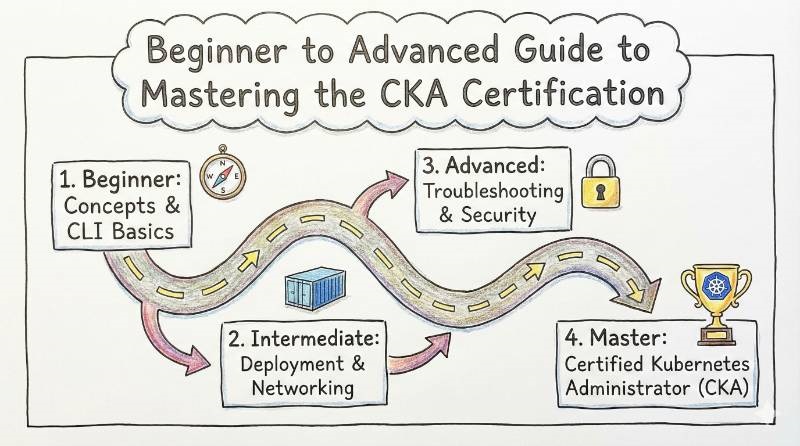
In the current era of cloud-native computing, Kubernetes has moved from being a luxury to an absolute necessity. Having observed the industry shift from physical data centers to virtual machines and finally to container orchestration, I can tell you that Kubernetes is the most significant shift in infrastructure management of the last decade.
For software engineers, DevOps practitioners, and engineering managers in India and across the world, the Certified Kubernetes Administrator (CKA) isn’t just a credential; it’s a testament to your ability to manage the complexity of modern, distributed systems.
Kubernetes & Cloud-Native Certification Overview
The Cloud Native Computing Foundation (CNCF) offers a variety of certifications. Understanding where the CKA fits is vital for planning your long-term career growth.
The Official Certification Roadmap
| Track | Level | Who it’s for | Prerequisites | Skills Covered | Recommended Order |
| KCNA | Foundational | Beginners, Managers | Basic Tech Literacy | Cloud-native ecosystem, K8s architecture | 1st (Optional) |
| CKAD | Intermediate | App Developers | Basic Containers | Designing and deploying applications | 1st or 2nd |
| CKA | Professional | Admins, SREs | Linux, Docker | Cluster setup, Network, Storage | 2nd (Primary) |
| CKS | Expert | Security Engineers | Valid CKA | Hardening clusters and supply chain security | 3rd (Advanced) |
Certified Kubernetes Administrator (CKA) Training Deep Dive
The CKA is a performance-based exam. This means you are not clicking “A” or “B”; you are solving real problems in a live command-line interface. This practical nature is why it is so highly valued by global tech giants.
What it is
The CKA program was established by the Linux Foundation and the CNCF to build the Kubernetes ecosystem. It serves as a benchmark for the skills, knowledge, and competency required of a Kubernetes administrator. It focuses on the actual installation, configuration, and day-to-day management of production-grade Kubernetes clusters.
Who should take it
- DevOps & Infrastructure Engineers: Who are responsible for building and maintaining automated software delivery platforms.
- Site Reliability Engineers (SREs): Who focus on the scalability, performance, and reliability of cluster environments.
- Software Engineers: Who wish to understand the underlying infrastructure that hosts their code to build more resilient applications.
- Engineering Managers: Who need a deep technical understanding to effectively lead, hire, and manage cloud-native teams.
Skills you’ll gain
- Cluster Installation & Configuration: Learning how to build a cluster from scratch using
kubeadmrather than relying on managed services. - Networking Mastery: Understanding how Pods talk to each other through CNI plugins and how Services and Ingress route external traffic.
- Storage Management: Mastering the lifecycle of Persistent Volumes (PV), Claims (PVC), and dynamic storage provisioning.
- Troubleshooting: Developing the “muscle memory” to diagnose node failures, network bottlenecks, and broken control plane components.
- Security Basics: Managing Role-Based Access Control (RBAC) to ensure users have only the permissions they need.
Real-world projects you should be able to do after it
- Deploying a Production-Grade Cluster: Setting up a highly available, multi-node cluster on Ubuntu or CentOS.
- Configuring Zero-Downtime Updates: Executing rolling updates and rollbacks for mission-critical applications.
- Implementing Network Security: Writing and applying Network Policies to isolate sensitive microservices from the public internet.
- Disaster Recovery Planning: Performing full backups and restores of the
etcddatabase to protect against total cluster failure.
Preparation Plan
- 7–14 Days (The Expert Sprint): This is for engineers already managing Kubernetes daily. Focus on the CKA exam environment, time management, and the specific tasks related to cluster upgrades and etcd maintenance.
- 30 Days (The Career Path): The most common path for working professionals. Dedicate 2 hours per day. Focus on one domain per week (Workloads, Networking, Storage, Troubleshooting) and use the final week for mock exams.
- 60 Days (The Foundation Path): Best for those new to Linux or containers. Spend the first 30 days mastering Linux administration and Docker fundamentals before moving into the Kubernetes curriculum.
Common mistakes
- Ignoring Imperative Commands: Writing YAML from scratch is a time-killer. Use
kubectl runorkubectl create --dry-run=client -o yamlto generate templates instantly. - Poor Context Management: Failing to switch to the correct cluster context before running a command can lead to failing a question you otherwise knew how to solve.
- Lack of Documentation Familiarity: You can use the official docs, but if you don’t know the exact keywords to search for, you will waste precious minutes.
- Spending too long on one question: If you get stuck on a 2% weightage question, move on. Secure the high-value marks first.
Best next certification after this
The Certified Kubernetes Security Specialist (CKS). Now that you know how to build the house (CKA), the CKS teaches you how to lock the doors and windows against hackers.
Choose Your Path: 6 Modern Learning Tracks
Kubernetes is the “kernel” of the modern cloud. Depending on your career direction, here is how the CKA serves as your foundation:
- DevOps Path: Focuses on the “how” of shipping code. CKA gives you the power to manage the deployment targets for your CI/CD pipelines.
- DevSecOps Path: Focuses on the “safety” of the pipeline. You use CKA knowledge to integrate security scanners and policy engines directly into the cluster.
- SRE Path: Focuses on the “uptime.” CKA helps you build self-healing systems and automate the recovery of failed nodes.
- AIOps/MLOps Path: Focuses on “intelligence.” You manage the GPU-heavy nodes and massive compute required for AI training via Kubernetes.
- DataOps Path: Focuses on “data flow.” You use Kubernetes to orchestrate distributed databases and complex data pipelines like Apache Spark.
- FinOps Path: Focuses on “cost.” You use your knowledge of resource limits and quotas to ensure the company doesn’t overspend on cloud resources.
Role → Recommended Certifications Mapping
| Role | Primary Cert | Strategic Growth Path |
| DevOps Engineer | CKA | Terraform Associate, AWS/Azure DevOps Pro |
| SRE | CKA | CKS, Observability (Prometheus) Certs |
| Platform Engineer | CKA | CKAD, Helm, ArgoCD |
| Cloud Engineer | CKA | Solutions Architect Professional (AWS/GCP) |
| Security Engineer | CKS | CKA (Required Prerequisite), CISSP |
| Data Engineer | CKA | Google Cloud Professional Data Engineer |
| FinOps Practitioner | FinOps Certified | CKA (to understand resource allocation) |
| Engineering Manager | KCNA | CKA (to build technical credibility) |
Next Certifications to Take
After the CKA, the learning journey continues. Here are the three most effective ways to branch out:
- Same Track (Specialization): Certified Kubernetes Security Specialist (CKS). This is the hardest and most prestigious certification in the K8s ecosystem.
- Cross-Track (Platform Mastery): AWS Certified Solutions Architect – Professional. Since most Kubernetes clusters run on AWS, mastering the underlying cloud is a massive career booster.
- Leadership (Management): Certified Software Development Professional (CSDP). For those moving into Director or VP levels, this shifts the focus from “how it runs” to “how it’s built” across the whole organization.
Top Institutions for Training & Certification
While self-study is possible, many professionals prefer structured training to ensure they pass on the first attempt and gain actual production skills.
1. DevOpsSchool
DevOpsSchool is a premier global training provider that has been at the forefront of IT education for over a decade. Their CKA program is famous for its “Lab-First” approach, where 80% of the training is spent in live terminal environments. They offer lifetime access to their Learning Management System (LMS) and technical support, ensuring you have a mentor even after your certification is complete.
2. Cotocus
Cotocus operates as a technical consulting and training wing that brings real-world enterprise experience into the classroom. Their instructors are often active consultants who implement Kubernetes solutions for large corporations, providing you with “from-the-field” insights that go beyond the standard exam curriculum. This makes their training highly valuable for engineers working on complex, multi-cloud environments.
3. Scmgalaxy
Originally started as a community hub, Scmgalaxy has evolved into a massive resource center for modern Ops professionals. They provide an extensive library of technical tutorials, troubleshooting guides, and community-led forums where you can discuss complex Kubernetes scenarios. It is an excellent choice for self-starters who want a deep repository of technical knowledge and peer-to-peer support.
4. BestDevOps
BestDevOps specializes in intensive, result-oriented bootcamps designed for the busy professional. Their CKA training is structured to be fast-paced and immersive, focusing on the most critical domains of the exam to ensure a high success rate. They are known for providing updated study materials that reflect the latest changes in the Kubernetes ecosystem.
5. devsecopsschool
This institution focuses exclusively on the intersection of security and operations. Their CKA-to-CKS transition programs are highly regarded, teaching you not only how to manage a cluster but how to secure the entire software supply chain. They are the go-to choice if you want to specialize as a Security Engineer or a Lead in DevSecOps.
6. sreschool
Sreschool is dedicated to the principles of Site Reliability Engineering. Their Kubernetes training focuses heavily on the “Reliability” and “Troubleshooting” aspects, teaching students how to handle SLOs (Service Level Objectives), error budgets, and chaos engineering. This is the ideal track for those aiming for high-level SRE roles in global tech firms.
7. aiopsschool
As AI and Machine Learning continue to dominate the market, aiopsschool provides the specialized training needed to run AI workloads on Kubernetes. They teach you how to orchestrate high-compute clusters and manage GPU-enabled nodes using tools like Kubeflow. It is perfect for engineers who want to bridge the gap between infrastructure and data science.
8. dataopsschool
Dataopsschool focuses on the challenges of managing data-heavy applications and stateful sets on Kubernetes. Their curriculum covers how to run distributed databases and complex data pipelines (like Spark or Kafka) within a containerized environment. This is essential training for Data Engineers looking to modernize their infrastructure skills.
9. finopsschool
With cloud costs becoming a major concern for leadership, finopsschool teaches the financial management side of Kubernetes. Their training focuses on resource quotas, limits, and cost-optimization strategies to ensure that your clusters remain cost-effective. This is a must-have for Engineering Managers and FinOps practitioners who need to justify infrastructure spend.
FAQs (General Career & Value)
1. How difficult is the CKA exam?
It is considered one of the harder certifications because it is 100% hands-on. You must know the commands; there is no guessing.
2. How much time does it take to prepare?
For a working professional, 4 to 6 weeks is the sweet spot.
3. Are there any prerequisites?
Technically, no. However, a strong grasp of Linux and Docker is highly recommended.
4. What is the passing score?
You need a 66% to pass the CKA exam.
5. How long is the certification valid?
It is valid for 3 years. After that, you must recertify to stay current with Kubernetes versions.
6. Is the CKA better than the CKAD?
They serve different purposes. CKA is for those who manage the cluster; CKAD is for those who build applications to run on it. CKA generally holds more weight for infrastructure roles.
7. Can I use the official documentation during the exam?
Yes. You are allowed to have one tab open with the official Kubernetes documentation.
8. Is the exam proctored?
Yes, it is remotely proctored. You will need a webcam and a quiet, private room.
9. Does CKA help in getting a remote job?
Absolutely. Global companies hire CKAs because it proves you can manage complex systems without hand-holding.
10. What is the average salary increase after CKA?
While it varies by region, certified engineers in India and globally often see a 20-30% jump in compensation.
11. Should I learn Docker before Kubernetes?
Yes. Kubernetes orchestrates containers; if you don’t understand how a single container works, managing a cluster will be very difficult.
12. Is the CKA worth it in 2026?
More than ever. As more companies move to “Cloud Native,” the demand for skilled administrators continues to outpace supply.
FAQs on CKA Certification Training Course
1. How long does the CKA certificate last?
It is valid for 3 years from the date you pass the exam.
2. Is the exam multiple choice?
No, it is a performance-based test where you solve technical problems in a live CLI.
3. What happens if I fail the first time?
Most exam vouchers come with a free second attempt if you don’t pass on the first try.
4. How much Linux knowledge do I need?
You should be comfortable with the command line, editing files with vim or nano, and understanding basic networking.
5. What is the passing mark for the CKA?
The passing score is 66%.
6. Is CKA helpful for Managers?
Yes. It provides the technical context needed to lead teams and estimate project timelines accurately.
7. Can I use notes during the exam?
You cannot use personal notes, but you can access the official Kubernetes documentation website.
8. Will this help me get a job in 2026?
Yes. Kubernetes is currently the standard for cloud infrastructure globally.
Conclusion
The journey to becoming a Certified Kubernetes Administrator is a rigorous one, but it is one of the most rewarding investments you can make. It transforms you from someone who “uses the cloud” into someone who “builds the cloud.” In my experience, the engineers who thrive are not those who just chase badges, but those who use the CKA as a reason to deeply understand how distributed systems function. Whether you are aiming for a role in SRE, DevSecOps, or leading a technical team, the CKA is your foundation.
Don’t wait for the industry to move past you. Start your labs, join a community like DevOpsSchool, and begin mastering the orchestration of the future.
