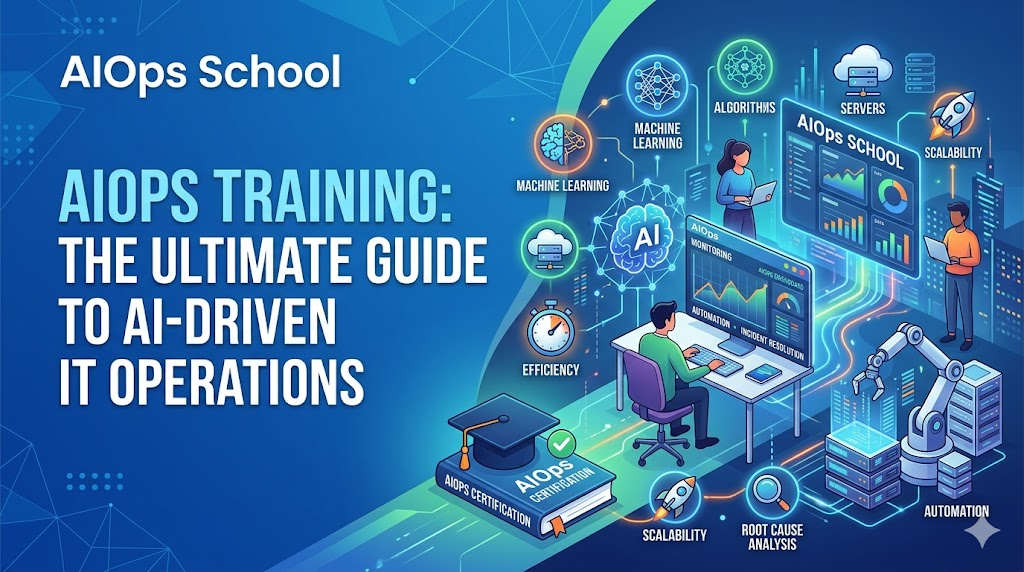
The complexity of modern IT environments has grown exponentially. As organizations shift toward hybrid multi-cloud architectures, microservices, and ephemeral containerized workloads, the traditional methods of managing infrastructure have reached a breaking point. IT teams are drowning in data, suffocating under the weight of “alert fatigue,” and struggling to resolve incidents before they impact the end-user experience. This is the reality for DevOps engineers, Site Reliability Engineers (SREs), and Platform engineers today. When thousands of telemetry streams, logs, and metrics flood a dashboard simultaneously, the human brain—and traditional rule-based monitoring—simply cannot keep pace.
Enter Artificial Intelligence for IT Operations (AIOps). By leveraging machine learning, big data, and advanced analytics, AIOps provides the observability and automation necessary to move from reactive firefighting to proactive, AI-driven IT operations. For professionals eager to stay ahead of this paradigm shift, structured AIOps training is no longer an optional skill; it is a career necessity.
What is AIOps?
AIOps, or Artificial Intelligence for IT Operations, is the application of machine learning, natural language processing (NLP), and advanced statistical analysis to IT operations data. It is not a single tool, but a strategic practice that uses big data to automate and enhance IT operations processes.
The evolution of AIOps traces back to the sheer unmanageability of monitoring logs and events. In the past, human operators manually correlated events, identified patterns, and interpreted logs. As the “Big Data” era of IT arrived, the velocity and volume of telemetry—metrics, logs, and traces—surpassed human cognitive limits.
AIOps acts as the bridge between raw observability data and actionable insights. Unlike traditional monitoring, which is largely dashboard-based and threshold-dependent, AIOps uses algorithmic intelligence to understand the “normal” behavior of a system. When a deviation occurs, AIOps platforms do not just trigger an alert; they correlate the event with thousands of others, identify the probable root cause, and, in advanced implementations, trigger automated remediation workflows. It is the transition from “what happened?” to “why did it happen, and how can we prevent it?”
Why AIOps Matters in Modern IT Operations
The core value proposition of AIOps is simple: it cuts through the noise. In a world where minutes of downtime equate to millions in lost revenue, the ability to rapidly identify root causes is invaluable.
Key Pillars of AIOps Implementation:
- Noise Reduction: By clustering similar alerts and filtering out false positives, AIOps ensures that IT teams only focus on what truly matters.
- Event Correlation: AIOps tools intelligently connect the dots between events occurring in different silos (e.g., a database spike causing a frontend latency issue), providing a holistic view of the service health.
- Root Cause Analysis (RCA): Machine learning models can analyze logs and changes to pinpoint exactly where an issue originated, often reducing MTTR (Mean Time to Resolution) from hours to minutes.
- Predictive Analytics: Beyond fixing issues, AIOps allows teams to forecast potential capacity constraints or failures before they manifest, moving operations from a reactive state to a predictive one.
- Auto-remediation: The ultimate goal. When the system detects a specific, known failure pattern, it executes automated scripts to resolve it without human intervention.
Who Should Take an AIOps Training Program?
The transition to AI-driven operations is not limited to data scientists. In fact, the most effective AIOps practitioners are those with deep operational knowledge.
- DevOps Engineers: To build automated CI/CD pipelines that incorporate intelligent monitoring.
- SREs: To implement error budget management and automated incident response.
- Platform Engineers: To design resilient, self-healing platforms that developers can build upon.
- Cloud Architects: To optimize cost and performance in hybrid multi-cloud environments.
- Monitoring Specialists: To evolve from managing dashboards to managing intelligence platforms.
- IT Managers & NOC Teams: To oversee the strategic implementation of AIOps and reduce operational costs.
- ML Engineers: To understand the specific nuances of applying machine learning models to real-time telemetry data.
What Will You Learn in an AIOps Course?
A comprehensive AIOps course must balance theory with practice. Whether you are a beginner or looking to sharpen your architecture skills, the curriculum should follow a structured progression.
- Module 1: AIOps Fundamentals: Defining the ecosystem, business value, and the shift from monitoring to observability.
- Module 2: Observability: Moving beyond traditional monitoring to understand the internal state of systems through external outputs.
- Module 3: Metrics: High-cardinality data analysis and time-series database management.
- Module 4: Logs: Aggregation, parsing, and semantic analysis at scale.
- Module 5: Tracing: Distributed tracing and identifying latency bottlenecks in microservices.
- Module 6: Event Correlation: Techniques for grouping disparate alerts and managing noise.
- Module 7: Anomaly Detection: Implementing ML models to identify deviations from baseline behaviors.
- Module 8: ML for Operations: Understanding supervised, unsupervised, and reinforcement learning in an IT context.
- Module 9: Incident Intelligence: Automating the escalation and notification processes.
- Module 10: Auto-remediation: Designing and testing safe, automated healing workflows.
- Module 11: OpenTelemetry: Utilizing industry-standard frameworks for data collection.
- Module 12: Enterprise AIOps Architecture: Scaling AIOps across global, high-stakes infrastructure.
Top AIOps Tools You Should Know
The market is saturated with tools, but the key is understanding how they utilize AI. Below is a snapshot of popular tools:
| Tool | AI Capabilities | Best For |
| Splunk | Advanced machine learning for security and ops. | Log aggregation, enterprise-scale data analysis. |
| Dynatrace | Davis AI, causal analysis, and full-stack observability. | Automated root cause analysis for complex apps. |
| Datadog | Watchdog AI, automated anomaly detection. | Unified monitoring, ease of cloud integration. |
| Prometheus | Metric-based monitoring (needs Grafana/Mimir for AI). | Kubernetes-native environments, scale. |
| Grafana | Visualization and alerting (ML via plugins). | Data visualization, dashboarding. |
| Elastic Stack | ML-driven anomaly detection and forecasting. | Searchable logs, security, and observability. |
| Moogsoft | Advanced event correlation and incident aggregation. | Reducing alert fatigue in large NOCs. |
| BigPanda | Incident intelligence and automation. | NOC/SRE collaboration and incident management. |
| New Relic | Applied Intelligence (AI) for incident detection. | End-to-end observability, full-stack visibility. |
Benefits of Earning an AIOps Certification
In 2026, the demand for specialized AI operations skills far outstrips supply. Obtaining a professional certification acts as a formal validation of your ability to implement and manage these complex systems.
- Career Advancement: Distinguish yourself in a competitive job market by proving you possess future-ready skills.
- Higher Salary Potential: AIOps engineers are among the highest-paid professionals in IT due to the specialized nature of their role.
- Enterprise Demand: Large enterprises are aggressively hiring talent to lead their digital transformation projects.
- Future-proofing: Traditional monitoring roles are being automated. AIOps skills ensure you are the one building the automation, not being replaced by it.
Why Choose AIOps School for AIOps Training?
AIOps School stands out by focusing on the practical application of AI in real-world IT environments. Unlike theoretical academic courses, the training here is designed for those who actually build and manage systems.
- Hands-on Labs: Don’t just read about anomaly detection; build it in live environments.
- Project-based Learning: Work on real-world scenarios that mirror enterprise challenges.
- Certification Pathways: Whether you are starting at the Foundation level or aiming to become an Architect, there is a structured track for your career level.
- Global Community: Connect with a network of professionals worldwide who are navigating the same challenges.
- Expert-Led: Learn from practitioners who have implemented these systems at scale.
Career Opportunities After Completing an AIOps Certification
Once you have mastered the material and earned your certification, your career trajectory opens up to high-impact roles:
- AIOps Engineer: The core technical role, building models and pipelines.
- SRE (Site Reliability Engineer): Leveraging AI to maintain service-level objectives (SLOs).
- Observability Engineer: Specializing in the “three pillars” of telemetry.
- Platform Engineer: Building the automated, self-service infrastructure for developers.
- Cloud Reliability Engineer: Focusing on the stability and cost-optimization of cloud-native systems.
- Incident Response Engineer: Orchestrating faster recovery times during outages.
- DevOps Architect: Designing the end-to-end lifecycle, from code to production.
- AI Operations Specialist: The strategist within an organization driving adoption.
Frequently Asked Questions (FAQ)
1. Is AIOps Training suitable for non-programmers?
While basic scripting skills are helpful, many foundational modules focus on architectural concepts, tool integration, and strategic implementation, making them accessible to IT managers and operations staff.
2. Can I transition from a traditional Network Ops role to AIOps?
Absolutely. Many AIOps practitioners come from network or system administration backgrounds. You already understand the infrastructure; this training teaches you how to layer AI on top of it.
3. Which programming language is most useful for AIOps?
Python is the industry standard due to its rich ecosystem of data science and machine learning libraries.
4. How does AIOps differ from standard Automation?
Standard automation follows “if-this-then-that” rules. AIOps uses data to determine when to execute those rules, and what to do based on complex, non-linear relationships.
5. Are these courses entirely online?
Yes, AIOps School offers flexible, self-paced, and cohort-based online programs designed to fit into a working professional’s schedule.
6. Do I need to be an expert in Data Science?
No. You need to understand how to apply data, but you do not need to be a research scientist. The focus is on Operations, not model research.
7. Is an AIOps Certification a recognized credential?
Yes, certifications from industry-leading platforms like AIOps School are increasingly sought after by hiring managers who want proof of practical competence.
8. What is the most critical tool to learn first?
While tools change, understanding the fundamentals of observability (metrics, logs, traces) is more important than mastering any single tool. Start with concepts, then apply them to tools like Prometheus or Elastic.
9. Can AIOps reduce my on-call burden?
That is one of the primary goals. By reducing false positives and automating remediation, AIOps can significantly decrease the number of unnecessary alerts that wake you up at 3:00 AM.
10. What is the next logical step after learning AIOps?
The logical evolution is MLOps (Machine Learning Operations), which focuses on managing the entire lifecycle of the machine learning models themselves at scale.
Conclusion
The future of IT Operations is intelligence-driven. As infrastructure continues to scale, human intervention alone cannot maintain the reliability and performance that modern businesses demand. AIOps provides the critical capabilities needed to thrive in this complex environment.
By investing in structured AIOps training, you aren’t just learning a new toolset—you are future-proofing your career. Whether you aim to optimize your current infrastructure or lead an enterprise-wide transformation, the knowledge gained from an AIOps course and certification will provide the leverage you need to excel. Start your journey today and master the future of AI-driven IT operations.
