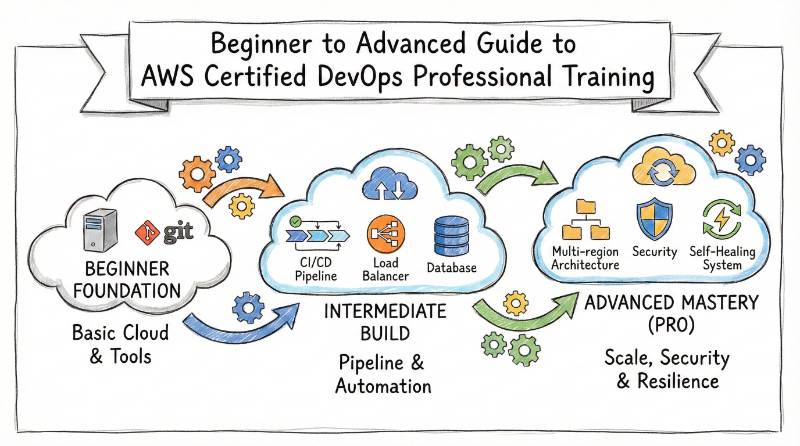
In the early days of my career, managing a data center meant physical cables and loud cooling fans. Today, those physical rooms have been replaced by lines of code and automated scripts. If you are a software engineer or a technical manager, you already know that the cloud has changed the rules of the game. It is no longer enough to just “know” AWS; you have to know how to make it work for you without constant manual fixing.
The AWS Certified DevOps Professional Training is where the real work begins. This isn’t just about passing a test to get a badge. It is about proving that you can take a chaotic production environment and turn it into a smooth, self-healing system. For those of us working in India or for global tech firms, this certification is the standard that separates those who follow instructions from those who build the future.
This guide is designed to be your roadmap. We will look at where you stand now, where you can go, and how to get there using the most effective tools available.
The AWS Training Landscape
To understand where you are going, you need to see the whole map. AWS certifications are built like a ladder. You don’t just jump to the top; you build a foundation first. Here is how the different tracks compare for engineers and managers today.
AWS Certification Comparison Table
| Track | Level | Who it’s for | Prerequisites | Skills Covered | Recommended Order |
| Cloud Practitioner | Foundational | Managers, Sales, New Hires | Basic IT knowledge | Global Infrastructure, Billing, Security | 1st |
| Solutions Architect | Associate | Developers, Aspiring Architects | Basic AWS concepts | S3, EC2, VPC, System Design | 2nd |
| Developer | Associate | Coders, Software Engineers | Basic programming | SDKs, CI/CD, DynamoDB, Serverless | 3rd |
| SysOps Administrator | Associate | System Admins, Ops Engineers | Systems management | CloudWatch, Troubleshooting, Scaling | 3rd |
| DevOps Engineer | Professional | Sr. DevOps, SREs, Lead Engineers | Associate Cert + 2 Years hands-on | SDLC, IaC, High Availability, Compliance | 4th |
| Solutions Architect | Professional | Principal Architects, Managers | Associate Cert + Experience | Enterprise Migration, Cost Strategy | 4th |
Deep Dive: AWS Certified DevOps Professional Training
This is the certification that forces you to stop thinking about servers and start thinking about systems. It is the most technical professional-level exam AWS offers, focusing heavily on how to automate every single part of the software development life cycle.
What it is
The AWS Certified DevOps Professional Training is an expert-level program designed to validate your ability to manage distributed application systems. It covers the entire “DevOps” philosophy: from the moment a developer commits code to the moment that code is running in front of millions of users. It focuses on stability, speed, and security through automation.
Who should take it
This path is for the “doers.” It is perfect for:
- Software Engineers who want to own their deployments.
- DevOps Professionals looking to move into senior or lead roles.
- SREs who need to standardize how their company handles scale and failure.
- Engineering Managers who want to ensure their teams are following global best practices.
Skills you’ll gain
This training takes your existing knowledge and adds a layer of extreme automation to it. You will move from being a “user” of the cloud to an “architect” of automation.
- Advanced Pipeline Management: You will learn to build CI/CD pipelines that can handle hundreds of updates a day across multiple regions without breaking.
- Policy-Driven Infrastructure: Using AWS Config and IAM, you will learn to write “rules” that prevent security breaches before they happen.
- Elastic Operations: You will gain the ability to build systems that automatically grow and shrink based on traffic, saving money while maintaining performance.
- Centralized Observability: Mastering logging and monitoring so you can see every single error across 50 different AWS accounts from one single screen.
Real-world projects you should be able to do
The true test of this training is what you can build after you finish. You will be prepared to lead high-stakes projects like:
- Automated Disaster Recovery: Building a system where, if a whole region goes offline, your application automatically wakes up in a different part of the world with zero lost data.
- Security Guardrails: Creating an “automated police force” that shuts down any unencrypted database or open security group instantly.
- Canary Deployments: Implementing a system that sends 5% of traffic to a new version of your app to test it, and automatically rolls back if it sees any errors.
Preparation plan
Preparation should be treated like training for a marathon. You cannot rush it, and you must stay consistent.
- 7–14 Days (The Final Push): If you are already a senior expert using these tools, use this time for “exam logic.” Focus on how AWS words its questions and identifying the one or two words in a scenario that change the entire answer.
- 30 Days (The Standard Route): Spend 2 hours a day. Two weeks on video courses and documentation, and two weeks on hands-on practice. Build things, then intentionally break them to see if your automation fixes them.
- 60 Days (The Deep Study): For those stepping up from the associate level. Spend the first month mastering the specific tools like CodePipeline, CloudFormation, and AWS Systems Manager. Use the second month for mock exams and reviewing whitepapers.
Common mistakes
I have mentored many engineers who failed because they were “too smart” for their own good. Don’t fall into these traps:
- Trying to be “too custom”: AWS wants you to use their services. If a question asks for a solution, and one option is a custom Python script and the other is an AWS-native service like AWS Config, pick the native service.
- Ignoring the “Well-Architected” Framework: Every answer must be secure, cost-effective, and reliable. If your answer is fast but expensive, it might be wrong.
- Speed issues: The questions are long. People often spend 5 minutes on one question and then have to rush the last 10. You must practice finishing questions in under 2 minutes.
Best next certification after this
After you finish the DevOps Pro, the smartest move is the AWS Certified Security – Specialty. In today’s world, DevOps without Security (DevSecOps) is incomplete. This specialty adds that final layer of protection to your skillset.
Choose Your Path: 6 Modern Learning Tracks
Once you have your DevOps foundation, you can branch out into these specific specializations based on where you want your career to go:
- DevOps Path: The classic route. Focus on CI/CD, speed, and automation.
- DevSecOps Path: The “security first” route. Mastering automated compliance and identity management.
- SRE Path: The “reliability” route. Focus on uptime, latency, and system health.
- AIOps/MLOps Path: The “future” route. Using AI to manage your cloud and automating the deployment of machine learning models.
- DataOps Path: The “data flow” route. Automating data pipelines and ensuring data quality at scale.
- FinOps Path: The “money” route. Managing cloud costs and ensuring every dollar spent on AWS adds value to the business.
Role → Recommended Certifications Mapping
Align your certifications with your current or target job title:
- DevOps Engineer: AWS DevOps Professional + Terraform Associate.
- SRE: AWS DevOps Professional + AWS SysOps Associate.
- Platform Engineer: AWS DevOps Professional + CKA (Kubernetes).
- Cloud Engineer: AWS Solutions Architect Associate + AWS DevOps Professional.
- Security Engineer: AWS Security Specialty + AWS DevOps Professional.
- Data Engineer: AWS Data Engineer Associate + AWS Solutions Architect Associate.
- FinOps Practitioner: AWS Cloud Practitioner + FinOps Certified Practitioner.
- Engineering Manager: AWS Cloud Practitioner + AWS Solutions Architect Associate.
Next Certifications to Take
Following the patterns of the most successful software engineers, here are your three best options after clearing the DevOps Pro exam:
- Same Track (The Specialty): AWS Certified Security – Specialty. This is the highest-value addition for anyone in the DevOps space.
- Cross-Track (The Multi-Cloud Tool): Certified Kubernetes Administrator (CKA). Since most AWS environments use Kubernetes (EKS), this makes you a master of the modern stack.
- Leadership (The Architect): AWS Certified Solutions Architect – Professional. This allows you to stop managing the “pipeline” and start managing the entire “enterprise strategy.”
Top Institutions for AWS Certified DevOps Training
To clear a professional exam, you need more than just videos; you need a structured environment. These institutions are the leaders in providing help in training cum certifications for the AWS Certified DevOps Professional Training (CDE):
- DevOpsSchool: A powerhouse in the industry. They offer a very deep, project-based curriculum that goes far beyond the exam. They help you master 50+ tools used in real production environments.
- Cotocus: Excellent for those who prefer an intensive, bootcamp-style approach. Their trainers focus on bridging the gap between theoretical knowledge and corporate requirements.
- Scmgalaxy: A massive community platform that provides specialized resources for SREs and DevOps leads. They are great for finding deep-dive technical tutorials.
- BestDevOps: Known for their streamlined and efficient training programs. This is a great choice for busy managers who need to get certified without wasting time.
- DevSecOpsSchool: The best place to learn how to bake security into your AWS workflows. They focus heavily on automated security testing.
- Sreschool: Dedicated to the art of reliability. If you want to specialize in keeping systems up 24/7, this is your institution.
- Aiopsschool: They focus on the intersection of AI and cloud operations. A great choice for those looking to stay ahead of the next tech wave.
- Dataopsschool: Ideal for engineers moving into the data space, teaching you how to manage data lakes and pipelines with DevOps rigor.
- Finopsschool: They specialize in the financial side of the cloud, helping you become an expert in cost management and cloud efficiency.
FAQs on AWS Certified DevOps Professional Training
1. Is the exam as hard as people say?
Yes, it is very challenging. It doesn’t ask you what a tool does; it asks you how to fix a failing system using three different tools at once. It requires real experience.
2. How much time should I spend studying?
For most working professionals, 8 to 12 weeks is the sweet spot. This gives you enough time to digest the concepts and do the hands-on labs.
3. Do I need to be a coding expert?
You don’t need to be a full-stack developer, but you must be comfortable with JSON, YAML, and basic Python for Lambda functions.
4. What is the biggest benefit of being certified?
Trust. When you have this badge, senior management and clients trust you with their most important production systems. It also leads to significant salary growth.
5. Should I take the SysOps exam before the DevOps Pro?
It is highly recommended. The SysOps Associate exam covers about 40% of the foundation you need for the Professional level.
6. Is this certification valid globally?
Yes. Whether you are in India, Europe, or the US, the AWS DevOps Professional is recognized as a top-tier engineering credential.
7. How much does the exam cost?
The exam fee is $300 USD, but if you have passed an associate exam, you can usually find a 50% discount voucher in your AWS certification account.
8. Can I pass by just using “exam dumps”?
No. AWS changes the questions frequently and focuses on logic. If you don’t understand the “why,” you will fail the scenario-based questions.
Conclusion
Taking on the AWS Certified DevOps Professional Training is a significant commitment, but it is one that will pay off for the rest of your career. In an industry that is always changing, having a deep, professional mastery of automation and reliability is the best insurance you can have. This journey isn’t just about learning a platform; it is about changing your mindset to see code and infrastructure as one single, powerful entity. Whether you are aiming to lead a DevOps team, secure a global enterprise, or optimize a startup’s cloud spend, the skills you build here will be your foundation. Start today, stay disciplined, and build the systems that the modern world depends on.
