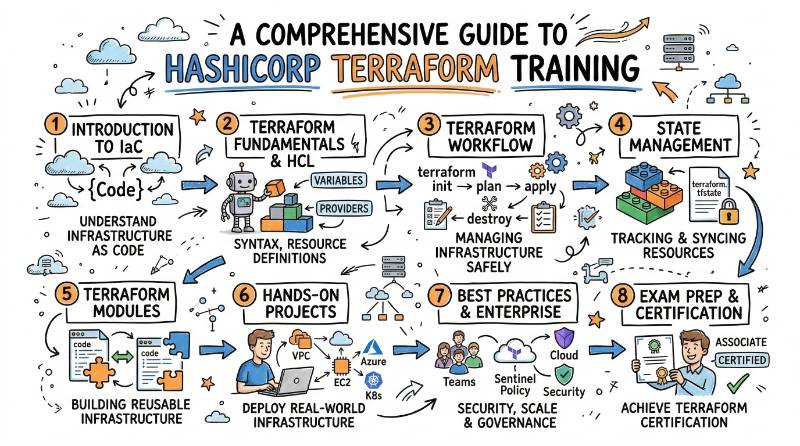
Hashicorp Terraform is a tool that allows people to manage infrastructure using code. Instead of clicking buttons in a cloud console, engineers write files that describe what the servers, networks, and databases should look like. This process is called Infrastructure as Code (IaC). Terraform is very popular because it works with many different cloud providers like AWS, Azure, and Google Cloud.
A training and certification program for Terraform helps engineers learn how to automate these tasks safely. It ensures that infrastructure is consistent, easy to repeat, and simple to fix if something goes wrong. For managers, having a team trained in Terraform means faster deployments and fewer manual errors.
Why Infrastructure as Code is Essential Today
In the modern world of software, speed is everything. Companies need to launch new features quickly. If a team has to set up every server by hand, it takes too long. Terraform solves this by treating infrastructure just like software. You can version it, share it, and test it.
Understanding Terraform is no longer just a “nice-to-have” skill. It is a core requirement for anyone working in cloud computing. Whether you are a Software Engineer or a Lead Manager, knowing how to handle these tools ensures your projects stay stable and scalable.
Master in Observability Engineering Certifications Program
While Terraform handles the creation of infrastructure, you also need to know what is happening inside that infrastructure. This is where the Master in Observability Engineering Certifications Program comes in. This program is designed to teach engineers how to monitor, trace, and log their systems effectively.
Observability is about looking at the data coming out of your systems to understand their internal state. By combining Terraform skills with Observability certification, an engineer becomes much more valuable. You learn not just how to build the house, but how to make sure the lights are always on and the plumbing is working perfectly.
Detailed Certification Breakdown
Below is a detailed look at the core certification track for Terraform.
| Track | Level | Who it’s for | Prerequisites | Skills covered | Recommended order |
| Infrastructure Automation | Associate | Cloud Engineers, DevOps, SRE | Basic Cloud Knowledge | State management, Providers, Modules, CLI | 1st |
Hashicorp Certified Terraform Associate
What it is
The Hashicorp Certified Terraform Associate is a professional credential that proves an engineer understands the basic concepts of Terraform. It focuses on the open-source version of the tool. It covers how to write, change, and destroy infrastructure using the HashiCorp Configuration Language (HCL).
Who should take it
This certification is ideal for Software Engineers, Systems Administrators, and DevOps professionals. It is also very helpful for Engineering Managers who want to understand the technical workflows their teams use daily. If you are looking to move into a Cloud or Platform engineering role, this is the best starting point.
Skills you’ll gain
You will learn how to manage the lifecycle of infrastructure. This involves understanding how Terraform keeps track of what it has built through “state files.” You will also learn how to make your code reusable so you don’t have to write the same thing over and over.
- Mastering HCL syntax and structure.
- Managing Terraform state and locking.
- Using variables and outputs for dynamic configurations.
- Implementing modules for better code organization.
- Using Terraform CLI commands like plan, apply, and destroy.
Real-world projects you should be able to do
After finishing this training, you will be able to automate the setup of a full web application environment. This includes the network, the virtual machines, and the security groups required to keep them safe.
- Building a multi-tier VPC on AWS or Azure from scratch.
- Setting up a Kubernetes cluster using automated scripts.
- Creating a disaster recovery environment that can be launched in minutes.
- Automating the scaling of database instances based on demand.
Preparation plan
Success requires a mix of reading and hands-on practice.
- 7–14 days: Best for those already using Terraform at work. Focus on the official documentation and take a few practice exams to find your weak spots.
- 30 days: The standard path. Spend two weeks reading the core concepts and two weeks building small projects.
- 60 days: Recommended for beginners. Spend the first month learning cloud basics and the second month focusing purely on Terraform syntax and state management.
Common mistakes
Many people fail because they try to memorize answers instead of understanding the logic. Another big mistake is not practicing the command-line interface.
- Ignoring how the state file works, which can lead to broken infrastructure.
- Hardcoding values instead of using variables, making the code hard to reuse.
- Not understanding the difference between “terraform plan” and “terraform apply.”
- Forgetting to manage “sensitive” data like passwords properly in the code.
Choose Your Path: 6 Learning Journeys
Infrastructure automation looks different depending on your specific job focus. Here are six paths you can follow:
- DevOps Path: Focuses on CI/CD integration. You learn how to make Terraform run automatically whenever code is updated.
- DevSecOps Path: Focuses on security. You learn how to use tools to scan your Terraform code for security holes before it is even deployed.
- SRE Path: Focuses on reliability. You use Terraform to build highly available systems that can survive server failures.
- AIOps/MLOps Path: Focuses on data science infrastructure. You learn how to spin up GPU-heavy servers and machine learning pipelines quickly.
- DataOps Path: Focuses on data pipelines. You use code to manage big data warehouses like Snowflake or BigQuery.
- FinOps Path: Focuses on cost. You learn how to use Terraform to tag resources so the finance team knows exactly how much money is being spent on each project.
Role → Recommended Certifications Mapping
- DevOps Engineer: Terraform Associate + Kubernetes Admin (CKA)
- SRE: Terraform Associate + Master in Observability
- Platform Engineer: Terraform Associate + Multi-cloud Professional
- Cloud Engineer: Terraform Associate + AWS/Azure Solutions Architect
- Security Engineer: Terraform Associate + Hashicorp Vault
- Data Engineer: Terraform Associate + Google Professional Data Engineer
- FinOps Practitioner: Terraform Associate + FinOps Certified Practitioner
- Engineering Manager: Terraform Associate + Cloud Digital Leader
Next Certifications to Take
Once you have mastered Terraform, you should look at these three directions to grow your career:
- Same Track: Look into Hashicorp Vault or Consul to manage security and service networking within the same ecosystem.
- Cross-Track: Move into Kubernetes (CKA) or Docker certifications to handle container orchestration alongside your infrastructure.
- Leadership: Consider Cloud Architect or Management certifications that focus on strategy and cost-optimization for large enterprises.
Top Institutions for Training and Certification
This institution offers a very deep curriculum that focuses on practical lab work. They provide mentors who have seen real production issues, which helps students learn more than just what is in the books.
Cotocus
Cotocus is known for its customized corporate training. They help large teams transition to modern DevOps practices by providing hands-on sessions that match the specific needs of the company.
Scmgalaxy
This community-driven platform provides a wealth of resources, including blogs and tutorials. It is a great place for engineers to find answers to complex automation problems.
BestDevOps
BestDevOps focuses on career-oriented training. They provide a structured environment where students can move from basic concepts to advanced architectural designs in a short time.
DevSecOpsSchool
If security is your main concern, this school is the right choice. They integrate security testing into the DevOps lifecycle, teaching you how to build safe infrastructure from the start.
Sreschool
Sreschool focuses on the “Reliability” part of the equation. They teach how to use Terraform to build systems that are resilient and can handle high amounts of traffic without breaking.
Aiopsschool
This institution bridges the gap between Artificial Intelligence and Operations. They teach how to automate the complex infrastructure needed for AI and Machine Learning projects.
Dataopsschool
For data professionals, this school provides the tools to manage data environments. They show how to use infrastructure as code to maintain data integrity and speed.
Finopsschool
Finopsschool teaches the financial side of the cloud. They help engineers and managers understand how to use automation to reduce waste and save money on cloud bills.
FAQs ( Career & Technical Focus)
1. How difficult is the Terraform Associate exam?
The exam is considered moderate. If you have used Terraform for a few months and understand the core workflow, you will find it manageable.
2. How long does it take to get certified?
For most working engineers, 30 days of consistent study for about one hour a day is enough to pass.
3. Are there any prerequisites for the Terraform exam?
There are no formal prerequisites, but having a basic understanding of at least one cloud provider (AWS, Azure, or GCP) is highly recommended.
4. In what order should I take these certifications?
Start with the Terraform Associate. After that, look into a cloud-specific certification or the Master in Observability program.
5. Is the certification worth it in 2026?
Yes. Automation is the foundation of modern IT. This certification proves to employers that you can handle high-level automation tasks.
6. What are the career outcomes after getting certified?
Many engineers see an increase in salary or a promotion to “Senior” or “Lead” roles. It opens doors to specialized Cloud and Platform Engineering jobs.
7. Can I pass the exam with just theory?
It is very difficult. The exam asks questions about specific command behaviors that are hard to remember without actually typing them in a terminal.
8. Does this certification expire?
Yes, most technical certifications expire after two years because the software changes so quickly.
9. How does Terraform compare to CloudFormation or Ansible?
Terraform is cloud-agnostic, meaning it works everywhere. Cloud Formation is only for AWS. Ansible is better for configuring software inside a server, while Terraform is better for building the server itself.
10. Do I need to know a programming language like Python?
You don’t need to be a programmer, but understanding basic logic like loops and conditionals will make learning HCL much easier.
11. Is the Master in Observability program related to Terraform?
They complement each other. Terraform builds the system, and Observability tells you how the system is performing.
12. Can a manager benefit from this certification?
Absolutely. It helps managers understand the “how” and “why” of their team’s work, leading to better project timelines and more realistic goals.
FAQs on Hashicorp Terraform Training & Certification Program
1. Where is the best place to find official training?
You can find comprehensive training and the official certification path at DevOpsSchool.
2. What is the format of the exam?
The exam usually consists of multiple-choice, multiple-response, and true/false questions. It is a proctored online exam.
3. Does the training include hands-on labs?
Most reputable training providers, like the ones listed above, include lab environments where you can practice without spending your own money on cloud fees.
4. Can I take the exam in India?
Yes, the exam can be taken from anywhere in the world as long as you have a stable internet connection and a private room.
5. What is the passing score?
The exact passing score can vary, but generally, you need to score around 70% or higher to receive the certification.
6. Is there a retake policy?
Yes, if you do not pass on your first attempt, you can pay to retake the exam after a waiting period.
7. Is the certification recognized globally?
Yes, Hashicorp is a global leader in infrastructure tools, and their certifications are recognized by major tech companies worldwide.
8. Will this help me get a job at a top-tier tech firm?
While no certification guarantees a job, it significantly strengthens your resume and helps you pass technical screenings.
Conclusion
Mastering Hashicorp Terraform is a journey that changes the way you think about technology. Moving away from manual tasks and toward automated code allows engineers to focus on solving bigger problems. For managers, it brings peace of mind knowing that the company’s infrastructure is documented and safe. By following a structured training program and earning your certification, you are not just learning a tool—you are adopting a mindset of efficiency and reliability. As the industry moves further into the cloud, those who can manage infrastructure as code will be the ones leading the way. Whether you choose to focus on DevOps, SRE, or the new frontiers of AIOps, Terraform remains the essential building block of a successful modern career.
