Introduction
The Certified Site Reliability Professional is a comprehensive framework designed to bridge the gap between traditional software engineering and systems operations. This guide is crafted for engineers and technical leaders who recognize that staying relevant in today’s market requires more than just knowing how to code; it requires understanding how to keep systems resilient and scalable at a global scale. In the modern landscape of cloud-native architectures and platform engineering, the ability to manage complex distributed systems is the most sought-after skill set.
By pursuing this path through SREschool, professionals can move beyond theoretical knowledge and embrace the practical realities of high-stakes production environments. This guide helps you navigate the various certification tiers, allowing you to make informed decisions about your career trajectory. Whether you are aiming to lead an SRE team at a major enterprise or want to implement reliability best practices in a growing startup, this certification provides the roadmap needed to achieve those goals.
What is the Certified Site Reliability Professional?
The Certified Site Reliability Professional represents a shift in how the industry views the intersection of development and operations. It exists to provide a standardized, rigorous benchmark for the skills required to run large-scale, production-grade systems efficiently. Unlike generic certifications that focus on a specific cloud provider’s tools, this program focuses on the core principles of Site Reliability Engineering: toil reduction, error budgets, and service level objectives.
The certification emphasizes real-world applications over pure theory, ensuring that candidates can handle the pressures of incident management and post-mortem analysis. It aligns perfectly with modern engineering workflows, where the boundary between “building” and “running” software has blurred into a single lifecycle. For enterprises, this certification acts as a validation that an engineer can maintain the delicate balance between feature velocity and system stability.
Who Should Pursue Certified Site Reliability Professional?
This certification is designed for a broad spectrum of technical professionals, ranging from software engineers looking to specialize in infrastructure to veteran system administrators transitioning to automated environments. DevOps engineers, platform engineers, and cloud architects will find the curriculum particularly relevant to their daily challenges. It is equally valuable for security professionals who need to understand the reliability context of DevSecOps and data engineers managing complex pipelines.
In India and across the global tech hubs, the demand for SRE talent has outpaced the supply, making this an ideal pursuit for those looking to advance their careers. Managers and technical leaders should also consider this path to better understand the metrics and cultural shifts required to build reliable products. Beginners with a strong foundation in Linux and networking can use this as a springboard, while experienced practitioners can use it to formalize their years of on-the-job experience.
Why Certified Site Reliability Professional is Valuable and Beyond
The longevity of the Certified Site Reliability Professional stems from its focus on principles rather than fleeting toolchains. While tools like Kubernetes or Terraform might evolve or be replaced, the fundamental need for reliability, observability, and scalability remains constant. This certification ensures that professionals stay relevant by mastering the underlying logic of distributed systems and automated recovery.
The enterprise adoption of SRE practices continues to accelerate as companies move away from legacy “siloed” operations toward integrated engineering models. By investing in this certification, you are securing a high return on time because the skills gained are transferable across any cloud provider or industry vertical. It provides a clear competitive edge in a crowded job market, signaling to employers that you possess the mindset required to protect their most critical production assets.
Certified Site Reliability Professional Certification Overview
The Certified Site Reliability Professional program is delivered through the Certified Site Reliability Professional platform and hosted on SREschool. The program is structured to accommodate learners at different stages of their professional journey, moving from foundational concepts to advanced architectural design. It utilizes a performance-based assessment approach that tests your ability to solve actual engineering problems rather than just memorizing definitions.
Ownership of the certification remains with a body of industry experts who ensure the curriculum stays current with evolving enterprise practices. The structure is modular, allowing professionals to focus on specific tracks that align with their current roles or future aspirations. By maintaining high standards for passing, the program ensures that the “Certified” status remains a prestigious and meaningful marker of technical proficiency within the global engineering community.
Certified Site Reliability Professional Certification Tracks & Levels
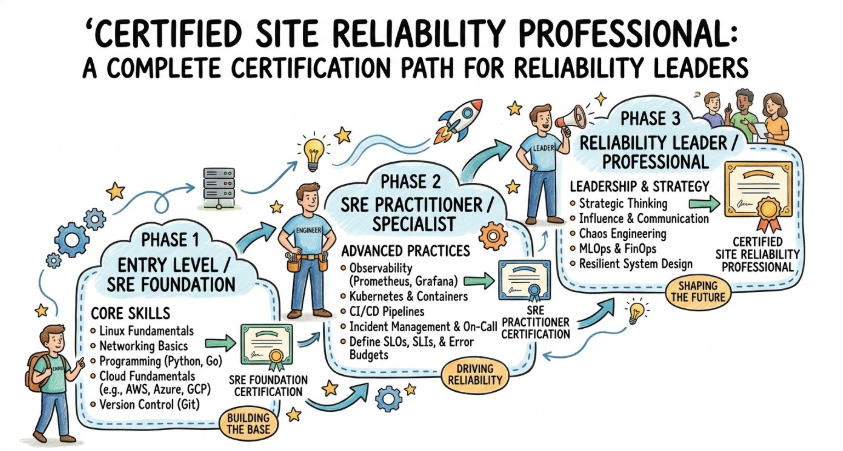
The certification is categorized into three primary levels: Foundation, Professional, and Advanced. The Foundation level introduces the SRE mindset, focusing on the cultural shift and basic metrics like SLAs and SLIs. This serves as the entry point for those new to the field or moving from traditional IT roles into the modern cloud ecosystem.
The Professional level dives deep into the technical implementation of SRE, including automation, observability, and incident response. This level is where most active engineers find the most value, as it maps directly to daily tasks in a DevOps or SRE role. The Advanced level is reserved for architects and leads, focusing on organizational SRE, reliability at scale, and long-term strategic planning for complex infrastructure.
Complete Certified Site Reliability Professional Certification Table
| Track | Level | Who it’s for | Prerequisites | Skills Covered | Recommended Order |
| Core SRE | Foundation | Beginners, Junior Devs | Basic Linux & Networking | SLOs/SLIs, Error Budgets, Toil | 1st |
| Core SRE | Professional | SREs, DevOps Engineers | 2+ Years Experience | Observability, Automation, On-call | 2nd |
| Core SRE | Advanced | Lead Engineers, Architects | 5+ Years Experience | Large-scale Architecture, Policy | 3rd |
| Platform | Professional | Platform Engineers | Infrastructure Knowledge | IaC, Kubernetes, CI/CD | 2nd |
| Reliability | Professional | Quality Engineers | Testing Fundamentals | Chaos Engineering, Load Testing | 2nd |
Detailed Guide for Each Certified Site Reliability Professional Certification
Certified Site Reliability Professional – Foundation
What it is
This certification validates a candidate’s understanding of the core SRE philosophy and the metrics used to measure reliability. It confirms that the individual understands the difference between DevOps and SRE and can speak the language of modern operations.
Who should take it
It is suitable for junior developers, system administrators, or technical project managers who need to understand the operational side of software. It is also an excellent starting point for computer science graduates looking to enter the infrastructure space.
Skills you’ll gain
- Defining Service Level Indicators (SLIs) and Objectives (SLOs).
- Calculating and managing Error Budgets.
- Identifying and eliminating operational Toil.
- Understanding the SRE lifecycle and team structures.
Real-world projects you should be able to do
- Designing a basic monitoring dashboard for a web application.
- Calculating the availability of a system based on historical downtime.
- Drafting a simple Service Level Agreement (SLA) for a microservice.
Preparation plan
- 7–14 days: Focused reading on the Google SRE Book and core definitions.
- 30 days: Practical exercises in setting up basic monitoring alerts and SLI tracking.
- 60 days: In-depth study of case studies and organizational change management in SRE.
Common mistakes
- Treating SRE as just another name for DevOps without understanding the nuances.
- Focusing too much on specific tools rather than the underlying principles of reliability.
Best next certification after this
- Same-track option: Certified Site Reliability Professional – Professional
- Cross-track option: Certified DevOps Professional
- Leadership option: Engineering Management Foundation
Certified Site Reliability Professional – Professional
What it is
This level validates the technical ability to implement SRE practices in a production environment. It covers the technical automation, monitoring, and incident management skills required for mid-to-senior level SRE roles.
Who should take it
This is for active SREs, DevOps engineers, and cloud architects who have at least two years of experience. It is for those who are responsible for the uptime and performance of customer-facing applications.
Skills you’ll gain
- Implementing full-stack observability and distributed tracing.
- Developing automation scripts to handle repetitive operational tasks.
- Leading incident response and conducting blameless post-mortems.
- Managing infrastructure as code (IaC) and configuration management.
Real-world projects you should be able to do
- Automating the recovery of a failed service using self-healing scripts.
- Setting up a Prometheus and Grafana stack for a multi-tenant environment.
- Conducting a simulated incident and leading the subsequent post-mortem meeting.
Preparation plan
- 7–14 days: Reviewing advanced automation patterns and observability best practices.
- 30 days: Hands-on labs focusing on incident response and infrastructure automation.
- 60 days: Complete deep dive into distributed systems architecture and chaos engineering.
Common mistakes
- Neglecting the cultural aspects of SRE, such as the “blameless” philosophy.
- Over-automating tasks without a clear understanding of the failure domains.
Best next certification after this
- Same-track option: Certified Site Reliability Professional – Advanced
- Cross-track option: Certified FinOps Professional
- Leadership option: Technical Lead Certification
Certified Site Reliability Professional – Advanced
What it is
The Advanced certification validates the ability to design and manage reliability across an entire organization. It focuses on high-level strategy, architectural patterns for resilience, and influencing engineering culture at scale.
Who should take it
This is intended for Principal SREs, Infrastructure Architects, and VPs of Engineering. Candidates should have extensive experience managing complex, global-scale systems and leading technical teams.
Skills you’ll gain
- Designing multi-region, highly available distributed architectures.
- Establishing organizational-wide SRE standards and governance.
- Mentoring SRE teams and building a culture of reliability.
- Strategic capacity planning and cost optimization at scale.
Real-world projects you should be able to do
- Designing a disaster recovery plan for a global financial platform.
- Implementing a standardized SLO framework across fifty engineering teams.
- Architecting a zero-trust infrastructure that maintains 99.99% availability.
Preparation plan
- 7–14 days: High-level review of architectural whitepapers and enterprise case studies.
- 30 days: Designing theoretical solutions for complex, multi-layered system failures.
- 60 days: Extensive research into organizational psychology and large-scale system design.
Common mistakes
- Focusing on micro-optimizations instead of macro-level organizational reliability.
- Failing to align reliability goals with the business’s financial and product objectives.
Best next certification after this
- Same-track option: Industry-specific Compliance Certifications
- Cross-track option: Advanced Cloud Architect Certifications
- Leadership option: CTO Leadership Program
Choose Your Learning Path
DevOps Path
The DevOps path focuses on the integration of development and operations to speed up delivery. Professionals here prioritize CI/CD pipelines, automated testing, and developer experience. By integrating SRE principles, DevOps engineers can ensure that the speed of delivery does not compromise the stability of the production environment. This path is ideal for those who enjoy the “build” phase as much as the “run” phase.
DevSecOps Path
In this path, security is integrated into every step of the reliability and deployment process. It focuses on automated security scanning, policy as code, and ensuring that reliability doesn’t come at the cost of vulnerability. A Certified Site Reliability Professional with a DevSecOps focus is highly valued in regulated industries like banking and healthcare. This path ensures that the system is not only up and running but also secure against external threats.
SRE Path
The pure SRE path is for those who want to specialize deeply in the science of reliability. It involves heavy automation, monitoring, and incident management with a goal of reducing manual intervention. Professionals on this path act as the bridge between software development and systems engineering. This is the core track for those aiming to work in high-growth tech companies and large-scale cloud providers.
AIOps Path
The AIOps path leverages machine learning and artificial intelligence to automate IT operations. Professionals in this area focus on using AI to analyze vast amounts of log data and predict system failures before they happen. By combining SRE with AIOps, engineers can build self-healing systems that adapt to changing workloads automatically. This is a forward-looking path for those interested in the intersection of data science and systems engineering.
MLOps Path
The MLOps path is specialized for managing the lifecycle of machine learning models in production. It focuses on the reliability of data pipelines, model training environments, and inference services. An SRE with MLOps skills ensures that AI models are deployed reliably and can be monitored for performance drift. This path is essential for organizations that are increasingly relying on AI to power their core business logic.
DataOps Path
The DataOps path applies SRE and DevOps principles to data management and analytics. It focuses on the reliability and quality of data flows from source to consumption. Professionals here ensure that data pipelines are resilient, scalable, and observable, preventing “silent” data failures. This path is critical for companies that make real-time decisions based on big data and analytics.
FinOps Path
The FinOps path combines SRE principles with financial accountability to optimize cloud spending. It focuses on the reliability of cost-tracking systems and the implementation of automated cost-saving measures. A professional in this path ensures that the infrastructure is not only reliable but also economically sustainable. This path is increasingly important as cloud budgets become a significant portion of an enterprise’s operational expenditure.
Role → Recommended Certified Site Reliability Professional Certifications
| Role | Recommended Certifications |
| DevOps Engineer | Certified Site Reliability Professional – Professional |
| SRE | Certified Site Reliability Professional – Professional & Advanced |
| Platform Engineer | Certified Site Reliability Professional – Professional |
| Cloud Engineer | Certified Site Reliability Professional – Foundation & Professional |
| Security Engineer | Certified Site Reliability Professional – Foundation (Security Focus) |
| Data Engineer | Certified Site Reliability Professional – Foundation (Data Focus) |
| FinOps Practitioner | Certified Site Reliability Professional – Foundation (Cost Focus) |
| Engineering Manager | Certified Site Reliability Professional – Foundation |
Next Certifications to Take After Certified Site Reliability Professional
Same Track Progression
Deep specialization within the SRE track involves moving from Foundation to Professional and eventually to Advanced. This progression allows you to master the nuances of reliability at different organizational levels. You might also look into specialized SRE certifications that focus on specific environments like Kubernetes or Serverless architectures. This ensures that you remain the go-to expert for reliability within your specific domain.
Cross-Track Expansion
Skill broadening is essential for senior engineers who need to understand how different parts of the stack interact. After achieving SRE certification, expanding into DevSecOps or FinOps can make you a more versatile professional. This cross-pollination of skills allows you to address reliability from multiple angles, such as security resilience or cost-effective scalability. It prepares you for roles that require a holistic view of the engineering ecosystem.
Leadership & Management Track
For those looking to move into leadership, transitioning from a technical SRE role to engineering management is a natural progression. The analytical and data-driven mindset of an SRE is perfectly suited for making management decisions. Certifications in technical leadership or organizational behavior can complement your SRE background. This path leads to roles like SRE Manager, Director of Infrastructure, or even CTO.
Training & Certification Support Providers for Certified Site Reliability Professional
DevOpsSchool
DevOpsSchool provides a robust platform for engineering professionals looking to master the intricacies of modern software delivery and operations. Their curriculum is known for being deeply technical, offering hands-on labs that simulate real-world production issues. They focus on bridging the skill gap for engineers in India and globally, providing mentorship from industry veterans. Their approach to SRE training emphasizes the integration of automation with cultural change, ensuring students understand the “why” behind the “how.” With a wide array of courses covering everything from basic Linux to advanced Kubernetes, they are a primary destination for career growth.
Cotocus
Cotocus stands out as a specialized provider that focuses on high-end technical consulting and training for enterprise-level organizations. They specialize in niche areas like platform engineering and advanced SRE practices, making them a preferred partner for large-scale digital transformations. Their training programs are often tailored to the specific needs of a company’s infrastructure, ensuring immediate applicability. Cotocus instructors are typically active practitioners who bring current industry challenges into the classroom. For professionals seeking a more bespoke and deep-dive learning experience, Cotocus offers a path that goes beyond standard certification requirements into architectural mastery.
Scmgalaxy
Scmgalaxy has built a massive community-driven platform that serves as a treasure trove of information for DevOps and SRE practitioners. They offer a unique blend of formal training and informal knowledge sharing through their extensive blog and forum network. Their certification support is particularly strong in the area of configuration management and source code control, which are foundational to SRE. By focusing on the “Galaxy” of tools and practices, they provide learners with a broad perspective on the entire ecosystem. It is an excellent resource for engineers who want to stay updated on the latest open-source trends and community-vetted best practices.
BestDevOps
BestDevOps focuses on delivering high-quality, streamlined training that targets the most essential skills required in the job market today. They pride themselves on a curriculum that is free of fluff, focusing instead on the core competencies that hiring managers look for. Their SRE-related offerings are designed to get professionals “job-ready” in a relatively short amount of time without sacrificing depth. They use a practical, project-based learning model that allows students to build a portfolio of work as they learn. For those looking for a clear and direct path to professional certification, BestDevOps provides a very efficient learning experience.
devsecopsschool.com
DevSecOpsSchool is the premier destination for engineers who recognize that reliability and security are two sides of the same coin. They specialize in integrating security protocols into the automated pipelines that SREs manage daily. Their courses cover critical topics like vulnerability management, automated compliance, and secure coding practices. By focusing on the “Security” in DevOps, they prepare professionals for high-stakes roles in industries that cannot afford a breach. The training here is essential for any SRE who wants to understand how to protect their systems while maintaining high availability and rapid deployment cycles.
sreschool.com
SRESchool.com is the primary authority and hosting site for the Certified Site Reliability Professional program, offering a dedicated focus on reliability engineering. Unlike generalist platforms, every resource here is curated to support the SRE journey from foundation to advanced levels. They offer a mix of theoretical frameworks and practical sandboxes where engineers can practice incident response in a safe environment. Their certification is recognized globally as a standard of excellence in the field. By focusing exclusively on SRE, they provide a depth of knowledge and a community of experts that is unmatched by more diverse training providers.
aiopsschool.com
AIOpsSchool addresses the growing need for intelligence in IT operations by teaching engineers how to apply machine learning to infrastructure management. Their curriculum is at the cutting edge of the industry, focusing on predictive analytics, automated root cause analysis, and anomaly detection. For an SRE, training from AIOpsSchool provides the tools to move from reactive to proactive operations. They help professionals understand how to handle the “Big Data” of logs and metrics that modern systems generate. This is the go-to provider for those looking to future-proof their careers as systems become too complex for manual management.
dataopsschool.com
DataOpsSchool provides the specialized training needed to bring the rigor of SRE to the world of data engineering and analytics. They focus on the reliability of data pipelines, ensuring that data is accurate, timely, and accessible. Their courses teach engineers how to use automation and monitoring to manage data at scale, reducing the friction between data producers and consumers. In an era where data drives every business decision, the skills taught here are vital for maintaining the integrity of the information flow. It is an essential stop for SREs who find themselves managing large-scale data warehouses or real-time streaming platforms.
finopsschool.com
FinOpsSchool is dedicated to the emerging discipline of cloud financial management, teaching engineers how to balance performance with cost. They provide a structured approach to understanding cloud billing, resource optimization, and the cultural shift required for financial accountability. For an SRE, this training is crucial for ensuring that a reliable system is also a cost-effective one. They offer certifications that help professionals speak the language of both engineering and finance. As cloud costs continue to rise, the expertise provided by FinOpsSchool is becoming a mandatory requirement for senior technical leaders and architects.
Frequently Asked Questions (General)
- How difficult is the Certified Site Reliability Professional exam?
The difficulty is moderate to high, as it requires a mix of theoretical knowledge and practical problem-solving skills. It is designed to be a true test of an engineer’s ability to handle production-like scenarios rather than just a memory test. - What are the prerequisites for the Professional level?
It is recommended that candidates have at least two years of experience in a DevOps, SRE, or Systems Administration role. Familiarity with at least one cloud provider and basic scripting in Python or Go is highly beneficial. - How long does the certification stay valid?
The certification is typically valid for two to three years, reflecting the fast-paced nature of the industry. Professionals are encouraged to renew by either retaking the exam or moving up to the next certification level. - Is this certification recognized globally?
Yes, the Certified Site Reliability Professional is recognized by major tech hubs worldwide, including those in India, the US, and Europe. It is increasingly appearing as a preferred qualification in job descriptions for SRE and Platform roles. - What is the total time commitment for preparation?
For the Foundation level, 30 days is usually sufficient. For the Professional and Advanced levels, candidates should expect to spend 60 to 90 days of consistent study and hands-on practice. - Does the certification cover specific cloud providers like AWS or Azure?
While the principles are cloud-agnostic, the practical components often use popular tools and environments. The goal is to teach you skills that are transferable across any major cloud platform or on-premise setup. - What is the return on investment for this certification?
Professionals often see a significant increase in salary and job opportunities after becoming certified. Beyond the financial aspect, it provides a structured learning path that saves time compared to self-directed, unguided study. - Can I jump straight to the Advanced level?
While it is technically possible for highly experienced architects, it is strongly recommended to at least review the Professional curriculum. The levels build upon each other, and the Advanced level assumes mastery of the lower tiers. - Are there labs included in the training?
Yes, most authorized training providers include hands-on labs that allow you to practice observability, automation, and incident response. These labs are crucial for passing the performance-based parts of the exam. - How does SRE differ from DevOps in this certification?
The certification views SRE as a specific implementation of DevOps. While DevOps is a broad cultural movement, SRE provides the concrete roles, metrics, and practices to make that culture a reality in production. - What happens if I fail the exam?
Most providers offer a retake policy after a specific waiting period. It is recommended to review the exam feedback and focus on the areas where your score was lowest before attempting the test again. - Is there a community for certified professionals?
Yes, holders of the Certified Site Reliability Professional gain access to exclusive forums and networking groups. This allows for continued learning and peer support from other experts in the field.
FAQs on Certified Site Reliability Professional
- How does this certification help with “on-call” fatigue?
The curriculum emphasizes toil reduction and automated self-healing, which directly reduces the number of manual alerts an engineer receives. By learning to build more resilient systems, you spend less time fighting fires and more time on high-value engineering tasks, significantly improving your work-life balance. - Does it cover Chaos Engineering?
Yes, the Professional and Advanced levels introduce Chaos Engineering as a proactive way to test system resilience. You will learn how to inject failures into a system to identify weaknesses before they cause actual downtime, which is a core skill for modern SREs. - Is coding a major part of the exam?
While you don’t need to be a senior developer, a solid understanding of scripting and automation is required. You should be comfortable writing small scripts to automate tasks and reading code to understand how an application might fail in production. - How does the certification address incident management?
It teaches a structured approach to incidents, focusing on the roles of the Incident Commander, Communications Lead, and Ops Lead. The focus is on resolving the issue quickly and then conducting a blameless post-mortem to prevent it from happening again. - Can a manager benefit from the Professional level?
Yes, technical managers who want to understand the daily challenges of their team will find it invaluable. It provides the technical context needed to make better decisions about resource allocation, error budgets, and feature deadlines versus reliability work. - Is Linux knowledge mandatory?
A strong foundation in Linux is highly recommended, as most SRE work involves interacting with Linux-based containers and servers. Understanding the kernel, file systems, and networking at a deep level is often the key to solving complex reliability issues. - How does this map to Kubernetes?
The certification treats Kubernetes as a primary orchestration tool. You will learn how to manage reliability within a Kubernetes cluster, including setting resource limits, liveness/readiness probes, and horizontal pod autoscaling to ensure application uptime. - What is the focus on “Service Level Objectives”?
SLOs are the heartbeat of this certification. You will learn how to set realistic objectives that balance the needs of the business with the capacity of the engineering team, creating a data-driven way to manage risk.
Final Thoughts: Is Certified Site Reliability Professional Worth It?
From the perspective of a senior mentor who has seen various industry trends come and go, the Certified Site Reliability Professional is a solid investment. It avoids the trap of being a “paper certification” by focusing on the actual, gritty reality of maintaining production systems. The skills it validates—observability, automation, and a disciplined approach to risk—are the exact skills that differentiate a good engineer from a great one.
As systems become more complex and distributed, the need for individuals who can ensure their reliability will only grow. This certification provides a clear, structured path for those who are willing to put in the work to master a difficult but rewarding discipline. If you are looking for a way to future-proof your career and take on more significant responsibilities within your organization, this is a path worth taking. There is no hype here—only the practical reality that reliability is the most important feature of any product.
