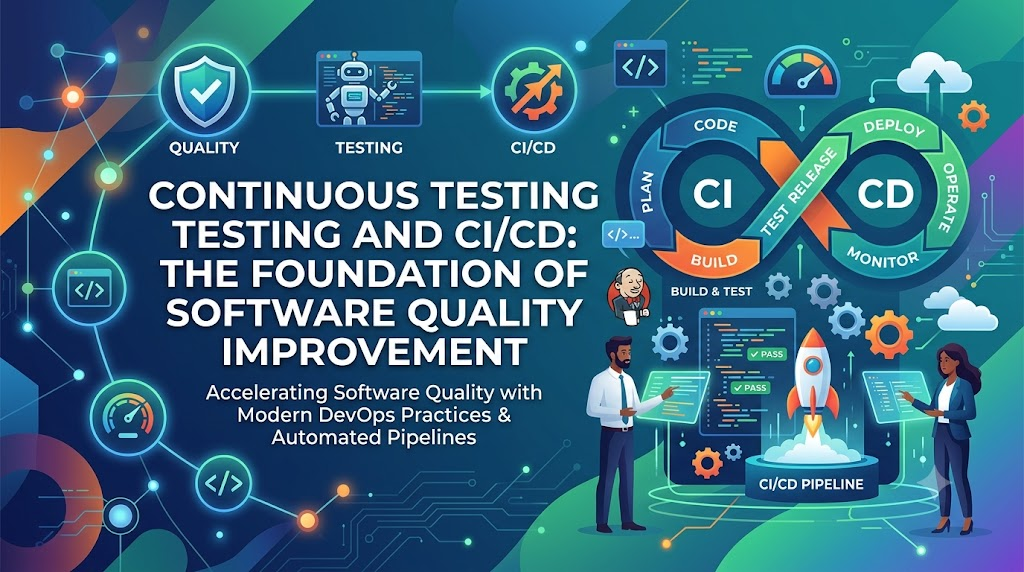
Introduction
In today’s fast-paced digital landscape, high software availability and stability are essential, yet traditional development models frequently struggle with siloed teams, manual deployments, and delayed testing that allow critical bugs to reach production. DevOps fundamentally transforms this paradigm by unifying development, quality engineering, and operations into a cohesive workflow where quality is built into every phase of the lifecycle through continuous integration, automated testing, and real-time observability. By shifting quality validation left and fostering shared operational responsibility, organizations can eliminate release bottlenecks and deliver reliable, secure, and scalable applications—a transformation you can master through hands-on, enterprise-focused learning paths at DevOpsSchool.
What Is Product Quality in Software Development?
Software product quality is not defined by a single metric. It represents a comprehensive measure of how well an application meets technical standards, business objectives, and user expectations.
+-----------------------------------------------------------------------+
|                    SOFTWARE PRODUCT QUALITY                           |
+-------------------+-------------------+-------------------------------+
| Functional        | Non-Functional    | Structural                    |
| - Accuracy        | - Performance     | - Code Cleanliness            |
| - Completeness    | - Reliability     | - Maintainability             |
| - User Workflows  | - Security        | - Scalability                 |
+-------------------+-------------------+-------------------------------+
Product quality spans several complementary dimensions:
Functional Quality
Functional quality ensures the system behaves exactly as designed. The features, business logic, workflows, and calculations must function accurately without crashing or generating incorrect data.
Performance
Performance measures how fast and efficiently the application handles user activity. It includes key parameters like response times, page load speeds, database query execution, throughput, and system resource consumption (CPU, memory, storage) under varied traffic conditions.
Reliability and Availability
Reliability reflects system consistency over time. High-quality software maintains uptime, recovers rapidly from hardware failures, and handles unexpected traffic spikes without losing user data or dropping active sessions.
Security
Security represents how well an application protects sensitive data, prevents unauthorized access, resists vulnerability exploits, and complies with industry regulations such as GDPR, HIPAA, or PCI-DSS.
User Experience (UX)
A high-quality software product is intuitive, responsive, visually clear, and easy to navigate. Software that functions correctly but presents an overly complex interface degrades the overall user perception of quality.
Maintainability and Scalability
Behind the scenes, maintainability refers to how clean, modular, documented, and easy-to-update the underlying codebase is. Scalability measures how effortlessly the system handles rapid growth in data, users, and infrastructure without requiring a total redesign.
Understanding the Relationship Between DevOps and Product Quality
DevOps is fundamentally a cultural, procedural, and technological movement aimed at unifying software creation, validation, and operations.
When organizations shift from traditional delivery models to DevOps, the relationship with software quality changes completely:
Traditional Approach:
[ Dev Work ] ---> [ Hand-off ] ---> [ QA Testing ] ---> [ Hand-off ] ---> [ Ops Deploy ]
                                                                             (High Risk)

DevOps Approach:
+------------------------------------------------------------------------------------+
|  Plan ---> Code ---> Build ---> Test ---> Release ---> Deploy ---> Monitor --->    |
|   ^                                                                           |    |
|   +----------------------- Continuous Feedback & Automation ------------------+    |
+------------------------------------------------------------------------------------+
                                                                        (Low Risk)
- Shared Responsibility: Quality ceases to be solely the responsibility of a separate QA group. Software developers write automated unit tests, test engineers build automated integration suites, operations specialists manage infrastructure templates, and security teams define compliance policies within code pipelines.
- Continuous Feedback Loops: Instead of waiting months to discover a software bug, developers receive automated feedback within minutes of pushing code to a shared repository.
- Automation as Quality Enforcement: Human beings are prone to fatigue and manual oversight during repetitive tasks. Automated pipelines ensure every build, test run, security scan, and deployment step runs with precise consistency.
- Continuous Shift-Left Strategy: Testing, security validation, performance checks, and architectural reviews shift left, occurring early in the development lifecycle when defects are easiest and cheapest to fix.
Why Traditional Development Often Struggles With Quality
Traditional waterfall or poorly integrated delivery frameworks encounter structural bottlenecks that compromise application quality.
Siloed Teams and Communication Gaps
Developers, testers, and system administrators often work in isolated silos. Developers focus on building features, QA teams focus on finding bugs, and operations teams focus on maintaining environment stability. These conflicting incentives create friction and slow down resolution times.
Delayed Testing Phases
In traditional models, testing occurs after development is marked complete. When testers finally receive a build, defects have compounded over months. Debugging issues late in the lifecycle requires extensive root-cause analysis across massive code changes, leading to delayed launches and rushed fixes.
Manual Deployments and Inconsistent Environments
Deploying applications manually using custom scripts or step-by-step documentation introduces high error rates. A configuration setting missed in staging can break production systems. The classic issue where code works on a developer’s machine but fails in production is a direct symptom of inconsistent infrastructure.
Slow Release Cycles
When releases occur only once or twice a year, each deployment carries hundreds of database schema changes, framework upgrades, and feature additions. Testing this massive surface area manually is practically impossible, leading to a high rate of production defects.
How DevOps Improves Product Quality
DevOps practices transform every aspect of software creation and delivery. The core practices, along with their direct quality benefits and enterprise impact, are summarized below:
| DevOps Practice | Quality Benefit | Business Impact |
| Automation | Removes human execution error; ensures consistent validation across builds. | Accelerated releases with near-zero manual setup defects. |
| Continuous Integration (CI) | Catches integration bugs immediately; enforces code quality and formatting guidelines. | Reduced defect repair costs and faster development velocity. |
| Continuous Testing | Provides continuous test execution across functional, security, and performance domains. | Higher application reliability and improved software stability. |
| Infrastructure as Code (IaC) | Eliminates environmental drift between dev, staging, and production clusters. | Predictable, repeatable deployments with reduced downtime. |
| Monitoring & Observability | Provides real-time visibility into production errors, resource usage, and application health. | Rapid incident resolution (low MTTR) and stable uptime. |
| DevSecOps | Scans dependencies, containers, and code for vulnerabilities early in development. | Reduced risk of security breaches and easy regulatory compliance. |
| Continuous Feedback | Integrates user usage data, error traces, and customer input into technical backlogs. | Higher user satisfaction and feature alignment with actual needs. |
Continuous Integration (CI) Improves Code Quality
Continuous Integration is the foundation of modern software engineering quality. Under CI, software engineers merge their code updates into a shared central repository multiple times per day.
[ Developer Commit ]
         |
         v
[ GitHub / GitLab Trigger ]
         |
         v
[ CI Server: Jenkins / GitHub Actions / GitLab CI ]
         |
         +---> 1. Automated Linting & Code Formatting
         |
         +---> 2. Compilation & Build Verification
         |
         +---> 3. Automated Unit & Component Tests
         |
         +---> 4. Static Code Analysis (SonarQube)
         |
         v
[ Pass: Code Merged ] OR [ Fail: Pipeline Breaks & Developer Notified ]
Frequent Code Integration
Instead of building features in long-lived isolation, engineers submit small, atomic updates. Smaller code commits are significantly easier to review, test, merge, and debug.
Automated Builds and Gatekeeping
Every time a pull request or code commit is made, an automated CI tool (such as Jenkins, GitHub Actions, or GitLab CI/CD) pulls the latest updates, compiles the code, and verifies that the application builds cleanly. If the build breaks, the pipeline flags the error instantly, preventing buggy code from entering the main branch.
Static Code Analysis
Modern CI pipelines run tools like SonarQube or ESLint directly during the build phase. These tools scan raw source code for potential bugs, dead code, code duplication, performance anti-patterns, security risks, and architectural technical debt before the code is ever deployed.
Continuous Testing Ensures Better Software Quality
Continuous testing means running automated tests automatically throughout every phase of the software delivery pipeline.
+--------------------------------------------------------------------+
|                    CONTINUOUS TESTING PYRAMID                      |
|                                                                    |
|                   /  End-to-End (E2E)  \       (Slowest, Fewest)   |
|                  /----------------------\                          |
|                 /   Integration & API    \                         |
|                /--------------------------\                        |
|               /   Unit & Component Tests   \   (Fastest, Most)     |
+--------------------------------------------------------------------+
A robust continuous testing framework covers multiple layers:
Unit Testing
Developers write unit tests to validate individual functions, classes, and isolated business logic rules. Unit tests execute in seconds, giving immediate feedback during code development.
Integration and API Testing
Integration tests ensure that disparate system modules, third-party services, microservices, and database connectors communicate correctly. API testing tools validate response codes, data schemas, and payload transformations.
Regression Testing
Automated regression test suites run with every pipeline execution. They verify that adding new features or patching bugs does not break existing functional capabilities.
Performance and Load Testing
Automated load tests simulate concurrent user traffic against staging environments using tools like Apache JMeter or k6. This allows engineering teams to identify memory leaks, thread locks, and database bottlenecks before production releases.
End-to-End (E2E) Testing
E2E testing tools drive actual browser windows or mobile user interfaces to simulate complete end-to-end user journeys, confirming that critical workflows operate smoothly.
Automation Reduces Human Errors
Manual software operations are slow, expensive, and prone to human error. Manual steps—like copying files over FTP, adjusting server settings by hand, or running manual regression scripts—introduce risk into release processes.
Automated Deployments
DevOps replaces manual release checklists with automated deployment strategies such as Canary Deployments, Blue-Green Deployments, and Rolling Updates.
- Blue-Green Deployments: Maintain two identical production environments. One processes live traffic while the second receives the new software update. Once validated, router traffic switches instantly to the updated environment.
- Canary Deployments: Route a small fraction of real user traffic (e.g., 5%) to the updated application version. If error rates remain normal, traffic scales incrementally to 100%.
Blue-Green Deployment Workflow:

               [ Router / Load Balancer ]
                           |
             +-------------+-------------+
             |                           |
             v                           v
     [ Environment A ]           [ Environment B ]
     (Active / Live v1)          (Idle / Staging v2)
                                         |
                                (Deploy & Validate)
                                         |
             +---------------------------+
             | (Switch Traffic)
             v
     [ Environment A ]           [ Environment B ]
     (Idle / Previous)           (Active / Live v2)
Automated Validation and Rollbacks
If an automated health check detects elevated 5xx server errors or latency spikes after a deployment, automated orchestration systems immediately roll back the environment to the last stable state. This minimizes system downtime and mitigates risk to end users.
Infrastructure as Code (IaC) Improves Environment Consistency
One of the most frequent causes of software defects in traditional environments is configuration drift—where development, test, staging, and production environments are configured differently.
Infrastructure as Code (IaC) allows engineering teams to define servers, networks, load balancers, database instances, and storage buckets using human-readable configuration files.
[ IaC Code: Terraform / Ansible ] ---> [ Version Control (Git) ] ---> [ Automated Provisioning ] ---> [ Identical Environments ]
Standardized Environments
By storing environment definitions in tools like Terraform, Ansible, or CloudFormation, every tier of the delivery pipeline utilizes identical infrastructure settings.
Reduced Configuration Drift
Instead of logging into servers via SSH to adjust settings manually, infrastructure changes are committed to version control and provisioned automatically. This guarantees that if software executes successfully in staging, it will perform identically in production.
Monitoring and Observability Improve Quality
Product quality tracking does not stop once software is successfully deployed to production. Continuous monitoring and observability ensure the application runs reliably over time.
[ Application Logs / Metrics / Traces ]
                   |
                   v
[ Aggregators: Prometheus / ELK / Datadog ]
                   |
                   v
[ Grafana Dashboards & Real-time Alerts ]
                   |
                   v
[ Automated Scaling & Incident Response ]
Metrics Collection and Dashboards
Monitoring platforms aggregate vital system metrics, including:
- Server CPU, Memory, and Disk Utilization
- Application Latency and Request Duration
- HTTP Error Rates (4xx, 5xx codes)
- Database Connection Pool Usage and Slow Query Logs
Centralized Logging and Tracing
When errors occur across microservices architectures, centralized logging tools (such as the Elastic/ELK Stack) aggregate server logs into searchable dashboards. Distributed tracing platforms allow developers to trace single user requests across multiple interconnected microservices, pinpointing exact performance bottlenecks.
Real-Time Incident Management
Observability frameworks combine metrics with automated alerting tools (such as PagerDuty or Alertmanager). When application metrics violate performance thresholds, engineering teams are instantly alerted, enabling fast MTTR (Mean Time to Resolution) before end users are significantly impacted.
DevSecOps Improves Product Security
Security is an essential component of overall software product quality. DevSecOps integrates security practices directly into every stage of the DevOps delivery pipeline rather than treating security as an afterthought.
+-----------------------------------------------------------------------+
|                       DEVSECOPS PIPELINE GATES                        |
|                                                                       |
|  [ Commit ] ---> SAST (Static Code Security Analysis)                 |
|  [ Build  ] ---> SCA (Software Composition Analysis / Dependencies)   |
|  [ Deploy ] ---> DAST (Dynamic Application Security Testing)          |
|  [ Runtime] ---> Secret Management & Compliance Auditing              |
+-----------------------------------------------------------------------+
Automated Vulnerability Scanning
- SAST (Static Application Security Testing): Scans source code during build phases for security flaws, such as SQL injection vulnerabilities or cross-site scripting (XSS).
- SCA (Software Composition Analysis): Scans open-source libraries and dependencies for known CVEs (Common Vulnerabilities and Exposures).
- DAST (Dynamic Application Security Testing): Simulates web attacks against running staging applications to identify runtime security flaws.
Secret Management and Compliance Automation
DevSecOps eliminates hardcoded API credentials, database passwords, and encryption keys from source code repositories, managing credentials securely with tools like HashiCorp Vault. Compliance checks are automated as policy-as-code, ensuring applications comply with corporate and legal security policies continuously.
Better Collaboration Leads to Better Software
DevOps transforms organizational communication and team structures.
Traditional Structure:
[ Software Engineers ] === (Handoff Wall) ===> [ QA Engineers ] === (Handoff Wall) ===> [ Systems / Ops ]

DevOps Collaborative Structure:
+-----------------------------------------------------------------------+
|  Cross-Functional Team: Devs + QA + Ops + Security + Product Owners   |
|  Goal: Shared Ownership of Quality, Availability, and User Value      |
+-----------------------------------------------------------------------+
When development, quality, security, operations, and product management teams work together daily:
- Clear Requirements: Test engineers and developers collaborate early during story grooming to define clear acceptance criteria, reducing miscommunication regarding feature expectations.
- Shared Ownership: Developers actively write automated test suites and assist with operational troubleshooting, while operations engineers assist with continuous delivery infrastructure.
- Rapid Resolution: When production incidents occur, cross-functional teams analyze root causes collaboratively through blameless post-mortems, focusing on systemic engineering fixes rather than assigning individual blame.
Customer Feedback and Continuous Improvement
DevOps connects real-world user activity directly to development workflows.
[ Live Users ] ---> [ Application Analytics & Error Logs ] ---> [ Product Backlog ] ---> [ Rapid Patch Release ]
User Analytics and Feature Toggles
Using feature flags (such as LaunchDarkly), teams can deploy code safely to production in a disabled state, enabling features selectively for specific target user segments. This allows for safe A/B testing, gradual rollouts, and rapid feature rollbacks if negative feedback or bugs surface.
Real-User Monitoring (RUM)
RUM tools capture live user sessions, monitoring real-time page render times, script errors, and network request failures across diverse client devices and geographic regions. This telemetry provides clear data on where user experience updates are needed.
Real-World Example of DevOps Improving Product Quality
To understand how these concepts operate together, let us examine a end-to-end software delivery workflow for a modern cloud application.
Step 1: Planning & Coding
[ Developer writes code locally and pushes updates to a Git branch ]
                              |
                              v
Step 2: Automated Integration (CI)
[ CI server triggers build, runs linters, unit tests, and SAST scans ]
                              |
                              v
Step 3: Continuous Testing
[ Automated regression, API, and component tests run in parallel ]
                              |
                              v
Step 4: Infrastructure Provisioning (IaC)
[ Staging server environments are automatically provisioned using Terraform ]
                              |
                              v
Step 5: Automated Deployment
[ App is deployed to staging using a Canary strategy ]
                              |
                              v
Step 6: Observability & Validation
[ Prometheus & Grafana monitor error rates and latency automatically ]
                              |
                              v
Step 7: Production Release & Continuous Feedback
[ Traffic routes to production; user analytics feed future feature backlogs ]
- Planning & Development: A developer picks up a ticket, writes code on a feature branch, and includes corresponding unit tests.
- Automated Integration (CI): Pushing code triggers a CI build. Static analysis tools check for formatting, performance issues, and security vulnerabilities.
- Continuous Testing: Upon build success, automated integration, security, and API tests run in parallel test suites.
- Environment Provisioning (IaC): The pipeline uses Terraform to build an isolated, production-identical testing environment on demand.
- Canary Deployment: The build deploys smoothly into production, routing 5% of user traffic to the updated code path.
- Observability & Health Checks: APM tools monitor system performance metrics. If latency increases or error rates rise, the traffic automatically routes back to the stable environment.
- Production Release & Feedback: After validating baseline performance metrics under full traffic load, the update is marked complete, and user session telemetry informs future updates.
Benefits of DevOps for Product Quality
Adopting a comprehensive DevOps strategy provides key quantitative quality advantages:
- Fewer Production Bugs: Early detection in CI/CD pipelines reduces bugs reaching live users by up to 80%.
- Faster Time-to-Market: Automated testing and release pipelines allow features to move from code commit to production safely in hours rather than months.
- Higher Reliability and Uptime: Automated health checks, self-healing infrastructure, and canary deployments minimize application outages.
- Rapid Mean-Time-To-Recovery (MTTR): Centralized observability and automated rollbacks drastically reduce recovery times when issues occur.
- Improved Security: Automated dependency scanning and policy enforcement ensure continuous security compliance.
- Greater Scalability: Infrastructure as Code enables systems to scale resources up or down automatically in response to user load.
Common Challenges in Maintaining Product Quality
Transitioning to a modern DevOps approach presents several challenges that teams must manage:
- Legacy Monolithic Systems: Tightly coupled legacy applications are difficult to break down into automated testing pipelines.
- Solution: Refactor legacy monoliths gradually using the Strangler Fig pattern, extracting isolated microservices step-by-step.
- Flaky Automated Tests: Unstable tests that intermittently fail create noise, causing developers to lose trust in build pipelines.
- Solution: Quarantine unstable tests immediately, fix underlying async/data dependency issues, and enforce strict test quality standards.
- Cultural Resistance: Teams accustomed to traditional siloed roles may resist continuous deployment and shared operational ownership.
- Solution: Implement change management strategies, offer structured training programs, and incentivize cross-functional collaboration.
- Inconsistent Environments: Environments configured outside version control cause unexplained runtime errors.
- Solution: Enforce strict Infrastructure as Code policies, disabling manual server configuration changes entirely.
Best Practices to Improve Product Quality Using DevOps
Use this checklist to evaluate and improve your software delivery pipeline:
- [ ] Automate Unit and Integration Testing: Require high test coverage before code can be merged into main branches.
- [ ] Establish Strict Quality Gates: Block builds automatically if security scans reveal high-severity CVEs or static analysis checks fail.
- [ ] Treat Infrastructure as Code: Version control every infrastructure setup file using Terraform, Ansible, or similar IaC tools.
- [ ] Shift Security Left: Integrate SAST, DAST, and open-source dependency scanning directly into early CI pipeline stages.
- [ ] Implement Continuous Observability: Set up centralized logging, distributed tracing, and real-time monitoring across all active environments.
- [ ] Adopt Progressive Deployment Strategies: Deploy major software releases using canary or blue-green rollout patterns to minimize operational risk.
- [ ] Conduct Blameless Post-Mortems: Treat production incidents as learning opportunities to improve automation pipelines and documentation.
Measuring Product Quality in DevOps
To ensure your DevOps processes improve software performance continuously, monitor key performance indicators (KPIs) and engineering quality metrics:
| Metric | Why It Matters | Target Outcome |
| Defect Escape Rate | Tracks the percentage of software bugs discovered in production versus staging. | Minimizing escaped bugs toward near-zero levels. |
| Deployment Frequency | Measures how often code is deployed to staging and production safely. | Multiple stable deployments per day or week. |
| Mean Time to Recovery (MTTR) | Measures how fast the team recovers service when a production failure occurs. | Under 15 minutes via automated rollbacks/fixes. |
| Test Coverage Percentage | Quantifies the percentage of the codebase validated by automated test suites. | High coverage on core, high-risk business logic. |
| Change Failure Rate (CFR) | Tracks the percentage of production deployments that result in failures or degradations. | Below 5% total release failure rates. |
| System Uptime / SLA | Measures total service availability for end users over specific time windows. | Achieving target uptime SLAs (e.g., 99.99%). |
Popular Tools That Improve Product Quality
Building a complete DevOps software delivery workflow requires selecting complementary tools across every layer of the delivery chain:
CI/CD Pipeline Automation
- Jenkins: Open-source automation server with an extensive ecosystem of custom build plugins.
- GitHub Actions: Native GitHub CI/CD automation built directly alongside source code repositories.
- GitLab CI/CD: Fully integrated platform for repository management, CI pipelines, and deployment tracking.
Automated Testing Frameworks
- Selenium / Playwright: Frameworks for automated browser end-to-end user interface testing.
- Postman / REST Assured: Tools designed for automated API schema, performance, and endpoint validation.
- k6 / Apache JMeter: Performance and load-testing tools built to simulate heavy user traffic.
Observability and Monitoring
- Prometheus & Grafana: Leading open-source metrics extraction and real-time visualization stack.
- ELK Stack (Elasticsearch, Logstash, Kibana): Centralized log management and analytical platform.
- Datadog: Unified cloud monitoring, tracing, and log management platform.
Infrastructure Automation
- Terraform: Declarative tool used to build, change, and version cloud infrastructure safely.
- Ansible: Agentless configuration management tool used to automate server software provisioning.
+-----------------------------------------------------------------------------------+
|                        DEVOPS QUALITY TOOLING MATRIX                              |
+----------------------+-----------------------+------------------+-----------------+
| Category             | Tool Options          | Setup Complexity | Industry Usage  |
+----------------------+-----------------------+------------------+-----------------+
| CI/CD Pipeline       | Jenkins, GitHub       | Moderate to High | High Enterprise |
| Testing Automation   | Playwright, Postman   | Low to Moderate  | Universal       |
| Monitoring & Logs    | Prometheus, Datadog   | Moderate         | High Enterprise |
| Infrastructure (IaC) | Terraform, Ansible    | Moderate         | Cloud-Native    |
| Security (DevSecOps) | SonarQube, Snyk       | Low to Moderate  | Universal       |
+----------------------+-----------------------+------------------+-----------------+
Industries Benefiting From DevOps Quality Practices
Implementing continuous delivery practices benefits organizations across diverse sectors:
Banking and Financial Services
Financial software requires zero-downtime performance, accurate calculations, and compliance checks. DevOps pipelines enable automated security validation, transaction auditing, and safe deployments for core banking platforms.
Healthcare Systems
Medical software systems handle sensitive patient records (HIPAA compliance) and mission-critical health monitoring metrics. DevOps provides strict access control policies, encrypted storage environments, and continuous reliability testing.
E-Commerce Platforms
Retail applications encounter sudden traffic spikes during promotional events. Infrastructure as Code combined with automated load testing ensures e-commerce sites scale computing resources dynamically without crashing payment pathways.
Certifications and Learning Paths
Developing hands-on skills in continuous testing, pipeline automation, and cloud management is a high-value career move for developers, testing professionals, and infrastructure engineers.
Learning Progression Path:

  [ Linux & Git Fundamentals ]
               |
               v
  [ CI/CD Pipeline Engineering ]
               |
               v
  [ Cloud Platforms & Containerization ]
               |
               v
  [ Infrastructure as Code & DevSecOps ]
               |
               v
  [ Advanced Observability & SRE ]
To validate your expertise and advance your software engineering career, consider working toward industry-recognized certifications:
| Certification | Best For | Skill Level | Focus Area |
| Certified Kubernetes Administrator (CKA) | Systems & Cloud Engineers | Intermediate/Advanced | Container Orchestration |
| AWS Certified DevOps Engineer – Professional | Cloud Architects & Engineers | Advanced | Cloud Delivery & Automation |
| HashiCorp Certified: Terraform Associate | Infrastructure Specialists | Beginner/Intermediate | Infrastructure as Code |
| Certified DevSecOps Professional | Security & Quality Engineers | Intermediate/Advanced | Security Automation |
Taking advantage of structured mentorship programs, like those provided by DevOpsSchool, offers structured hands-on projects, expert guidance, and practical training across these core engineering domains.
Common Mistakes That Reduce Product Quality
Avoid these common operational pitfalls when implementing DevOps strategies:
- Automating Broken or Poorly Designed Processes: Automating chaotic manual workflows simply produces errors faster. Clean up processes before building pipelines.
- Treating Automated Testing as Optional: Skipping continuous test automation in pipelines to hit short-term delivery deadlines degrades software quality over time.
- Ignoring Monitoring Alerts: Alert fatigue occurs when teams receive hundreds of non-critical notifications. Fine-tune alerting rules so engineers respond promptly to critical operational events.
- Neglecting Pipeline Security: Leaving CI/CD servers unpatched or hardcoding API tokens inside code repositories introduces severe platform vulnerabilities.
- Focusing Exclusively on Tools Over Culture: Purchasing enterprise software tools without changing organizational communication structures will fail to deliver quality improvements.
Future of Product Quality in DevOps
As software delivery pipelines evolve, emerging technologies continue to reshape how engineering teams manage application quality:
+--------------------------------------------------------------------+
|                    NEXT-GEN DEVOPS QUALITY TRENDS                  |
|                                                                    |
|  * AI-Driven Test Suite Optimization & Flaky Test Detection       |
|  * AIOps for Predictive Incident Prevention                        |
|  * Platform Engineering & Developer Self-Service Portals          |
|  * GitOps-Driven Infrastructure Alignment                          |
+--------------------------------------------------------------------+
AI-Driven Quality Engineering
Artificial intelligence and machine learning models are transforming automated testing. AI systems analyze code commits to predict high-risk modules, automatically generating regression test cases and flagging flaky tests before execution.
Predictive AIOps and Intelligent Monitoring
Next-generation observability platforms leverage predictive analytics to identify performance anomalies, storage leaks, and hardware degradation before errors disrupt end users.
Platform Engineering and Developer Self-Service
Organizations are adopting Internal Developer Platforms (IDPs). Platform engineering teams build curated self-service workflows that allow developers to provision fully compliant, secure environments instantly, embedding quality governance directly into the platform.
Frequently Asked Questions (FAQs)
How does DevOps improve software product quality?
DevOps improves product quality by introducing automated CI/CD pipelines, continuous automated testing, Infrastructure as Code, and real-time observability. This allows teams to find and fix bugs early in the lifecycle while eliminating manual deployment errors.
Why is CI/CD important for software quality?
Continuous Integration and Continuous Delivery (CI/CD) enforce automated code validation with every code update. This prevents unstable code from reaching central repositories, accelerates defect discovery, and ensures deployments remain fast and predictable.
What role does test automation play in DevOps quality engineering?
Test automation allows software suites—including unit, integration, performance, and security checks—to execute rapidly within delivery pipelines. It eliminates manual regression testing bottlenecks, providing fast feedback to developers.
How does DevSecOps contribute to overall software quality?
DevSecOps embeds security checks directly into early pipeline phases using static analysis, container scanning, and automated dependency auditing. This prevents security flaws and compliance violations from reaching production systems.
What is the difference between traditional QA and DevOps Quality Engineering?
In traditional QA, testing occurs manually near the end of a software development cycle. In DevOps, quality engineering is continuous, with developers and automated pipelines running tests throughout the entire software creation process.
Can DevOps help reduce production bugs?
Yes. By using automated unit tests, static code analysis, canary deployments, and production monitoring, organizations typically reduce production-escaping defects significantly.
How does production monitoring improve software quality?
Monitoring platforms capture metrics, application logs, and request traces continuously. This gives operations and development teams immediate visibility into latency spikes, database errors, or memory leaks, enabling rapid fixes.
What key quality metrics should software teams track?
Teams should monitor Defect Escape Rate, Deployment Frequency, Change Failure Rate, Mean Time to Recovery (MTTR), and Test Coverage percentages.
Why is Infrastructure as Code (IaC) necessary for product quality?
IaC eliminates configuration drift across development, staging, and production environments. Storing server configurations in code guarantees that testing environments accurately match live production environments.
How does cross-team collaboration improve application quality?
When software developers, QA engineers, security teams, and operations specialists collaborate daily, feature requirements become clearer, system architecture improves, and operational incidents are resolved faster.
Which tools are essential for automated DevOps quality management?
Key tools include Jenkins/GitHub Actions (CI/CD), Playwright/Postman (Testing), SonarQube (Static Analysis), Terraform (IaC), and Prometheus/Grafana (Observability).
Can small companies and startups benefit from DevOps quality practices?
Yes. Small teams can leverage automated testing and CI/CD pipelines to ship new features rapidly without needing large dedicated manual QA teams, keeping software high-quality as business operations expand.
What certifications validate expertise in DevOps quality processes?
Prominent certifications include Certified Kubernetes Administrator (CKA), AWS Certified DevOps Engineer – Professional, HashiCorp Certified: Terraform Associate, and Certified DevSecOps Professional.
Is DevOps a suitable career path for QA engineers?
Yes. Modern QA professionals are transitioning into Quality Engineering and DevOps roles by developing skills in automated test scripting, CI/CD pipeline configuration, and cloud-native infrastructure automation.
How do I start learning DevOps practices for quality improvement?
Begin by mastering basic Linux commands, Git source control, script writing (Bash/Python), and fundamental continuous integration workflows. Enrolling in structured education platforms like DevOpsSchool provides practical project experience across modern enterprise tooling.
Final Thoughts
Achieving high software product quality is a continuous process, not a static destination. As systems become more complex and cloud-native microservices architectures expand, traditional software delivery and manual quality assurance methods are no longer sufficient to meet modern user expectations. DevOps changes how engineering organizations think about software reliability, performance, security, and user experience. By making quality a shared responsibility across development, QA, security, and operations teams, software development shifts from a risky, manual endeavor to a streamlined, automated, and predictable pipeline. By combining continuous testing with Infrastructure as Code, progressive deployment strategies, and real-time observability, organizations can accelerate feature releases while simultaneously elevating overall system stability. Embracing these practices equips engineering teams to build software products that stand out in today’s digital market.
