Introduction
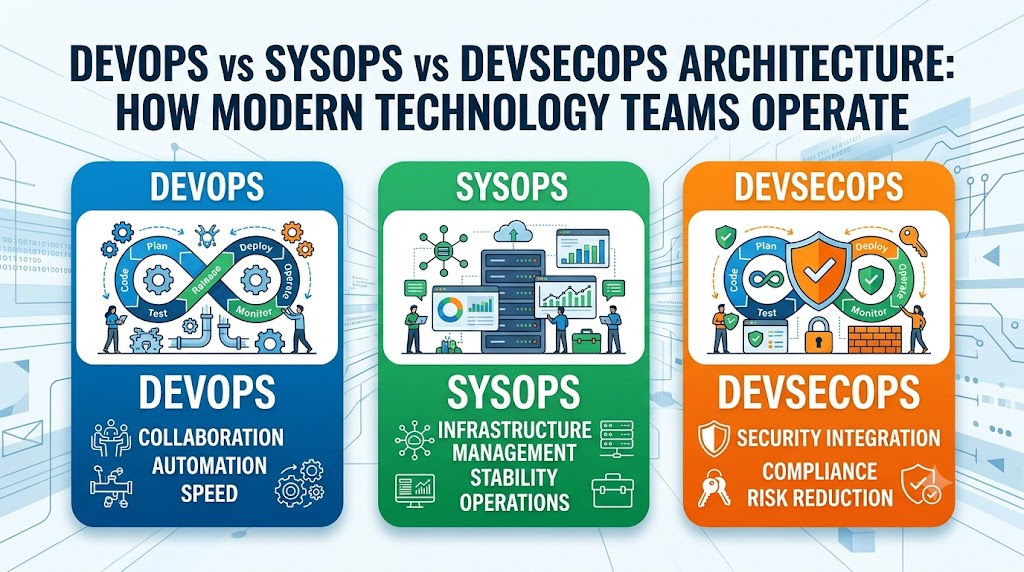
The rise of cloud computing and continuous delivery transformed software deployment, shifting traditional IT boundaries from rigid server maintenance to dynamic cloud ecosystems and creating specialized roles like SysOps, DevOps, and DevSecOps that beginners often confuse. Consider an engineer like Rahul transitioning from traditional system administration: faced with managing cloud instances, automating release pipelines, and securing infrastructure, he must choose whether to double down on cloud operations as a SysOps specialist, focus on software delivery automation as a DevOps engineer, or embed platform protection as a DevSecOps consultant. While SysOps provides the reliable infrastructure foundation, DevOps creates automated delivery highways for rapid releases, and DevSecOps ensures those release paths remain protected against cyber threats—distinct career paths that structured learning platforms like DevOpsSchool help engineers navigate effectively.
What Is SysOps?
SysOps, short for Systems Operations, originates from traditional IT system administration. In a cloud-native or hybrid enterprise, SysOps focuses on configuring, maintaining, operating, and supporting computing infrastructure to keep business services running smoothly.
+-----------------------------------------------------------------------+
|                           SYSOPS CORE FOCUS                           |
|                                                                       |
|   +------------------+     +------------------+     +-------------+   |
|   | Provisioning &   | --> | Monitoring &     | --> | Incident    |   |
|   | Configuration    |     | Health Checks    |     | Management  |   |
|   +------------------+     +------------------+     +-------------+   |
+-----------------------------------------------------------------------+
Evolution from Traditional System Administration
Traditional system administration relied on physical hardware, manual server rack installations, static IP addresses, and local network wiring. System administrators managed operating systems directly, ran manual software updates, and restored backups during hardware failures.
The shift to cloud platforms changed this dynamic. System administrators evolved into SysOps engineers. Instead of racking physical servers, SysOps professionals use cloud management consoles, command-line interfaces, and specialized scripts to manage virtualized servers, cloud storage buckets, virtual private clouds, and managed database services.
Core Infrastructure Management Responsibilities
- Server Management: Installing, patching, configuring, and updating operating systems across Linux and Windows environments.
- Monitoring and Health Checks: Setting up monitoring agents to track CPU usage, memory utilization, disk space, network latency, and service availability.
- Troubleshooting: Identifying root causes of hardware faults, network outages, resource bottlenecks, and system crashes.
- Cloud Infrastructure Administration: Provisioning virtual machines, configuring storage volumes, setting up load balancers, and managing domain name systems.
- Backup and Disaster Recovery: Running regular system snapshots, managing off-site database backups, and performing recovery tests to ensure business continuity.
- Performance Optimization: Tuning kernel parameters, resizing instances based on workload, and eliminating resource constraints.
The Role of SysOps Engineers in Modern Organizations
While automation and software-driven deployment have altered how infrastructure operates, the core need for stability remains. SysOps engineers serve as guardians of operational uptime.
They make sure computing platforms meet service level agreements, maintain operational compliance, and remain available to end users. When an enterprise database reaches maximum storage capacity at midnight, or a cloud region experiences networking issues, SysOps engineers identify, isolate, and resolve the problem.
What Is DevOps?
DevOps is a operational framework and cultural mindset that breaks down traditional barriers between software development and IT operations. Historically, software developers wrote features and passed them over the wall to operations teams for deployment, leading to long release cycles and frequent operational friction.
+-----------------------------------------------------------------------+
|                          DEVOPS LOOP MODEL                            |
|                                                                       |
|     [ PLAN ] ---> [ CODE ] ---> [ BUILD ] ---> [ TEST ]               |
|        ^                                          |                   |
|        |                                          v                   |
|     [ MONITOR ] <--- [ OPERATE ] <--- [ DEPLOY ] <---                  |
+-----------------------------------------------------------------------+
The Combination of Development and Operations
DevOps combines software engineering practices with system deployment concepts. Instead of treating software creation and platform management as separate tasks, DevOps integrates them into a continuous cycle.
Development Mindset (Speed, Features, Agility)
                       +
Operations Mindset (Stability, Reliability, Control)
                       =
DevOps Philosophy (Automated, Continuous Software Delivery)
Cultural Alignment and Continuous Delivery
The core mission of DevOps is to increase an organization’s ability to deliver applications and services at high velocity. This acceleration relies on automated workflows rather than manual interventions.
- Collaboration Culture: Cross-functional teams work together throughout the entire application lifecycle, sharing accountability for software quality and uptime.
- Automation: Replacing manual deployment steps, manual software builds, and manual testing with reproducible code scripts.
- Continuous Integration and Continuous Deployment (CI/CD): Developers frequently commit code changes into a central repository. Automated builds and test runs validate these changes immediately. Once validated, the code deploys automatically to staging or production environments.
- Infrastructure as Code (IaC): Managing and provisioning infrastructure using machine-readable configuration files rather than manual console clicks.
How DevOps Improves Software Delivery
By replacing manual deployment steps with continuous automated workflows, DevOps reduces time-to-market. Software updates move from developer workstations to live production environments in minutes or hours instead of months.
When issues occur, small, frequent updates make identifying bugs faster, minimizing the impact of breaking changes on business operations.
What Is DevSecOps?
DevSecOps extends DevOps principles by integrating security practices directly into every stage of the software delivery process. Rather than treating security as a final review before release, DevSecOps embeds security controls into continuous development workflows.
+-----------------------------------------------------------------------+
|                         DEVSECOPS INTEGRATION                         |
|                                                                       |
|   Plan  -->  Code  -->  Build  -->  Test  -->  Deploy  -->  Monitor   |
|    |          |          |          |            |             |      |
|  [Sec]      [Sec]      [Sec]      [Sec]        [Sec]         [Sec]    |
|  Threat    Static      SAST/      DAST/       Runtime       Runtime   |
|  Model     Analysis    Secret     Image       Policy        Audit     |
|                        Scan       Scan                                |
+-----------------------------------------------------------------------+
Security Integration into DevOps (Shift-Left Security)
In traditional software development, security audits occurred at the end of the development cycle. Security engineers ran vulnerability scans on completed applications right before deployment. Finding critical flaws at this late stage led to delayed releases, rushed fixes, or vulnerable software reaching production.
TRADITIONAL APPROACH:
[ Plan ] -> [ Code ] -> [ Build ] -> [ Test ] -> [ Deploy ] -> | SECURITY AUDIT | (Bottleneck)

DEVSECOPS APPROACH (Shift-Left):
[ Security ] -> [ Security ] -> [ Security ] -> [ Security ] -> [ Security ]
[  Plan    ] -> [  Code    ] -> [  Build   ] -> [  Test    ] -> [ Deploy   ]
DevSecOps uses a “shift-left” strategy, pushing security controls earlier in the software development lifecycle. Developers receive instant feedback on software flaws, vulnerable dependencies, or insecure infrastructure configurations while writing code.
Core Principles of DevSecOps
- Automated Security Gateways: Integrating security tools directly into CI/CD build runs. If a code commit contains high-risk vulnerabilities, the automated build stops immediately.
- Secure Infrastructure Delivery: Scanning infrastructure configuration files for policy violations, open ports, or overly permissive access controls before cloud resources launch.
- Continuous Threat Monitoring: Monitoring live application environments for real-time attack vectors, unexpected system calls, and unauthorized access attempts.
- Compliance as Code: Defining corporate compliance rules and data protection policies as programmable code files that run automated audits against cloud workloads.
Security as a Shared Responsibility
DevSecOps transforms security from an isolated gatekeeper team into a shared responsibility across development, operations, and security engineers. Developers write code with security standards in mind, DevOps engineers build secure pipelines, and security specialists focus on threat modeling, tool policy selection, and high-level strategy.
Evolution of SysOps, DevOps, and DevSecOps
The evolution from physical data centers to modern cloud systems highlights how operational engineering adapted to changing business demands.
| Era | Operational Approach | Main Focus | Typical Deployment Frequency | Primary Infrastructure Type |
| 1990s – 2000s | Traditional IT Operations | Hardware uptime, server stability, ticket queues | Quarterly or Annually | Physical On-Premises Servers |
| 2000s – 2010s | SysOps & Cloud Infrastructure | Virtualization, cloud migrations, manual provisioning | Monthly or Bi-Weekly | Virtual Machines & Hosted Cloud |
| 2010s – 2018 | DevOps Transformation | Pipeline automation, CI/CD, microservices, containerization | Daily or Multiple Times per Day | Cloud Infrastructure & Containers |
| 2018 – Present | DevSecOps & Cloud Native | Embedded pipeline security, automated compliance, edge platforms | Continuous On-Demand | Multi-Cloud, Kubernetes, Serverless |
Phase 1: The Traditional IT Operations Era
Enterprise technology relied on physical server infrastructure. Developers worked on local codebases and handed finished software builds to system administrators through manual ticket workflows. Operations teams focused on keeping physical hardware operational, managing physical network cabling, and running manual server updates.
Phase 2: The SysOps Cloud Revolution
Hypervisors and cloud platforms transformed operational management. Infrastructure shifted from physical hardware to virtual resources created on demand. SysOps emerged as an evolution of system administration, using cloud portals and custom scripts to maintain compute instances, load balancers, and network configurations.
Phase 3: The DevOps Automation Wave
As cloud systems scaled, managing infrastructure manually became a bottleneck for fast-moving software development. Organizations adopted DevOps principles to unite development and operations. Infrastructure as Code replaced manual cloud clicks, and CI/CD automation replaced manual release steps.
Phase 4: The DevSecOps Ecosystem
Fast delivery cycles introduced new risks when software updates bypassed traditional security checks. Modern enterprises adopted DevSecOps to integrate security controls directly into continuous automation pipelines, ensuring fast delivery without sacrificing platform security.
DevOps vs SysOps vs DevSecOps: Key Differences
Understanding how these engineering disciplines differ helps clarify their primary objectives, team interactions, and technical approaches.
| Comparison Feature | SysOps | DevOps | DevSecOps |
| Primary Objective | Maintain platform health, uptime, and infrastructure stability | Automate software delivery and streamline developer operations | Secure continuous software releases and automate policy compliance |
| Primary Focus | Managing operating systems, cloud resources, and hardware health | Building CI/CD pipelines and infrastructure code | Hardening systems, scanning pipeline code, and managing vulnerabilities |
| Team Structure | Dedicated infrastructure and operations teams | Integrated teams bridging development and operations | Embedded security engineering across development and operations |
| Security Approach | Traditional perimeter security, firewalls, and OS patching | Functional testing and pipeline checks before deployment | Automated, continuous security checks embedded throughout the lifecycle |
| Automation Focus | Task automation, server backup scripts, configuration maintenance | End-to-end pipeline automation and infrastructure provisioning | Automated security testing, secret management, and compliance checks |
| Deployment Model | Scheduled maintenance windows and manual updates | Continuous Integration and Continuous Deployment (CI/CD) | Continuous deployment with automated security validation gates |
| Infrastructure Management | Cloud web consoles, hypervisors, CLI commands, and scripts | Declarative Infrastructure as Code (e.g., Terraform, Ansible) | Immutable infrastructure scanning and security policy management |
| Monitoring Target | System health, server metrics (CPU, RAM, Disk), and network routing | Application performance, build run logs, and deployment success | Vulnerability tracking, threat detection, and access audit logs |
| Core Technical Skills | Linux/Windows admin, cloud services, networking, shell scripting | Python/Go, CI/CD tools, containers, Docker, IaC, Kubernetes | Application security, SAST/DAST tools, secret management, compliance |
| Typical Key Performance Indicator (KPI) | System Uptime (99.99%), Mean Time to Repair (MTTR) | Deployment Frequency, Lead Time for Changes | Vulnerability Remediation Rate, Pipeline Security Audit Success |
+-----------------------------------------------------------------------+
|                    PRACTICAL WORKPLACE COMPARISON                     |
|                                                                       |
| Scenario: Deploying a new database and backend application service    |
|                                                                       |
| SYSOPS APPROACH:                                                      |
| Configures virtual machine instances, sets up storage volumes, and    |
| adjusts firewall rules via cloud console.                             |
|                                                                       |
| DEVOPS APPROACH:                                                      |
| Writes Terraform scripts to provision cloud resources and constructs   |
| a GitOps pipeline to build and launch containerized services.          |
|                                                                       |
| DEVSECOPS APPROACH:                                                   |
| Integrates container image scans into the build pipeline, audits      |
| Terraform templates for weak permissions, and enforces encrypted      |
| secret storage before launching to production.                        |
+-----------------------------------------------------------------------+
Role and Responsibilities Comparison
Each role serves a distinct operational purpose within an IT organization.
+-----------------------------------------------------------------------+
|                   RESPONSIBILITY DOMAINS MATRIX                       |
|                                                                       |
|  +--------------------+  +--------------------+  +-----------------+  |
|  |       SYSOPS       |  |       DEVOPS       |  |    DEVSECOPS    |  |
|  | - Virtual Machines |  | - CI/CD Pipelines  |  | - Vulnerability |  |
|  | - Network Routing  |  | - Infrastructure   |  |   Scanning      |  |
|  | - System Backup    |  |   as Code          |  | - Secret Mgmt   |  |
|  | - OS Patching      |  | - Container Orchestration | - Security Audits|
|  +--------------------+  +--------------------+  +-----------------+  |
+-----------------------------------------------------------------------+
SysOps Engineer Responsibilities
SysOps engineers manage the underlying cloud and server infrastructure that supports business services.
- Server and OS Maintenance: Configuring Linux and Windows servers, applying security patches, managing package updates, and handling kernel settings.
- Network Administration: Configuring virtual private clouds, subnets, gateway routing tables, firewalls, and corporate VPN connectivity.
- System Health Monitoring: Monitoring performance metrics using enterprise tools to detect hardware strain, storage constraints, or network drops.
- Incident Response: Managing operational tickets, responding to automated infrastructure alerts, and resolving service downtime.
- Disaster Recovery Executions: Testing backup restoration procedures, managing instance snapshots, and executing recovery operations during cloud outages.
DevOps Engineer Responsibilities
DevOps engineers build automated delivery infrastructure to help development teams deploy high-quality software safely and quickly.
- CI/CD Pipeline Architecture: Designing, building, and supporting continuous integration pipelines that test, package, and deploy code changes.
- Infrastructure Automation: Writing declarative configuration files to provision, update, and tear down cloud environments automatically.
- Container Lifecycle Management: Packaging applications into container environments and managing container clusters using orchestration tools.
- Release Orchestration: Managing application rollouts using blue-green or canary deployment strategies to prevent service disruption.
- Developer Platform Support: Creating self-service tooling and reusable templates so software engineers can provision development environments on demand.
DevSecOps Engineer Responsibilities
DevSecOps engineers embed security checks directly into development automation pipelines, ensuring system safety without slowing down production teams.
- Pipeline Security Automation: Integrating Static Application Security Testing (SAST) and Dynamic Application Security Testing (DAST) into automated builds.
- Software Dependency Analysis: Scanning third-party software packages and container bases for known security vulnerabilities.
- Secret Management Architecture: Securing API tokens, passwords, and private keys by replacing hardcoded credentials with dynamic vaults.
- Cloud Security Posture Management: Auditing cloud configurations continuously to catch exposed storage buckets or excessive access permissions.
- Security Compliance Automation: Writing automated test policies that enforce standards such as HIPAA, PCI-DSS, or SOC2 within deployment pipelines.
Skills Comparison: DevOps vs SysOps vs DevSecOps
The skills needed for each role vary based on operational goals and daily workflows.
| Skill Matrix Domain | SysOps Engineer | DevOps Engineer | DevSecOps Engineer |
| Linux & Operating Systems | Advanced (Kernel tuning, user privileges, system services) | Intermediate to Advanced (Container base images, shell usage) | Intermediate (OS hardening, access control policies) |
| Networking & Protocols | Deep Knowledge (TCP/IP, DNS, BGP, Subnets, VPNs) | Solid Foundation (VPC design, ingress routes, service discovery) | Advanced Security Focus (TLS certificates, microsegmentation, firewalls) |
| Cloud Computing Platforms | Cloud Console & CLI (Resource management, instance sizing) | Cloud Automation (Provisioning APIs, declarative architectures) | Cloud Security Controls (IAM policies, resource auditing, encryption) |
| Scripting & Programming | Shell, Bash, PowerShell (Task automation, maintenance) | Python, Go, Bash (Tooling construction, automation logic) | Python, Go, Rego (Security policy scripts, scanning integration) |
| Automation & Configuration | Ansible, Puppet, Chef (Server patch management) | Terraform, Ansible, CloudFormation (Environment management) | Open Policy Agent, Checkov, TFSec (Infrastructure code security) |
| Container Technologies | Basic Docker management (Running service instances) | Deep Docker & Kubernetes (Helm charts, cluster operations) | Secure Containers (Image scanning, runtime defense, policy controls) |
| CI/CD Engineering | Basic integration (Triggering manual deployments) | Expert (Building Jenkins pipelines, GitHub Actions, GitLab CI) | Pipeline Hardening (Signing builds, auditing build runner agents) |
| Security Engineering | System patching, firewall administration, SSH keys | Basic practices (IAM access management, SSH key deployment) | Expert (Vulnerability scanning, threat modeling, cryptography) |
| Monitoring & Observability | Infrastructure health tools (Nagios, Zabbix, CloudWatch) | Full Observability (Prometheus, Grafana, Datadog, Distributed Tracing) | Security Observability (SIEM platforms, Falco, cloud audit log analysis) |
Tools Used Across These Roles
While these roles share some cloud platforms, they rely on different toolsets to accomplish their daily tasks.
| Tool Category | SysOps Tooling | DevOps Tooling | DevSecOps Tooling |
| Cloud Infrastructure Platforms | AWS EC2, Azure VMs, Google Cloud Engine, VMware vSphere | AWS Elastic Beanstalk, EKS, Azure DevOps, Google Kubernetes Engine | AWS Security Hub, Azure Defender, GCP Security Command Center |
| Infrastructure Automation | Ansible, Puppet, Chef, PowerShell DSC | Terraform, AWS CloudFormation, Pulumi, OpenTofu | TFSec, Checkov, Kube-Linter, Terrascan |
| CI/CD Build Systems | Jenkins (Basic scheduled maintenance tasks) | Jenkins, GitHub Actions, GitLab CI, CircleCI, ArgoCD | Snyk, SonarQube, Dependency-Track, Trivy |
| Containers & Orchestration | Docker Desktop, basic VM hypervisors | Docker Engine, Kubernetes, Helm, Rancher, Nomad | Sysdig, Falco, Aqua Security, Docker Bench for Security |
| Security & Vulnerability Tools | OS Patching tools, Nessus vulnerability scanners | HashiCorp Vault (Secret deployment), basic Linters | Snyk, SonarQube, OWASP ZAP, HashiCorp Vault, Trivy, Grype |
| Monitoring & Observability | Nagios, Zabbix, Datadog Infrastructure, CloudWatch | Prometheus, Grafana, Datadog APM, New Relic, Jaeger | Splunk, ELK Stack, AWS CloudTrail, Falco, Wazuh SIEM |
+-----------------------------------------------------------------------+
|                       TOOL ECOSYSTEM INTEGRATION                      |
|                                                                       |
|                     +---------------------------+                     |
|                     |      CLOUD PLATFORMS      |                     |
|                     |   (AWS / Azure / GCP / VM)  |                     |
|                     +-------------+-------------+                     |
|                                   |                                   |
|         +-------------------------+-------------------------+         |
|         |                         |                         |         |
|         v                         v                         v         |
|  +--------------+          +--------------+          +--------------+ |
|  |   SYSOPS     |          |    DEVOPS    |          |  DEVSECOPS   | |
|  |  Ansible     |          |  Terraform   |          |  TFSec       | |
|  |  CloudWatch  |          |  Kubernetes  |          |  Trivy       | |
|  |  Zabbix      |          |  GitHub Act. |          |  SonarQube   | |
|  +--------------+          +--------------+          +--------------+ |
+-----------------------------------------------------------------------+
Purpose of Key Tool Categories
- Cloud Infrastructure Platforms: Provide the raw compute, network, and storage foundations needed to run software applications.
- Infrastructure Automation Tools: Allow engineering teams to define, provision, and update cloud infrastructure using code files instead of manual console adjustments.
- CI/CD Systems: Automate compilation, testing, and deployment cycles, moving code updates into live environments without human intervention.
- Container Orchestration Tools: Manage application containers, handling scaling, resource allocation, and container health automatically across cloud clusters.
- Security & Vulnerability Scanners: Analyze codebases, third-party software dependencies, and container images for security flaws before software reaches end users.
- Observability Frameworks: Collect log, metric, and tracing data across cloud platforms, giving teams real-time visibility into system health and potential threats.
How SysOps, DevOps, and DevSecOps Work Together
These three disciplines are not mutually exclusive. They work together as complementary parts of an enterprise engineering platform.
+-----------------------------------------------------------------------+
|                      ENTERPRISE OPERATIONAL FLOW                      |
|                                                                       |
|  [ SysOps Layer ]   --> Provision resilient cloud compute & networks  |
|          |                                                            |
|          v                                                            |
|  [ DevOps Layer ]   --> Automate pipelines & package applications      |
|          |                                                            |
|          v                                                            |
|  [ DevSecOps Layer ]--> Embed scanning, vault secrets & compliance    |
|          |                                                            |
|          v                                                            |
|  [ Live Platform ]  --> Secure, automated, highly available system     |
+-----------------------------------------------------------------------+
The Integrated Workflow
- Infrastructure Foundation (SysOps): SysOps engineers establish network routing, configure core cloud accounts, maintain domain services, and manage underlying operating platforms.
- Delivery Pipeline Automation (DevOps): DevOps engineers write Infrastructure as Code scripts that build on this cloud foundation, building CI/CD pipelines that deploy application services automatically.
- Embedded Security Integration (DevSecOps): DevSecOps engineers integrate automated security checks into those pipelines, scan container images, secure service tokens, and monitor live environments for security threats.
[ Infra Provisioning ] -> [ Code Build ] -> [ Security Scan ] -> [ Production Release ] -> [ Health Monitoring ]
     (SysOps)               (DevOps)          (DevSecOps)            (DevOps)                  (SysOps)
Without SysOps, the underlying cloud infrastructure risks stability, performance, and networking issues. Without DevOps, software updates face manual delivery delays and deployment bottlenecks. Without DevSecOps, fast-moving updates can introduce security vulnerabilities into live production environments.
Career Path Comparison
Choosing the right engineering focus depends on your technical background, interest in coding versus infrastructure operations, and career goals.
| Career Dimension | SysOps Engineering Path | DevOps Engineering Path | DevSecOps Engineering Path |
| Ideal For | Engineers who love system operations, hardware virtualization, and cloud platforms | Professionals who like writing software code, automating pipelines, and streamlining delivery | Specialists focused on cyber defense, system vulnerability resolution, and secure coding |
| Typical Entry Background | System Administrators, Desktop Support, IT Support Engineers | Software Engineers, Cloud Developers, Experienced SysOps Engineers | Security Analysts, QA Engineers, Experienced DevOps Engineers |
| Career Growth Trajectory | Cloud Systems Administrator → Cloud Operations Manager → VP of IT Operations | DevOps Engineer → Senior Platform Engineer → Cloud Solutions Architect → Head of Platform | DevSecOps Engineer → Cybersecurity Architect → Principal Security Engineer → Chief Information Security Officer (CISO) |
| Primary Technical Focus | Operational resilience, uptime, hardware sizing, network design | Release velocity, automation systems, container delivery, pipeline health | System defense, vulnerability mitigation, automated policy enforcement |
SYSOPS PATH:
System Administrator ---> Cloud Systems Engineer ---> IT Infrastructure Manager

DEVOPS PATH:
Software Developer / SysOps ---> DevOps Engineer ---> Platform / Cloud Architect

DEVSECOPS PATH:
DevOps / Security Analyst ---> DevSecOps Engineer ---> Chief Information Security Officer
Which Career Path Should You Choose?
Selecting the right engineering track comes down to understanding what type of daily work you enjoy most.
+-----------------------------------------------------------------------+
|                       CAREER DECISION FLOWCHART                       |
|                                                                       |
|   What type of technical challenges do you prefer solving?            |
|                                                                       |
|   A) Server stability, OS tuning, cloud infrastructure management     |
|      --> Choose: SYSOPS CAREER PATH                                   |
|                                                                       |
|   B) Writing code, building CI/CD pipelines, container orchestration |
|      --> Choose: DEVOPS CAREER PATH                                   |
|                                                                       |
|   C) Cybersecurity, scanning pipeline vulnerabilities, compliance     |
|      --> Choose: DEVSECOPS CAREER PATH                                |
+-----------------------------------------------------------------------+
Choose SysOps If You Enjoy:
- Managing server platforms, configuring Linux environments, and working with cloud infrastructure components.
- Troubleshooting system hardware faults, resolving network drops, and analyzing server resource bottlenecks.
- Setting up monitoring agents to ensure system uptime and platform availability.
- Managing backup procedures and handling disaster recovery scenarios.
Choose DevOps If You Enjoy:
- Writing software scripts to automate repetitive system delivery tasks.
- Building continuous deployment pipelines that take software from code repositories to live production environments.
- Working with container platforms like Docker and Kubernetes.
- Collaborating with developers to speed up feature releases and improve delivery workflows.
Choose DevSecOps If You Enjoy:
- Analyzing system components to discover vulnerabilities before malicious actors exploit them.
- Integrating security scanning tools directly into continuous automation pipelines.
- Designing secure cloud architectures, managing encrypted secrets, and implementing access control models.
- Bridging the gap between software delivery teams and enterprise security auditors.
Benefits of Learning DevOps, SysOps, and DevSecOps Skills
Gaining skills across these three domains makes you a more effective and adaptable technical professional.
| Benefit Area | Practical Skill Application | Enterprise Career Impact |
| Broader Cloud Platform Knowledge | Understand how compute resources, networks, and cloud services interact under heavy workloads | Ability to design resilient, efficient cloud systems |
| High-Efficiency Automation | Replace manual operational steps with reproducible code scripts and automated workflows | Dramatically reduces manual operational tasks and deployment errors |
| Early Security Awareness | Catch software vulnerabilities and insecure cloud settings early during development | Prevents high-risk security flaws from reaching live users |
| Cross-Functional Communication | Bridge technical communication gaps between developers, system administrators, and security teams | Position yourself for technical leadership and architectural roles |
| Complex Problem Solving | Diagnose platform issues across infrastructure layers, build steps, and security rules | Faster root-cause analysis and incident resolution |
| Enterprise Career Readiness | Ability to adapt to modern platform engineering models used across tech enterprises | High industry demand for engineers with well-rounded operational skills |
Common Misconceptions
Clear up these common industry myths to make better decisions about your cloud career.
Misconception 1: “SysOps Is Obsolete”
Fact: SysOps is not obsolete; it has evolved. While traditional physical data center administration is less common, managing cloud computing infrastructure, hypervisors, network routing, and host-level health remains critical. Modern SysOps focuses on managing virtualized cloud resources at scale.
Misconception 2: “DevOps Is Just Writing Software Code”
Fact: DevOps is not just software engineering, nor is it simply writing application code. It combines software development with operational best practices. Successful DevOps engineers need a strong understanding of operating systems, networking, system stability, and cloud infrastructure alongside their scripting skills.
Misconception 3: “DevSecOps Replaces Dedicated Security Teams”
Fact: DevSecOps does not eliminate the need for specialized security teams. Security specialists are still needed for deep threat modeling, risk management, and overall security strategy. DevSecOps gives software and pipeline engineers the tools to catch routine vulnerabilities automatically, letting security teams focus on complex security challenges.
Misconception 4: “Adopting Modern Tools Means You Are Doing DevOps”
Fact: Installing tools like Docker, Terraform, or Jenkins does not mean an organization is practicing DevOps. DevOps is fundamentally a collaborative culture supported by automated processes. Using modern tools without breaking down team silos or adopting continuous integration practices misses the true purpose of the approach.
Real-World Example: How These Roles Collaborate
To understand how these engineering roles interact in practice, look at how a fictional fintech enterprise processes a major software update.
+-----------------------------------------------------------------------+
|                  ENTERPRISE COLLABORATION SCENARIO                    |
|                                                                       |
|  [ Step 1: SysOps ]    Provisions resilient cloud database & network  |
|  [ Step 2: Dev Team ]  Develops application feature code              |
|  [ Step 3: DevOps ]    Automates build, test, and release pipeline    |
|  [ Step 4: DevSecOps]  Scans code, dependencies & secrets in pipeline |
|  [ Step 5: Live System] Application releases securely with monitoring |
+-----------------------------------------------------------------------+
The Scenario: Rolling Out a Secure Payment API Update
- SysOps Prepares the Infrastructure: The SysOps engineer configures a dedicated multi-region cloud platform, sets up network routing tables, and manages load balancer configurations to ensure high availability.
- Development Builds the Service: Software developers write code for a new payment gateway service on their local workstations and commit their updates to a central Git repository.
- DevOps Automates the Pipeline: The commit triggers an automated build pipeline built by the DevOps engineer. The pipeline packages the payment service into a Docker container, executes unit tests, and provisions staging resources using Terraform.
- DevSecOps Scans for Vulnerabilities: As the pipeline runs, automated DevSecOps security checks kick in. A dependency scanner checks third-party packages for known vulnerabilities, an image scanner audits the Docker container, and a secret scanner verifies that no API access keys are exposed in the code.
- Deployment and Production Health: Once all security scans pass, the pipeline deploys the update to production using a canary deployment strategy. The SysOps team monitors underlying platform resources, while the DevOps team tracks deployment health, ensuring a smooth, secure release.
How to Transition Between These Roles
IT professionals frequently move between SysOps, DevOps, and DevSecOps as their interests and technical skills grow.
+-----------------------------------------------------------------------+
|                      CAREER TRANSITION ROADMAP                        |
|                                                                       |
|   SysOps Engineer                                                     |
|          |                                                            |
|          +---> Add Infrastructure as Code (Terraform)                 |
|          +---> Learn CI/CD Systems (Jenkins, GitHub Actions)          |
|          |                                                            |
|          v                                                            |
|   DevOps Engineer                                                     |
|          |                                                            |
|          +---> Add Automated Vulnerability Scanning (Trivy, Snyk)     |
|          +---> Learn Secret Management & Policy as Code               |
|          |                                                            |
|          v                                                            |
|   DevSecOps Engineer                                                  |
+-----------------------------------------------------------------------+
Transitioning from SysOps to DevOps
System administrators and SysOps engineers already have strong foundational knowledge in operating systems, networking, and server troubleshooting. To transition into a DevOps role:
- Learn Declarative Infrastructure Automation: Shift from manual server configuration and ad-hoc shell scripts to Infrastructure as Code tools like Terraform or Ansible.
- Master Version Control & Branching: Learn Git workflows inside out, as version control forms the base for modern software delivery workflows.
- Build CI/CD Pipelines: Practice creating automated build pipelines using platforms like GitHub Actions, GitLab CI, or Jenkins.
- Gain Container Expertise: Learn how to containerize software using Docker and orchestrate container platforms with Kubernetes.
Transitioning from DevOps to DevSecOps
DevOps engineers who want to specialize in security can make the transition by focusing on security practices and vulnerability management:
- Automate Pipeline Security Scans: Integrate static code scanners and dependency checking tools into existing build workflows.
- Implement Secret Management Tools: Replace hardcoded configuration credentials with secure, dynamic secret vaults like HashiCorp Vault.
- Study Cloud Security Best Practices: Master identity and access management models, encryption standards, and container hardening techniques.
- Learn Policy as Code: Write programmable compliance policies using tools like Open Policy Agent to audit cloud environments automatically.
Transitioning from Software Developer to DevOps
Software developers already understand programming concepts, application design, and version control. To move into a DevOps role:
- Master Cloud Infrastructure Platforms: Learn how underlying compute, storage, and networking platforms function under production workloads.
- Gain Hands-On Linux Administration Skills: Develop a deep understanding of Linux system commands, process management, and networking diagnostics.
- Focus on Platform Operations: Practice managing live runtime environments, tracking performance metrics, and building self-healing systems.
How DevOpsSchool Helps Professionals Learn DevOps Skills
Navigating the transition between SysOps, DevOps, and DevSecOps requires hands-on practice, structured learning, and clear guidance.
Platforms like DevOpsSchool offer comprehensive training programs designed to help engineers build real-world skills across modern cloud operations, pipeline automation, and platform security.
+-----------------------------------------------------------------------+
|                    PRACTICAL LEARNING ROADMAP                         |
|                                                                       |
|  [ Fundamentals ]  --> Linux, Cloud Basics, Networking, Git           |
|         |                                                             |
|         v                                                             |
|  [ Automation ]    --> Infrastructure as Code, CI/CD, Scripting       |
|         |                                                             |
|         v                                                             |
|  [ Containers ]    --> Docker, Kubernetes Orchestration, Helm         |
|         |                                                             |
|         v                                                             |
|  [ Security & SRE ]--> DevSecOps Pipelines, Monitoring, Observability |
+-----------------------------------------------------------------------+
Key Training Highlights
- Industry-Focused Syllabi: Courses designed around practical production workflows rather than theoretical concepts alone.
- Hands-On Lab Environments: Step-by-step guidance for building CI/CD pipelines, provisioning cloud resources, and securing container workloads.
- End-to-End Skill Coverage: Structured paths covering foundational Linux, cloud platforms, container orchestration with Kubernetes, Infrastructure as Code, and integrated security tools.
- Mentorship for Career Transitions: Practical guidance to help system administrators, developers, and security analysts gain the skills needed for modern cloud roles.
Future of DevOps, SysOps, and DevSecOps
As cloud architectures become more complex, operational roles continue to evolve alongside new technology trends.
+-----------------------------------------------------------------------+
|                        FUTURE CLOUD TRENDS                            |
|                                                                       |
|  +-----------------------+   +-------------------------------------+  |
|  | Platform Engineering  |   | AI-Assisted Cloud Operations (AIOps)|  |
|  | Building self-service |   | Automated anomaly detection and     |  |
|  | developer platforms   |   | intelligent log analysis            |  |
|  +-----------+-----------+   +------------------+------------------+  |
|              |                                  |                     |
|              +-----------------+----------------+                     |
|                                |                                      |
|                                v                                      |
|  +-----------------------------------------------------------------+  |
|  | GitOps & Shift-Left Compliance                                  |  |
|  | Git-driven delivery and continuous automated policy enforcement   |  |
|  +-----------------------------------------------------------------+  |
+-----------------------------------------------------------------------+
Key Industry Trends
- Platform Engineering: Organizations are building internal developer platforms that give software teams self-service access to infrastructure, reducing operational friction.
- AI-Driven Operations (AIOps): Machine learning models analyze real-time metric streams, trace logs, and system events to detect anomalies and fix routine issues automatically.
- GitOps Operational Models: Managing infrastructure and application deployments declaratively through Git repositories, making system state traceable and simple to audit.
- Shift-Left Security & Compliance: As cyber threats grow, embedding automated security checks and compliance controls directly into development pipelines is becoming standard practice across enterprises.
- Observability over Basic Monitoring: Modern systems are moving beyond basic health checks to full observability—combining metrics, logs, and distributed traces to provide deep insight into complex, microservice-based applications.
Frequently Asked Questions
What is the main difference between DevOps and SysOps?
SysOps focuses on managing, operating, and maintaining underlying server and cloud infrastructure to ensure stability and uptime. DevOps focuses on automating software delivery workflows, building CI/CD pipelines, and streamlining collaboration between development and operations teams.
Is DevSecOps simply an extension of DevOps?
Yes. DevSecOps builds on DevOps core principles by embedding automated security checks, vulnerability scanning, and compliance auditing directly into continuous software delivery pipelines.
Which role is better for complete beginners in tech?
For professionals with an IT support or hardware background, SysOps provides an approachable entry point into system administration and cloud platforms. For those with a background in writing software or scripts, starting with DevOps fundamentals is often a natural fit.
Do SysOps engineers need software programming skills?
SysOps engineers generally do not need advanced software development skills, but they should be comfortable writing command-line scripts in Bash, Shell, or PowerShell to automate routine server management tasks.
Is DevOps harder to learn than SysOps?
DevOps can feel more complex initially because it requires a broader set of skills—including software programming, CI/CD build tools, container management, and cloud architecture—whereas SysOps focuses primarily on system administration and platform health.
What core skills are needed to work in DevSecOps?
A DevSecOps engineer needs a solid foundation in DevOps practices (CI/CD, container orchestration, scripting) combined with specialized security skills, such as vulnerability scanning, static and dynamic code analysis, secret management, and cloud security architecture.
Can a system administrator move directly into a DevOps role?
Yes. System administrators can transition into DevOps by learning version control with Git, Infrastructure as Code tools like Terraform, CI/CD pipeline automation using tools like Jenkins or GitHub Actions, and container management with Docker.
Which career path has better long-term growth opportunities?
All three tracks offer strong long-term career growth. As organizations move to cloud-native architectures, demand is especially high for engineers who combine platform automation skills (DevOps) with robust cloud security expertise (DevSecOps).
What is the difference between SRE (Site Reliability Engineering) and SysOps?
SysOps focuses on operational administration, infrastructure health, and server maintenance. Site Reliability Engineering (SRE) applies software engineering approaches to solve operational problems, using code to build self-healing, highly available cloud platforms.
Does DevSecOps slow down software development?
No. When implemented correctly, DevSecOps speeds up secure software releases by catching security flaws early in the build pipeline, avoiding costly release delays and late-stage security fixes right before deployment.
What is Infrastructure as Code (IaC)?
Infrastructure as Code is the practice of managing and provisioning cloud compute, storage, and networking resources using declarative configuration files (such as Terraform or CloudFormation) rather than manual console steps.
Why is shift-left security important in cloud computing?
Shift-left security pushes testing and vulnerability checks earlier in the development process. Catching issues while developers are writing code makes bugs significantly cheaper and faster to fix than discovering vulnerabilities in live production systems.
What tools should I learn first for a DevOps career?
Start by mastering Linux operating system basics, version control using Git, shell scripting, cloud platform fundamentals (such as AWS or Azure), Infrastructure as Code with Terraform, and build automation using GitHub Actions or Jenkins.
Is Kubernetes required for SysOps engineers?
While SysOps engineers do not always need deep Kubernetes expertise, understanding container fundamentals and basic cluster operations is increasingly helpful as companies migrate workloads to container platforms.
Do small companies need separate SysOps, DevOps, and DevSecOps engineers?
In smaller organizations, a single engineer often covers responsibilities across all three domains. As companies scale, they typically split these tasks into specialized roles to manage growing system complexity.
Final Thoughts
Navigating modern cloud engineering requires understanding that SysOps, DevOps, and DevSecOps work as complementary pillars—where SysOps guarantees system stability, DevOps accelerates software delivery through continuous automation, and DevSecOps embeds vital security controls into every stage of the development lifecycle. Choosing the right career path depends entirely on whether your passion lies in managing resilient infrastructure, building automated release pipelines, or protecting cloud platforms against evolving security threats. By continually assessing your strengths, building hands-on pipeline and cloud projects, and adapting to industry trends like platform engineering and automated security, you can build a successful, future-proof technology career in cloud operations.
