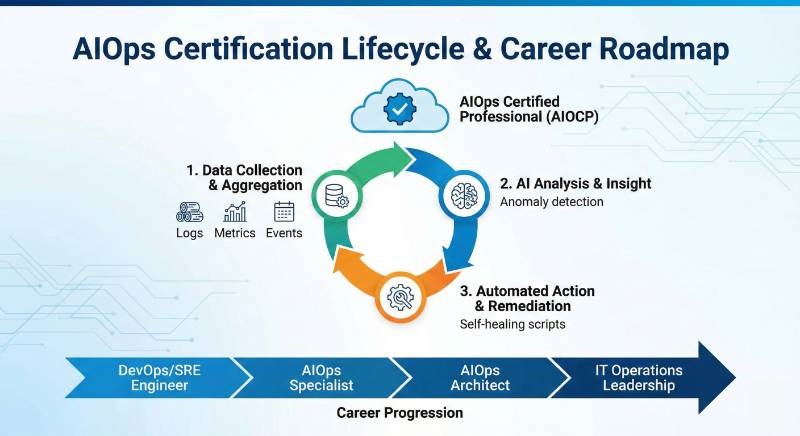
The world of software and IT operations is moving faster than ever before. In the past, a small team could manage a few servers and fix problems as they happened. Today, we deal with thousands of cloud servers, millions of lines of code, and data that never stops flowing. For a human being, it is now impossible to watch every screen and find every error manually. This is exactly where Artificial Intelligence for IT Operations, or AIOps, comes into play.
If you are a Software Engineer, a Systems Administrator, or a Technical Manager, you have likely felt the stress of “alert fatigue.” This happens when your phone or email is flooded with hundreds of notifications, making it hard to find the one problem that actually matters. AIOps is the solution that uses smart algorithms and machine learning to find that one problem before it causes a crash.
This master guide will help you understand the AIOps Certification Training Course | AIOps. We will explore why this is the most important step for your career, how to choose the right learning path, and how to become an expert in intelligent automation.
Why AIOps is the Future of IT Operations
The jump from traditional DevOps to AIOps is a massive shift. As someone who has watched the industry move from physical data centers to the cloud, I can tell you that those who do not adopt AI-driven tools will struggle to keep up. Companies across India and the globe are no longer looking for engineers who just “fix things.” They are looking for engineers who can build systems that fix themselves.
By taking an AIOps Certification Training Course, you are proving that you can handle the complexity of modern tech stacks. You are moving from being a person who responds to fires to being an architect who prevents them from starting. This is why AIOps professionals are currently among the highest-paid experts in the IT industry.
Master Certification Overview Table
To help you understand the whole picture, here is a detailed list of certifications across different tracks. This will help you see where AIOps fits and what you might want to learn next.
| Track | Level | Who it’s for | Prerequisites | Skills Covered | Recommended Order |
| AIOps | Professional | SREs, DevOps, Managers | Basic Linux & Python | ML for Ops, RCA, Automation | 1st |
| DevOps | Master | Software Engineers | Coding basics | CI/CD, Docker, Kubernetes | 2nd |
| SRE | Expert | Platform Engineers | DevOps basics | Reliability, SLIs/SLOs, Toil | 3rd |
| DevSecOps | Professional | Security Engineers | DevOps knowledge | Pipeline Security, Auditing | 4th |
| MLOps | Professional | Data Engineers | AI/ML Basics | Model Deployment, Pipelines | 5th |
| FinOps | Practitioner | Managers, Cloud Ops | Cloud Billing | Cost Optimization, Finance | 6th |
AIOps Certification Training Course | AIOps
This specific program is designed to take your technical skills to the next level by adding an intelligence layer to your operations.
What it is
The AIOps Certification Training Course | AIOps is a professional-level program that teaches you how to use Big Data and Machine Learning to automate IT tasks. It focuses on gathering data from many different sources, using AI to find patterns, and setting up systems that can automatically respond to incidents without human help.
Who should take it
- Working Engineers: If you are tired of manual monitoring and want to learn how to automate complex tasks.
- Software Engineers: If you want to understand how your code behaves in a production environment at scale.
- Technical Managers: If you need to lead a team toward digital transformation and reduce operational costs.
- SREs and DevOps Pros: If you want to move from “standard” automation to “intelligent” automation.
Skills you’ll gain
- Event Correlation: Learning how to connect thousands of tiny events into one clear story of what went wrong.
- Anomaly Detection: Building systems that know what “normal” looks like and can spot “strange” behavior immediately.
- Predictive Maintenance: Using historical data to predict when a system might fail in the future.
- Automated Root Cause Analysis (RCA): Quickly finding the exact line of code or server setting that caused an error.
- Infrastructure as Code (IaC) with AI: Managing your cloud resources using smart scripts that optimize themselves.
Real-world projects you should be able to do after it
- Self-Healing Web Server: Create a setup where an AI bot detects a slow website and automatically fixes the memory issue or restarts the service.
- Intelligent Alert Filter: Build a tool that looks at 5,000 daily alerts and filters them down to the 5 most important ones for the team to see.
- Capacity Forecasting Tool: Design a system that looks at last year’s traffic and tells you exactly how many servers you will need for next month’s big sale.
- AI-Powered Log Analyzer: Develop a script that reads through millions of log lines to find hidden security threats that humans would miss.
Preparation plan
- 7-Day Crash Course: Focus on the core theory of AIOps. Learn about the “Data-to-Action” loop and the basic tools like ELK or Prometheus.
- 30-Day Steady Learning: Spend two weeks on data science basics and two weeks on hands-on labs. This is the best way to ensure the knowledge sticks.
- 60-Day Deep Dive: For those new to automation, spend the first month mastering DevOps tools and the second month focusing entirely on AI integration.
Common mistakes
- Ignoring Data Quality: AI is only as good as the data you give it. If your logs are messy, your AI will give you wrong answers.
- Over-complicating things: Start with small automations. Don’t try to make a “perfect” AI on day one.
- Focusing only on tools: Remember that AIOps is a change in how your team works. You need to focus on culture as much as the software.
Best next certification after this
Once you have mastered AIOps, you should look into MLOps Certified Professional. This will teach you how to manage the lifecycle of the machine learning models you are now using in your operations.
Choose Your Path: 6 Learning Journeys
To become a leader in the tech world, you should pick a path that matches your goals. Here are the six main ways to grow:
- The DevOps Path: Perfect for those who love speed. You focus on building fast and reliable pipelines to get code into production.
- The DevSecOps Path: For the security-minded. You learn how to make every step of the software process safe from hackers.
- The SRE Path: For those who value stability. You treat operations like a software engineering problem to ensure 99.99% uptime.
- The AIOps/MLOps Path: The “Smart” path. You use data and AI to manage the massive complexity of modern systems.
- The DataOps Path: Focuses on the “pipes” of the company. You ensure that data moves quickly and accurately to the people who need it.
- The FinOps Path: The “Value” path. You help the company save money by making sure every dollar spent on the cloud is used wisely.
Role → Recommended Certifications Mapping
| If your current role is… | You should focus on these certifications: |
| DevOps Engineer | DevOps Master + AIOps Professional |
| SRE | SRE Foundation + AIOps Professional |
| Platform Engineer | Kubernetes Expert + AIOps Professional |
| Cloud Engineer | Cloud Architect + AIOps Professional |
| Security Engineer | DevSecOps Professional + AIOps Professional |
| Data Engineer | DataOps Professional + MLOps Professional |
| FinOps Practitioner | FinOps Certified + AIOps (for cost prediction) |
| Engineering Manager | AIOps Foundation + SRE Leadership |
Why Choose DevOpsSchool?
When it comes to learning these advanced skills, DevOpsSchool is a name you can trust. They have spent years helping engineers transform their careers through deep technical training.
- Hands-on Labs: They believe in “learning by doing.” You won’t just watch videos; you will work on real servers and solve real problems.
- Expert Mentors: The trainers are experts who have worked in the industry for years. They know exactly what modern companies are looking for.
- Lifetime Support: They don’t just leave you after the exam. You get access to a community of professionals who help each other grow.
- Career Guidance: They provide help with resumes and interview prep to make sure your new certification leads to a better job.
Next Certifications to Take
After you finish your AIOps Certification Training Course, keep your momentum going. Based on industry trends, here are three great options:
- Same Track (Vertical Growth): MLOps Certified Professional. Learn how to build and maintain the AI models that fuel your AIOps systems.
- Cross-Track (Horizontal Growth): DevSecOps Certified Professional. Adding security to your AI skills makes you an invaluable “all-rounder” for any tech team.
- Leadership Track: SRE Leadership Training. Use your technical expertise to move into a high-level management or CTO-track role.
Top Institutions for AIOps Training and Certification
If you are looking for the best places to get trained for the AIOps Certification Training Course | AIOps, these institutions are the top choices:
- DevOpsSchool: Known as a leader in Ops training, they offer a very deep and technical AIOps program. Their courses are designed for working professionals who need real skills quickly.
- Cotocus: This institution focuses on consulting and high-end technical workshops. They are great if you want a very personalized learning experience with small groups.
- Scmgalaxy: A massive community platform that provides thousands of blogs and tutorials. It is an excellent place to find extra resources while you study for your certification.
- BestDevOps: They offer intensive bootcamps that are perfect for teams or individuals who want to learn a lot of information in a very short amount of time.
- DevSecOpsSchool: The best place to go if you want to combine your AIOps knowledge with a heavy focus on security and automated compliance.
- Sreschool: Dedicated entirely to the world of Site Reliability Engineering. They help you use AI to make your systems more stable and reliable.
- Aiopsschool: A specialized institution that lives and breathes Artificial Intelligence for IT Operations. They offer the most focused content in this specific field.
- Dataopsschool: If your work involves a lot of big data and analytics, this institution will help you understand how to manage the data that your AI tools need.
- Finopsschool: A great choice for managers who want to learn how AI can be used to forecast cloud costs and keep the company’s budget under control.
Frequently Asked Questions (General)
1. Is AIOps hard for someone with no AI background?
It is not hard if you have a good mentor. You don’t need to be a math genius. You just need to understand how IT systems work and follow the logic of the tools.
2. How long does it take to get certified?
Most people who work full-time can finish the course and pass the exam in about 30 to 45 days.
3. Will this certification help me get a higher salary?
Yes, AIOps is a “premium” skill. Because there are not many people who know how to do this yet, companies are willing to pay much more for certified experts.
4. Do I need to learn Python for AIOps?
Basic Python is very helpful for writing automation scripts, and most AIOps courses will teach you the basics you need.
5. Is the exam online or in person?
Most certifications, including those from DevOpsSchool, can be taken online from the comfort of your home or office.
6. What is the difference between DevOps and AIOps?
DevOps is about the process of moving code faster. AIOps is about using AI to manage and monitor that code once it is running.
7. Can a manager benefit from this course?
Absolutely. Managers need to understand AIOps to make smart decisions about which tools to buy and how to structure their teams for the future.
8. Is AIOps just another name for monitoring?
No. Monitoring tells you “something is wrong.” AIOps tells you “why it is wrong” and “how to fix it automatically.”
9. Are there any prerequisites?
Having a basic understanding of Linux and how servers work is very helpful before you start the AIOps track.
10. Is the certification recognized in other countries?
Yes, certifications from top providers like DevOpsSchool are recognized by tech companies all over the world.
11. Does AIOps replace human engineers?
No. It replaces the “boring” parts of an engineer’s job so they can focus on building new and exciting things.
12. Why is AIOps so popular right now?
Because cloud systems have become too big for humans to manage without help from smart software.
FAQs on AIOps Certification Training Course | AIOps
1. What is the official name of the program?
The program is officially called the AIOps Certified Professional (AIOCP).
2. Where can I find the official course link?
You can find all the details at DevOpsSchool AIOps Page.
3. Does the course include real projects?
Yes, you will work on several real-world projects that you can show to future employers.
4. Are the trainers available for questions?
Yes, instructor-led sessions allow you to ask questions and get help with your labs in real-time.
5. Is the study material updated regularly?
Yes, the curriculum is updated frequently to include the latest AI tools and industry practices.
6. Do I get a certificate that I can put on LinkedIn?
Yes, you will receive a professional digital certificate that is easy to share on your social profiles and resume.
7. What tools will I learn to use?
You will gain experience with popular tools like ELK, Prometheus, Grafana, and various AI-driven automation platforms.
8. Can I get a group discount for my team?
Most institutions like DevOpsSchool offer special pricing for corporate teams looking to get certified together.
Conclusion
The transition to AI-driven operations is not a matter of “if,” but “when.” As systems continue to grow in size and complexity, the old ways of managing them will simply stop working. By choosing to take the AIOps Certification Training Course | AIOps, you are making a smart investment in your own future.
Whether you are a developer looking to understand production better, an SRE wanting to reduce your workload, or a manager trying to stay ahead of the curve, this certification is your gateway to success. Don’t wait for the industry to leave you behind. Start your journey into the world of intelligent automation today and become the expert that every modern company needs.
