Introduction
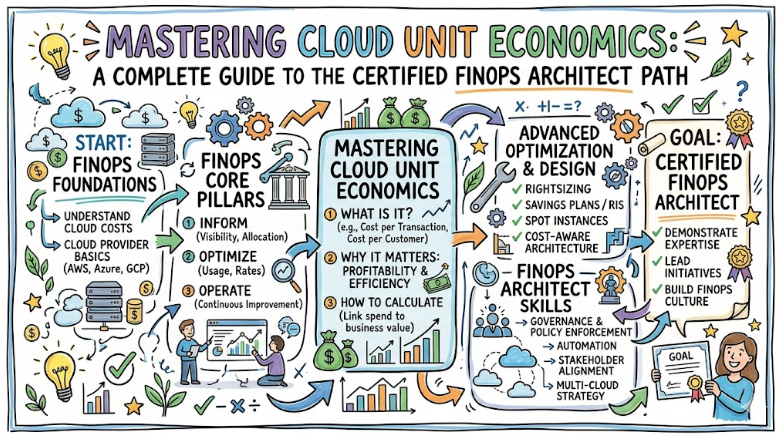
As cloud environments grow in complexity, the need for structured financial management has moved from a “nice-to-have” to a core operational requirement. This guide provides a deep dive into the Certified FinOps Architect program, designed for professionals who want to bridge the gap between engineering execution and business value. Whether you are a cloud engineer looking to specialize or a manager aiming to optimize unit economics, this resource helps you navigate the various paths available. By understanding the curriculum and certification outcomes provided by finopsschool, you can make an informed decision about your career trajectory in the evolving landscape of cloud-native operations and platform engineering.
What is the Certified FinOps Architect?
The Certified FinOps Architect represents the highest level of mastery in the intersection of cloud technology and financial accountability. It is not just a theoretical credential; it is a framework that exists to provide engineers and architects with the tools to manage variable cloud spend in real-time. In modern production environments, every line of code has a cost implication, and this certification ensures that technical decisions are aligned with enterprise fiscal goals. It moves beyond simple cost-cutting and focuses on value realization, ensuring that cloud investments directly support business growth through advanced architectural patterns and automated governance.
Who Should Pursue Certified FinOps Architect?
This certification is primarily built for Cloud Architects, DevOps Engineers, and Site Reliability Engineers (SREs) who find themselves responsible for large-scale cloud budgets. It is equally valuable for FinOps practitioners who want to deepen their technical understanding of how resource provisioning affects the bottom line. Beginners in the cloud space can use this as a roadmap to understand the “Inform, Optimize, and Operate” phases of the FinOps lifecycle, while seasoned managers can use it to build high-performing, cost-aware engineering cultures. Globally, and specifically in the rapidly growing tech hubs of India, this role is becoming central to digital transformation strategies.
Why Certified FinOps Architect is Valuable and Beyond
The demand for FinOps expertise is surging as enterprises realize that moving to the cloud without financial guardrails leads to “bill shock” and wasted resources. Holding this certification ensures long-term career longevity because it combines technical cloud skills with business acumen—a rare and highly sought-after combination. Even as specific cloud tools evolve or change, the core principles of financial architecture remain constant, providing a stable foundation for professional growth. Investing time in this certification offers a significant return, as companies are increasingly prioritizing “Cost-Efficiency” as a key performance indicator for their engineering leadership teams.
Certified FinOps Architect Certification Overview
The program is delivered via the official curriculum at finopsschool.com and is hosted on the finopsschool.com platform. The certification is structured to guide a professional from fundamental concepts to advanced architectural design. It uses a multi-level assessment approach that includes practical exams and case-study-based evaluations to ensure that candidates can apply their knowledge to real-world scenarios. The ownership of this program lies with industry experts who have managed multi-million dollar cloud estates, ensuring that the training reflects actual enterprise challenges rather than just vendor-specific feature lists.
Certified FinOps Architect Certification Tracks & Levels
The certification is organized into three distinct tiers: Foundation, Professional, and Architect. The Foundation level introduces the core vocabulary and the three phases of the FinOps journey, making it suitable for all stakeholders including finance and procurement teams. The Professional level dives deeper into optimization techniques, data ingestion for billing, and unit economics. Finally, the Architect level focuses on designing complex, multi-cloud architectures that are cost-efficient by design, incorporating automated scaling and policy-driven governance. This progression allows a professional to build their skills incrementally as they take on more responsibility within their organization.
Complete Certified FinOps Architect Certification Table
| Track | Level | Who it’s for | Prerequisites | Skills Covered | Recommended Order |
| Core FinOps | Foundation | Beginners, Finance, Managers | Basic Cloud Awareness | Lifecycle, Vocabulary, Culture | 1st |
| Operations | Professional | DevOps, SRE, FinOps Analysts | 1+ Year Cloud Exp | Data Analytics, Cost Modeling | 2nd |
| Architecture | Architect | Senior Architects, Tech Leads | Professional Level | Policy Automation, Multi-cloud | 3rd |
Detailed Guide for Each Certified FinOps Architect Certification
Certified FinOps Architect – Foundation
What it is
This entry-level certification validates a professional’s understanding of basic FinOps principles and the cultural shift required for cloud financial management. It ensures all team members speak the same language regarding cloud spending.
Who should take it
It is suitable for software engineers, finance professionals, and procurement officers who are new to the world of variable cloud spending and need a baseline of knowledge.
Skills you’ll gain
- Understanding the three phases: Inform, Optimize, and Operate.
- Identifying different cloud pricing models (On-demand, Reserved, Spot).
- Grasping the importance of tagging and resource allocation.
Real-world projects you should be able to do
- Conduct a basic audit of a cloud bill to identify wasted resources.
- Create a simple tagging policy for a small engineering team.
Preparation plan
- 7 Days: Focus on the official glossary and core lifecycle definitions.
- 14 Days: Review case studies of successful FinOps cultural shifts.
Common mistakes
- Underestimating the importance of the cultural/people aspect of FinOps.
- Focusing too much on technical tools rather than the framework.
Best next certification after this
- Same-track option: Certified FinOps Professional.
- Cross-track option: Cloud Digital Leader.
- Leadership option: Engineering Management Foundation.
Certified FinOps Architect – Professional
What it is
The Professional level validates the ability to implement and manage FinOps practices within a larger organization. It focuses on the mechanics of data ingestion and reporting.
Who should take it
This is intended for DevOps Engineers and Cloud Analysts who are tasked with the daily management of cloud costs and reporting for multiple teams.
Skills you’ll gain
- Building advanced dashboards using billing APIs.
- Designing unit economic models to measure business value.
- Negotiating and managing commitment-based discounts.
Real-world projects you should be able to do
- Automate the delivery of cost reports to different business units.
- Implement a showback or chargeback system for an enterprise.
Preparation plan
- 30 Days: Deep dive into cloud billing data structures and SQL-based reporting.
- 60 Days: Practice building forecasting models based on historical usage.
Common mistakes
- Ignoring the data quality of labels/tags before building reports.
- Failing to align technical metrics with business KPIs.
Best next certification after this
- Same-track option: Certified FinOps Architect.
- Cross-track option: Certified Kubernetes Administrator (CKA).
- Leadership option: Technical Program Management.
Certified FinOps Architect – Architect (Advanced)
What it is
This is the pinnacle of the program, certifying an individual’s ability to design entire cloud ecosystems that are financially optimized by default.
Who should take it
Senior Cloud Architects and Principal Engineers who have authority over the organization’s infrastructure strategy and long-term cloud roadmaps.
Skills you’ll gain
- Designing serverless and auto-scaling architectures for cost efficiency.
- Implementing policy-as-code for automated cost guardrails.
- Strategy for multi-cloud and hybrid-cloud financial management.
Real-world projects you should be able to do
- Design a self-healing infrastructure that shuts down idle resources automatically.
- Lead a migration strategy that includes a pre-calculated ROI and cost-benefit analysis.
Preparation plan
- 30 Days: Research advanced architectural patterns like FinOps-by-Design.
- 60 Days: Analyze complex multi-cloud billing scenarios and policy automation tools.
Common mistakes
- Designing for cost at the expense of performance or security.
- Lack of focus on automated governance versus manual intervention.
Best next certification after this
- Same-track option: Specialized FinOps for Kubernetes.
- Cross-track option: Solutions Architect Professional (AWS/Azure/GCP).
- Leadership option: Chief Technology Officer (CTO) Roadmap.
Choose Your Learning Path
DevOps Path
In this path, the focus is on integrating financial metrics directly into the CI/CD pipeline. Engineers learn how to provide developers with immediate feedback on the cost impact of their infrastructure changes. This ensures that cost becomes a first-class citizen in the development lifecycle, similar to security or performance. By mastering these skills, DevOps professionals can ensure that rapid deployments do not lead to unmanaged spending.
DevSecOps Path
The DevSecOps professional looks at FinOps through the lens of compliance and risk management. This involves ensuring that cost-saving measures do not introduce security vulnerabilities or violate regulatory requirements. You will learn to use automated policies to enforce both security guardrails and budget limits simultaneously. This dual-focus ensures a secure, compliant, and cost-efficient cloud environment.
SRE Path
For the Site Reliability Engineer, FinOps is about balancing reliability with cost—the “Error Budget” for finances. You will learn how to design systems that scale down aggressively during low demand without affecting service level objectives (SLOs). The path emphasizes automation and observability, using financial data as a signal for system health and efficiency. This results in a highly resilient infrastructure that only consumes the resources it truly needs.
AIOps Path
This path explores the use of artificial intelligence to manage cloud operations and costs at scale. You will focus on using machine learning algorithms to predict future spend and identify anomalies in billing data that humans might miss. AIOps practitioners use these insights to trigger automated remediation actions. It is a forward-thinking path for those who want to manage massive, complex environments with minimal manual intervention.
MLOps Path
MLOps professionals face unique financial challenges, specifically around the high cost of GPU instances and large-scale data processing. This path focuses on optimizing the machine learning lifecycle, from training to deployment, to ensure models are cost-effective. You will learn how to manage the specialized billing associated with AI services and data warehouses. This ensures that data science projects remain economically viable as they move into production.
DataOps Path
DataOps focuses on the financial management of data pipelines, storage, and analytics platforms. Since data egress and storage costs can spiral out of control, this path teaches strategies for lifecycle management and query optimization. You will learn how to design data architectures that balance accessibility with storage costs. This is essential for organizations that rely on big data and real-time analytics to drive their business decisions.
FinOps Path
The pure FinOps path is designed for those who want to lead the Cloud Financial Management office within an organization. It focuses heavily on the cultural, organizational, and financial aspects of the framework, including budgeting and forecasting. You will learn how to act as a translator between the engineering, finance, and executive teams. This path prepares you for a strategic role in shaping the financial future of the company’s cloud journey.
Role → Recommended Certified FinOps Architect Certifications
| Role | Recommended Certifications |
| DevOps Engineer | FinOps Foundation, FinOps Professional |
| SRE | FinOps Professional, FinOps Architect |
| Platform Engineer | FinOps Architect |
| Cloud Engineer | FinOps Foundation, FinOps Professional |
| Security Engineer | FinOps Foundation (focus on Governance) |
| Data Engineer | FinOps Professional (Data Analytics focus) |
| FinOps Practitioner | FinOps Foundation, Professional, and Architect |
| Engineering Manager | FinOps Foundation, FinOps Professional |
Next Certifications to Take After Certified FinOps Architect
Same Track Progression
Once you have achieved the Architect level, the next step is to specialize in niche areas of cloud financial management. This could include focusing exclusively on Kubernetes FinOps (GreenOps) or focusing on the sustainability aspects of cloud computing. Deepening your expertise in specific cloud provider billing engines (like AWS Billing and Cost Management or Azure Cost Management) can also make you a subject matter expert in those specific ecosystems.
Cross-Track Expansion
To become a more well-rounded professional, consider moving into technical certifications that complement your financial knowledge. Earning a professional-level Solutions Architect certification or a Kubernetes certification (CKA/CKS) allows you to implement the cost-saving designs you architect. Understanding the underlying technology at a deep level makes your financial recommendations more credible and practical for engineering teams to implement.
Leadership & Management Track
For those looking to move into executive roles, the next step involves certifications in ITIL, PMP, or specialized leadership programs for CTOs. These programs help you manage the people and processes that sit above the technology. Combining FinOps mastery with high-level management skills prepares you to lead large departments and make strategic decisions that impact the entire organization’s profitability and technological direction.
Training & Certification Support Providers for Certified FinOps Architect
DevOpsSchool
DevOpsSchool provides a robust ecosystem for professionals looking to master FinOps and cloud-native technologies. Their training programs are designed with a heavy emphasis on practical application, moving beyond simple theory to ensure that students can handle real-world production environments. They offer a variety of learning formats, including instructor-led sessions and self-paced modules, tailored to the needs of busy working professionals. With a focus on the latest industry trends, they ensure that their curriculum remains relevant in a fast-paced market. Their reputation in the industry makes them a go-to choice for those seeking to validate their skills through recognized certifications and hands-on projects.
Cotocus
Cotocus specializes in delivering high-end technical training with a focus on specialized “Ops” domains like FinOps, SRE, and DevSecOps. Their approach is highly modular, allowing learners to pick specific tracks that align with their career goals. They prioritize laboratory-based learning, where students work on simulated enterprise environments to solve complex infrastructure and financial challenges. The instructors at Cotocus are often industry veterans who bring years of practical experience into the classroom, providing insights that are not found in standard textbooks. This focus on real-world readiness helps candidates not only pass certification exams but also excel in their daily professional responsibilities.
Scmgalaxy
Scmgalaxy is a comprehensive community and training platform that has been a staple in the DevOps and Software Configuration Management world for years. They offer extensive resources, including tutorials, blogs, and community forums, which complement their formal certification training. For FinOps aspirants, Scmgalaxy provides a wealth of information on tool integrations and automation strategies that are critical for modern cloud financial management. Their programs are known for being deeply technical and thorough, covering the intricacies of billing data and cloud architecture. By fostering a collaborative learning environment, they help professionals stay connected with peers and industry experts worldwide.
BestDevOps
BestDevOps focuses on providing streamlined and efficient training paths for cloud professionals who want to upgrade their skills quickly. Their FinOps programs are structured to strip away the fluff and focus on the core competencies required by modern enterprises. They offer intensive bootcamps and workshops that are designed to take a candidate from a basic understanding to professional proficiency in a short period. The curriculum is updated regularly to reflect the changing landscapes of major cloud providers like AWS, Azure, and Google Cloud. This makes BestDevOps an excellent choice for professionals who need to deliver immediate value to their organizations.
devsecopsschool.com
This institution focuses on the critical intersection of development, security, and operations, providing a unique perspective on FinOps. Their training emphasizes the importance of building cost-awareness into the security and compliance frameworks of an organization. By teaching students how to automate budget guardrails using security-as-code principles, they produce professionals who can manage cloud spend without compromising on safety. Their courses are ideal for those who want to specialize in the governance and compliance aspects of cloud financial management. The curriculum is designed to be rigorous, ensuring that graduates are well-prepared for the challenges of modern, high-stakes enterprise environments.
sreschool.com
sreschool.com is dedicated to the discipline of Site Reliability Engineering, where efficiency and reliability are the primary goals. Their FinOps training is viewed through the lens of system performance and resource optimization, teaching students how to treat cost as a key reliability metric. The courses cover advanced topics such as automated scaling, predictive analytics, and capacity planning. By focusing on the technical mechanics of how resources are consumed, they empower engineers to design inherently cost-effective systems. This training is particularly valuable for those working in large-scale, high-traffic environments where small inefficiencies can lead to massive financial losses.
aiopsschool.com
At aiopsschool.com, the focus is on the future of operations—using artificial intelligence and machine learning to manage complex IT estates. Their FinOps modules explore how AI can be leveraged to automate cost discovery, anomaly detection, and predictive forecasting. This training is essential for professionals who want to stay ahead of the curve and manage cloud spending at a scale that is impossible for humans to handle manually. The programs combine data science principles with cloud financial management, offering a unique skill set that is in high demand. Students learn to build and deploy intelligent agents that can optimize infrastructure costs in real-time.
dataopsschool.com
dataopsschool.com addresses the specific financial challenges inherent in managing big data and analytics pipelines. Their training focuses on the cost implications of data storage, egress, and processing across various cloud platforms. Students learn how to design data architectures that are optimized for both performance and budget, avoiding the common pitfalls of unmanaged data growth. The curriculum includes deep dives into data warehousing costs and the financial management of real-time streaming services. For data engineers and architects, this training provides the necessary tools to ensure that data-driven initiatives remain profitable and sustainable for the business over the long term.
finopsschool.com
finopsschool.com is the primary authority and dedicated resource for the Certified FinOps Architect program. Their entire focus is on the FinOps framework, providing the most comprehensive and up-to-date training available in the industry. They offer a clear certification path from foundation to advanced architecture, supported by a wealth of case studies and industry-standard practices. Their programs are designed to create leaders who can drive cultural change and financial accountability across large organizations. By specializing exclusively in FinOps, they offer a depth of knowledge and a community of experts that is unmatched by more generalist training providers.
Frequently Asked Questions (General)
- How difficult is the Certified FinOps Architect exam?
The difficulty increases significantly with each level; the Foundation is accessible, while the Architect level requires a deep understanding of complex system design. - How long does it take to prepare for the certification?
On average, a professional can prepare for the Foundation in two weeks, while the Architect level typically requires two to three months of focused study. - What are the prerequisites for the advanced level?
You generally need to pass the Professional level and have several years of experience in cloud architecture or DevOps roles. - Is the ROI for this certification worth the cost?
Yes, as companies face rising cloud costs, professionals with validated FinOps skills are seeing higher salary brackets and more leadership opportunities. - Do I need a finance background to succeed in FinOps?
No, while helpful, the program is designed to teach engineers the necessary financial concepts and finance professionals the necessary technical concepts. - In what order should I take these certifications?
It is highly recommended to follow the logical order: Foundation, then Professional, and finally Architect to build a solid knowledge base. - How long is the certification valid?
Most certifications in this track are valid for two or three years, after which you must renew or progress to a higher level to stay current. - Is this certification recognized by major cloud providers like AWS?
Yes, FinOps is a vendor-neutral framework that is widely recognized and supported by AWS, Microsoft Azure, and Google Cloud. - Can this certification help me move into management?
Absolutely, it demonstrates your ability to align technical decisions with business value, which is a key requirement for engineering leadership roles. - Does the program cover multi-cloud environments?
Yes, the Architect level specifically focuses on managing financial accountability across diverse, multi-cloud, and hybrid-cloud infrastructures. - Are there practical labs included in the training?
Yes, most reputable providers include hands-on labs where you practice analyzing billing data and implementing optimization policies. - Will I learn about specific tools like CloudHealth or Apptio?
While the focus is on the framework, you will learn the criteria for selecting and using various cloud financial management tools effectively.
FAQs on Certified FinOps Architect
- What is the core difference between a FinOps Practitioner and an Architect?
The Practitioner focuses on the daily operations and reporting, whereas the Architect focuses on the high-level design of systems to ensure they are cost-efficient from the start. - How does the Architect certification handle serverless costs?
The program includes specific modules on the variable and often hidden costs of serverless architectures, teaching you how to optimize event-driven designs. - Does the curriculum include Kubernetes and container cost management?
Yes, managing shared resources in a cluster is a major part of the advanced curriculum, including concepts like label-based cost allocation and bin packing. - Are real-world case studies part of the exam?
The Architect level exam often uses scenario-based questions that require you to solve complex financial and technical problems based on real-world business cases. - Does the certification cover automated remediation?
Yes, a key skill gain is learning how to write and implement policies that automatically take action, such as deleting unattached disks or rightsizing instances. - How does FinOps align with the Well-Architected Framework?
The certification teaches you how to implement the “Cost Optimization” pillar of the Well-Architected Framework at an enterprise scale. - What role does unit economics play in the certification?
You will learn how to move beyond total spend and instead calculate the cost per business transaction, such as “cost per customer signup.” - Is the certification exam proctored online?
Yes, the certification is typically delivered through a secure, proctored online platform, allowing you to take the exam from anywhere in the world.
Final Thoughts: Is Certified FinOps Architect Worth It?
From the perspective of a seasoned mentor, the Certified FinOps Architect is one of the most practical investments you can make in the current cloud landscape. We have moved past the era of “growth at all costs,” and organizations now demand engineers who are as fiscally responsible as they are technically proficient. This certification provides a clear, structured path to gaining that expertise without the need for marketing fluff or hype. If you are looking to elevate your career from a tactical engineer to a strategic architect, mastering the financial dimensions of the cloud is no longer optional—it is a necessity. By focusing on real-world outcomes and architectural integrity, this program ensures you are ready to lead in an environment where efficiency is the ultimate measure of success.
