Introduction
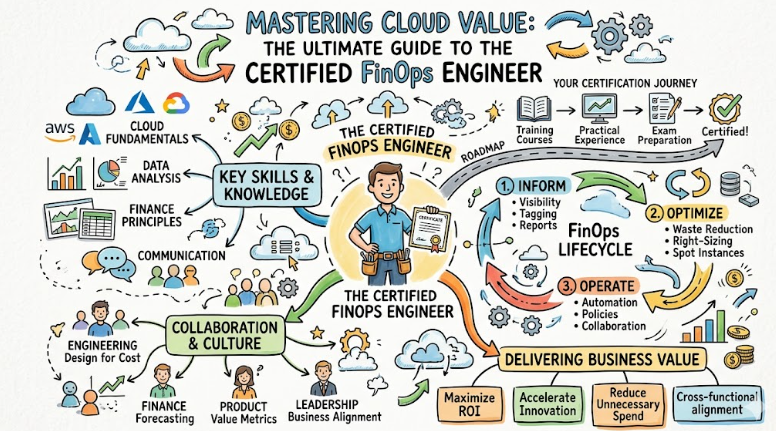
The Certified FinOps Engineer is designed for professionals who want to manage cloud cost, usage, governance, and business accountability in modern cloud environments. It is especially useful for DevOps engineers, cloud engineers, SREs, platform teams, finance teams, and engineering managers.
This guide helps you understand whether this certification fits your career goals, what skills it builds, and how it supports real-world FinOps practices. The program is hosted by finopsschool, a platform focused on FinOps learning, certification, and cloud cost management education.
What is the Certified FinOps Engineer?
The Certified FinOps Engineer is a professional credential that validates an individual’s ability to implement financial management practices within a technical cloud environment. It exists to solve the “black hole” of cloud billing where engineers deploy resources without visibility into the downstream financial impact. This certification emphasizes real-world application, focusing on how to build automated guardrails, rightsizing scripts, and cost-allocation tagging policies in production environments. Unlike theoretical certifications, it aligns directly with enterprise workflows where DevOps and Finance teams must collaborate to ensure unit economics remain healthy as the business grows.
Who Should Pursue Certified FinOps Engineer?
This path is ideal for DevOps engineers, SREs, and Platform professionals who are tired of reactive cost-cutting measures and want to build proactive cost-aware systems. Security and Data engineers also benefit significantly, as data egress and security tooling often account for massive, hidden portions of a cloud budget. It serves beginners looking for a niche specialization and experienced managers who need to oversee massive cloud spends across global regions. In the Indian market and across global tech hubs, this certification is becoming a prerequisite for senior leadership roles in large-scale enterprise cloud transformations.
Why Certified FinOps Engineer is Valuable and Beyond
The demand for cloud cost management is accelerating as enterprises realize that unmanaged cloud spending can erode profit margins faster than any other operational expense. Holding this certification ensures longevity in a career because while tools and cloud providers may change, the fundamental logic of financial optimization remains constant. It helps professionals stay relevant by providing a unique “dual-language” skill set—speaking code to engineers and value to executives. The return on investment is immediate, as certified individuals often identify savings that pay for their training costs within the first few weeks of implementation.
Certified FinOps Engineer Certification Overview
The program is delivered via the official curriculum and is hosted on the primary platform of the provider. It is structured to provide a logical progression from understanding the FinOps lifecycle—Inform, Optimize, and Operate—to technical execution. The assessment approach is rigorous, using practical scenarios to test an engineer’s ability to handle multi-cloud billing data and complex architectural trade-offs. Ownership of the certification rests with a community-led body, ensuring that the material remains updated with the latest industry shifts and cloud provider updates.
Certified FinOps Engineer Certification Tracks & Levels
The certification is categorized into three distinct levels to mirror the professional growth of a FinOps practitioner. The Foundation level introduces the core terminology and the FinOps framework, making it accessible for those new to the domain. The Professional level dives deep into technical automation, cloud-native cost tools, and policy-driven governance. Finally, the Advanced level is designed for architects and leads who are building entire FinOps practices from scratch within large organizations. These tracks align with career progression from an individual contributor to a strategic lead.
Complete Certified FinOps Engineer Certification Table
| Track | Level | Who it’s for | Prerequisites | Skills Covered | Recommended Order |
| Core FinOps | Foundation | Beginners, Managers | Basic Cloud Literacy | FinOps Lifecycle, Terminology | 1 |
| Engineering | Professional | SRE, DevOps, Cloud Engineers | Foundation Cert | Automation, Rightsizing, Tagging | 2 |
| Architecture | Advanced | Architects, FinOps Leads | Professional Cert | Unit Economics, Practice Building | 3 |
Detailed Guide for Each Certified FinOps Engineer Certification
Certified FinOps Engineer – Foundation Level
What it is
This certification validates a fundamental understanding of the FinOps culture and the collaborative relationship between finance and engineering. It ensures a baseline knowledge of cloud billing concepts and cost management principles.
Who should take it
Early-career cloud engineers, finance professionals working with tech teams, and engineering managers who need to understand the language of cloud cost management.
Skills you’ll gain
- Understanding the three phases of the FinOps lifecycle.
- Mastering cloud billing terminology across AWS, Azure, and GCP.
- Identifying the primary drivers of cloud spend.
- Establishing a culture of cost accountability within teams.
Real-world projects you should be able to do
- Perform a basic audit of monthly cloud invoices to identify waste.
- Create a team-wide dashboard showing daily spend trends.
Preparation plan
- 7-14 Days: Review the official practitioner guidebook and memorize key terminology.
- 30 Days: Attend foundational webinars and complete basic cloud billing modules.
- 60 Days: Not typically required for this level unless the candidate is entirely new to cloud.
Common mistakes
Focusing too much on specific tool features rather than the overarching FinOps principles and cultural shifts.
Best next certification after this
- Same-track option: Certified FinOps Engineer – Professional.
- Cross-track option: Cloud Provider Solutions Architect Associate.
- Leadership option: Engineering Management Fundamentals.
Certified FinOps Engineer – Professional Level
What it is
This level validates the technical ability to implement cost-optimization strategies through automation and policy enforcement. It proves the candidate can translate financial requirements into technical configurations.
Who should take it
Senior DevOps engineers, SREs, and Platform engineers who are responsible for maintaining large-scale production environments and managing infrastructure spend.
Skills you’ll gain
- Advanced tagging and resource allocation strategies.
- Building automated scripts for rightsizing and resource scheduling.
- Implementing spot instance and reserved instance strategies at scale.
- Managing data egress and storage tiering costs.
Real-world projects you should be able to do
- Automate the shutdown of non-production environments during off-hours.
- Implement a “showback” or “chargeback” system for multi-tenant clusters.
Preparation plan
- 7-14 Days: Deep dive into cloud provider pricing APIs and billing exports.
- 30 Days: Practice writing automation scripts to detect unattached storage or idle load balancers.
- 60 Days: Lead a pilot optimization project in a staging environment to document results.
Common mistakes
Neglecting the “Operate” phase and focusing only on one-time cost-cutting rather than sustainable, automated governance.
Best next certification after this
- Same-track option: Certified FinOps Engineer – Advanced.
- Cross-track option: Site Reliability Engineering (SRE) Professional.
- Leadership option: Principal Engineer Leadership Track.
Choose Your Learning Path
DevOps Path
In the DevOps path, the focus is on integrating cost-checks into the CI/CD pipeline. Engineers learn how to use “Policy as Code” to prevent expensive resources from being deployed without approval. This ensures that cost is treated as a first-class citizen, similar to security or performance, during the development lifecycle.
DevSecOps Path
The DevSecOps professional looks at the intersection of security tooling and cost. Many security scanners and logging agents incur high costs due to data processing and storage. This path teaches how to optimize security data ingestion without compromising the safety or compliance of the infrastructure.
SRE Path
For Site Reliability Engineers, the goal is balancing reliability with cost. This path focuses on “Cost-aware SRE,” where error budgets and SLOs are weighed against the financial impact of over-provisioning for high availability. It involves mastering the trade-offs between system redundancy and cloud expenditure.
AIOps Path
In an AIOps context, engineers use machine learning models to predict future spend and detect anomalies in real-time. This path focuses on using intelligent algorithms to manage massive, fluctuating datasets that are too complex for manual human analysis, ensuring proactive cost management.
MLOps Path
MLOps professionals deal with the heavy costs of GPU instances and large-scale data processing for model training. This path explores how to optimize training jobs, use managed ML services efficiently, and manage the lifecycle of expensive machine learning artifacts to keep experimental costs under control.
DataOps Path
DataOps focuses on the massive costs associated with data lakes, warehouses, and ETL pipelines. Professionals on this path learn how to optimize query performance to reduce compute costs and how to implement lifecycle policies for vast amounts of cold and hot data.
FinOps Path
The pure FinOps path is for those moving into dedicated cost management roles. It covers the full spectrum of the discipline, from negotiating enterprise agreements with cloud vendors to building internal organizational units dedicated to cloud financial excellence and unit economic reporting.
Role → Recommended Certified FinOps Engineer Certifications
| Role | Recommended Certifications |
| DevOps Engineer | Foundation + Professional |
| SRE | Professional + SRE Specialized |
| Platform Engineer | Professional + Advanced |
| Cloud Engineer | Foundation + Associate |
| Security Engineer | Foundation + Security Cross-Track |
| Data Engineer | Professional + DataOps Specialized |
| FinOps Practitioner | Foundation + Professional + Advanced |
| Engineering Manager | Foundation + Leadership Track |
Next Certifications to Take After Certified FinOps Engineer
Same Track Progression
Once the engineering levels are mastered, the next logical step is moving into architectural certifications that focus on high-level strategy. This involves learning how to design entire systems for cost-efficiency from the ground up, rather than just optimizing existing ones. It leads toward becoming a Chief Architect or a Cloud Economist.
Cross-Track Expansion
Expanding into related fields like Site Reliability Engineering or Cloud Security is highly recommended. A FinOps-certified engineer who also understands SRE principles is incredibly valuable because they can quantify the cost of reliability. Similarly, understanding the financial impact of security breaches adds another layer to your professional profile.
Leadership & Management Track
For those looking to move into people management, certifications in Engineering Management or ITIL are beneficial. The ability to manage a budget is a core requirement for Directors and VPs of Engineering. Combining FinOps expertise with leadership training prepares you for C-level roles like the Chief Technology Officer or Head of Infrastructure.
Training & Certification Support Providers for Certified FinOps Engineer
DevOpsSchool
DevOpsSchool provides comprehensive training programs that bridge the gap between technical operations and financial management. Their curriculum is designed for working professionals who need hands-on experience with real-world scenarios. They focus on the practical application of FinOps principles within the DevOps lifecycle. The instructors are industry veterans who bring years of production experience to the classroom. Students get access to a robust library of resources and laboratory environments to test their skills.
Cotocus
Cotocus offers specialized training modules focused on the technical aspects of cloud financial management. Their approach is highly practical, emphasizing the use of automation and scripting to manage cloud costs. They cater to both individual learners and corporate teams looking to upskill their workforce. The training is structured to help candidates pass the certification exams while gaining useful job skills. Their support system includes mentorship and project-based learning to ensure knowledge retention and practical competency.
Scmgalaxy
Scmgalaxy is a well-known community and training hub that provides extensive resources for FinOps candidates. They offer a mix of free and paid content, including detailed guides, blogs, and video tutorials. Their focus is on the integration of FinOps with Software Configuration Management and CI/CD practices. The platform serves as a collaborative space where engineers can share best practices and solve complex billing challenges. Their training programs are updated frequently to reflect the latest changes in the cloud industry.
BestDevOps
BestDevOps focuses on delivering high-quality, enterprise-grade training for cloud professionals. Their FinOps courses are designed to help engineers move into senior roles by mastering cost-optimization techniques. They provide a structured learning path that covers everything from basic terminology to advanced architectural patterns. The training includes case studies from large organizations, giving students insight into how FinOps works at scale. Their goal is to produce engineers who can immediately deliver value to their employers.
devsecopsschool.com
This provider specializes in the intersection of security and operations, with a strong emphasis on cost-effective security practices. Their FinOps training highlights how to maintain a strong security posture without overspending on expensive security tools. They teach students how to evaluate the ROI of security investments and how to automate security compliance. The curriculum is ideal for security engineers who want to broaden their financial understanding. Their instructors provide deep insights into modern security-first engineering workflows.
sreschool.com
Sreschool.com focuses on the critical balance between system reliability and operational cost. Their FinOps modules are tailored specifically for Site Reliability Engineers who need to manage error budgets alongside financial budgets. They offer specialized training on how to design highly available systems that are also cost-efficient. The school emphasizes the use of metrics and monitoring to drive financial decisions. Students learn how to use observability tools to gain visibility into cloud spend and performance.
aiopsschool.com
Aiopsschool.com provides cutting-edge training on using artificial intelligence to manage IT operations and costs. Their FinOps curriculum explores how machine learning can be used to predict cloud spending and identify anomalies automatically. This is ideal for engineers looking to work in highly complex, dynamic cloud environments. They teach students how to build and deploy AIOps models that drive financial efficiency. The training is forward-looking, preparing professionals for the future of automated cloud management.
dataopsschool.com
This provider focuses on the financial management of data-intensive applications. Their FinOps training is geared toward data engineers and architects who manage large-scale data lakes and warehouses. They provide practical strategies for reducing data storage and processing costs without sacrificing performance. The curriculum covers the unique billing challenges of big data platforms and cloud-native data services. Students learn how to implement data governance policies that include financial accountability as a core component.
finopsschool.com
Finopsschool.com is a dedicated platform for all things related to cloud financial management. They offer a wide range of certifications and training programs that cover every level of the FinOps discipline. Their curriculum is built on the core pillars of the FinOps Foundation, ensuring that students receive industry-standard education. The platform provides a wealth of resources, including webinars, whitepapers, and community forums. It is the primary destination for professionals who want to specialize exclusively in the field of FinOps.
Frequently Asked Questions (General)
- How difficult is the certification exam for an experienced engineer?
The difficulty depends on your familiarity with cloud billing. For most engineers, the technical parts are manageable, but the financial terminology and cultural aspects require dedicated study. - What is the typical time commitment required for preparation?
A professional with cloud experience should expect to spend 30 to 40 hours of focused study for the foundation level and significantly more for professional levels. - Are there any specific prerequisites before I can take the exam?
Most foundation levels have no strict prerequisites, but professional and advanced levels usually require passing the previous certification or having documented experience. - What kind of ROI can my company expect from my certification?
Companies often see a reduction in cloud waste of 15% to 30% within the first year of implementing a certified FinOps practitioner’s recommendations. - Does the certification focus on one specific cloud provider?
No, the certification is designed to be cloud-agnostic, covering principles that apply to AWS, Azure, Google Cloud, and even private cloud environments. - How long does the certification remains valid?
Typically, these certifications are valid for two to three years, after which you must recertify to show you are up to date with current practices. - Is there a hands-on component to the exam?
The professional and advanced levels often include scenario-based questions or lab environments where you must solve real-world cost problems. - Can a non-technical person pass the foundation level?
Yes, the foundation level is designed to be accessible to finance, procurement, and management professionals who need to understand the FinOps framework. - How does this certification differ from a standard Cloud Architect cert?
While an architect cert focuses on how to build systems, this certification focuses specifically on the financial lifecycle and efficiency of those systems. - Is there a community or network for certified professionals?
Yes, most providers offer access to exclusive forums and alumni groups where you can network with other FinOps experts globally. - Are the exams proctored or can I take them at home?
Most exams are offered through online proctored platforms, allowing you to take them from your home or office while maintaining security. - Which level should I start with if I have 10 years of DevOps experience?
Even with extensive experience, starting with the Foundation level is recommended to master the specific terminology and lifecycle stages used in the FinOps discipline.
FAQs on Certified FinOps Engineer
- What specific tools are covered in the curriculum?
The curriculum focuses on native tools like AWS Cost Explorer and Azure Cost Management, as well as third-party platforms. It teaches you how to evaluate any tool based on the FinOps lifecycle. - Does this certification help with career shifts into Finance?
It facilitates a shift into “Tech-Finance” roles, such as Cloud Economist or FinOps Lead, rather than traditional accounting roles, staying within the technology domain. - How does FinOps relate to GreenOps or sustainability?
FinOps and GreenOps are closely linked; reducing unused cloud resources directly lowers the carbon footprint of your infrastructure, making this certification valuable for ESG goals. - Are there specific study groups for the Indian market?
Many Indian training providers like DevOpsSchool host local study groups and webinars specifically tailored to the nuances of the Indian tech ecosystem and enterprise landscape. - What is the passing score for the engineering exams?
Passing scores vary by level but generally hover around 70% to 75%, requiring a thorough understanding of both theory and practical application. - Can I use my existing cloud credits for the practical labs?
Most training programs provide their own sandboxed environments, so you don’t have to worry about incurring personal costs during your study labs. - Does the exam cover multi-cloud environments specifically?
Yes, a major component of the advanced tracks involves managing complex billing and resource optimization across multiple different cloud service providers simultaneously. - Is there a focus on containerization and Kubernetes costs?
Absolutely, managing Kubernetes spend is a high-priority topic, including cost allocation for shared clusters and optimizing pod-level resource requests and limits.
Final Thoughts: Is Certified FinOps Engineer Worth It?
In the current landscape, being “just” an engineer is no longer enough for high-growth companies. The ability to demonstrate fiscal responsibility is what separates senior staff from the rest of the pack. The Certified FinOps Engineer isn’t just another badge; it is a fundamental shift in how you view infrastructure. It empowers you to make technical decisions that are grounded in business reality. If you want to be the person who not only builds the cloud but also proves its value to the board, this is the right path. It is a rigorous, rewarding journey that pays dividends in career stability and organizational impact.
