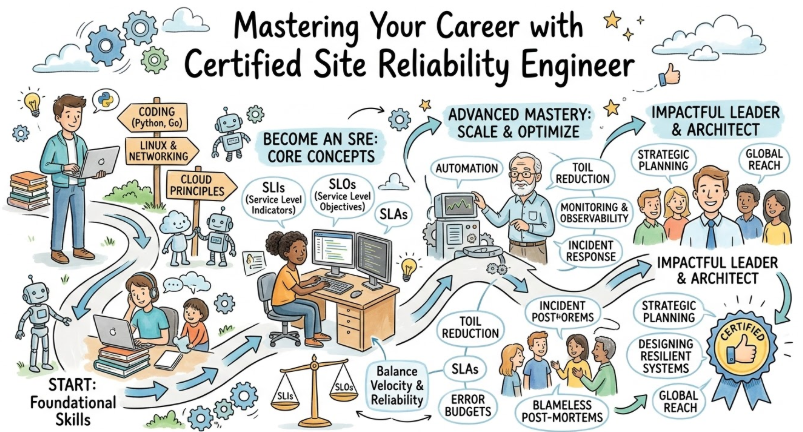
The landscape of modern infrastructure is shifting from traditional maintenance to automated, resilient systems. If you are looking to solidify your expertise in high-availability environments, the Certified Site Reliability Engineer program offers a structured path to mastering these complex ecosystems. This guide is designed for professionals navigating the intersection of software engineering and operations, providing a clear roadmap for career advancement within the cloud-native space. Whether you are a seasoned developer or a systems administrator, understanding the principles of Site Reliability Engineering is essential for making informed decisions about your technical trajectory and long-term professional growth.
What is the Certified Site Reliability Engineer?
The Certified Site Reliability Engineer represents a benchmark for professionals who prioritize production stability and scalable automation. It is not merely a theoretical badge; it exists to bridge the gap between code development and reliable system performance. This certification focuses on the practical application of SRE principles, such as error budgets, service level objectives, and toil reduction. By aligning with modern engineering workflows, it ensures that practitioners can handle the rigors of distributed systems and microservices architectures found in top-tier enterprise environments.
Who Should Pursue Certified Site Reliability Engineer?
This certification is tailored for a broad spectrum of technical roles, including DevOps engineers, platform specialists, and cloud architects who manage critical infrastructure. Security professionals and data engineers who need to ensure the high availability of their pipelines will also find significant value in this curriculum. It is equally relevant for beginners aiming to enter the field with a solid foundation and experienced managers who need to lead SRE teams effectively. In both the Indian tech hub and the global market, this credential serves as a signal of competence in maintaining complex, high-traffic digital services.
Why Certified Site Reliability Engineer is Valuable and Beyond
In an era where downtime translates directly to massive financial loss, the demand for SRE expertise continues to surge. Organizations are moving away from reactive “firefighting” toward proactive, automated reliability, ensuring that the Certified Site Reliability Engineer remains a high-value asset. This certification helps professionals stay relevant by focusing on core principles that transcend specific toolsets, protecting them against the rapid churn of technology. Investing time in this path provides a strong return on career investment, as enterprises prioritize candidates who can guarantee system uptime and operational efficiency.
Certified Site Reliability Engineer Certification Overview
The Certified Site Reliability Engineer program is delivered via the official course page and hosted on the SRE School platform. The assessment approach is designed to be practical, testing a candidate’s ability to handle real-world scenarios rather than rote memorization of definitions. The ownership of the certification lies with a body of practitioners who ensure the content evolves alongside industry trends like OpenTelemetry and Kubernetes. The structure is modular, allowing professionals to progress from foundational reliability concepts to advanced architectural strategies in a logical, step-by-step manner.
Certified Site Reliability Engineer Certification Tracks & Levels
The certification is organized into Foundation, Professional, and Advanced levels to accommodate various stages of a professional’s career. The Foundation level introduces core SRE vocabulary and metrics, while the Professional level dives deep into automation, incident response, and capacity planning. Advanced tracks allow for specialization in niche areas such as FinOps-aligned SRE or AI-driven operations. This tiered approach allows engineers to progress systematically, gaining more responsibility and higher-tier roles as they master each successive level of the framework.
Complete Certified Site Reliability Engineer Certification Table
| Track | Level | Who it’s for | Prerequisites | Skills Covered | Recommended Order |
| Core SRE | Foundation | Junior Engineers / Students | Basic Linux & Networking | SLIs/SLOs, Error Budgets, Toil | 1st |
| SRE Operations | Professional | DevOps & SysAdmins | 2+ Years Experience | Incident Management, Monitoring | 2nd |
| SRE Architecture | Advanced | Senior SREs / Architects | Professional Level Cert | Distributed Systems, Scalability | 3rd |
| SRE Leadership | Expert | Team Leads / Managers | 5+ Years Experience | Team Building, Reliability Culture | 4th |
Detailed Guide for Each Certified Site Reliability Engineer Certification
What it is
This certification validates a candidate’s understanding of the fundamental principles of Site Reliability Engineering. It confirms that the individual understands the cultural shift required to move from traditional operations to an SRE model.
Who should take it
It is suitable for junior developers, system administrators, or technical project managers who are new to the SRE discipline. It serves as an entry point for anyone looking to understand how modern software is kept running.
Skills you’ll gain
- Defining Service Level Indicators (SLIs) and Service Level Objectives (SLOs)
- Identifying and reducing operational toil through automation
- Understanding the concept of Error Budgets and their impact on releases
- Basic monitoring and alerting strategies for cloud-native apps
Real-world projects you should be able to do
- Create a reliability dashboard for a simple web application
- Calculate an error budget based on historical uptime data
- Automate a repetitive manual task using basic scripting
Preparation plan
- 7–14 days: Focus on core terminology and the SRE handbook concepts.
- 30 days: Deep dive into the relationship between DevOps and SRE.
- 60 days: Apply concepts to a small personal project and review case studies.
Common mistakes
- Ignoring the cultural aspect of SRE in favor of just learning tools.
- Confusing SLOs with SLAs, which are business-level agreements.
Best next certification after this
- Same-track option: Certified SRE Professional
- Cross-track option: Certified DevOps Engineer
- Leadership option: SRE Team Lead Foundation
Choose Your Learning Path
DevOps Path
In this path, the focus is on integrating SRE principles directly into the continuous integration and delivery pipeline. Engineers learn how to balance the need for speed in feature delivery with the necessity of system stability. This involves creating “guardrails” that prevent unreliable code from reaching production while maintaining a high velocity of change.
DevSecOps Path
The security-focused path emphasizes that reliability is impossible without security. Here, the SRE practices are used to ensure that security patches and compliance checks do not disrupt service availability. Professionals learn to automate vulnerability scanning and response within the same framework used for operational monitoring and incident management.
SRE Path
This is the “pure” path designed for those who want to specialize exclusively in system reliability and scalability. The curriculum centers on the deep technical aspects of distributed systems, from kernel-level tuning to global load balancing. It is intended for engineers who want to be the primary defenders of production environments in high-stakes industries.
AIOps Path
This path explores the use of machine learning and artificial intelligence to enhance reliability engineering. Engineers learn to use predictive analytics to identify potential failures before they occur and automate complex root-cause analysis. It is designed for those looking at the future of autonomous infrastructure and high-volume data environments.
MLOps Path
Focusing on the reliability of machine learning models in production, this path applies SRE principles to data science workflows. It covers the monitoring of model drift, the scalability of inference engines, and the automated retraining of models. This is critical for organizations where AI services are core to the business product.
DataOps Path
DataOps focuses on the reliability and quality of data pipelines. By applying SRE concepts like SLOs to data delivery, engineers ensure that downstream analytics and applications receive accurate information on time. This path covers the automation of data testing and the orchestration of complex data movements across cloud environments.
FinOps Path
The FinOps path connects technical reliability with financial accountability. Engineers learn to optimize cloud spend while maintaining the required performance levels for their services. This involves understanding the cost impact of architectural decisions and using SRE metrics to drive cost-efficient scaling strategies.
Role → Recommended Certified Site Reliability Engineer Certifications
| Role | Recommended Certifications |
| DevOps Engineer | Certified SRE Foundation, Professional DevOps Engineer |
| SRE | Certified SRE Foundation, Professional, and Advanced |
| Platform Engineer | Certified SRE Professional, Cloud Architecture |
| Cloud Engineer | Certified SRE Foundation, Professional Cloud Specialist |
| Security Engineer | Certified SRE Foundation, DevSecOps Professional |
| Data Engineer | Certified SRE Foundation, DataOps Specialist |
| FinOps Practitioner | Certified SRE Foundation, FinOps Professional |
| Engineering Manager | Certified SRE Foundation, SRE Leadership |
Next Certifications to Take After Certified Site Reliability Engineer
Same Track Progression
Once you have mastered the Certified Site Reliability Engineer curriculum, the logical next step is to pursue deep specialization in areas like Advanced Distributed Systems or High-Scale Traffic Management. This allows you to transition from a general practitioner to a subject matter expert who can design global-scale architectures. Deepening your knowledge in specific SRE tools and proprietary cloud reliability frameworks will further solidify your position as a top-tier expert.
Cross-Track Expansion
Reliability does not exist in a vacuum, so broadening your skills into adjacent domains is highly beneficial. Moving into security-focused tracks or data engineering allows you to apply SRE principles to new challenges, making you a more versatile “T-shaped” professional. Understanding how SRE interacts with FinOps or DevSecOps can help you break down silos within your organization and lead larger cross-functional initiatives.
Leadership & Management Track
For those looking to move away from individual contributor roles, the leadership track focuses on building and scaling SRE organizations. This involves learning how to hire the right talent, managing team burnout, and advocating for reliability at the executive level. Transitioning to management requires a shift from technical troubleshooting to strategic planning and cultural transformation, ensuring the SRE mindset permeates the entire company.
Training & Certification Support Providers for Certified Site Reliability Engineer
DevOpsSchool offers a comprehensive suite of training programs designed to help engineers master the complexities of SRE and DevOps. Their curriculum is built by industry veterans who bring real-world scenarios into the classroom, ensuring that students gain practical knowledge rather than just theoretical concepts. With a focus on hands-on labs and project-based learning, they provide a robust foundation for anyone looking to clear the Certified Site Reliability Engineer exam. Their support extends beyond the classroom with a strong community and updated resources that keep pace with the evolving tech landscape.
Cotocus provides specialized consulting and training services that focus on high-end automation and cloud-native technologies. Their approach to SRE training is deeply rooted in enterprise-grade architecture, making them an ideal choice for professionals working in large-scale environments. They emphasize the integration of various tools and frameworks, helping students understand the “big picture” of system reliability. Their instructors are often active practitioners, ensuring that the techniques taught are relevant to current industry standards and challenges.
Scmgalaxy is a long-standing community and training hub that focuses on the lifecycle of software development and operations. They provide a wealth of resources, including tutorials, videos, and practice exams specifically tailored for SRE and configuration management. Their training programs are designed to be accessible yet thorough, catering to both beginners and advanced professionals. By focusing on the practical “how-to” of reliability, they help candidates build the confidence needed to manage production systems effectively.
BestDevOps specializes in delivering high-impact training for modern engineering roles, with a particular focus on the SRE discipline. Their courses are structured to provide a logical progression from basic concepts to advanced implementation strategies. They leverage a variety of learning formats to ensure that different learning styles are accommodated. Their commitment to excellence is reflected in their curriculum, which is frequently updated to include the latest trends in automation, observability, and incident management.
devsecopsschool.com focuses on the critical intersection of security and reliability. Their training programs emphasize the “Secure” in SRE, teaching professionals how to build resilient systems that are also hardened against threats. They provide deep dives into automated security testing, compliance as code, and secure infrastructure management. For SREs who want to broaden their impact, this provider offers the specialized knowledge needed to lead DevSecOps initiatives within their organizations.
sreschool.com is the primary platform for SRE-specific certifications and advanced learning modules. They offer a dedicated environment for engineers to hone their skills in reliability, performance tuning, and scalability. Their curriculum is designed to be the definitive source for SRE knowledge, covering everything from the core pillars to the most advanced architectural patterns. By focusing exclusively on Site Reliability Engineering, they provide a depth of expertise that is difficult to find elsewhere.
aiopsschool.com addresses the growing need for intelligence in IT operations. Their training focuses on the application of AI and machine learning to SRE tasks, such as anomaly detection and automated remediation. They help engineers transition into the world of AIOps by providing the mathematical and technical foundations required to work with intelligent systems. This is an essential resource for those looking to stay at the cutting edge of infrastructure management.
dataopsschool.com provides targeted training for maintaining the reliability and flow of data across the enterprise. Their courses apply SRE principles to data engineering, ensuring that data pipelines are as resilient as the applications they support. They cover topics like data quality monitoring, pipeline orchestration, and automated testing. This provider is crucial for engineers who are responsible for the massive data ecosystems that drive modern business intelligence and machine learning.
finopsschool.com bridges the gap between engineering and finance, focusing on the “cost-aware” SRE. Their training teaches professionals how to monitor, manage, and optimize cloud costs without sacrificing performance or reliability. They provide the frameworks and tools needed to implement financial accountability in an automated, cloud-native world. For SREs who want to demonstrate their value in business terms, this provider offers the necessary skills to manage infrastructure budgets effectively.
Frequently Asked Questions (General)
How difficult is the Certified Site Reliability Engineer exam? The difficulty depends on your experience level, but it is generally considered a mid-to-high level challenge. It requires a solid grasp of both software development and system operations, along with practical experience in troubleshooting.
What are the prerequisites for the Foundation level? There are no formal prerequisites for the Foundation level, though a basic understanding of Linux, networking, and the software development lifecycle is highly recommended to get the most out of the course.
How long does it take to get certified? Most candidates complete the training and pass the exam within 30 to 60 days of consistent study, depending on their prior familiarity with the subject matter.
Is there a practical component to the assessment? Yes, higher levels of the certification often include lab-based assessments where you must solve real-world reliability problems in a simulated environment.
Does this certification expire? Most certifications in this field are valid for two to three years, after which you may need to renew or progress to a higher level to stay current.
What is the return on investment (ROI) for this certification? Engineers often see a significant increase in salary and job opportunities, as SRE remains one of the highest-paying and most sought-after roles in the tech industry.
Can I jump straight to the Professional level? While possible if you have extensive industry experience, it is generally recommended to start with the Foundation level to ensure you have a firm grasp of the specific SRE terminology and framework.
How does this differ from a standard DevOps certification? While DevOps focuses on the entire lifecycle, SRE is a specific implementation of DevOps that focuses primarily on the reliability and operational aspects of production systems.
Are there group discounts for corporate teams? Yes, most training providers listed above offer corporate training packages for teams looking to standardize their SRE practices.
Is the exam conducted online? Yes, the certification exams are typically offered online through proctored platforms, allowing you to take them from anywhere in the world.
What resources are provided with the course? Candidates usually receive study guides, access to lab environments, practice exams, and sometimes access to a community forum for peer support.
Will this help me move into a management role? Yes, the certification includes modules on reliability culture and team dynamics, which are essential skills for anyone looking to lead an SRE or DevOps team.
FAQs on Certified Site Reliability Engineer
What specific tools are covered in the Certified Site Reliability Engineer curriculum? The curriculum is designed to be tool-agnostic, focusing on the principles of reliability. However, you will likely work with industry-standard tools like Prometheus, Grafana, Kubernetes, and various infrastructure-as-code platforms during the practical labs to demonstrate your ability to apply these principles.
How does this certification address the concept of “Toil”? Toil is a central theme. The certification teaches you how to identify manual, repetitive, and automatable tasks that provide no long-term value. You will learn strategies to limit toil to a specific percentage of your time, ensuring you have space for project work that improves system reliability.
Are error budgets a major part of the exam? Yes, understanding how to define, measure, and defend an error budget is a core requirement. You will be tested on your ability to use error budgets as a data-driven way to negotiate the balance between feature velocity and system stability.
Does the certification cover multi-cloud environments? The principles taught are applicable across all major cloud providers (AWS, Azure, GCP). The focus is on creating resilient architectures that can withstand failures regardless of the underlying cloud provider’s specific implementation.
How is incident response handled in the training? You will learn the roles involved in an incident, such as the Incident Commander and Scribe. The training emphasizes the importance of blameless post-mortems and using incidents as learning opportunities to prevent future occurrences.
Is coding knowledge required for this certification? A basic ability to read and write code (usually in Python, Go, or Bash) is necessary, as SRE is about “treating operations as a software problem.” You will need to automate tasks and understand application behavior.
How does the certification help with capacity planning? The curriculum covers how to use historical data and trend analysis to predict future resource needs. This ensures that systems can scale gracefully without over-provisioning and wasting budget.
What is the focus on observability versus simple monitoring? The certification teaches you the difference between knowing “something is wrong” (monitoring) and being able to understand “why it is wrong” (observability) by using logs, metrics, and traces effectively.
Conclusion
When you strip away the industry buzzwords, the core mission of an SRE is to ensure that systems work as intended for the people who rely on them. The Certified Site Reliability Engineer path is a structured, disciplined way to master this mission. It is not a shortcut or a magic ticket, but it is a powerful validator of your skills in an increasingly complex technical world.
From a mentor’s perspective, I have seen many engineers struggle to find their footing as they transition from traditional roles into the cloud-native era. This certification provides the map and the compass for that transition. If you are willing to put in the work, move beyond just using tools, and embrace the mindset of engineering for reliability, this investment will pay dividends throughout your career. It places you in the room where architectural decisions are made and gives you the authority to advocate for the health of the systems you build. In the end, the value is not just in the certificate itself, but in the confidence and competence you gain along the way.
