The world of Artificial Intelligence is moving fast. Building a Machine Learning model is one thing, but running it in production is a whole different challenge. This is where MLOps (Machine Learning Operations) comes in. It is the bridge between data science and reliable engineering. If you are an engineer or a manager looking to lead in the AI era, getting certified is the best way to prove your expertise. The MLOps Certified Professional (MLOCP) is designed to give you that edge. This guide covers everything you need to know about this program and how it fits into your career.
The Landscape of Modern Operations Certifications
Before we dive into the details of MLOCP, it is important to see where it stands. The “Ops” world has many branches. Each one focuses on a specific part of the software and data lifecycle.
Master Certification Comparison Table
| Track | Level | Who it’s for | Prerequisites | Skills Covered | Recommended Order |
| DevOps | Professional | Software Engineers, Ops | Basic Linux, Git | CI/CD, Docker, Ansible | 1st |
| DevSecOps | Professional | Security Engineers | DevOps Basics | Security in CI/CD, Vault | 2nd |
| SRE | Professional | SREs, Admins | Linux, Python | SLOs, SLIs, Monitoring | 2nd |
| MLOps | Professional | ML Engineers, Managers | Python, DevOps basics | ML Pipelines, MLflow | 3rd |
| AIOps | Professional | Operations Managers | Monitoring basics | AI for Ops, Log Analysis | 3rd |
| DataOps | Professional | Data Engineers | SQL, Data Basics | Data Pipelines, Quality | 2nd |
| FinOps | Professional | Finance, Managers | Cloud basics | Cloud Cost Management | 3rd |
Detailed Look: MLOps Certified Professional (MLOCP)
The MLOCP is a world-class program. It helps you master the skills needed to manage the complete lifecycle of machine learning. It is not just about writing code; it is about building systems that scale and survive in the real world.
What it is
MLOCP is a comprehensive certification provided by DevOpsSchool. It teaches you how to design, build, and manage end-to-end Machine Learning pipelines. It covers the entire lifecycle—from data versioning and experiment tracking to model deployment and automated retraining.
Who should take it
- Software Engineers who want to work on AI/ML projects.
- Data Scientists who want to learn how to deploy their models.
- DevOps Engineers looking to specialize in MLOps.
- Engineering Managers leading AI/ML teams.
- Cloud Engineers who manage ML infrastructure.
Skills you’ll gain
- Containerization: Mastering Docker and Kubernetes for ML models.
- Orchestration: Using Kubeflow and Apache Airflow for complex workflows.
- Experiment Tracking: Managing model versions with MLflow.
- CI/CD for ML: Automating the training and deployment of models.
- Monitoring: Using Prometheus and Grafana to track model drift.
- Infrastructure as Code: Using Terraform to set up ML labs.
Real-world projects you should be able to do
- End-to-End ML Pipeline: Build a system that takes raw data and outputs a deployed model automatically.
- Automated Retraining: Set up a pipeline that retrains a model when its performance drops.
- Scalable Model Serving: Deploy a model using KServe that can handle thousands of requests.
- Drift Detection System: Create a dashboard that alerts you when your data changes over time.
Preparation Plan for MLOCP
Success requires a plan. Depending on your experience, you can choose one of these timelines.
The 14-Day Sprint (For Experienced Engineers)
- Days 1–3: Focus on Linux basics, Bash scripting, and Git workflows.
- Days 4–7: Master Docker and Kubernetes. Learn how to containerize a simple Python ML app.
- Days 8–11: Deep dive into MLflow for tracking and Kubeflow for pipelines.
- Days 12–14: Mock exams and setting up an end-to-end project on AWS.
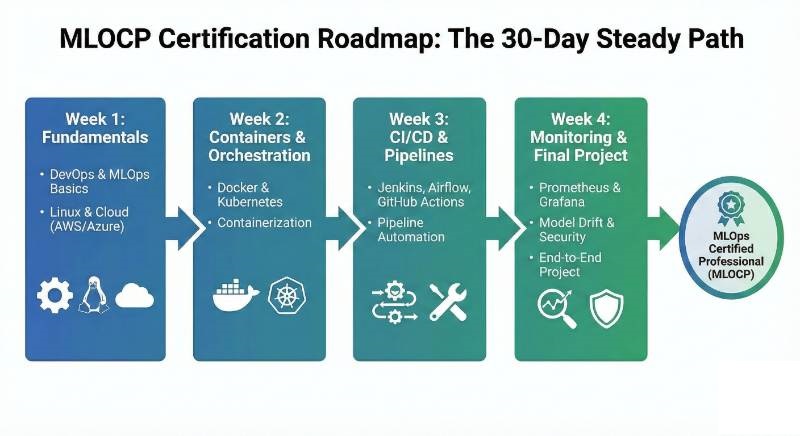
The 30-Day Steady Path (Recommended for most)
- Week 1: Fundamentals of DevOps and MLOps. Linux and Cloud (AWS/Azure) basics.
- Week 2: Containerization and Orchestration. Get comfortable with Kubernetes commands.
- Week 3: CI/CD and Pipeline Tools. Focus on Jenkins, Airflow, and GitHub Actions.
- Week 4: Monitoring, Security, and Final Project. Focus on Prometheus and model drift.
The 60-Day Deep Dive (For Beginners)
- Month 1: Focus heavily on Python, Data Engineering basics, and Infrastructure.
- Month 2: Focus on the MLOps specific tools and high-level architecture. Build at least 3 distinct projects.
Common Mistakes to Avoid
- Ignoring Infrastructure: Many focus only on the ML model and forget about the cloud and servers.
- Manual Deployments: If you are still deploying models manually, you are not doing MLOps. Automate everything.
- Forgetting Data Versioning: Models are nothing without data. You must version your data just like your code.
- Lack of Monitoring: A model that works today might fail tomorrow. Without monitoring, you won’t know why.
Best Next Certification After MLOCP
Once you master MLOps, the best next step is usually AIOps Certified Professional (AIOCP). This helps you apply AI to improve general IT operations.
Choose Your Path: 6 Learning Journeys
Every engineer has a different goal. Here are the 6 paths you can follow based on your interest.
1. The DevOps Path
This is the foundation. You focus on general software delivery.
- Certifications: DevOps Professional → DevOps Architect.
- Focus: CI/CD, Automation, Infrastructure.
2. The DevSecOps Path
For those who love security.
- Certifications: DevOps Professional → DevSecOps Professional.
- Focus: Security scanning, Vault, Compliance as Code.
3. The SRE Path
For those who want to build highly reliable systems.
- Certifications: DevOps Professional → SRE Certified Professional.
- Focus: Reliability, SLOs, Incident Management.
4. The AIOps/MLOps Path
The cutting edge of technology.
- Certifications: DevOps Professional → MLOps Certified Professional (MLOCP).
- Focus: ML Life Cycle, Model Deployment, AI Automation.
5. The DataOps Path
For the data enthusiasts.
- Certifications: Data Engineer → DataOps Certified Professional.
- Focus: Data Quality, Pipeline Orchestration, ETL Automation.
6. The FinOps Path
For those who want to manage the business side of the cloud.
- Certifications: Cloud Engineer → FinOps Professional.
- Focus: Cost Optimization, Budgeting, Cloud Economics.
Role → Recommended Certifications Mapping
| Your Current Role | Recommended Certifications |
| DevOps Engineer | DevOps Professional, DevSecOps Professional |
| SRE | SRE Certified Professional, Observability Master |
| Platform Engineer | Kubernetes Master, DevOps Architect |
| Cloud Engineer | AWS/Azure Professional, Terraform Associate |
| Security Engineer | DevSecOps Professional, Certified Ethical Hacker |
| Data Engineer | DataOps Professional, MLOps Professional |
| FinOps Practitioner | FinOps Professional, Cloud Practitioner |
| Engineering Manager | DevOps Manager, MLOps Manager |
Next Certifications to Take
After completing your MLOCP, you should look at these three options to further your career:
- Same Track: MLOps Certified Manager Focus on leading teams and managing the business value of ML projects.
- Cross-Track: AIOps Certified Professional Learn how to use AI to automate your own IT operations and log analysis.
- Leadership: Certified DevOps Architect Take a high-level view of how all these “Ops” tracks fit into an enterprise strategy.
Top Training & Certification Support Institutions
If you want to pass the MLOCP on your first try, you need expert help. These institutions are the best in the business.
- DevOpsSchool: A pioneer in “Ops” training. They offer 100% hands-on labs and lifetime access to materials. Their mentors have real-world experience.
- Cotocus: Known for their intensive bootcamps and enterprise-grade training programs. They focus on job-ready skills and career support.
- Scmgalaxy: A great resource for community-driven learning and technical blogs. They provide deep-dive tutorials on SCM and MLOps tools.
- BestDevOps: Offers specialized courses for working professionals. Their curriculum is updated regularly to match industry trends.
- AiOpsSchool: Focuses specifically on the intersection of AI and Operations. They are experts in MLOps and AIOps tracks.
- DataOpsSchool: The go-to place for data engineering and DataOps certifications. They help you master data pipelines and quality.
- FinOpsSchool: Specializes in cloud cost management and financial operations. Ideal for managers looking to optimize cloud spend.
FAQs (General Career & Value)
- How difficult is the MLOCP exam? It is moderately challenging. It tests both your knowledge of tools (like Docker) and your understanding of the ML lifecycle.
- Are there any prerequisites? No strict ones, but knowing Python and basic DevOps will help you finish faster.
- How long does it take to get certified? Most working professionals finish the training and pass the exam within 30 to 45 days.
- What is the sequence of certifications I should follow? Start with DevOps Professional, then move to MLOps Professional (MLOCP).
- Is this certification recognized globally? Yes, DevOpsSchool certifications are recognized by top MNCs in India, the US, and Europe.
- Will this help me get a salary hike? Absolutely. MLOps is one of the highest-paying roles in the tech industry today.
- Do I need a background in Data Science? You don’t need to be a Ph.D. in Math. You just need to understand how ML models work and how to handle data.
- What tools will I learn? You will master Git, Docker, Kubernetes, MLflow, Kubeflow, and Airflow.
- Can a manager take this course? Yes. It helps managers understand the technical hurdles their teams face in AI projects.
- Is there a lab environment provided? Yes, institutions like DevOpsSchool provide cloud-based labs for hands-on practice.
- How long is the certification valid? The certification is valid for 3 years, after which you can go for a refresher or advanced cert.
- What are the career outcomes? You can apply for roles like MLOps Engineer, ML Architect, or Lead AI Engineer.
FAQs (Specific to MLOCP Certification)
- What is the official URL for MLOCP? You can find it here: MLOCP Official Page.
- Who is the primary provider? The program is provided by DevOpsSchool.
- Does the course include real projects? Yes, the program is 80% hands-on with real-world scenarios.
- Can I take the exam online? Yes, the exam is conducted online, making it easy for global professionals.
- What if I fail the exam? Most providers allow a retake after 30 days of additional study.
- Does the certification cover LLMs? The advanced modules touch upon deploying and managing Large Language Models.
- Is Python mandatory for MLOCP? Yes, Python is the primary language used for ML pipelines.
- How much does the certification cost? Prices vary based on the training format (Live vs Self-paced). Check the official site for the latest deals.
Conclusion
The shift toward AI-driven software is permanent. Companies are no longer looking for just “developers”; they want engineers who can operationalize AI. The MLOps Certified Professional (MLOCP) is your ticket to this new world. It validates that you can handle the messy, complex, and exciting world of production Machine Learning.
Whether you are in India or working globally, this certification sets a standard of excellence. It proves you have the grit to build systems that don’t just work on a laptop, but work for millions of users. Start your journey today and become the expert the industry is looking for!
