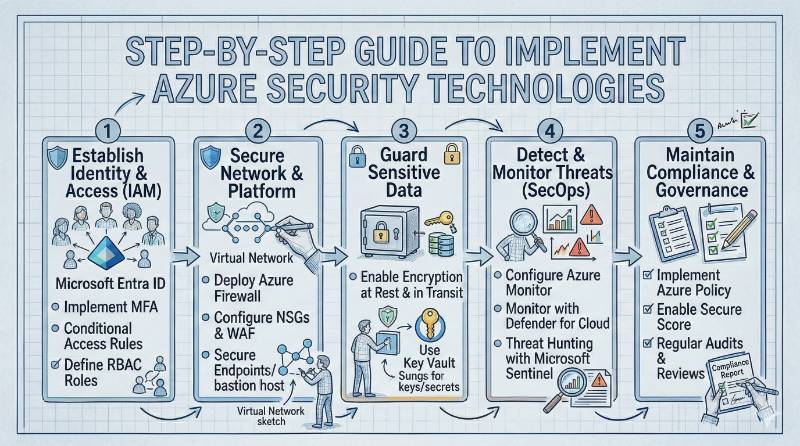
In the old days of IT, we built high walls around our data centers and assumed everything inside was safe. Those days are gone. Today, the “perimeter” is wherever your user happens to be sitting with their laptop. Security has moved from the physical gate to the digital identity. After years of watching systems fail and succeed, I can tell you that the most valuable engineers today are those who stop treating security as a “final check” and start treating it as the primary building block of their infrastructure.
The Microsoft Azure Security Technologies (AZ-500) program isn’t just a certificate to hang on your wall. It is a rigorous deep-dive into the tools that keep global enterprises running safely. This guide is designed to help you navigate this path, whether you are an engineer in the trenches or a manager looking to protect your organization’s future.
AZ-500 Certification: At a Glance
Before we dig into the technical layers, here is the essential roadmap for the AZ-500 track.
| Track | Level | Who it’s for | Prerequisites | Skills Covered | Recommended Order |
| Azure Security | Associate | Engineers, SREs, Managers, Developers | Azure Fundamentals & Admin experience | Identity, Platform Protection, Data & App Security, Security Ops | AZ-900 → AZ-104 → AZ-500 |
Deep Dive into the AZ-500 Certification
What it is
The AZ-500 is a specialized credential that validates your ability to secure Azure environments. It goes far beyond simple passwords. It covers how to manage identities, protect networks from sophisticated attacks, encrypt sensitive data, and set up continuous monitoring to catch threats in real-time. It is the gold standard for anyone who wants to be recognized as a security professional in the Microsoft cloud ecosystem.
Who should take it
This path is for those who are responsible for the safety of cloud resources. It is ideal for:
- Software Engineers who want to build secure applications.
- Cloud Engineers and SREs responsible for infrastructure uptime and safety.
- Security Analysts moving from on-premise to the cloud.
- Engineering Managers who need to understand the security posture of their departments.
Skills you’ll gain
By mastering this program, you gain the ability to look at a cloud environment and see the gaps before a hacker does. You will learn to manage the entire lifecycle of security, from setting up the first user account to investigating a complex security breach.
- Identity Control: You will learn to manage “who gets in” using Azure Active Directory, Multi-Factor Authentication (MFA), and Conditional Access policies.
- Perimeter Defense: You will learn to build digital “fences” using Azure Firewall, Network Security Groups (NSGs), and Web Application Firewalls (WAF).
- Data Protection: You will master the art of keeping secrets safe using Azure Key Vault and ensuring all your databases are encrypted and hidden from the public eye.
- Active Monitoring: You will learn to use Microsoft Sentinel and Defender for Cloud to watch your environment 24/7 and respond to alerts automatically.
Real-world projects you should be able to do after it
True expertise is measured by what you can build. After this certification, you will have the confidence to handle high-stakes security projects.
- Implementing Zero-Trust: Designing a system where every access request is fully verified and authorized, regardless of where it comes from.
- Hardening Cloud Networks: Setting up isolated environments for sensitive apps so that even if one part is compromised, the rest stays safe.
- Automated Threat Hunting: Creating custom rules in Sentinel to find specific patterns of unauthorized access or data movement.
- Compliance Auditing: Using Azure Policy to automatically find and fix any resource that doesn’t meet your company’s security standards.
Preparation plan
The best way to learn is through a mix of theory and doing. Choose the plan that fits your current life.
- 7–14 days (The “Fast Track”): Best for those who already work in Azure Security. Spend your time on practice exams to get used to the question style and focus on the latest updates in the Azure portal.
- 30 days (The “Professional Pace”): Best for working engineers. Dedicate 90 minutes a day. Spend two weeks on Identity and Networking, and two weeks on Data Security and Operations.
- 60 days (The “Deep Dive”): Best for managers or those new to security. Take the time to go through every lab twice. Understand not just how to turn on a feature, but why it is necessary.
Common mistakes
In my experience, many people fail not because they don’t know the tools, but because they don’t know the details.
- Skipping the Labs: You cannot pass this exam by just reading. You must navigate the Azure portal and see where the settings live.
- Ignoring Key Vault: Many engineers struggle with secret management. Make sure you understand how to grant access to keys and secrets properly.
- Underestimating Sentinel: Advanced monitoring is a big part of the exam. Don’t ignore the logging and alert-writing sections.
Best next certification after this
- Same Track: SC-100 (Cybersecurity Architect Expert) for those who want to design global security strategies.
- Cross-Track: AZ-400 (DevOps Engineer Expert) to learn how to automate security in the deployment pipeline.
- Leadership: AZ-305 (Solutions Architect Expert) to lead large-scale, secure cloud migrations.
Choose Your Path: Learning Roadmaps
Azure security is a massive field. Depending on your goals, you can focus your expertise in different areas:
- DevOps Path: Focus on “Infrastructure as Code.” Use your AZ-500 knowledge to ensure that every server and network you deploy is automatically secured.
- DevSecOps Path: This is the bridge. You help developers write secure code and help operations build secure environments. You are the glue that keeps the cycle safe.
- SRE Path: Security is a part of reliability. Use your skills to prevent security incidents that could cause system downtime.
- AIOps/MLOps Path: Secure your data models. Ensure that the AI systems your company builds aren’t vulnerable to data theft or model tampering.
- DataOps Path: Focus on the data. Use encryption and access controls to ensure your company’s “oil”—its data—is never leaked.
- FinOps Path: Secure your budget. Use Azure Policy to stop unauthorized, expensive resources from being created by rogue actors or mistakes.
Role → Recommended Certifications Mapping
| Your Role | The Best Path Forward |
| DevOps Engineer | AZ-104 → AZ-500 → AZ-400 |
| SRE | AZ-104 → AZ-500 → AZ-700 |
| Platform Engineer | AZ-104 → AZ-500 → AZ-305 |
| Cloud Engineer | AZ-900 → AZ-104 → AZ-500 |
| Security Engineer | AZ-500 → SC-200 → SC-300 |
| Data Engineer | DP-203 → AZ-500 |
| FinOps Practitioner | AZ-900 → AZ-500 |
| Engineering Manager | AZ-900 → AZ-500 |
Top Institutions for Training & Certification
Finding the right mentor is half the battle. Here are the top institutions that provide high-quality training for the AZ-500.
- DevOpsSchool: A premier institution known for its deep, hands-on labs and expert-led sessions. They focus on real-world scenarios rather than just exam theory, making it perfect for working professionals who need to apply skills immediately.
- Cotocus: They specialize in high-end cloud architecture and security training. Their courses are designed for teams who need to understand the complex side of cloud governance and advanced security configurations.
- Scmgalaxy: A vibrant community-driven platform that offers a mix of formal training and massive amounts of free technical resources. It is ideal for those who like to learn through peer discussion and technical blogs.
- BestDevOps: They provide a streamlined, efficient way to learn the most important parts of the DevOps and Security world. Their curriculum is updated constantly to keep up with the fast-moving cloud landscape.
- DevSecOpsSchool: The best place for those who want to specialize specifically in securing the delivery pipeline. They take the concepts of AZ-500 and show you how to automate them for faster, safer releases.
- Sreschool: Focuses on the intersection of security and system stability. They help you understand how threat detection and response are key to maintaining five-nines of reliability.
- Aiopsschool: Teaches you how to use advanced analytics and AI to manage security logs. This is perfect for those dealing with massive, global cloud environments.
- Dataopsschool: Focuses heavily on the data protection pillar. They help data engineers understand how to secure pipelines and data lakes without slowing down the business.
- Finopsschool: Provides a unique look at how security and cost management go hand-in-hand. They teach you how to use policies to protect both your data and your cloud budget.
FAQs: Career & Outcomes
- Is the AZ-500 exam very difficult? Yes, it is considered one of the tougher Associate exams because it covers a wide range of advanced security services.
- How long is the study time? For a working engineer, about 30 to 45 days of steady study is usually sufficient.
- Should I take the AZ-104 first? Highly recommended. Knowing how to manage Azure (AZ-104) makes it much easier to understand how to secure it (AZ-500).
- What kind of jobs can I get? Roles like Cloud Security Engineer, Security Analyst, and Senior DevOps Engineer are common for those with this cert.
- Is this certification valued in India? Extremely. Most major IT firms and global centers in India require this for their cloud security teams.
- Does it expire? It is valid for one year, but you can renew it for free through a short online assessment on the Microsoft site.
- Is there coding? You should be comfortable with basic scripting (PowerShell/CLI) and reading JSON templates.
- What is the pass score? You need a 700 out of 1000 to pass the exam.
- Are there labs in the exam? Sometimes Microsoft includes labs where you have to perform tasks in a real portal. Be prepared for them.
- Can a manager benefit from this? Yes. It gives you the technical understanding to lead your security team and make better risk decisions.
- How much does it cost? Usually around $165 USD, but prices vary by region. Check the official site for local currency pricing.
- What if I fail the first time? You can retake it after 24 hours. If you fail again, the wait time increases significantly.
FAQs: Technical Questions
- What is the focus of the Identity section? It’s all about Azure AD (Entra ID), managing users, MFA, and setting up “Just-In-Time” access with PIM.
- Do I need to know about networking? Yes. You must understand how to configure VNets, Firewalls, and Network Security Groups.
- What is Microsoft Sentinel? It is a “Cloud Native SIEM”—a tool that collects logs from everywhere to find and respond to threats.
- What is the difference between Key and Secret in Key Vault? Keys are for encryption/decryption; Secrets are for storing strings like passwords or connection tokens.
- What is Defender for Cloud? It is a tool that scans your resources to find security gaps and gives you a “Security Score.”
- Do I need to know about Container security? Yes, basic security for AKS (Azure Kubernetes Service) is part of the syllabus.
- How do I manage security at scale? Using Azure Policy to automatically enforce security rules across all your subscriptions.
- Does the exam cover Hybrid Cloud? Yes. You need to know how to securely connect your office to the Azure cloud using VPNs or ExpressRoute.
Conclusion
Mastering Microsoft Azure Security Technologies is not just about passing an exam; it is about changing your perspective on how modern systems should be built. In my years of seeing the industry evolve, the one constant is that security is the most stable and rewarding niche an engineer can choose. The AZ-500 provides you with the battle-tested skills needed to protect an organization’s most sensitive assets in a world that is always under threat. This guide has given you the map—from the initial learning path to the best institutions and real-world projects. Whether you are aiming for a salary hike, a more senior role, or just the peace of mind that your systems are safe, the AZ-500 is your gateway. Take the first step, invest in your training, and become the security expert that every cloud team needs.
