Digital transformation in healthcare is accelerating rapidly. Hospitals, clinics, and healthcare startups are investing heavily in technology to improve efficiency, patient care, and operational control.
However, one common confusion still exists:
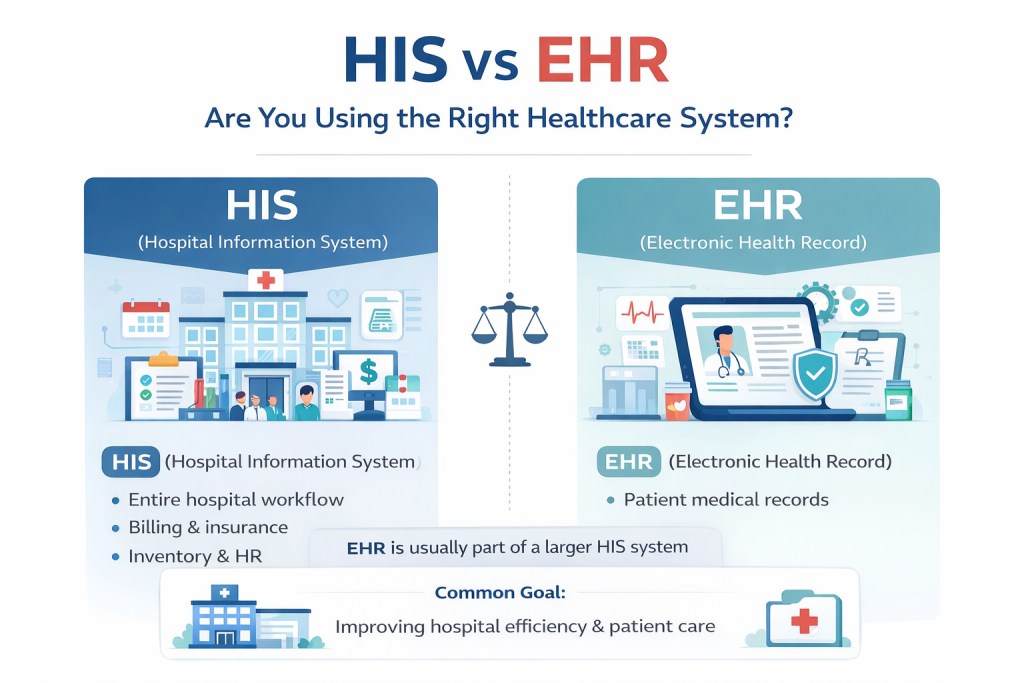
HIS and EHR are often used interchangeably — but they are NOT the same.
Understanding the difference between a Hospital Information System (HIS) and an Electronic Health Record (EHR) is critical before investing in healthcare software.
If you choose the wrong system, you may overspend, underutilize features, or miss key operational capabilities.
Let’s break it down clearly and practically.
What is HIS (Hospital Information System)?
A Hospital Information System (HIS) is a comprehensive software platform that manages the entire hospital’s operations — both clinical and administrative.
It connects every department inside a hospital.
Think of HIS as the operating system of the hospital.
Core Functions of HIS
- Patient registration & admission (OPD/IPD)
- Billing & insurance processing
- Pharmacy management
- Laboratory management
- Radiology integration
- Appointment scheduling
- Bed management
- Inventory & supply chain
- HR & payroll
- Financial reporting
- MIS dashboards
In simple terms:
👉 HIS = Runs the hospital
It ensures smooth coordination between departments and centralizes hospital operations.
What is EHR (Electronic Health Record)?
An Electronic Health Record (EHR) focuses specifically on patient medical information.
It digitizes and stores a patient’s:
- Medical history
- Diagnosis
- Prescriptions
- Lab results
- Imaging reports
- Allergies
- Immunizations
- Treatment plans
- Doctor notes
EHR improves clinical decision-making and patient continuity of care.
In simple terms:
👉 EHR = Stores patient health data
It ensures doctors have complete, accurate medical information at the point of care.
The Key Difference: HIS vs EHR
Let’s compare them clearly:
| Feature | HIS | EHR |
|---|---|---|
| Purpose | Manages entire hospital operations | Manages patient medical records |
| Scope | Clinical + Administrative | Clinical only |
| Used By | Admin staff, billing team, HR, doctors, management | Doctors, nurses, clinicians |
| Includes Billing? | Yes | Usually No |
| Includes Inventory? | Yes | No |
| Stores Medical Records? | Yes (via EHR module) | Yes |
| System Size | Enterprise-level | Department-level or standalone |
| Role | Operational management | Clinical documentation |
Important:
An EHR is often a module inside a full HIS platform.
Why People Confuse HIS and EHR
Many vendors market their solutions loosely.
Some call their product “HIS” even if it only includes EHR functionality.
Others call a full hospital management system “EHR” for simplicity.
This creates confusion.
But the distinction is clear:
- If it manages finance, HR, inventory, and operations → It’s HIS
- If it focuses only on patient records → It’s EHR
When Do You Need an EHR?
You need a standalone EHR if:
- You run a small clinic
- You are an independent doctor
- You want digital patient records only
- You don’t need full hospital operational control
- You already have billing software
EHR systems are ideal for:
- Specialty clinics
- Diagnostic centers
- Individual practitioners
- Telemedicine platforms
They are simpler, lighter, and more focused on clinical workflows.
When Do You Need a Full HIS?
You need a complete HIS if:
- You operate a multi-specialty hospital
- You manage inpatient and outpatient workflows
- You require billing + insurance + pharmacy integration
- You need centralized reporting
- You manage large staff and departments
- You want end-to-end digital transformation
HIS is designed for:
- Medium to large hospitals
- Multi-location healthcare networks
- Corporate hospital chains
- Government healthcare institutions
Digital Transformation Mistake Most Hospitals Make
Many hospitals invest in EHR thinking it will solve all operational problems.
But later they realize:
- Billing is disconnected
- Inventory is unmanaged
- Department coordination is weak
- Reporting is fragmented
They end up buying additional software — increasing complexity and cost.
The smarter approach is:
Define your operational goals first, then choose the right system.
Benefits of HIS
- Centralized hospital management
- Reduced operational errors
- Integrated billing and insurance
- Real-time financial tracking
- Better resource utilization
- Complete department coordination
- Executive-level reporting dashboards
Benefits of EHR
- Better patient data accuracy
- Faster access to medical history
- Improved clinical decisions
- Reduced paperwork
- Enhanced patient safety
- Continuity of care
- Easier compliance with regulations
Can You Use Both?
Yes — and most hospitals do.
Typically:
HIS = Main system
EHR = Clinical module inside HIS
Modern HIS platforms include:
- Integrated EHR
- Pharmacy module
- Laboratory module
- Radiology integration
- Billing system
- ERP-like features
So instead of choosing one over the other, many institutions adopt a complete HIS that includes EHR functionality.
Strategic Questions Before You Invest
Before selecting a system, ask:
- Are you a clinic or a full hospital?
- Do you need billing & insurance integration?
- Do you manage inventory and supply chains?
- Do you require department-level coordination?
- Do you need enterprise reporting?
- Will you expand to multiple branches?
Your answers will determine whether you need:
- Only EHR
or - A complete HIS
Future of Healthcare IT
The future of healthcare systems includes:
- AI-powered clinical decision support
- Cloud-based HIS platforms
- Mobile-first EHR systems
- Interoperability between systems
- Real-time analytics
- Patient portals & telemedicine integration
Hospitals that choose the right foundation today will scale more efficiently tomorrow.
Final Thoughts
HIS and EHR are not competitors.
They serve different purposes.
🔹 HIS manages hospital operations.
🔹 EHR manages patient medical data.
An EHR is typically a part of a larger HIS system.
Before investing in healthcare technology, clearly define your needs.
Because the wrong system can slow your digital transformation — while the right one can transform your entire healthcare operation.
