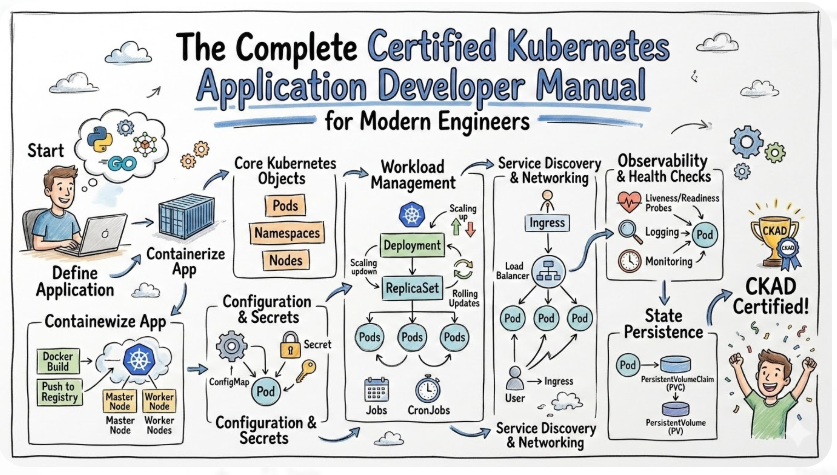
In the current era of software delivery, the wall between writing code and running it has crumbled. For a long time, developers focused only on logic, while operations teams handled the servers. Today, that model is broken. To build reliable software at scale, every engineer must understand the platform where their code lives. Kubernetes has become that platform. It is the operating system of the modern cloud.
When I talk to engineering teams and leadership, the conversation eventually turns to validation. How do you prove a developer truly understands how to navigate a containerized world? The Certified Kubernetes Application Developer (CKAD) stands out as the gold standard. It is not a test of what you can remember; it is a test of what you can actually build under pressure.
This guide provides a roadmap for engineers and managers to understand the CKAD program and how it fits into a long-term career in modern technology.
Global Certification Landscape: Where to Begin
Navigating the world of certifications can be confusing. This table breaks down the essential tracks for those looking to master the cloud-native ecosystem.
| Track | Level | Who it’s for | Prerequisites | Skills Covered | Recommended Order |
| Cloud-Native | Entry | Managers & Newbies | General Tech Knowledge | Containers, Orchestration basics | 1 |
| Kubernetes App Dev | Specialist | Software Engineers | Docker / Container Basics | Pod Design, Networking, Storage, Security | 2 |
| Kubernetes Admin | Professional | SREs & Admins | Linux & Networking | Cluster setup, Logging, Troubleshooting | 3 |
| Security | Advanced | Security Engineers | CKA Certification | Hardening, Supply chain, Runtime security | 4 |
| Infrastructure | Associate | DevOps Engineers | Basic Cloud Knowledge | Terraform, Automation, IaC | 5 |
| Management | Foundation | Leads & Directors | Engineering Experience | DevOps culture, Metrics, ROI | 6 |
The Core Pillar: Certified Kubernetes Application Developer (CKAD)
The CKAD is unique because it forces you to step out of your IDE and into the cluster. It validates that you can take an application and make it run successfully in a distributed environment.
What it is
The CKAD is a performance-based certification managed by the Linux Foundation and the CNCF. It is a two-hour proctored exam where you are given a series of tasks to complete on a live Kubernetes cluster. There are no multiple-choice questions. You either solve the problem or you don’t. It focuses on the specific resources and patterns used to deploy and manage applications, rather than the administration of the cluster itself.
Who should take it
This is for any Software Engineer who wants to be proficient in modern delivery. If you are building microservices, you need this. For Engineering Managers, having this certification means you understand the technical hurdles your team faces every day. It allows you to speak the same language as your SRE and DevOps teams, making you a much more effective leader.
Skills you’ll gain
Preparing for this exam requires a shift in mindset. You stop thinking about individual virtual machines and start thinking about a pool of resources.
The primary skills you will develop include:
- Designing and Building (20%): Mastering multi-container patterns and choosing the right container images.
- Deployment and Configuration (20%): Learning how to roll out updates and use Helm for repeatable deployments.
- Observability (15%): Using logs and probes to ensure your application is actually healthy, not just “running.”
- Security and Environment (25%): Managing passwords (Secrets), configuration (ConfigMaps), and resource limits.
- Networking (20%): Connecting your services together and controlling traffic flow with Network Policies and Ingress.
Real-world projects you should be able to do after it
The value of the CKAD shows up in your daily work. Once you master these concepts, you can handle complex production tasks that used to require a dedicated operations person.
You will be able to:
- Build Resilient Systems: Set up auto-scaling so your app handles traffic spikes without manual intervention.
- Manage Secrets Safely: Ensure database credentials and API keys are never hard-coded but managed securely through the platform.
- Troubleshoot Fast: Quickly find out why a service is failing by looking at logs, events, and container states.
- Control Traffic: Route users to specific parts of your application based on their URL or request headers.
- Automate Everything: Use YAML and imperative commands to make deployments predictable and fast.
Preparation plan (7–14 days / 30 days / 60 days)
The time you need to spend depends on your current hands-on experience with kubectl.
The 7–14 Day Plan (For Daily K8s Users)
If you already work in Kubernetes every day, you just need to learn the exam’s “speed.”
- First Half: Study the exam domains. Focus on areas you don’t use often, like Network Policies or specific Pod patterns.
- Second Half: Do mock exams. Speed is the biggest killer in this exam. You must be fast with the command line.
The 30-Day Plan (For Most Engineers)
This is for the developer who knows containers but hasn’t spent much time in a production cluster.
- Week 1-2: Master the core objects: Pods, Deployments, Services, and ConfigMaps. Learn how to create them using commands rather than writing long YAML files.
- Week 3: Focus on Networking and Storage. Understand how to connect things and how to save data.
- Week 4: Practice. Take the official mock exams and focus on finishing them within 90 minutes.
The 60-Day Plan (For Beginners)
If you are coming from a non-container background, take your time.
- Month 1: Focus on Linux and Docker. You cannot run Kubernetes if you don’t understand how a container works.
- Month 2: Follow the 30-day plan. Move from local Docker to a local Kubernetes tool like Minikube to practice.
Common mistakes
I have seen many talented engineers fail this exam because they treated it like a school test.
- Over-reliance on documentation: Yes, you can look things up, but if you do it for every question, you will run out of time.
- Forgetting the Context: Each question might be on a different cluster. If you don’t switch your “context” first, you’ll be doing the work in the wrong place.
- Typos: One wrong space in a YAML file can break everything. Use imperative commands (
kubectl create) as much as possible to avoid typing errors. - Stubbornness: If a question is worth 2% and you’ve spent 10 minutes on it, move on. You need to pass, not get a perfect score.
Choose Your Path: 6 Specializations for Your Career
Once you have your CKAD, you have a strong base. Now, you should decide which direction you want to grow in. Modern engineering has six major branches.
1. DevOps
This path is about the “how” of software delivery. You focus on building the roads (CI/CD pipelines) that the code travels on. Your goal is to make software delivery fast, safe, and repeatable.
2. DevSecOps
Security is no longer a separate step at the end. In this path, you learn how to bake security into every part of the process—from scanning the code to locking down the Kubernetes cluster itself.
3. SRE (Site Reliability Engineering)
SREs are responsible for keeping the lights on. You focus on scaling, performance, and reliability. You use software to solve operational problems, ensuring that the system can handle whatever the world throws at it.
4. AIOps / MLOps
As AI grows, we need people who know how to run machine learning models at scale. This path focuses on using Kubernetes to manage the heavy data and processing needs of AI applications.
5. DataOps
Data is the lifeblood of most companies. DataOps is about managing the flow of data. You focus on running big data tools like Spark or Kafka on top of Kubernetes to keep data moving smoothly.
6. FinOps
Cloud costs can get out of control quickly. FinOps is the practice of managing those costs. You use your technical knowledge to make sure the company is getting the most value for every dollar spent on cloud resources.
Role → Recommended Certifications
If you are looking for your next career move, here is how you should align your learning:
| Your Current Role | Must-Have Cert | Next Step |
| Software Engineer | CKAD | Cloud Associate |
| DevOps Engineer | CKA | Terraform / CKS |
| SRE | CKA | CKAD / SRE Foundation |
| Platform Engineer | CKA | CKS / Terraform |
| Security Engineer | CKS | DevSecOps Foundation |
| Data Engineer | DataOps | CKAD |
| FinOps Professional | FinOps | Cloud Basics |
| Engineering Manager | Cloud Basics | CKAD (Expertise) |
What Comes Next?
Passing the CKAD is a milestone, not a finish line. To keep growing, you should look at one of these three options:
- Stay in the Track: Take the CKA (Administrator) exam. This will teach you how the cluster works under the hood, making you a much better troubleshooter.
- Go Cross-Track: Learn Terraform. While Kubernetes manages your apps, Terraform manages the hardware and networks they run on. Together, they make you a powerhouse.
- Go into Leadership: Focus on the DevOps Foundation. This teaches you how to change the culture of a company, which is often harder than changing the technology.
Top Training Institutions for CKAD Success
For those who want guided learning, these organizations provide excellent training and hands-on labs to help you master Kubernetes.
- DevOpsSchool: This is a leading global institution that offers deep-dive training with a focus on real-world application. Their instructors are veterans who help you build actual skills, not just pass a test.
- Cotocus: They specialize in corporate training and technical workshops. If your whole team needs to get up to speed on Kubernetes, they are a great choice for standardizing knowledge.
- Scmgalaxy: A very established name in the community, they focus on the “how-to” of software management. Their training covers everything from source code to final deployment.
- BestDevOps: They provide result-driven training that focuses heavily on the imperative commands and speed needed to succeed in the CKAD environment.
- devsecopsschool: If you want to learn Kubernetes with a focus on security from day one, this school offers great programs that bridge that gap.
- sreschool: Their curriculum is designed for those who care about uptime and reliability, focusing on the monitoring and debugging aspects of Kubernetes.
- aiopsschool: Ideal for engineers moving into the world of AI, they teach you how to manage data-heavy workloads on a Kubernetes platform.
- dataopsschool: They provide the specialized knowledge needed to run large-scale data systems and pipelines using modern orchestration.
- finopsschool: A great resource for those who want to understand the financial side of the cloud, helping you balance performance with cost.
Strategic FAQs: For Leaders and Seniors
1. Why is the CKAD better than a multiple-choice exam?
Multiple-choice tests memory. CKAD tests ability. In a high-stakes environment, I would always trust an engineer who has proven they can solve a live problem over someone who just passed a written test.
2. Is this certification worth the investment for my team?
Yes. It standardizes the knowledge across your team. When everyone understands the core concepts of Kubernetes, you spend less time explaining basics and more time building features.
3. How does this impact our hiring process?
It acts as a pre-filter. If a candidate has a CKAD, you know they can at least navigate a terminal and understand the basics of pod design. It saves your senior engineers from doing basic technical screening.
4. Does it matter if we use AWS, Azure, or Google Cloud?
No. The CKAD is vendor-neutral. The skills your team learns will work on any cloud provider that supports Kubernetes, preventing vendor lock-in.
5. Is Kubernetes too complex for smaller teams?
It can be, but the CKAD teaches you the “right” way to do things. Even for small teams, following these patterns prevents “technical debt” that becomes very expensive later.
6. What is the biggest hurdle to passing?
Time management. Most people who fail know the answers; they just didn’t have enough time to type them out.
7. How often should my team re-certify?
The certificate lasts for two years. Because the technology changes so fast, it is a good idea to refresh every two years to stay current with new features.
8. Should my managers take this too?
At least the basic version. A manager who doesn’t understand the platform their team uses will struggle to make good decisions about timelines and resources.
9. Can we self-study for this?
Yes, but it takes longer. Structured training usually cuts the learning time in half because it points out the common traps that self-study often misses.
10. Does this help with security?
Absolutely. A large part of the CKAD is about managing Secrets and Service Accounts. These are the building blocks of a secure application.
11. What is the value of the free retake?
It lowers the pressure. Knowing you have a “practice run” helps engineers overcome the anxiety of the live environment.
12. Is the documentation helpful during the exam?
Yes, but only if you know exactly where to look. You should use it as a reference for syntax, not as a textbook to learn new things.
Practical FAQs: For Candidates
1. Where do I register?
You can find the official link and details here: CKAD Official URL. The training is often facilitated through DevOpsSchool.
2. What is the exam environment like?
It is a remote-proctored terminal in your browser. You will have a list of tasks on one side and a command line on the other.
3. Do I need to know how to install Kubernetes?
No. That is for the CKA (Administrator). You just need to know how to use an existing cluster.
4. Can I use a Mac or Windows?
You can take the exam on either, as long as you have a stable internet connection and a webcam. The actual exam environment is Linux-based.
5. What happens if I lose my internet connection?
The proctors are usually understanding. If it’s a short glitch, you can jump back in. If it’s a long outage, you may need to use your retake.
6. Is there a lot of YAML writing?
There is a lot of YAML reading and editing. You should use commands to generate the basic files and then edit them to save time.
7. How long do results take?
Usually, you will get your results via email within 24 to 48 hours.
8. Can I use my own aliases?
Yes. Setting up alias k=kubectl is the first thing every candidate should do when the timer starts.
Conclusion
The shift toward containerized applications is the biggest change in our industry in the last decade. It has changed how we think about servers, scale, and reliability. For an engineer, mastering Kubernetes is no longer about adding a buzzword to a resume; it is about gaining the technical maturity to build software that actually lasts. The CKAD is the most practical way to prove you have reached that level. It requires discipline, speed, and a deep understanding of the platform. Whether you are an individual contributor looking to level up or a manager trying to build a world-class team, investing in this certification is a strategic move that pays off in higher quality code and more reliable systems. The technology will keep changing, but the principles you learn here will stay with you for the rest of your career.
