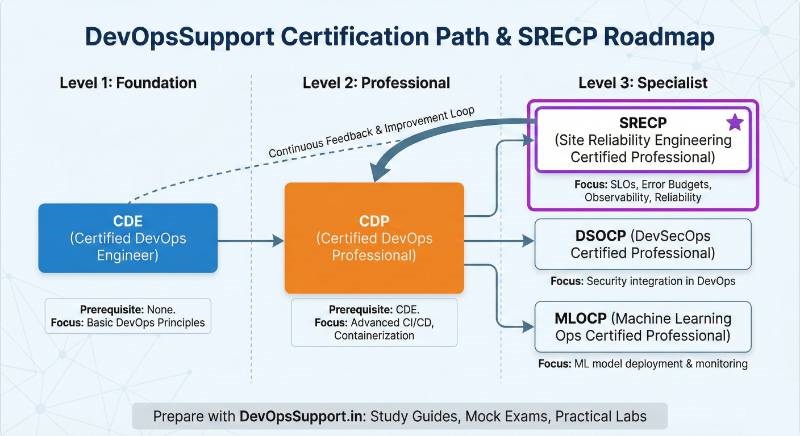
In an era where every minute of downtime is a headline and every glitch costs customer trust, the stakes for maintaining software systems have never been higher. Site Reliability Engineering (SRE) has evolved as the essential bridge between high-speed development and rock-solid stability. Whether you are a software engineer tired of 2 AM fire drills or a manager looking to build a resilient, scalable culture, the SRE Certified Professional (SRECP) program is your master roadmap. This guide is designed to help you navigate the training and certification landscape, turning operational headaches into engineering solutions that power the global digital economy.
The Master Certification Roadmap
Choosing the right certification depends on your current career stage and where you want to go. Below is a comprehensive look at the professional tracks available through DevOpsSchool.
| Track | Certification | Level | Who it’s for | Prerequisites | Skills Covered | Recommended Order |
| SRE | SRE Certified Professional (SRECP) | Professional | SREs, DevOps, SysAdmins | Linux, Git, CI/CD | SLOs, Error Budgets, Monitoring, Toil | After CDP |
| DevOps | Certified DevOps Engineer (CDE) | Foundation | Freshers, Software Eng | Basic Logic | Git, Docker, Ansible, Maven | 1st Step |
| DevOps | Certified DevOps Professional (CDP) | Professional | Working Engineers | CDE or 1yr Exp | Jenkins, K8s, Terraform, Prometheus | 2nd Step |
| DevSecOps | DSOCP | Professional | Security/DevOps Eng | Basic DevOps | SonarQube, Vault, Trivy, Compliance | After CDP |
| MLOps | MLOCP | Professional | Data Scientists, ML Eng | Python, ML Basics | ML Pipelines, Model Deployment | After CDP |
| AIOps | AIOCP | Professional | SREs, Data Engineers | Ops experience | Predictive Analytics, Auto-Remediation | After SRECP |
| DataOps | DOCP | Professional | Data Eng, DBAs | SQL, Data Pipelines | Data Quality, Pipeline Automation | After CDE |
| FinOps | FCP | Professional | Cloud Eng, Managers | Cloud Basics | Cost Optimization, Cloud Billing | Standalone |
Deep Dive: SRE Certified Professional (SRECP)
What it is
The SRE Certified Professional (SRECP) is a specialized program designed to teach you how to treat operations as a software problem. It focuses on the core principles of reliability, such as using data to balance system stability with the speed of new feature releases.
Who should take it
- Software Developers who want to deeply understand how their code performs at scale.
- DevOps Engineers looking to move into high-level reliability and architecture roles.
- System Administrators modernized their skills for cloud-native, automated environments.
- Engineering Managers who need to implement SRE practices across their organizations.
Skills you’ll gain
- Mastery of Service Level Objectives (SLOs) and Service Level Indicators (SLIs) to track real system health.
- Implementing Error Budgets to make data-driven decisions on release velocity.
- Advanced Full-Stack Observability using tools like Prometheus and Grafana.
- Strategic Incident Management and conducting effective, blameless post-mortems.
- Automating manual processes (Toil Reduction) using Python, Ansible, and Terraform.
Real-world projects you should be able to do
- Build a self-healing system that detects and restarts failing services automatically.
- Create a central observability dashboard that tracks “Golden Signals” (Latency, Traffic, Errors, Saturation).
- Develop a disaster recovery playbook that ensures zero data loss during a region failure.
- Automate infrastructure provisioning for a multi-cloud environment using a GitOps workflow.
Preparation Plan
- 7–14 Days (The Expert Sprint): This is for engineers already working in DevOps or Cloud roles. Spend your first week mastering the theory of SLIs, SLOs, and Error Budgets. Use the second week to refresh your hands-on skills with Prometheus and Kubernetes through intensive lab sessions.
- 30 Days (The Professional Path): This is the ideal timeline for most working engineers. Dedicate 45 minutes daily. Spend the first two weeks on Observability and Monitoring (Prometheus/Grafana). Use the third week for Automation and Toil Reduction (Ansible/Python). Reserve the final week for mock exams and incident management simulations.
- 60 Days (The Career Transformer): If you are moving from a traditional SysAdmin or manual testing role, take the slow and steady route. Spend the first month building a foundation in Linux, Python, and Git. Spend the second month following the SRECP syllabus, focusing heavily on how to automate infrastructure using Terraform and Kubernetes.
Common Mistakes
- Treating SRE as “SysAdmin 2.0”: SRE is about engineering, not just maintaining servers. If you aren’t writing code to automate your work, you aren’t doing SRE.
- Over-alerting: Sending alerts for every small spike leads to fatigue. Only alert on issues that actually impact your SLOs.
- Ignoring the Culture: SRE fails in a culture of blame. You must focus on fixing the system, not pointing fingers at people.
Best next certification after this
Once you are a certified SRE, the natural progression is AIOps Certified Professional (AIOCP) to bring artificial intelligence into your monitoring, or the Master in DevOps Engineering (MDE) for an executive-level view of the entire stack.
Choose Your Path: 6 Specialized Learning Tracks
- The DevOps Path: The baseline for modern delivery. Focuses on speed and collaboration across the entire development lifecycle.
- The DevSecOps Path: Security is no longer an afterthought. This track bakes security testing and compliance directly into your automated pipelines.
- The SRE Path: The gold standard for production. Focuses on system reliability, high availability, and proactive observability.
- The AIOps/MLOps Path: The cutting edge. Learn how to use AI to manage infrastructure or how to build reliable pipelines specifically for Machine Learning models.
- The DataOps Path: Data is the lifeblood of business. This path ensures that data pipelines are as reliable and automated as software pipelines.
- The FinOps Path: Cloud costs can spiral out of control. This track teaches you how to optimize cloud spend and bring financial accountability to engineering.
Role → Recommended Certifications
- DevOps Engineer: CDE → CDP → KCAD
- Site Reliability Engineer (SRE): SRECP → Master in Observability Engineering
- Platform Engineer: CDP → KCAD → Master in DevOps Engineering
- Cloud Engineer: CDP → AWS/Azure/GCP Architect Professional
- Security Engineer: CDP → DSOCP → Security Architect
- Data Engineer: DataOps Foundation → DOCP → CDP
- FinOps Practitioner: FCP → CDP → Cloud Cost Specialist
- Engineering Manager: Master in DevOps Engineering → CDM
Top Institutions for SRE Training & Certification
Getting certified is important, but where you train matters just as much. These institutions are the leaders in helping engineers transition into SRE roles:
- DevOpsSchool: The primary hub for the SRECP certification. They offer energetic, live instructor-led sessions that focus on real-world projects and the actual day-to-day challenges SREs face.
- Cotocus: Specializes in high-end consulting and technical training for enterprise teams. They are known for deep-dive workshops that help large companies shift to an SRE model.
- Scmgalaxy: A massive community-driven platform. It is a goldmine of tutorials, scripts, and documentation for anything related to configuration management and CI/CD.
- BestDevOps: Focuses on “job-ready” programs. They bridge the gap between classroom learning and the specific skills top-tier tech companies are looking for.
- DevSecOpsSchool: The specialized wing for security integration, ensuring that your reliability efforts are always compliant and secure.
- SRESchool: A dedicated portal focusing 100% on Site Reliability Engineering, chaos engineering, and observability.
- AIOpsSchool: Leads the charge in showing how AI can be used to predict failures and automate fixes before an outage even occurs.
- DataOpsSchool: Focuses specifically on the automation and quality of big data and analytics pipelines.
- FinOpsSchool: The go-to institution for learning how to manage cloud costs without sacrificing system performance.
Next Steps in Your Journey
Earning your SRECP is a massive milestone, but the tech landscape never stands still. To stay ahead of the curve, consider these three distinct paths for your next move:
- Same Track (Deep Specialization): Master in Observability Engineering (MOE). Go beyond basic monitoring. Learn the deep mechanics of distributed tracing, log aggregation, and advanced metrics to become the person who can find a needle in a digital haystack.
- Cross-Track (Broaden Your Impact): DevSecOps Certified Professional (DSOCP). A reliable system must also be a secure one. Learning to bake security scanning and compliance directly into your SRE workflows makes you a dual-threat in the job market.
- Leadership (Career Growth): Certified DevOps Manager (CDM). If you want to move from the terminal to the boardroom, this is the path. It teaches you how to lead SRE teams, manage budgets, and drive digital transformation at an organizational level.
General Career & Outcome FAQs
1. Is SRECP hard to pass? It is a professional-level exam. It requires a solid mix of theory and practical lab work. If you follow the coursework and do the labs, you will be well-prepared.
2. How long does the preparation take? Most working engineers find that 30 days of consistent study is perfect. If you are a beginner, aim for 60 days to build your foundation.
3. Are there prerequisites? Technically no, but we highly recommend a basic understanding of Linux and CI/CD (like the CDE certification) before starting SRECP.
4. What is the market value of an SRE? SRE is one of the highest-paying roles in the industry. Companies globally are desperate for engineers who can guarantee uptime and reliability.
5. Can a developer become an SRE? Yes! SRE is essentially a software engineering approach to operations. Developers often make the best SREs because they love to solve problems with code.
6. Does it cover cloud platforms? Yes, the principles of SRECP are cloud-agnostic and apply to AWS, GCP, Azure, and on-premise environments.
7. Is the certification globally recognized? Yes, the SRECP from DevOpsSchool is recognized by major tech firms across India, the US, and Europe.
8. Is there a focus on coding? Yes. You will learn how to use Python and Bash to automate away “toil” and build self-healing systems.
9. Will this help me get a job in India? Absolutely. India’s tech hubs like Bangalore, Pune, and Hyderabad have a massive demand for certified SREs.
10. What are the career outcomes? Expect to move into roles like Senior SRE, Infrastructure Architect, or Reliability Lead.
11. Is the exam online? Yes, both the training and the certification exam are available fully online.
12. Does it help with incident response? Yes, it provides a structured framework for handling outages and conducting blameless post-mortems.
SRECP Specific FAQs
1. What is the core toolset in SRECP? The course focuses heavily on Prometheus, Grafana, Kubernetes, and Ansible.
2. Do we learn about “Error Budgets”? Yes. This is a core part of the syllabus—learning how to manage the trade-off between speed and risk.
3. Is there a focus on “Toil”? Identifying and eliminating manual, repetitive work (toil) is a major theme throughout the certification.
4. Does the course include real labs? Yes, the program is roughly 70% hands-on labs where you build and break real systems.
5. What is “Blamelessness”? It’s a cultural practice you’ll learn that focuses on system failures rather than human mistakes during an outage.
6. Is there interview support? Most DevOpsSchool programs include guidance on building your portfolio and preparing for SRE-specific interviews.
7. How long is the certification valid? It typically stays valid for 2-3 years, keeping you up-to-date with the latest industry shifts.
8. Can I start with SRE if I am a fresher? It’s better to start with the CDE (DevOps Foundation) and then move to SRE once you have the basics down.
Conclusion
Mastering Site Reliability Engineering is about much more than just learning new tools; it is about adopting a mindset that views failure as an opportunity for engineering improvement. The SRE Certified Professional (SRECP) certification provides the technical foundation and cultural framework needed to protect your systems and your company’s reputation. By choosing this path, you are not just getting a certificate—you are becoming an indispensable architect of the modern, always-on digital world. Take the first step, choose your learning track, and start building a more reliable future today.
