The landscape of software development has shifted beneath our feet. A decade ago, we could manage a handful of servers with simple scripts. Today, we are dealing with thousands of moving parts that exist in the cloud for only a few minutes at a time. If you are an engineer or a manager, you have likely felt that sinking feeling when a system crashes and nobody knows why. You look at your dashboards, and everything is green, yet users are screaming that the app is broken. This is the “blind spot” of modern engineering.
Mastering Observability Engineering is about removing those blind spots. It is not just about having more charts; it is about having the right data to ask questions you didn’t even know you had. This guide is designed to help you navigate this transition and understand how a professional certification can give you the edge in a crowded global market. Whether you are in India or working for a remote startup in the West, these skills are what separate the people who fix problems from the people who prevent them.
The Evolution from Monitoring to Observability
For a long time, we relied on monitoring. Monitoring is great for known problems—like when a disk is full. But modern systems fail in ways we cannot predict. Observability is a more human way of looking at technology. It allows us to explore the “why” instead of just the “what.” It is the difference between a doctor checking your pulse and a doctor performing a full MRI scan.
As someone who has navigated the ups and downs of tech shifts, I can tell you that the demand for this specific expertise is exploding. Companies are no longer looking for people who can just “run” tools; they want engineers who understand the telemetry of the entire business.
Core Certification Details: Master in Observability Engineering
If you are looking to formalize your expertise, the Master in Observability Engineering is the definitive path. It is built to bridge the gap between basic devops tasks and high-level architectural visibility.
| Track Name | Skill Level | Target Audience | Essential Prerequisites | Core Skills Covered | Recommended Sequence |
| Observability Systems | Master / Expert | SRE, Devs, Platform Leads | Linux, Cloud Basics, Docker | Tracing, SLOs, OpenTelemetry, Log Aggregation | Foundation → Master |
A Practitioner’s View: The Master in Observability Engineering (MOE)
Understanding the Core of the Program
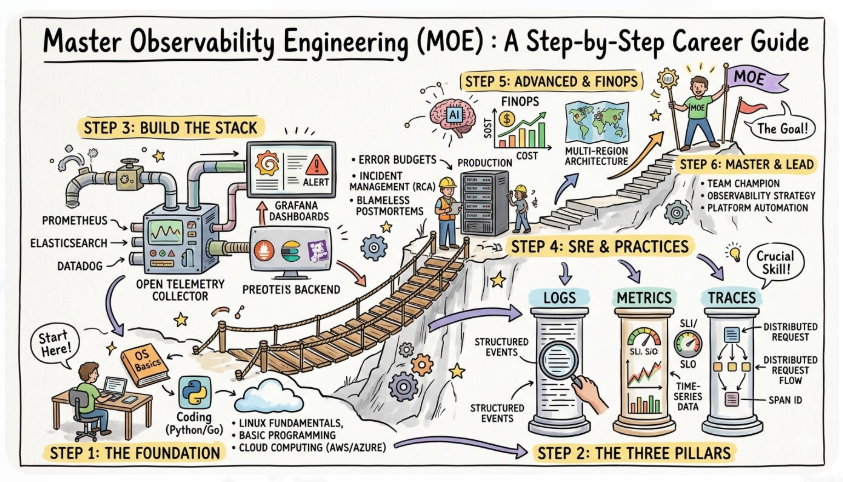
The Master in Observability Engineering is a specialized curriculum provided by DevOpsSchool. This isn’t just a series of videos; it is a deep dive into the soul of modern infrastructure. It focuses on the three pillars—logs, metrics, and traces—but goes much deeper by teaching you how to build a unified telemetry strategy. You learn how to make your systems “talk” to you in a way that makes sense during a high-pressure outage.
Identifying the Right Candidates for Mastery
This journey is perfect for those who are already working in the field but feel stuck. If you are a Software Engineer who wants to understand how your code behaves in the wild, or a DevOps Engineer who wants to move into a senior SRE role, this is for you. Managers also find this invaluable because it gives them the vocabulary to lead teams toward better reliability and performance. It is for anyone who believes that “guessing” is not a valid troubleshooting strategy.
Practical Abilities You Will Develop
You will gain a toolkit of skills that are immediately applicable to any production environment. You will learn to navigate the complexities of modern data collection without slowing down your applications.
- Deep Instrumentation: You will master the art of adding telemetry to applications using OpenTelemetry, ensuring you get data from every layer of the stack.
- Trace Analysis: You will learn how to stitch together thousands of individual service calls into a single, understandable story of a user’s journey.
- Service Level Mastery: You will move past simple uptime percentages and learn how to create meaningful SLOs and SLIs that reflect true user happiness.
- High-Cardinality Data Management: You will learn how to handle massive amounts of data efficiently, ensuring your observability tools don’t cost more than your actual infrastructure.
Real-World Outcomes: What You Will Build
After completing this path, you will have a portfolio of projects that prove you can handle real-world chaos.
- The Distributed Blueprint: You will build a system that can track a single request across a complex web of microservices, identifying exactly where latency is hiding.
- The Intelligent Alerting Engine: You will design a system that ignores the “noise” and only alerts your team when there is a genuine threat to the user experience.
- The Telemetry Pipeline: You will create a centralized hub that collects data from various sources, cleans it, and sends it to the right team members for analysis.
Your Learning Timeline
- Phase 1 (14 Days): Focus on the vocabulary. Understand the difference between events and metrics. Set up a basic sandbox environment to see how data flows from a container to a dashboard.
- Phase 2 (30 Days): Start the heavy lifting. Instrument a real application. Learn to write queries that find hidden patterns in your logs. This is where the theory starts to feel real.
- Phase 3 (60 Days): Focus on scale. How do you do this for 1,000 servers? Learn about sampling, data retention, and how to manage the cost of your observability stack.
Common Pitfalls to Avoid
Many engineers fail because they try to “monitor everything.” This leads to alert fatigue and wasted money.
- Data Hoarding: Don’t collect data just for the sake of it. If you don’t know what question the data answers, don’t store it.
- Ignoring the Human Factor: A dashboard is useless if no one knows how to read it. Focus on creating views that tell a clear story.
- Focusing on Tools over Principles: Tools change every year. Focus on the principles of telemetry and data analysis; they will serve you for the next decade regardless of which software you use.
Choosing Your Professional Direction: 6 Specialized Paths
Observability is the “connective tissue” of modern IT. Depending on your interests, you can take your mastery in several directions:
- The DevOps Path: Use observability to make your deployments safer. If a new version of code starts acting strangely, your observability tools should catch it before it hits all your users.
- The DevSecOps Path: Security is just another form of observability. By watching your system’s behavior, you can spot hackers or unauthorized data transfers much faster than traditional security tools.
- The SRE Path: This is the ultimate goal for many. Use your data to balance the need for fast changes with the need for a stable system.
- The AIOps/MLOps Path: Feed your high-quality observability data into machine learning models to predict failures before they happen.
- The DataOps Path: Ensure your data pipelines are healthy. If your data is wrong, the business makes wrong decisions. Observability keeps your data trustworthy.
- The FinOps Path: Use your visibility to see exactly where your cloud budget is going. Turn off what you don’t need and optimize what you do.
Role-Based Certification Recommendations
Not every role needs the same path. Here is how I recommend you map your growth:
- DevOps Engineer: Start with foundational DevOps certs, move to Kubernetes mastery, and finish with the Master in Observability.
- Site Reliability Engineer (SRE): Focus heavily on SRE principles first, then move directly into the Observability Master program.
- Platform Engineer: Your goal is to build tools for others. Learn the Master in Observability to provide “Observability as a Service” to your developers.
- Security Engineer: Focus on DevSecOps certifications but use the Observability Master to learn how to hunt for threats in system logs.
- FinOps Practitioner: Combine your financial knowledge with the technical visibility gained in the Observability Master program to truly control cloud costs.
- Engineering Manager: You need to understand the “big picture.” Take the Certified DevOps Manager course and then the Observability Master to lead with data.
Why Choose DevOpsSchool?
When you are looking for a place to learn, you want a partner that understands the industry’s pulse. DevOpsSchool is not just a training center; it is a community of experts. They focus on “Humanized” learning, meaning they don’t just throw manuals at you. They provide real-world scenarios, live labs, and direct access to mentors who have been in the trenches. Their focus is on making you employable and expert-level, not just passing a test. They understand that for engineers in places like India, being “good” isn’t enough—you have to be the best.
Top Institutions for Growth and Mastery
DevOpsSchool
This is the premier destination for anyone serious about a master-level career. Their labs are designed to mimic real production environments, and their instructors focus on the “why” behind the technology, ensuring you are prepared for any challenge.
Cotocus
If you learn best by doing, Cotocus is a fantastic choice. They provide incredibly stable and complex lab environments that allow you to break things and fix them without any risk, which is the best way to learn observability.
Scmgalaxy
This institution has a massive library of resources and a very active community. It is a great place for those who want to stay updated on the latest open-source tools and how they integrate into the larger DevOps world.
BestDevOps
For those who need to get up to speed quickly, BestDevOps offers streamlined programs that focus on the most important tools. It is highly practical and aimed at getting you ready for your next job interview.
DevSecOpsSchool
This is the specialized arm for those who want to focus on security visibility. They teach you how to use observability data to build a “fortress” around your applications using automated security responses.
SRESchool
SRESchool dives deep into the culture of reliability. They don’t just teach tools; they teach the mindset of how to keep a global system running 24/7 without burning out your team.
AIOpsSchool
This school is at the cutting edge of automation. They teach you how to use artificial intelligence to manage your infrastructure, using the data you collect through observability to drive automated decision-making.
DataOpsSchool
Specializing in the health of data systems, this institution ensures that your data engineers have the same level of visibility as your software engineers. They focus on the flow and quality of business-critical information.
FinOpsSchool
The primary focus here is the “bottom line.” They teach you how to use technical monitoring to drive financial savings, making you a hero in the eyes of the CFO by optimizing cloud spending.
Testimonials from the Field
“I finally understand how our microservices interact. This program changed my entire approach to debugging.”
— Ananya
“The hands-on labs were much more difficult than I expected, but that’s exactly why they were so valuable for my daily work.”
— Rohan
“I used to spend hours guessing where the bottleneck was. Now, I can point to it in seconds using traces.”
— Vikram
“Being able to connect my engineering work to the business costs has made my reports to leadership much more impactful.”
— Saritha
Your Next Steps after Mastery
Don’t let your learning stop at one certificate. Based on the latest industry trends found on Gurukul Galaxy, you should consider these follow-up steps:
- Same Track (Specialization): Advanced Chaos Engineering – Learn how to intentionally break your systems to test if your observability actually works.
- Cross-Track (Expansion): DevSecOps Professional – Take your visibility skills and apply them specifically to cyber-defense and threat hunting.
- Leadership (Career Growth): Certified DevOps Architect (CDA) – Use your technical mastery to design entire systems for large global organizations.
FAQs: Navigating Your Journey
- Is this certification difficult for someone with a development background? It is a shift in mindset. You move from writing code to watching how code lives. It requires patience but is very rewarding for devs.
- How much time should I dedicate daily? If you want to finish in 60 days, try to spend about 1 to 2 hours every evening. Consistency is more important than long hours once a week.
- Are there any specific prerequisites I should study first? Being comfortable with the Linux command line and understanding how Docker containers work will make your journey much smoother.
- What is the sequence of the courses? I always recommend starting with the Master in DevOps to get the foundation, then moving into the Master in Observability.
- How much value does this add to a resume in India? Huge value. The Indian market is shifting from “support” to “engineering,” and observability is the key skill for high-paying engineering roles.
- Will I learn about specific cloud providers? Yes, the program covers how to use observability in AWS, Azure, and Google Cloud, but focuses on tools that work across all of them.
- Is there a focus on open-source tools? Yes, the core of the course is built on OpenTelemetry, Prometheus, and Grafana, which are the industry standards.
- What happens if I get stuck during a lab? The mentors at DevOpsSchool are available to help you navigate through the technical hurdles so you never feel alone.
- What is the passing score for the final assessment? Most students find that if they complete all the labs, they can easily achieve the 70% required to pass.
- Is there a community I can join? Yes, you get access to a global network of alumni who share job leads and technical advice.
- Do I need a high-end computer for the labs? No, most of the labs are cloud-based, so a standard laptop with a good internet connection is all you need.
- Can this help me move into a management role? Absolutely. Managers who understand observability can make much better decisions about team resources and project timelines.
Deep-Dive FAQs on the Master in Observability Engineering
- Does the program cover AIOps? Yes, it includes modules on how to use AI to find anomalies in the data you collect.
- Is the certification recognized by major tech companies? Yes, many global firms recognize DevOpsSchool certifications as a mark of practical expertise.
- Are the instructors actually working in the industry? Yes, the lead mentors, including experts like Rajesh Kumar, have years of practical experience in the field.
- How often is the course content updated? The curriculum is reviewed and updated several times a year to keep up with the fast pace of tech.
- Is there a focus on cost-saving? Yes, the FinOps modules teach you how to use observability to reduce your monthly cloud bill significantly.
- Can I take the exam online? Yes, the entire process from training to the final certification exam is available online for your convenience.
- Is there support for job placement? While no one can guarantee a job, the program provides resume workshops and interview prep to give you the best chance.
- What is the biggest benefit of this master program? The biggest benefit is the confidence you gain. You will never be afraid of a production outage again because you will have the tools to see what’s happening.
Conclusion
The journey to becoming a Master in Observability Engineering is one of the most significant steps you can take in your career today. We are living in an era where the complexity of our systems often exceeds our ability to understand them. By choosing to master these skills, you are choosing to be the person who brings clarity to the chaos. This certification is more than just a piece of paper; it is a testament to your ability to handle the pressures of modern, global-scale infrastructure. Whether you are looking to increase your earning potential in India, lead a team of elite SREs, or simply build software that users can trust, the path forward is through better visibility. The institutions mentioned here, especially the comprehensive programs at DevOpsSchool, provide the foundation you need. Take the time to invest in yourself, follow the 60-day plan, and move from being a reactive engineer to a proactive master of your craft. The future of engineering belongs to those who can see through the noise.
