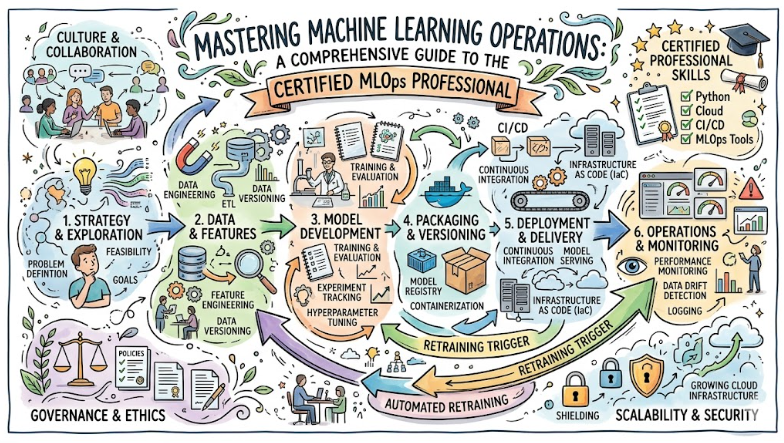
The gap between developing a machine learning model and deploying it into a stable production environment remains one of the most significant challenges in the modern tech landscape. Many organizations find that while their data scientists can build highly accurate models, the operational side of managing these models—scaling, monitoring, and updating—often falls short. This is where the Certified MLOps Professional comes into play. It is a specialized designation designed to bridge the chasm between data science and traditional software operations, ensuring that machine learning is not just a laboratory experiment but a core driver of business value.
This guide is written for engineers, managers, and architects who are looking to formalize their skills in this emerging domain. As organizations transition from manual model deployments to automated pipelines, the demand for certified talent is skyrocketing. Whether you are coming from a DevOps background or moving from data science into engineering, this guide will help you understand the curriculum, the career impact, and the practical steps required to earn your credentials from AIOps School. By the end of this article, you will have a clear roadmap for your professional development and a deep understanding of how this certification fits into the broader ecosystem of cloud-native and platform engineering.
What is the Certified MLOps Professional?
The Certified MLOps Professional is a rigorous validation of an engineer’s ability to manage the end-to-end lifecycle of machine learning models in a production environment. Unlike general data science certifications that focus on algorithms and model training, this program focuses on the “Operations” side of the equation. It represents a shift from building models to building the systems that serve those models. It exists because the industry has realized that model code is only a small fraction of a real-world machine learning system; the surrounding infrastructure—configuration, data collection, feature extraction, and monitoring—is where the real complexity lies.
This certification emphasizes real-world, production-focused learning over abstract theory. It aligns with modern engineering workflows by incorporating principles from DevOps, such as continuous integration and continuous deployment (CI/CD), and applying them to the unique challenges of machine learning. It covers the necessity of versioning not just the code, but also the datasets and the models themselves. For an enterprise, having a Certified MLOps Professional on the team means having someone who can ensure model reliability, scalability, and security, ultimately reducing the time-to-market for AI-driven features.
Who Should Pursue Certified MLOps Professional?
The Certified MLOps Professional designation is designed for a broad spectrum of technical professionals. Software engineers and DevOps practitioners who find themselves increasingly supporting data science teams will find this certification particularly beneficial. It provides them with the specific vocabulary and tooling knowledge required to manage ML-specific infrastructure. Similarly, Site Reliability Engineers (SREs) who need to ensure the uptime of AI services will gain insights into model drift and performance latency issues that differ from traditional microservices.
Cloud professionals and security engineers are also ideal candidates. As ML workloads move to the cloud, understanding the cost and security implications of large-scale model training is essential. For data scientists, this certification offers a path toward becoming more “engineering-heavy,” allowing them to take ownership of their models from conception to production. In the context of both the Indian and global markets, managers and technical leaders should pursue this to better understand the resources and skill sets required to build a successful ML department, ensuring they can lead their teams through the complexities of digital transformation.
Why Certified MLOps Professional is Valuable Beyond Today
The longevity of the Certified MLOps Professional designation is rooted in the explosive growth of artificial intelligence across all industry verticals. Enterprise adoption of ML is no longer a luxury but a competitive necessity. As these organizations scale their AI initiatives, the “manual” approach to model management becomes impossible to maintain. This certification teaches professionals how to build sustainable, automated frameworks that can handle hundreds or thousands of models. This ensures that your skills remain relevant even as specific tools like TensorFlow, PyTorch, or Kubeflow evolve; the underlying operational principles remain constant.
Furthermore, the return on time and career investment for this certification is high because it addresses a massive skill shortage. While there are many data scientists, there are relatively few engineers who understand how to operate ML systems at scale. By earning this credential, you position yourself as a high-value asset capable of reducing operational overhead and preventing “technical debt” in machine learning. It provides a signal to employers that you understand the nuances of the ML lifecycle, including data governance, reproducible pipelines, and automated retraining, which are critical for long-term enterprise success.
Certified MLOps Professional Certification Overview
The program is delivered via the official course page at Certified MLOps Professional and is hosted on the AIOps School platform. This certification is structured to cater to different career stages, moving from fundamental concepts to highly complex architectural patterns. The assessment approach is practical, often requiring candidates to demonstrate their ability to configure pipelines, manage registries, and implement monitoring solutions rather than just answering multiple-choice questions.
Ownership of the learning journey remains with the professional, but the structure is guided by industry standards. The program is divided into logical modules that cover the entire ML stack. From the initial stages of data ingestion and feature engineering to the final stages of model serving and observability, the certification ensures a holistic understanding. It is designed to be rigorous yet accessible, providing a clear path for those who are serious about mastering the operational side of artificial intelligence.
Certified MLOps Professional Certification Tracks & Levels
The certification is typically categorized into three distinct levels to align with career progression. The Foundation level focuses on the basic terminology, the ML lifecycle, and the role of various tools in the stack. It is intended for those new to the field or managers who need a high-level understanding of the workflow. This level sets the stage by explaining the “Why” behind MLOps and the fundamental challenges of bringing models to production.
The Professional level is where the deep technical work begins. This track covers the “How” of MLOps, focusing on CI/CD pipelines, model versioning, and containerization. Finally, the Advanced or Specialist level focuses on scale and optimization. This includes topics like distributed training, high-performance model serving, and FinOps for machine learning. By following these levels, a professional can grow from an entry-level practitioner to a lead architect who can design enterprise-grade machine learning platforms.
Complete Certified MLOps Professional Certification Table
| Track | Level | Who it’s for | Prerequisites | Skills Covered | Recommended Order |
| MLOps Core | Foundation | Beginners/Managers | Basic IT knowledge | ML Lifecycle, Terminology | 1st |
| MLOps Core | Professional | Engineers/SREs | Linux, Git, Python | CI/CD, Model Registry, Serving | 2nd |
| MLOps Core | Advanced | Architects/Leads | Professional Level | Distributed Training, Scale | 3rd |
| MLOps Security | Specialization | Security Engineers | Professional Level | Model Governance, DevSecOps | Optional |
| MLOps Finance | Specialization | FinOps/Managers | Foundation Level | Cloud Cost for ML, Resource Optimization | Optional |
Detailed Guide for Each Certified MLOps Professional Certification
Certified MLOps Professional – Foundation
What it is
This certification validates a candidate’s understanding of the fundamental principles of Machine Learning Operations and the differences between traditional DevOps and MLOps.
Who should take it
Aspiring MLOps engineers, project managers, and junior developers who want to understand the high-level workflow of machine learning in production.
Skills you’ll gain
- Understanding the ML project lifecycle.
- Identifying the roles of data scientists vs. ML engineers.
- Knowledge of standard MLOps terminology.
- Basic understanding of model drift and monitoring concepts.
Real-world projects you should be able to do
- Map out an end-to-end ML pipeline for a simple project.
- Create a documentation template for model governance and tracking.
Preparation plan
- 7-14 days: Review official whitepapers and the AIOps School syllabus for fundamental terms.
- 30 days: Participate in introductory webinars and complete basic modules.
- 60 days: Deep dive into case studies of successful enterprise ML implementations.
Common mistakes
- Focusing too much on specific ML algorithms instead of the operational workflow.
- Underestimating the importance of data versioning in the lifecycle.
Best next certification after this
- Same-track option: Certified MLOps Professional – Professional Level.
- Cross-track option: Certified DataOps Professional.
- Leadership option: Engineering Management Certification.
Certified MLOps Professional – Professional
What it is
This is the core technical certification that proves an engineer’s ability to build and maintain automated machine learning pipelines using industry-standard tools.
Who should take it
DevOps engineers, SREs, and ML engineers who are responsible for the daily deployment and maintenance of models.
Skills you’ll gain
- Building CI/CD pipelines for machine learning (CT – Continuous Training).
- Implementing model registries and version control for datasets.
- Containerizing models using Docker and orchestrating with Kubernetes.
- Setting up automated monitoring and alerting for model performance.
Real-world projects you should be able to do
- Deploy a model using a fully automated pipeline that triggers on code or data changes.
- Set up a Prometheus and Grafana dashboard to track model latency and accuracy drift.
Preparation plan
- 7-14 days: Hands-on practice with Git and basic Docker containers for Python scripts.
- 30 days: Build a local MLOps pipeline using tools like MLflow or DVC.
- 60 days: Execute a full deployment on a cloud provider (AWS/GCP/Azure) including automated testing.
Common mistakes
- Neglecting the “Data” part of the pipeline and focusing only on code.
- Hard-coding configurations instead of using environment variables and secrets.
Best next certification after this
- Same-track option: Certified MLOps Professional – Advanced Level.
- Cross-track option: Certified DevSecOps Professional.
- Leadership option: Technical Lead / Architect Certification.
Certified MLOps Professional – Advanced
What it is
This certification validates expertise in managing large-scale, distributed ML systems and optimizing infrastructure for performance and cost.
Who should take it
Senior engineers, Principal architects, and Technical leads who design the infrastructure for multi-team ML environments.
Skills you’ll gain
- Designing distributed training architectures for massive datasets.
- Implementing advanced model serving techniques like A/B testing and Canary deployments.
- Managing enterprise-scale feature stores.
- Optimizing GPU/TPU utilization and managing cloud costs for ML.
Real-world projects you should be able to do
- Design a multi-tenant ML platform that supports hundreds of concurrent experiments.
- Implement an automated retraining strategy based on complex drift detection algorithms.
Preparation plan
- 7-14 days: Study advanced Kubernetes patterns and distributed computing concepts.
- 30 days: Practice with specialized MLOps platforms and feature store implementations.
- 60 days: Conduct a cost-benefit analysis and optimization of a large-scale training cluster.
Common mistakes
- Over-engineering solutions for small-scale problems.
- Ignoring the financial implications of high-performance compute resources.
Best next certification after this
- Same-track option: Specialization in Generative AI Operations.
- Cross-track option: Certified FinOps Professional.
- Leadership option: CTO or Head of Engineering track.
Choose Your Learning Path
DevOps Path
This path focuses on engineers who are already proficient in CI/CD and infrastructure as code. The goal here is to adapt existing DevOps practices to handle the non-deterministic nature of machine learning. Professionals will learn how to treat models as artifacts and data as a first-class citizen in the deployment pipeline. This transition involves moving from simple application deployments to complex, multi-stage pipelines that include data validation and model evaluation.
DevSecOps Path
The DevSecOps path is critical for those working in regulated industries like finance or healthcare. This path emphasizes the security of the ML pipeline, including protecting training data from poisoning attacks and ensuring model integrity. You will learn how to implement security scans for containers, manage access controls for sensitive datasets, and ensure that the inference endpoints are protected against adversarial attacks. It integrates security directly into the MLOps lifecycle.
SRE Path
For Site Reliability Engineers, the MLOps journey focuses on observability and system health. Unlike traditional apps, an ML service can be “up” but still “broken” if the model predictions are inaccurate. This path teaches SREs how to monitor for statistical drift, manage the high latency often associated with large models, and ensure the reliability of the underlying compute clusters. It bridges the gap between infrastructure stability and model performance.
AIOps Path
AIOps focuses on using artificial intelligence to improve IT operations. This path is for professionals who want to apply ML to log analysis, predictive maintenance, and automated incident response. While related to MLOps, AIOps is about the application of AI to the infrastructure itself. Learning MLOps fundamentals helps AIOps practitioners understand how to deploy and manage the very models they use to monitor their data centers and cloud environments.
MLOps Path
The dedicated MLOps path is for those who want to be pure-play Machine Learning Engineers. This is the most direct route, focusing heavily on the intersection of data science and software engineering. You will master tools like MLflow, Kubeflow, and DVC. This path is designed to make you the primary bridge between the data science team and the production environment, ensuring that models are deployed rapidly and reliably.
DataOps Path
DataOps is the foundation upon which successful MLOps is built. This path is for professionals who focus on the data pipeline—ingestion, cleaning, and transformation. Since ML is only as good as its data, understanding DataOps is crucial. This path teaches how to automate data quality checks and ensure that the data flowing into the training and inference pipelines is consistent, accurate, and timely.
FinOps Path
Machine learning can be incredibly expensive due to the high cost of GPU instances and large-scale storage. The FinOps path for MLOps professionals focuses on cost transparency and optimization. You will learn how to track the ROI of ML projects, right-size compute resources for training jobs, and use spot instances or serverless inference to reduce operational expenses. It is an essential path for those looking to manage the business side of AI.
Role → Recommended Certified MLOps Professional Certifications
| Role | Recommended Certifications |
| DevOps Engineer | MLOps Foundation, MLOps Professional |
| SRE | MLOps Professional, MLOps Advanced |
| Platform Engineer | MLOps Professional, MLOps Advanced |
| Cloud Engineer | MLOps Foundation, MLOps Professional |
| Security Engineer | MLOps Foundation, MLOps Security Specialization |
| Data Engineer | MLOps Foundation, DataOps Certifications |
| FinOps Practitioner | MLOps Foundation, MLOps Finance Specialization |
| Engineering Manager | MLOps Foundation, MLOps Finance Specialization |
Next Certifications to Take After Certified MLOps Professional
Same Track Progression
Once you have achieved the Professional level, the natural progression is toward the Advanced level or specialized tracks. This allows you to deepen your expertise in specific areas like Generative AI Operations (GenAI-Ops) or Large Language Model Operations (LLM-Ops). These niche areas require a deeper understanding of vector databases, prompt engineering pipelines, and specialized hardware acceleration that build directly upon the core MLOps foundation.
Cross-Track Expansion
An MLOps professional can greatly benefit from expanding into DataOps or DevSecOps. Understanding the upstream data processing (DataOps) allows you to build more resilient ML pipelines. Conversely, mastering the security aspects (DevSecOps) makes you an invaluable asset for enterprise-grade deployments. Expanding horizontally into these areas ensures you have a 360-degree view of the modern software delivery ecosystem, making you more versatile and employable.
Leadership & Management Track
For those looking to move into leadership, the next step is to pursue certifications in Engineering Management or IT Strategy. With a solid technical foundation in MLOps, you are well-positioned to become a Head of AI Infrastructure or a CTO. These roles require a shift from technical execution to strategic planning, budgeting, and team building. Understanding the technical complexities of MLOps ensures that as a leader, you set realistic expectations and build sustainable roadmaps.
Training & Certification Support Providers for Certified MLOps Professional
DevOpsSchool
DevOpsSchool has established itself as a premier destination for technical training, offering a massive catalog of courses that cater to the evolving needs of the IT industry. Their approach to the Certified MLOps Professional program is deeply rooted in hands-on learning, providing students with access to real-world environments and production-like scenarios. They offer a blend of self-paced content and instructor-led sessions, ensuring that learners from various backgrounds can find a pace that suits them. With a focus on the entire lifecycle of software development, DevOpsSchool helps engineers understand where MLOps fits within the broader DevOps culture. Their community support and extensive library of troubleshooting guides make them a reliable choice for those looking to gain practical, job-ready skills in machine learning operations.
Cotocus
Cotocus is known for its boutique approach to technical consulting and training, often working closely with enterprises to upskill their workforce. Their training for the Certified MLOps Professional designation is characterized by its focus on architectural integrity and enterprise standards. They don’t just teach tools; they teach the “why” behind design decisions. This makes Cotocus an excellent choice for senior engineers and architects who need to understand the strategic implications of MLOps. Their instructors are typically active consultants who bring real-time industry challenges into the classroom. By choosing Cotocus, learners benefit from a curriculum that is constantly updated to reflect the latest shifts in cloud-native technologies and machine learning best practices, ensuring a high return on investment for their time.
Scmgalaxy
Scmgalaxy is a community-centric platform that has been a cornerstone of the configuration management and DevOps world for years. Their support for the Certified MLOps Professional program is driven by a vast repository of blogs, tutorials, and open-source contributions. They provide a wealth of free resources that complement their formal training programs, making it easier for candidates to grasp complex concepts through community-shared knowledge. Scmgalaxy excels at breaking down the complexities of version control and build automation, which are critical components of any MLOps strategy. For professionals who prefer a learning environment that feels like a collaborative community, Scmgalaxy offers the perfect mix of formal instruction and peer-to-peer knowledge exchange, helping candidates stay motivated throughout their certification journey.
BestDevOps
BestDevOps focuses on simplifying the path to certification by offering streamlined, high-impact training modules. Their philosophy for the Certified MLOps Professional program is to strip away the fluff and focus on the core competencies that employers value most. They provide excellent summaries, cheat sheets, and practice exams that are highly effective for candidates looking to clear the certification within a specific timeframe. The platform is designed for busy professionals who need to balance their learning with a full-time job. BestDevOps provides a very structured roadmap, ensuring that no time is wasted on irrelevant topics. Their practical lab sessions are designed to be completed in short bursts, making it easier for learners to build their skills incrementally.
devsecopsschool.com
As the name suggests, devsecopsschool.com is the go-to resource for integrating security into the modern engineering workflow. For the Certified MLOps Professional, they provide a unique lens focused on the security of machine learning models and data pipelines. Their curriculum covers essential topics like model signing, data privacy, and vulnerability scanning for ML libraries. This specialized focus is increasingly important as AI becomes a primary target for cyberattacks. By training with devsecopsschool.com, professionals ensure that they are not just building functional ML systems, but secure and compliant ones. Their expertise in regulatory requirements and security frameworks makes them an invaluable partner for engineers working in sensitive industries who need to earn their MLOps credentials.
sreschool.com
sreschool.com approaches MLOps from the perspective of reliability, scalability, and observability. Their training for the Certified MLOps Professional designation is perfect for those who want to master the art of keeping ML models running smoothly in high-pressure production environments. They place a heavy emphasis on monitoring, alerting, and incident management specific to machine learning workloads. Learners will explore concepts like error budgets for ML models and automated recovery patterns. The school provides deep dives into Kubernetes orchestration and cloud-native monitoring tools. For Site Reliability Engineers looking to expand their domain expertise into AI, sreschool.com provides the specialized knowledge required to ensure that machine learning services meet the same rigorous uptime standards as traditional software.
aiopsschool.com
AIOps School is the primary host and authority for the Certified MLOps Professional designation. Their training programs are the gold standard, designed by the same experts who developed the certification standards. They offer the most comprehensive and up-to-date curriculum, covering every facet of the MLOps lifecycle from foundation to advanced levels. Being at the source, learners at AIOps School get the first look at new modules and emerging industry trends. Their platform is optimized for a seamless learning experience, combining video lectures, interactive labs, and direct access to mentors. For anyone serious about this certification, AIOps School provides the most direct and authoritative path to success, ensuring that candidates are fully prepared for the challenges of modern AI operations.
dataopsschool.com
DataOps School recognizes that machine learning is nothing without high-quality data. Their support for the Certified MLOps Professional program focuses on the critical “Data” component of the pipeline. They teach professionals how to automate data engineering tasks, implement data quality gates, and manage data versioning at scale. This training is essential for MLOps candidates because it addresses the root cause of most model failures: poor data. By learning the principles of DataOps, engineers can build more robust and predictable ML systems. The school provides practical experience with data orchestration tools and feature stores, ensuring that the transition from raw data to a trained model is as smooth and automated as possible.
finopsschool.com
FinOps School provides the financial perspective that is often missing from technical training. For the Certified MLOps Professional, they offer specialized modules on managing the costs associated with large-scale machine learning experiments and deployments. This is a critical skill for senior engineers and managers who must justify their AI budgets. Their curriculum covers cloud cost optimization, resource tagging for ML workloads, and the financial implications of different model serving architectures. By training with finopsschool.com, professionals learn how to build “frugal” ML systems that deliver high value without breaking the bank. This knowledge is key to making MLOps sustainable within a business context, ensuring that AI initiatives are both technically successful and financially viable.
Frequently Asked Questions (General)
- What is the difficulty level of the Certified MLOps Professional exam?
The exam is considered moderate to high difficulty, depending on your background. It requires a solid grasp of both DevOps tools and machine learning workflows. It is not just about memorization but about applying concepts to solve production-level problems. - How long does it take to get certified?
Most professionals with a technical background can complete the requirements in 2 to 4 months of dedicated study. This includes time for watching lectures, completing hands-on labs, and taking practice assessments. - Are there any prerequisites for this certification?
While there are no strict barriers to the Foundation level, the Professional level assumes familiarity with Linux, Git, and Python. Experience with Docker and basic cloud services is also highly recommended. - What is the ROI of getting this certification?
The ROI is significant, often leading to salary increases and opportunities for senior roles. It validates a niche skill set that is in high demand, making you a competitive candidate for lead engineer and architect positions. - Can I take the exam online?
Yes, the certification process is designed to be accessible globally through the online platform at AIOps School, allowing you to learn and take assessments from anywhere. - Does this certification cover specific cloud providers like AWS or Azure?
The certification focuses on vendor-neutral principles and tools like Kubernetes and MLflow, but the labs often use major cloud providers to demonstrate these principles in action. - How often do I need to renew the certification?
Certifications typically require renewal every two to three years to ensure that practitioners are up to date with the rapidly evolving tools and best practices in the MLOps space. - Is this certification recognized by major tech companies?
Yes, the curriculum is designed to align with the engineering standards used by top-tier tech firms and global enterprises, making it a recognized mark of professional competence. - What kind of support is available during the learning process?
Candidates have access to community forums, mentor sessions, and detailed documentation provided by support partners like DevOpsSchool and AIOps School. - How does MLOps differ from standard DevOps?
MLOps includes everything in DevOps but adds complexity around data versioning, model retraining, and monitoring for statistical drift, which are not present in traditional software. - Should I learn Data Science before MLOps?
You don’t need to be a data scientist, but a basic understanding of how models are trained and evaluated is essential for success in MLOps. - Is there a community for certified professionals?
Yes, earning the certification grants you access to an exclusive network of professionals and alumni where you can share insights and find career opportunities.
FAQs on Certified MLOps Professional
- How does the Certified MLOps Professional handle Generative AI?
The program includes modules on managing LLM pipelines, focusing on the unique infrastructure requirements of large-scale models. - What tools are emphasized in the Professional level?
The curriculum focuses on industry standards such as MLflow for tracking, DVC for data versioning, and Kubernetes for orchestration. - Does the certification include hands-on labs?
Yes, a significant portion of the assessment is based on practical lab work where you must build and deploy actual pipelines. - Is there a focus on model ethics and governance?
Yes, the Advanced track specifically addresses model explainability, bias detection, and compliance within the operational lifecycle. - Can this certification help me move from a Data Analyst role to Engineering?
Absolutely. It provides the technical engineering foundation that analysts need to transition into more technical MLOps roles. - How are the exams structured?
The exams are a mix of scenario-based questions and practical tasks that require you to interact with a live environment. - What is the difference between the Foundation and Professional levels?
Foundation is about concepts and vocabulary, while Professional is about implementation, automation, and technical troubleshooting. - Are there group discounts for enterprise teams?
Yes, many training providers offer corporate packages for teams looking to standardize their MLOps practices across the organization.
Final Thoughts: Is Certified MLOps Professional Worth It?
From the perspective of a mentor who has seen the evolution of the software industry over two decades, the Certified MLOps Professional designation is one of the most practical investments you can make today. We are currently in a phase where companies have moved past the “hype” of AI and are now struggling with the “reality” of running it. The reality is that models break, data drifts, and infrastructure costs can spiral out of control if not managed by skilled professionals. This certification doesn’t just teach you how to use a tool; it teaches you how to build a reliable system.
If you are looking for a quick badge for your profile, this might not be for you—it requires genuine effort and a willingness to get your hands dirty with code and infrastructure. However, if you are looking to future-proof your career and move into a role that sits at the cutting edge of technology, the path is clear. The demand for these skills is not a passing trend; it is the new standard for how modern software is built and maintained. My advice is simple: start with the foundation, build your labs, and focus on the principles. The tools will change, but the expertise you gain here will last a career.
