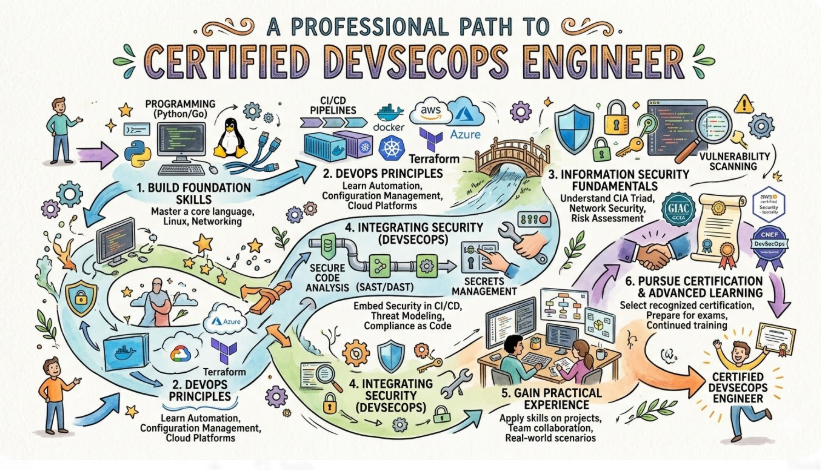
The way software is built has changed forever. In the past, security was a final gate that code had to pass through before going live. Today, that approach is too slow and too risky. A Certified DevSecOps Engineer is the person who fixes this by making security a part of the daily workflow for developers and operations teams. This role is about more than just finding bugs; it is about building a system where security is automated, invisible, and constant.
For engineers and managers looking to stay relevant in the global market, this certification is a key milestone. It provides a structured way to learn how to protect applications without slowing down the business.
Master in Observability Engineering Certifications Program
In high-scale environments, you cannot secure what you cannot see. This is why the Master in Observability Engineering Certifications Program has become so important for senior professionals. While security tools find vulnerabilities, observability tools allow you to understand how your system behaves in real-time.
Observability is the practice of using logs, metrics, and traces to build a clear picture of a system’s internal state. For a DevSecOps expert, this is a superpower. It helps in identifying silent security breaches, performance lags, and configuration errors that traditional monitoring might miss. This program is designed to move an engineer from basic monitoring to deep system insights, which is essential for managing the complex infrastructure of modern digital companies.
A Deep Dive : Certified DevSecOps Engineer
This certification is the industry standard for those who want to prove they can handle the technical and cultural challenges of modern security.
What it is
The Certified DevSecOps Engineer program is a deep dive into the “Shift-Left” philosophy. It is a technical track that teaches you how to embed security tools directly into the CI/CD pipeline. Instead of waiting for a security team to run a scan, the pipeline does it automatically. The certification covers everything from secure coding practices and container security to automated compliance and cloud defense.
Who should take it
This path is built for Software Engineers who want to write safer code, DevOps Engineers who want to automate security, and Security Professionals who want to learn about automation. It is also a vital resource for Engineering Managers who are responsible for the safety of their company’s data. Whether you are working in India or for a global firm, these skills are universally required.
Skills you’ll gain
The program focuses on practical skills that are used in production environments every day. The goal is to turn manual security processes into automated code.
- Static and Dynamic Analysis: You will learn how to use SAST and DAST tools to scan code and running applications for weaknesses automatically.
- Infrastructure as Code (IaC) Security: You will gain the ability to secure the scripts that build your servers, ensuring that your cloud setup is safe from the start.
- Vulnerability Management: You will learn how to prioritize and fix security flaws based on the actual risk they pose to the business.
- Container and Orchestration Security: You will understand how to harden Docker images and secure Kubernetes clusters against modern attacks.
- Automated Compliance: You will learn how to write tests that ensure your system always follows regulations like GDPR or SOC2.
Real-world projects you should be able to do after it
After completing the certification, you will be expected to lead high-impact security projects.
- Developing a Self-Healing Pipeline: You will be able to build a delivery system that automatically blocks and reports any code that fails security checks.
- Centralized Secrets Management: You will learn to implement systems that protect passwords, keys, and certificates, ensuring they are never exposed in the code.
- Cloud Security Auditing: You will be able to set up automated tools that continuously audit your cloud environment for misconfigurations.
- Security Monitoring Dashboards: You will learn to create visual reports that give stakeholders a clear view of the organization’s security posture.
Preparation plan
Success in this certification depends on a disciplined study schedule. You can choose a path based on your current knowledge:
- 7–14 days (The Expert Path): This is for those who already use Jenkins, Terraform, and Docker daily. The focus is on learning specific security tools and understanding the exam structure.
- 30 days (The Standard Path): This is the best choice for most working engineers. It allows for a deep dive into one topic per week, with plenty of time for hands-on lab exercises.
- 60 days (The Foundation Path): This is for those who are moving from traditional IT or manual security. It provides the time needed to learn DevOps basics before moving into advanced security automation.
Common mistakes
Many candidates fail because they don’t treat DevSecOps as a unified discipline.
- Treating Security as a Silo: The biggest mistake is thinking security is someone else’s job. In DevSecOps, everyone is responsible.
- Ignoring the “Dev” in DevSecOps: If a security tool makes life too hard for developers, they will find a way to bypass it. Tools must be developer-friendly.
- Relying on Theory Only: You cannot pass this exam or do the job without getting your hands dirty in the terminal. Labs are the most important part of preparation.
Best next certification after this
Once you have the skills to secure a pipeline, the next logical step is to learn how to observe the entire system. The Master in Observability Engineering is the perfect follow-up, as it provides the data needed to prove that your security measures are working effectively.
Comparison of Top Certifications for Software Engineers
The following table provides a comparison of the different career tracks available today.
| Track | Level | Who it’s for | Prerequisites | Skills Covered | Recommended Order |
| DevSecOps | Intermediate | Software Engineers | Basic CI/CD | Pipeline Security, Automation | 1st for Security |
| SRE | Intermediate | Ops Engineers | Linux Basics | Reliability, SLOs, SLIs | After DevOps |
| AIOps/MLOps | Advanced | Data Engineers | Python & ML | AI for System Ops | After SRE |
| Cloud Arch | Expert | Senior Engineers | Cloud Basics | System Design, Costs | After 5 Years |
| DataOps | Intermediate | Data Scientists | Data Flow | Data Quality, Delivery | After Cloud |
| FinOps | Intermediate | Managers | Cloud Basics | Cost Optimization | Anytime |
Choose Your Path: 6 Learning Journeys
There are six main directions you can take to grow your career in modern operations.
- DevOps Path: Focuses on the speed and efficiency of the software delivery process.
- DevSecOps Path: Focuses on integrating automated security into every step of the lifecycle.
- SRE Path: Focuses on the reliability, scalability, and uptime of large-scale systems.
- AIOps/MLOps Path: Focuses on using artificial intelligence to automate complex operational tasks.
- DataOps Path: Focuses on the smooth and secure flow of data within an organization.
- FinOps Path: Focuses on the financial side of the cloud, ensuring that resources are used efficiently.
Role → Recommended Certifications Mapping
To help you plan your career, here is a mapping of roles to the most relevant certifications:
- DevOps Engineer: Certified DevOps Professional, Certified Kubernetes Administrator.
- SRE: SRE Certified Professional, Master in Observability Engineering.
- Platform Engineer: Infrastructure as Code Expert, Certified DevSecOps Engineer.
- Cloud Engineer: AWS, Azure, or GCP Certified Architect.
- Security Engineer: Certified DevSecOps Engineer, Cloud Security Specialist.
- Data Engineer: DataOps Professional, Big Data Specialist.
- FinOps Practitioner: Certified FinOps Associate.
- Engineering Manager: DevOps Leader, Cloud Business Professional.
Next Certifications to Take
After you achieve the Certified DevSecOps Engineer status, you should consider your next move based on these three paths:
- Same Track (Specialization): Advanced security for specific platforms like AWS Security Specialty or Azure Security Engineer.
- Cross-Track (Broadening): SRE Certified Professional. This helps you understand how security impacts the overall stability of the system.
- Leadership (Growth): DevOps Leader. This is for those who want to move from technical roles into management and strategy.
Top Training Institutions for Certified DevSecOps Engineer
Choosing the right training partner is essential for passing the certification and gaining practical skills.
DevOpsSchool is a globally recognized institution that offers instructor-led training for various DevOps tracks. Their programs are designed to be highly interactive and technical, ensuring that students get plenty of hands-on practice. They focus on real-world scenarios that prepare engineers for the actual challenges they will face in their jobs.
Cotocus provides high-level consulting and training for corporate teams. They specialize in helping organizations transition to a DevSecOps culture by providing customized learning paths. Their approach is very practical, making them a preferred choice for large companies in India and abroad.
Scmgalaxy is a comprehensive community platform that offers a wealth of resources for DevOps and security professionals. They provide a mix of self-paced learning and community support, making it easy for engineers to stay up to date with the latest tools and trends.
BestDevOps is known for its intensive bootcamps that focus on speed and efficiency. Their courses are designed to get you ready for the certification exam in a short amount of time without sacrificing the quality of the technical training.
DevSecOpsSchool is a dedicated platform that focuses specifically on the security aspects of DevOps. They offer specialized courses that dive deep into automated security, threat modeling, and container defense. This is the ideal place for those who want to become true security specialists.
Sreschool focuses on the principles of Site Reliability Engineering. Their training is a great addition for any DevSecOps engineer, as it teaches how to maintain and troubleshoot the secure systems you have built.
Aiopsschool teaches the future of operations by showing how to use artificial intelligence to manage systems. This is a great path for engineers who want to stay ahead of the curve and learn how to use data to predict and prevent system failures.
Dataopsschool provides specialized training for managing data pipelines. They teach how to apply the fast-moving principles of DevOps to the world of data, ensuring that information is delivered quickly and securely.
Finopsschool focuses on the business and financial management of the cloud. They help engineers and managers understand how to track and optimize cloud costs, which is a vital skill for any modern organization.
FAQs on Certified DevSecOps Engineer
1. Is the Certified DevSecOps Engineer exam difficult for beginners? The exam is technical and requires a good understanding of both coding and operations. While beginners can pass, they will need more time to practice in the lab to feel comfortable with the automation tools.
2. How much time should I dedicate to study? For most working professionals, 30 to 60 days of consistent study is the best approach. Spending an hour or two each day is better than trying to study for long hours only on the weekends.
3. Are there any prerequisites for taking this certification? There are no strict prerequisites, but you should have a basic understanding of Linux, how the cloud works, and the general software development lifecycle.
4. What is the best order to take these certifications? Most engineers start with a general DevOps certification, move on to Kubernetes training, and then specialize in DevSecOps or SRE.
5. What is the market value of this certification? The market value is very high. Companies everywhere are looking for engineers who can automate security, and being certified proves that you have the skills they need.
6. What are the career benefits of getting certified? Many professionals see a significant increase in their salary and get access to more senior roles like DevSecOps Lead or Security Architect.
7. Can I take the exam and training online? Yes, all the mentioned institutions offer online training and proctored exams, so you can get certified from anywhere in the world.
8. Is this certification recognized internationally? Yes, it is recognized by major technology firms and startups globally, as it is based on industry-standard security and DevOps practices.
9. Can a manager benefit from this technical certification? Absolutely. It helps managers understand the technical challenges their teams face, leading to better decision-making and project planning.
10. Does the course include live projects? Yes, the training is designed to be hands-on, with several real-world projects that simulate the tasks of a DevSecOps engineer.
11. What is the passing score for the exam? The passing score is usually around 70%, but this can change depending on the specific version of the exam.
12. How does this differ from a standard Cyber Security certification? While traditional cyber security focuses on defense and penetration testing, DevSecOps focuses specifically on the automation of security within the software development process.
FAQs on Certified DevSecOps Engineer
1. What is the main goal of the Certified DevSecOps Engineer program? The primary goal is to teach engineers how to automate security within the software development process. This ensures that security is a continuous part of the workflow rather than a final, manual step.
2. Does this certification cover cloud-native security? Yes, a significant part of the training is focused on securing cloud environments like AWS, Azure, and Google Cloud, as well as modern technologies like Docker and Kubernetes.
3. How much coding is required for this certification? You don’t need to be a professional developer, but you should be comfortable reading code and writing scripts to automate security tasks and manage infrastructure.
4. What tools will I learn to use? You will gain hands-on experience with a wide range of tools for static and dynamic analysis, container security, secrets management, and infrastructure automation.
5. Is there a difference between DevOps and DevSecOps? DevOps focuses on the speed and quality of delivery, while DevSecOps adds a layer of automated security to that process. They are parts of the same philosophy focused on better software delivery.
6. How long is the certification valid? The certification is typically valid for two or three years. You can renew it by taking a refresher course or by earning a more advanced certification in the same track.
7. How does this certification help an Engineering Manager? It helps managers understand the technical requirements of building a secure pipeline. This allows them to lead their teams better, set realistic goals, and make informed decisions about security tools.
8. Why is the “Shift-Left” approach so important? Shifting left means finding and fixing security issues early in the development process. This is much cheaper and faster than trying to fix a security breach after the software has been released.
Conclusion
The path to becoming a Certified DevSecOps Engineer is one of the most rewarding journeys a modern technical professional can take. It represents a shift from traditional, manual security to a future where protection is a native part of the software itself. By mastering the tools of automation and the culture of collaboration, an engineer becomes an invaluable asset to any organization. This certification provides the structure and the technical depth needed to lead this change. In a world where digital threats are always evolving, the ability to build secure, automated systems is more than just a career move—it is a critical requirement for the success of the modern digital economy. Those who take this step now will be the leaders of the technology landscape for many years to come.
