Introduction
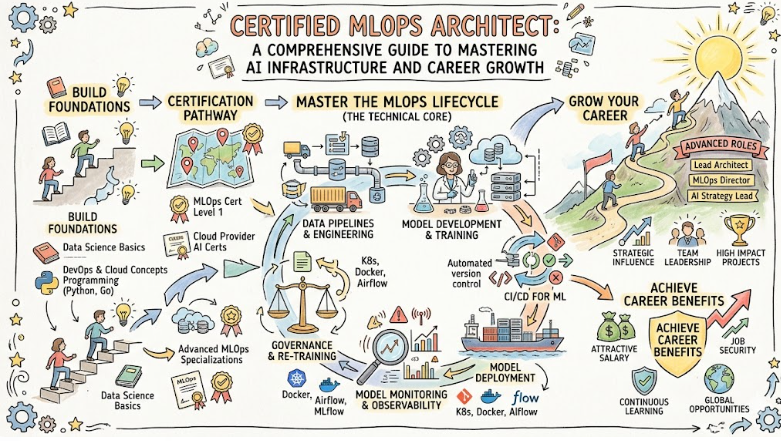
The transition from traditional software development to machine learning requires more than just knowing how to build a model. It demands a robust architectural framework that ensures models are reproducible, scalable, and secure in production environments. The Certified MLOps Architect program is designed to bridge the gap between data science and operational excellence, providing a structured roadmap for professionals looking to master the intersection of DevOps and Machine Learning. This guide is crafted for software engineers, SREs, and technical managers who recognize that the real challenge of AI is not the algorithm itself, but the pipeline that supports it.
In the current landscape of cloud-native technologies, the role of an architect has evolved to include the orchestration of complex data flows and automated retraining loops. By exploring this certification, professionals can gain the specific skills needed to manage the entire lifecycle of an ML model, from data ingestion to monitoring in a live environment. Whether you are looking to pivot your career or enhance your current team’s capabilities, this guide serves as a practical resource to understand the curriculum and the value proposition offered by AIOps School. Choosing the right certification path is a strategic career decision that requires an understanding of how theoretical concepts translate into production-ready systems.
What is the Certified MLOps Architect?
The Certified MLOps Architect is a professional designation that validates an individual’s ability to design, implement, and manage automated machine learning pipelines. Unlike general AI courses that focus on model mathematics, this certification emphasizes the “Ops” part of MLOps, focusing on the engineering rigor required to make AI sustainable in an enterprise setting. It represents a shift toward treating machine learning models as first-class citizens in the software delivery lifecycle, ensuring they are subject to the same CI/CD principles as any other microservice.
This certification exists because modern enterprises struggle with “technical debt” in machine learning, where models fail to perform in production due to lack of monitoring or poor data engineering. The program aligns with modern engineering workflows by teaching participants how to integrate MLOps tools into existing cloud-native ecosystems like Kubernetes and serverless platforms. It moves beyond theory, requiring candidates to understand how to handle data drift, model versioning, and infrastructure as code, which are critical components for any organization aiming for a high level of operational maturity.
Who Should Pursue Certified MLOps Architect?
This certification is tailored for professionals who sit at the crossroads of development and operations. Software engineers and DevOps practitioners who want to expand their expertise into the data domain will find this path particularly rewarding. It is also highly relevant for Site Reliability Engineers (SREs) who are increasingly tasked with maintaining the uptime and performance of AI-driven applications. Security professionals and data engineers who need to understand the governance and compliance aspects of automated ML workflows will also benefit significantly from the curriculum.
For beginners, the certification provides a structured entry point into a specialized field, while experienced engineers can use it to formalize their knowledge and prove their architectural seniority. Managers and technical leaders should pursue this to better understand the resource requirements and architectural trade-offs involved in scaling AI initiatives. Globally, and specifically in the rapidly growing tech hubs of India, there is a massive demand for architects who can move models out of Jupyter notebooks and into resilient, production-grade environments.
Why Certified MLOps Architect is Valuable and Beyond
The demand for specialized MLOps talent is skyrocketing as more companies move past the “experimental” phase of AI and into full-scale production. Organizations are realizing that having data scientists is not enough; they need architects who can build the “factory” that produces and maintains models. This certification ensures longevity in a professional’s career by focusing on architectural patterns and principles that remain relevant even as specific tools and libraries evolve over time. It provides a competitive edge in a crowded job market where “full-stack” expertise now includes data and model management.
Enterprise adoption of MLOps is no longer optional for businesses that want to remain competitive, and this certification signals to employers that you possess the discipline to manage these complex systems. The return on investment for this certification is reflected in the ability to reduce lead times for model deployment and increase the reliability of AI services. By mastering these skills, you become an essential asset to any technical organization, capable of driving high-impact projects that directly contribute to the company’s bottom line through automated intelligence and operational efficiency.
Certified MLOps Architect Certification Overview
The Certified MLOps Architect program is a comprehensive educational journey delivered through the official platform at Certified MLOps Architect and hosted on the broader AIOps School ecosystem. The program is structured to provide a logical progression from foundational concepts to advanced architectural design, ensuring that learners are not overwhelmed. It utilizes a practical assessment approach, where candidates are often tested on their ability to solve real-world engineering challenges rather than just memorizing definitions.
The certification is owned and managed by industry experts who have practical experience in deploying large-scale AI systems. The structure includes multiple modules covering data engineering, pipeline automation, model governance, and cloud infrastructure. This approach ensures that a Certified MLOps Architect is not just a specialist in one tool, but a versatile professional capable of designing vendor-neutral solutions. The program focuses on hands-on labs and case studies that mirror the complexities of modern enterprise environments, making the transition from learning to doing seamless.
Certified MLOps Architect Certification Tracks & Levels
The certification is organized into three distinct levels to accommodate professionals at different stages of their career journey. The Foundation level focuses on core terminology, the MLOps lifecycle, and basic automation principles, making it ideal for those new to the field. The Professional level dives deeper into CI/CD for ML, experiment tracking, and model deployment strategies. Finally, the Advanced level is designed for aspiring architects, focusing on multi-cloud strategies, enterprise-wide governance, and complex system integration.
These levels allow for specialization based on an individual’s existing career track. For example, an SRE might focus heavily on the monitoring and observability modules, while a Data Engineer might spend more time on the data versioning and feature store tracks. This modularity ensures that the certification aligns with various career progression paths, whether one aims to remain a deep technical specialist or transition into a high-level architectural or leadership role. Each level builds upon the previous one, creating a comprehensive knowledge base that is both broad and deep.
Complete Certified MLOps Architect Certification Table
| Track | Level | Who it’s for | Prerequisites | Skills Covered | Recommended Order |
| Foundation | Associate | Junior Engineers, Managers | Basic Linux, Python | MLOps Lifecycle, Git, Basics of ML | 1 |
| Professional | Practitioner | DevOps/Data Engineers | Foundation Level, CI/CD | Model Versioning, Feature Stores | 2 |
| Advanced | Architect | Senior Engineers, Lead SREs | Professional Level | Scalability, Governance, Security | 3 |
| Specialization | Security | DevSecOps Professionals | Professional Level | Model Privacy, Compliance, Scanning | Optional |
| Specialization | Cost | FinOps/Platform Engineers | Professional Level | Resource Optimization, ML Budgeting | Optional |
Detailed Guide for Each Certified MLOps Architect Certification
Certified MLOps Architect – Foundation Level
What it is
This certification validates a candidate’s understanding of the fundamental principles of MLOps. It ensures the professional is familiar with the vocabulary, the core stages of the machine learning lifecycle, and why automation is necessary for modern data science.
Who should take it
It is suitable for entry-level engineers, project managers, and traditional DevOps professionals who are new to machine learning. It serves as the essential first step for anyone looking to build a career in the MLOps space.
Skills you’ll gain
- Understanding the difference between traditional DevOps and MLOps.
- Knowledge of basic machine learning workflows and model training.
- Proficiency in using version control for both code and data.
- Familiarity with the concepts of continuous integration in an ML context.
Real-world projects you should be able to do
- Setting up a basic automated pipeline for a simple linear regression model.
- Implementing version control for a small dataset using DVC.
- Creating a standardized environment for data scientists using Docker.
Preparation plan
- 7–14 days: Review official documentation and familiarize yourself with the MLOps glossary.
- 30 days: Complete introductory labs on Git and basic Python scripting for ML.
- 60 days: Take a mock exam and build a small end-to-end ML workflow on your local machine.
Common mistakes
- Focusing too much on the math of the models rather than the operational pipeline.
- Ignoring the importance of data versioning in the early stages.
Best next certification after this
- Same-track option: Professional MLOps Practitioner
- Cross-track option: Certified DataOps Associate
- Leadership option: Technical Product Manager in AI
Certified MLOps Architect – Professional Level
What it is
This level focuses on the practical implementation of automated pipelines and the management of model artifacts. It validates the ability to bridge the gap between experimental code and production-ready deployments.
Who should take it
This is intended for DevOps engineers, Data engineers, and software developers who have at least one year of experience in a cloud or automated environment and want to specialize in ML infrastructure.
Skills you’ll gain
- Designing and implementing CI/CD pipelines specifically for machine learning models.
- Managing feature stores to ensure data consistency between training and inference.
- Implementing automated experiment tracking and model registries.
- Deploying models using various strategies like A/B testing and Canary releases.
Real-world projects you should be able to do
- Building a full CI/CD pipeline that triggers model retraining on data changes.
- Setting up an automated model monitoring dashboard for detecting drift.
- Implementing a centralized feature store for a multi-team environment.
Preparation plan
- 7–14 days: Deep dive into specific MLOps tools like MLflow or Kubeflow.
- 30 days: Build complex pipelines that involve automated testing and validation.
- 60 days: Focus on cloud-specific ML services (AWS SageMaker, Azure ML, or GCP Vertex AI).
Common mistakes
- Underestimating the complexity of data drift and how to automate the response.
- Failing to implement proper logging and observability from the start.
Best next certification after this
- Same-track option: Advanced MLOps Architect
- Cross-track option: Certified SRE Professional
- Leadership option: Engineering Manager (ML Infrastructure)
Certified MLOps Architect – Advanced Level
What it is
The Advanced level validates the expertise required to design enterprise-grade, high-scale MLOps architectures. It focuses on governance, security, and the optimization of complex, multi-cloud ML environments.
Who should take it
This is designed for senior engineers, principal architects, and technical leads who are responsible for the overall strategy and reliability of an organization’s AI platform.
Skills you’ll gain
- Architecting multi-tenant MLOps platforms that support hundreds of models.
- Implementing strict governance, compliance, and security measures for AI.
- Optimizing infrastructure costs and performance for large-scale training and inference.
- Designing disaster recovery and high-availability strategies for ML services.
Real-world projects you should be able to do
- Designing a global-scale model serving architecture with low latency requirements.
- Implementing a complete governance framework for model auditing and explainability.
- Creating a cost-optimization strategy for massive distributed training jobs.
Preparation plan
- 7–14 days: Study advanced architectural patterns and enterprise security standards.
- 30 days: Conduct deep-dive research into multi-cloud orchestration and edge computing.
- 60 days: Design and document a full-scale enterprise MLOps strategy for a hypothetical large corporation.
Common mistakes
- Designing overly complex systems that are difficult for the data science team to use.
- Neglecting the financial and cost-management aspects of high-scale ML.
Best next certification after this
- Same-track option: Fellow in AI Operations
- Cross-track option: Certified FinOps Professional
- Leadership option: Chief Technology Officer (CTO) or VP of Engineering
Choose Your Learning Path
DevOps Path
Professionals coming from a DevOps background should focus on how their existing knowledge of automation and CI/CD applies to machine learning. The primary shift involves moving from “stateless” code deployments to “stateful” model deployments where data is a primary variable. You will need to learn how to manage the lifecycle of data alongside the lifecycle of the code. This path emphasizes the integration of ML tools into current DevOps toolchains like Jenkins, GitLab CI, or GitHub Actions.
DevSecOps Path
In the DevSecOps path, the focus is on the security of the ML pipeline and the privacy of the data being used. You will explore techniques for securing model endpoints, scanning for vulnerabilities in ML libraries, and ensuring that training data remains compliant with regulations like GDPR. This path is critical for industries like finance and healthcare where data integrity is paramount. You will learn to implement “Security as Code” within the context of automated machine learning workflows.
SRE Path
The Site Reliability Engineering path centers on the availability, latency, performance, and capacity of ML services. SREs will focus on monitoring model drift, managing the resource consumption of inference engines, and creating automated failover systems for AI-driven applications. This path teaches how to apply the principles of error budgets and SLIs/SLOs to the unique and often unpredictable nature of machine learning outputs. It ensures that the AI systems are as reliable as any other critical business service.
AIOps Path
The AIOps path is about using artificial intelligence to improve the operations of IT systems themselves. Professionals here will learn how to apply MLOps principles to build models that predict system failures, automate root cause analysis, and optimize infrastructure automatically. This is a meta-application of the technology, where you use the architected pipelines to feed data back into the operational ecosystem. It requires a deep understanding of log analysis, metric correlation, and automated incident response.
MLOps Path
The pure MLOps path is for those who want to be the primary facilitators between the data science team and the production environment. This involves a heavy focus on experiment tracking, model registries, and the seamless transition of models from research to deployment. You will become an expert in the tools and processes that allow for rapid iteration and reliable scaling of machine learning initiatives. This path is ideal for those who want to be at the heart of the AI transformation within their organization.
DataOps Path
DataOps focuses on the delivery of high-quality data to the ML pipelines, ensuring that the “fuel” for the models is always clean, fresh, and versioned. Professionals on this path will study data orchestration, automated data quality testing, and the management of large-scale data lakes and warehouses. Since MLOps is only as good as the data it processes, this path is foundational for the success of any ML architect. You will learn to treat data pipelines with the same level of automation and monitoring as code pipelines.
FinOps Path
The FinOps path addresses the high costs associated with training and running machine learning models in the cloud. As an MLOps architect with a FinOps focus, you will learn to optimize GPU and TPU utilization, implement cost-aware scheduling, and provide transparency into the cloud spend of AI projects. This is increasingly important as companies look to scale their AI efforts without breaking their budgets. You will bridge the gap between engineering decisions and financial outcomes, ensuring sustainable growth.
Role → Recommended Certified MLOps Architect Certifications
| Role | Recommended Certifications |
| DevOps Engineer | Foundation, Professional |
| SRE | Professional, Advanced |
| Platform Engineer | Professional, Advanced |
| Cloud Engineer | Foundation, Professional |
| Security Engineer | Professional, Security Specialization |
| Data Engineer | Foundation, Professional |
| FinOps Practitioner | Foundation, Cost Specialization |
| Engineering Manager | Foundation |
Next Certifications to Take After Certified MLOps Architect
Same Track Progression
For those who wish to stay within the MLOps domain, the logical next step is to seek out specialized training in niche areas like Edge MLOps or High-Performance Computing (HPC) for ML. These specializations allow you to tackle the most demanding technical challenges, such as deploying models on resource-constrained devices or managing distributed training across thousands of nodes. Deepening your expertise ensures that you remain at the forefront of the architectural evolution in the AI space.
Cross-Track Expansion
Broadening your skills often leads to becoming a more effective architect. After completing the MLOps path, many professionals choose to pursue certifications in SRE or DevSecOps to provide a more holistic approach to their infrastructure. Understanding how model operations interact with overall system reliability and security makes you a “T-shaped” professional—someone with deep MLOps expertise and broad knowledge of modern engineering practices. This makes you invaluable for cross-functional leadership roles.
Leadership & Management Track
If you are moving into management, certifications in technical leadership or engineering management are excellent follow-ups. These programs focus on team building, project estimation for complex AI initiatives, and strategic alignment of technical capabilities with business goals. An architect who understands both the technical “how” and the business “why” is best positioned to lead departments and drive the long-term vision of an organization’s artificial intelligence strategy.
Training & Certification Support Providers for Certified MLOps Architect
DevOpsSchool
DevOpsSchool is a leading provider of technical training, offering a wide array of courses designed to upskill engineers in modern automation. Their curriculum is known for being highly practical and aligned with current industry needs, making them a strong partner for anyone pursuing MLOps certifications. They provide extensive resources, including video tutorials and community support, to ensure students succeed in their certification journey.
Cotocus
Cotocus specializes in high-end consulting and technical training, focusing on complex infrastructure and cloud-native technologies. Their approach to MLOps training is rooted in real-world consulting experience, providing students with insights that go beyond standard textbooks. They are an excellent choice for professionals looking for advanced architectural knowledge and hands-on laboratory exercises that simulate enterprise environments.
Scmgalaxy
Scmgalaxy is a prominent community and training hub for Configuration Management and DevOps professionals. They offer a wealth of free resources, articles, and structured courses that help engineers stay updated with the latest trends in automation. Their support for MLOps certifications is characterized by a strong community-driven approach, allowing learners to connect with peers and mentors across the globe.
BestDevOps
BestDevOps focuses on providing curated learning paths for engineers who want to excel in the DevOps and MLOps ecosystem. Their training programs are designed to be concise and effective, targeting the specific skills that are most in demand by employers. They offer specialized support for those preparing for the Certified MLOps Architect exam, emphasizing the most critical architectural patterns.
devsecopsschool.com
This platform is the go-to resource for security integration within the delivery pipeline. As security becomes a cornerstone of MLOps, devsecopsschool.com provides the necessary training to ensure that ML architects can build safe and compliant systems. Their courses cover everything from container security to model privacy, making them an essential support provider for the security-conscious professional.
sreschool.com
SRESchool focuses on the reliability and performance aspects of engineering. For an MLOps architect, understanding the principles taught here is vital for maintaining production systems. Their curriculum includes deep dives into monitoring, incident response, and performance tuning, which are directly applicable to managing the lifecycle of machine learning models in high-availability environments.
aiopsschool.com
As the primary host for the Certified MLOps Architect program, AIOpsSchool offers the most direct and comprehensive support for this certification. Their platform is dedicated entirely to the intersection of AI and operations, providing specialized labs and expert-led sessions. They are the central hub for anyone looking to master the specific nuances of architecting AI-driven infrastructure.
dataopsschool.com
DataOpsSchool provides the foundational training required to manage the data pipelines that feed machine learning models. Their focus on data quality, orchestration, and versioning is a perfect complement to the MLOps architect’s skillset. By utilizing their resources, engineers can ensure they have a complete understanding of the entire data-to-model value chain.
finopsschool.com
FinOpsSchool is dedicated to the discipline of cloud financial management. Given the significant costs associated with ML infrastructure, their training is invaluable for architects who need to build cost-effective solutions. They provide the tools and frameworks needed to track, manage, and optimize the spend associated with large-scale machine learning initiatives.
Frequently Asked Questions (General)
- How difficult is the Certified MLOps Architect exam?
The exam is considered moderately difficult as it requires a blend of software engineering, DevOps, and machine learning knowledge. It is designed to test practical application rather than just theoretical memorization. - How much time does it take to prepare for this certification?
Depending on your background, most professionals spend between 30 and 60 days preparing. This includes completing the coursework, hands-on labs, and review sessions. - What are the prerequisites for the advanced level?
Ideally, you should have a solid understanding of cloud platforms and have completed the Professional level certification or have equivalent industry experience in MLOps. - Is this certification recognized globally?
Yes, the skills and principles covered in the program are based on industry standards used by major tech companies worldwide. - Does the certification focus on specific tools?
While it covers popular tools like Kubernetes and MLflow, the focus is on architectural patterns that are vendor-neutral and applicable across different platforms. - What is the return on investment for this certification?
Certified professionals often see significant career advancement and salary increases due to the high demand for specialized MLOps expertise. - Do I need to be a data scientist to take this?
No, this is an engineering and architecture certification. While you need to understand the ML lifecycle, you do not need to be an expert in building mathematical models. - In what order should I take the certifications?
It is highly recommended to start with the Foundation level, then proceed to Professional, and finally the Advanced level to ensure a solid grasp of the basics. - How long is the certification valid?
The certification is typically valid for two to three years, after which you may need to recertify to stay current with the rapidly evolving technology. - Are there hands-on labs included in the training?
Yes, practical labs are a core component of the program, allowing you to build and manage actual pipelines in a controlled environment. - Can I take the exam online?
Yes, the certification process is designed to be accessible globally through online proctored examination platforms. - Who manages the curriculum for this program?
The curriculum is developed and maintained by a board of industry experts with extensive experience in MLOps, DevOps, and AI.
FAQs on Certified MLOps Architect
- What makes a Certified MLOps Architect different from a Data Engineer?
While a Data Engineer focuses on the flow and quality of data, an MLOps Architect focuses on the entire lifecycle of the model, including its deployment, monitoring, and automated retraining. - Can this certification help me transition from a traditional DevOps role?
Absolutely. It is specifically designed to leverage your existing DevOps skills while introducing the unique challenges of machine learning operations. - What is the focus of the “Architect” designation?
The focus is on high-level system design, ensuring that all components of the ML pipeline work together efficiently, securely, and at scale. - Does the program cover multi-cloud MLOps strategies?
Yes, the advanced levels specifically address how to design architectures that can span multiple cloud providers to avoid vendor lock-in and improve resilience. - How does the certification address model governance?
The curriculum includes modules on auditing, versioning, and ensuring that models are compliant with organizational and legal standards. - Is there a focus on cost optimization?
Yes, the architectural training includes principles of resource management and cost efficiency for both training and inference workloads. - How does the program handle the concept of “Data Drift”?
It teaches automated methods for detecting when a model’s performance is degrading due to changes in real-world data and how to trigger automated retraining. - Are edge computing and IoT covered?
The advanced levels touch upon the challenges of deploying and managing machine learning models on edge devices with limited connectivity and power.
Final Thoughts: Is Certified MLOps Architect Worth It?
From the perspective of a mentor who has watched the industry evolve for two decades, the shift toward MLOps is one of the most significant architectural movements since the rise of the cloud. The Certified MLOps Architect program provides more than just a credential; it offers a mental framework for solving the most pressing challenge in modern AI: reliability. While many can build a model, very few can build the system that allows that model to thrive in a production environment for years without failing.
Investing in this certification is a commitment to mastering a discipline that will define the next decade of enterprise technology. It moves you away from being a generalist and positions you as a specialist in a field where talent is scarce and the impact is high. If you are willing to put in the work to understand the nuances of data pipelines, automation, and system reliability, this path will undoubtedly provide a robust foundation for a long and successful career in the age of intelligence. Keep your focus on practical application, and let the architectural principles guide your engineering decisions.
