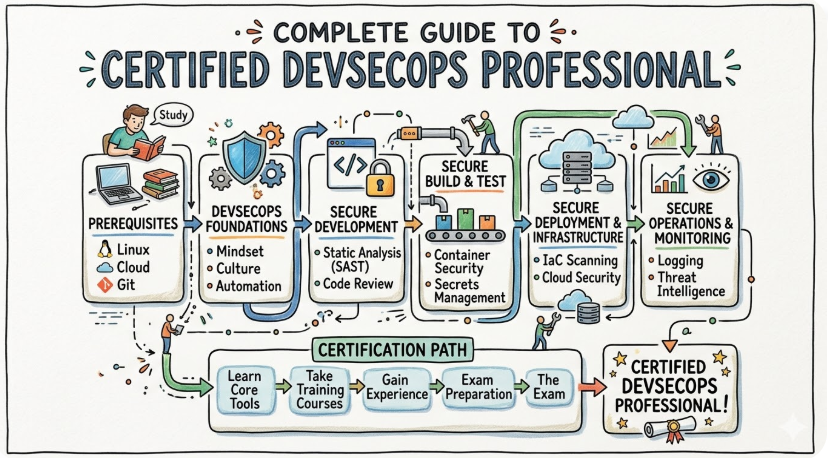
Engineering is no longer just about building features; it is about ensuring those features survive in a hostile production environment. As we move further into the era of cloud-native complexity, the “move fast and break things” mantra has evolved into “move fast with architectural integrity.” For software engineers and engineering managers in India and globally, the mission is now centered on the convergence of speed and safety.
In the decades spent observing the rise of automation, one thing has become certain: security is the ultimate bottleneck unless it becomes code. This is the essence of DevSecOps. This guide is designed to help you navigate the Certified DevSecOps Professional (CDP) journey—a critical milestone for any leader or practitioner aiming to master the modern software delivery lifecycle.
The Strategic Necessity of DevSecOps in Global Tech
The global tech economy runs on CI/CD pipelines. However, a pipeline that delivers vulnerable code is simply a faster way to create a crisis. Enterprises today are shifting away from centralized security teams toward a decentralized model where every engineer is a guardian of the codebase.
For the modern professional, attaining a certification like the Certified DevSecOps Professional (CDP) is not just about adding a line to a resume. It is about acquiring the specialized technical literacy required to protect complex systems at scale. Whether you are managing a team in Bengaluru or architecting a system in Silicon Valley, the ability to automate defense is the most sought-after skill in the industry.
Deep Dive: Certified DevSecOps Professional
The path to becoming a Certified DevSecOps Professional (CDP) involves a fundamental shift in how you perceive the software lifecycle. It requires moving from reactive security to proactive, automated defense.
What it is
The Certified DevSecOps Professional (CDP) is a technical mastery program that validates an engineer’s ability to inject security protocols into every heartbeat of the DevOps lifecycle. Unlike standard certifications that focus on compliance checklists, the CDP is an engineering-first credential. It focuses on the actual implementation of security tools, the automation of vulnerability management, and the creation of “self-securing” infrastructure.
Who should take it
- Software Engineers: Developers who want to master “Secure-by-Design” principles and understand the operational security of their code.
- DevOps and SRE Professionals: Those looking to deepen their automation expertise by adding the “Sec” layer to their existing pipelines.
- Security Engineers: Security practitioners who want to move away from manual auditing and enter the world of high-velocity automation.
- Engineering Managers: Leaders who need to build high-performance teams that can meet modern regulatory and security standards without sacrificing delivery speed.
Skills you’ll gain
This certification transforms you into a security architect who speaks the language of automation. You will move from understanding threats to building systems that neutralize them.
- Automated Security Orchestration: You will gain the ability to weave security gates into modern CI/CD tools such as Jenkins, GitHub Actions, and GitLab.
- End-to-End Vulnerability Scanning: Mastery over SAST (Static) and DAST (Dynamic) methodologies to identify flaws in both code and runtime environments.
- Supply Chain Resilience: Learn to use Software Composition Analysis (SCA) to manage the massive risks associated with open-source dependencies.
- Hardening Cloud-Native Infrastructure: Gain the skills to secure Docker images and manage the complex attack surface of Kubernetes clusters.
- Infrastructure as Code (IaC) Governance: Learn to automatically audit Terraform and Ansible configurations for security anti-patterns before they hit production.
- Identity and Secret Management: Implementation of secure, centralized vaults to protect the credentials that power your automated systems.
Real-world projects you should be able to do after it
The CDP is designed for immediate application. After completion, you will be prepared to lead high-impact technical projects:
- Zero-Trust Pipeline Architecture: Design a delivery system where code is only promoted after passing a gauntlet of automated security tests.
- Automated Regulatory Compliance: Create “Compliance-as-Code” frameworks that allow your organization to be “audit-ready” at any moment for standards like SOC2 or ISO.
- Secure Container Lifecycle Management: Build a system that automatically identifies, patches, and redeploys vulnerable containers across a global cluster.
- Secrets-Free Infrastructure: Implement an organization-wide vault system that ensures no human or script ever sees a plaintext password.
Preparation plan
Your roadmap to success should be tailored to your current professional commitments.
- The 14-Day Sprint (Expert Level): For engineers already comfortable with CI/CD and containers. Focus 100% on tool integration labs and the specific nuances of the CDP exam environment.
- The 30-Day Professional Path (Standard): Spend the first two weeks mastering code and dependency scanning. Spend the second half focusing on runtime, container security, and integrated pipeline labs.
- The 60-Day Transformation (Foundation): Dedicate the first month to the fundamentals of DevOps (Git, Linux, Docker). Use the second month to layer on the security-specific skills of the CDP.
Common mistakes
Navigating this certification requires avoiding several common industry traps.
- The “Tool-Only” Fallacy: Many assume that installing a scanner is the same as having a security posture. The CDP teaches you the strategy behind the tools—don’t neglect the logic.
- Friction-Based Security: Beginners often create security gates that are so strict they stop development entirely. Learn how to create “frictionless” security that aids developers rather than hindering them.
- Neglecting the Lab Environment: This is not a memory test. If you don’t spend hours writing the scripts and fixing broken pipelines in the labs, the exam will be extremely difficult.
Global Certification Landscape: The Master Mapping
Mapping your career requires understanding the broader ecosystem of technical certifications. here is the current landscape.
| Track | Level | Who it’s for | Prerequisites | Skills Covered | Recommended Order |
| DevSecOps | Professional | Engineers/Managers | DevOps Basics | SAST, DAST, SCA, CI/CD | 1st (Securing the Build) |
| Observability | Master | Senior Engineers | 2+ Years Exp. | Metrics, Tracing, SLOs | 2nd (Securing the Runtime) |
| SRE | Professional | SREs/Ops | Cloud Basics | Error Budgets, Reliability | 1st (Reliability First) |
| AIOps | Professional | Data/Ops | Python/Stats | Anomaly Detection, ML | 3rd (Intelligent Ops) |
| FinOps | Associate | Managers/Architects | Cloud Basics | Cost Governance | 2nd (Economic Efficiency) |
Choose Your Path: 6 Specialized Career Tracks
Modern engineering is not a one-size-fits-all career. Choose the track that aligns with your professional passion:
- DevOps: The Architect of Velocity. Focus on the seamless movement of code from idea to production.
- DevSecOps: The Guardian of the Pipeline. Focus on automated defense and building secure delivery systems.
- SRE: The Master of Stability. Focus on making massive, complex systems inherently reliable and scalable.
- AIOps/MLOps: The Engineer of Intelligence. Use data science to predict failures and automate operational decisions.
- DataOps: The Custodian of Information. Focus on the secure, reliable flow of data across the enterprise.
- FinOps: The Strategic Optimizer. Bridge the gap between engineering performance and cloud financial accountability.
Role → Recommended Certifications Mapping
Align your technical growth with your current or desired role:
- DevOps Engineer: DevOps Professional → Certified DevSecOps Professional.
- SRE: SRE Professional → Master in Observability Engineering.
- Platform Engineer: Kubernetes Specialist → Certified DevSecOps Professional.
- Cloud Engineer: Cloud Solutions Architect → Certified DevSecOps Professional.
- Security Engineer: Penetration Testing → Certified DevSecOps Professional.
- Data Engineer: DataOps Professional → Master in Observability Engineering.
- FinOps Practitioner: FinOps Associate → Master in Observability Engineering.
- Engineering Manager: DevSecOps Manager → Master in Observability Engineering.
Leading Institutions for Professional Training
When it comes to high-level technical training, the quality of mentorship and lab environments is paramount. These institutions lead the way in providing support for the Certified DevSecOps Professional program.
DevOpsSchool
DevOpsSchool is recognized for its immersive, mentor-led approach to engineering. Their programs are built around the concept of “Real-World Readiness,” providing students with the lab hours and architectural insights needed to lead complex digital transformations in the global market.
Cotocus
Cotocus focuses on the advanced technical skills required for modern cloud-native environments. Their training methodology emphasizes practical application, ensuring that engineers are prepared for the high-pressure demands of top-tier technology firms and startups alike.
Scmgalaxy
Scmgalaxy serves as a comprehensive knowledge hub and community for automation professionals. They provide specialized training that covers the intricate details of software configuration management, build automation, and integrated security.
BestDevOps
BestDevOps offers high-impact, focused training modules designed for the working professional. Their approach is results-oriented, helping engineers quickly acquire the specific high-value skills needed to advance into senior technical roles.
This institution is dedicated specifically to the intersection of security and development. Their curriculum is highly specialized, ensuring that graduates are experts in the niche but critical field of automated security testing and pipeline hardening.
sreschool
SRESchool is the definitive resource for mastering Site Reliability Engineering. They provide the frameworks and technical deep-dives necessary to maintain enterprise-scale systems at the highest levels of performance and uptime.
aiopsschool
As infrastructure complexity exceeds human management capabilities, AIOpsSchool provides the training needed to use AI for operational excellence. They focus on the future of self-healing and predictive infrastructure.
dataopsschool
DataOpsSchool addresses the critical need for reliability in data pipelines. They teach engineers how to apply the rigor of DevOps to data engineering, ensuring that information is delivered securely and at high velocity.
finopsschool
FinOpsSchool focuses on the financial governance of the cloud. They provide engineers and managers with the skills to balance technical innovation with financial responsibility, a skill set that is increasingly vital as cloud budgets expand.
Next Step Certification Options:
- Direct Track: Certified DevSecOps Expert – for those aiming for the pinnacle of defensive engineering.
- Cross-Discipline: Master in Observability Engineering – to gain total transparency and a feedback loop for your security efforts.
- Management Track: Technical Leadership Masterclass – for those transitioning from hands-on engineering to strategic departmental leadership.
FAQs – Career & Growth Perspective
- Is DevSecOps relevant for small startups? Absolutely. A single breach can end a startup. Automated security is actually more cost-effective for small teams than manual audits.
- How does the Indian tech market view these certifications? India’s massive SaaS and FinTech sectors are currently paying a premium for engineers who can prove they understand DevSecOps and SRE.
- Is the Master in Observability Engineering a separate career? No, it is an essential skill set for any Senior SRE or DevSecOps lead who wants to manage production with confidence.
- Can I study for these while working full-time? Yes. The 30-day preparation paths are specifically designed for the working professional’s schedule.
- What is the return on investment for the CDP? Beyond salary increases, it provides career “insurance” by making you a specialist in a high-demand, low-supply field.
- Are these skills valid across all clouds (AWS/Azure/GCP)? Yes. The tools might change slightly, but the principles of SAST, DAST, and O11y are universal.
- Do I need a background in cybersecurity? No. The CDP is built for engineers. It teaches you the security you need to know from a builder’s perspective.
- What is the difference between SRE and DevOps? DevOps is a culture of delivery; SRE is the specific engineering practice used to make that delivery reliable.
- How do certifications help in a manager role? They provide the technical “BS meter” needed to make better hiring and budgeting decisions.
- Is there a community to help with the labs? Yes, platforms like Scmgalaxy offer extensive communities for networking and problem-solving.
- How much coding is involved? You should be comfortable with YAML and basic scripting (Python or Bash). You don’t need to be a senior developer.
- How often should I update my certifications? Given the pace of tech, a refresh every 2 years is the industry standard to stay at the cutting edge.
FAQs – Certified DevSecOps Professional Specifics
- What is the exam format for the CDP? It is a practical, performance-based exam where you must configure security tools in a live lab environment.
- Does it cover Kubernetes security? Yes, hardening container clusters is a major component of the certification.
- What are the primary tools taught? You will work with Snyk, SonarQube, OWASP ZAP, HashiCorp Vault, and various open-source security scanners.
- Is training required to pass? While not strictly required, the complexity of the labs makes formal training from a provider like DevOpsSchool highly recommended.
- What is “Security as Code”? It is the practice of defining security policies in machine-readable files that can be automatically enforced by your pipeline.
- Does the CDP help with SOC2 or ISO audits? Yes, it teaches the automation needed to collect evidence for these compliance frameworks continuously.
- Is the certification recognized by global tech giants? Yes, the skills covered (SAST, DAST, SCA) are the exact standards used by companies like Google, Meta, and Amazon.
- Can I take the exam from home? Yes, proctored online exam options are available through authorized training partners.
Conclusion
The evolution of an engineer into a Certified DevSecOps Professional marks a transition from being a contributor to being a strategic architect of trust. In an industry where speed is a given but security is a choice, those who choose to master the automation of defense will lead the next generation of engineering teams. By committing to this path—and eventually expanding into the Master in Observability Engineering—you are ensuring that your technical skills remain resilient against the shifting tides of the technology market. The future of engineering is secure, automated, and fully visible; the journey begins with the first line of security code you write today.
