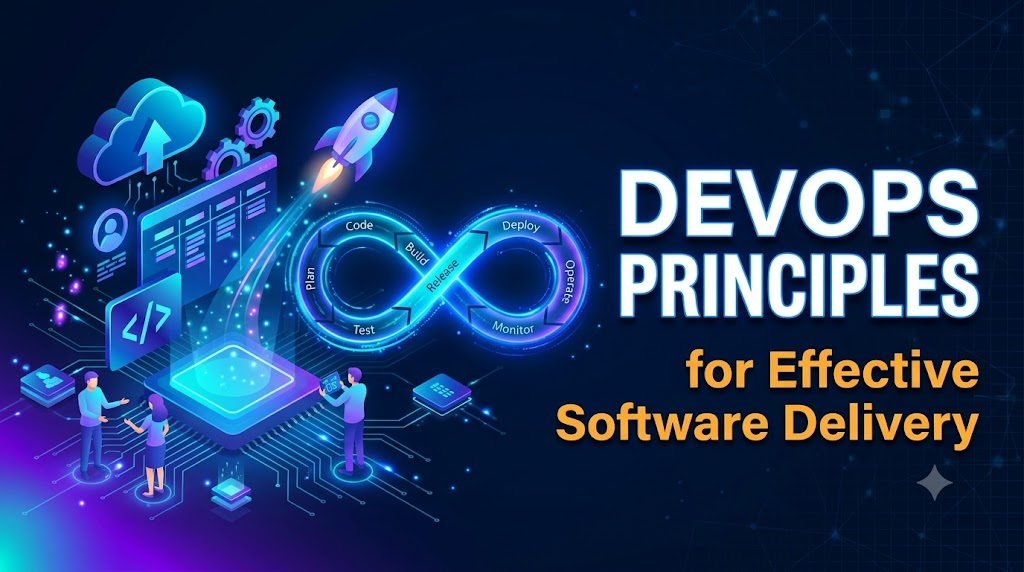
Software engineering teams frequently encounter friction when moving code from development to production—from delayed releases and manual deployment errors to communication silos and sudden outages. DevOps Principles for Effective Software Delivery address these operational bottlenecks by bridging the cultural and technical divide through shared responsibility, continuous integration and delivery (CI/CD), infrastructure as code, automated testing, and end-to-end observability. Rather than functioning as a standalone tool or a rigid mandate to release constantly, DevOps establishes a collaborative, automated, and feedback-driven framework that enables cross-functional teams to build, test, and release reliable software with greater predictability and speed.
What Is DevOps?
DevOps is a operational and cultural philosophy that combines software development (Dev) and IT operations (Ops). Its goal is to shorten the systems development life cycle while delivering features, fixes, and updates reliably and frequently.
Historically, software developers wrote application code and handed it over to system administrators to deploy and maintain. This split created conflicting incentives:
- Development teams were rewarded for shipping features quickly.
- Operations teams were evaluated on platform stability and uptime, making them naturally cautious about introducing new changes.
DevOps unifies these objectives. By establishing cross-functional teams with shared goals, organizations treat software delivery as a single continuous capability. This alignment relies on several foundational pillars:
- Cultural alignment: Fostering transparent communication and shared ownership across developers, operations engineers, security specialists, and quality assurance.
- Process automation: Removing error-prone, repetitive manual steps from builds, testing, provisioning, and releases.
- Continuous delivery pipelines: Enabling code to move safely through automated validation steps directly into operational environments.
- Proactive observability: Collecting operational insights to understand how systems perform under real user workloads.
DevOps is neither a single software utility nor a solitary job title. It is an evolving combination of cultural norms, engineering practices, and technical tooling that allows teams to deliver value iteratively.
Why DevOps Principles Are Important for Effective Software Delivery
Writing functional application logic is only one part of the delivery challenge. Code must also be compiled, validated against quality and security standards, configured for specific target environments, deployed without disrupting existing users, and monitored for performance anomalies.
Adopting core DevOps principles helps engineering organizations navigate these operational realities by:
- Minimizing manual intervention: Automating recurring build and deployment steps reduces configuration drift and avoids human error during routine changes.
- Catching integration defects early: Frequently merging code into shared branches alongside automated test suites flags breaking changes within minutes instead of days.
- Standardizing execution environments: Using codified definitions for infrastructure ensures that development, staging, and production environments share consistent runtime configurations.
- Mitigating release risk: Breaking large releases into smaller, incremental changes simplifies code reviews, isolates failures, and allows rapid rollback if an anomaly occurs.
- Shortening incident resolution cycles: Unified telemetry across application logs, metrics, and traces gives operations and development teams the context needed to debug production problems quickly.
- Establishing dependable feedback loops: Real-time data from production informs future architecture designs, sprint planning, and performance optimizations.
These operational improvements depend directly on implementation quality, underlying system architectures, organizational constraints, and team maturity. DevOps principles do not guarantee zero downtime or bug-free releases, but they build resilient engineering workflows capable of identifying, handling, and recovering from defects systematically.
Core DevOps Principles for Effective Software Delivery
Successful DevOps adoptions are anchored by foundational engineering and organizational principles. Below are the primary tenets that govern sustainable, high-velocity delivery pipelines.
       [ Plan & Code ]
              │
              ▼
   [ Continuous Integration ]  ◄── (Automated Tests & Quality Checks)
              │
              ▼
    [ Continuous Delivery ]   ◄── (IaC & Immutable Environments)
              │
              ▼
  [ Production Deployment ]   ◄── (Small Batches & Canary/Flags)
              │
              ▼
   [ Observability & SRE ]    ──► [ Feedback Loop to Engineering ]
1. Collaboration and Shared Responsibility
In traditional organizations, development builds the software and hands off operational problems to operations, while security audits software only right before launch. This siloed model creates blind spots, slow release turnarounds, and finger-pointing during outages.
DevOps replaces handoffs with shared responsibility. Developers participate in deployment configurations, review operational telemetry, and join on-call rotations for their services. Operations engineers advise on software architecture, resilience design, and deployment pipelines early in the design phase.
Shared responsibility must never mean ambiguous accountability. Instead, cross-functional teams establish clear service ownership: the team that designs and builds a service is also responsible for its operational reliability, security compliance, and performance in production.
- Practical Example: An operations engineer and a backend developer sit together during sprint planning to define resource allocations, logging formats, and health check endpoints before a new microservice is written, eliminating configuration surprises during deployment.
2. Continuous Integration (CI)
Continuous Integration requires developers to merge code changes into a central version control repository frequently—often several times a day. Every pull request or merge triggers an automated pipeline that checks out the code, executes compilation steps, runs static analysis, and executes automated test suites.
CI directly targets the problem of “merge debt,” where multiple engineers work on isolated feature branches for weeks, only to face massive, conflicting code integrations later.
- Version Control Hygiene: Teams use tools like Git with structured branching strategies (such as trunk-based development or short-lived feature branches).
- Automated Feedback: The CI runner executes unit tests, code linters, and integration checks, returning pass/fail status back to the developer within minutes.
- Early Defect Detection: Flaws are caught while the architectural context is still fresh in the developer’s mind, making remediation faster and less costly.
- Practical Example: A developer opens a pull request with 80 lines of code. The CI runner automatically executes the unit test suite, runs a static linter, and validates API contracts. A broken integration test fails the build in four minutes, allowing the engineer to fix the bug locally before the code ever merges to the main branch.
3. Continuous Delivery and Continuous Deployment
While often used interchangeably, Continuous Delivery (CD) and Continuous Deployment represent distinct levels of release automation:
- Continuous Delivery: Every validated build in the pipeline is packaged, tested in production-like staging environments, and held in an immediately deployable state. Deploying to production remains an explicit, often business-driven decision triggered by an authorized manual approval.
- Continuous Deployment: Every code commit that passes all automated test and compliance stages in the pipeline is deployed directly to production automatically, with no human intervention required.
Continuous Integration:
[ Code ] ──► [ Build ] ──► [ Test ]

Continuous Delivery:
[ Code ] ──► [ Build ] ──► [ Test ] ──► [ Staging ] ──► [ Manual Approval ] ──► [ Production ]

Continuous Deployment:
[ Code ] ──► [ Build ] ──► [ Test ] ──► [ Staging ] ──► [ Automated Release ] ──► [ Production ]
The choice between continuous delivery and continuous deployment depends on regulatory mandates, business risk profiles, and operational readiness. Both models require repeatable, automated deployment pipelines with robust rollback and recovery mechanisms.
- Practical Example: A financial technology application uses Continuous Delivery. Every code change automatically builds, runs through test suites, and deploys to a pre-production sandbox. Once business stakeholders approve the regulatory audit checks, the release manager clicks an approval button that automatically deploys the verified artifact into production.
4. Automation of Repetitive Processes
Manual procedures are inherently error-prone, inconsistent, and difficult to scale. DevOps prioritizes automating high-frequency, predictable operational tasks across the delivery pipeline:
- Compiling binaries and resolving dependencies
- Executing regression, unit, and performance tests
- Provisioning cloud resources and runtime networks
- Deploying container images and running database schema migrations
- Rotating secrets, certificates, and compliance checks
Teams should evaluate automation initiatives based on frequency, execution risk, and ongoing maintenance overhead. Automation is not a substitute for sound architectural design; an automated flawed workflow simply produces failures more quickly. Automated tasks still require monitoring, regular review, and engineering oversight.
- Practical Example: Rather than having an engineer manually SSH into five servers to apply software patches, unpack tarballs, and restart system services, the team executes an automated deployment workflow that updates and verifies instances sequentially using containerized tasks.
5. Infrastructure as Code (IaC)
Infrastructure as Code manages and provisions computing infrastructure—including virtual machines, networks, load balancers, and storage—using declarative configuration files rather than manual console interactions or one-off scripts.
By managing infrastructure configurations in version control systems like Git, teams apply standard software engineering practices to infrastructure:
- Repeatable Environments: Identical infrastructure can be spun up on demand for development, testing, staging, and disaster recovery.
- Configuration Drift Prevention: Discrepancies caused by ad-hoc manual changes to running servers are prevented, as all modifications must be introduced through code.
- Auditing and Review: Infrastructure changes go through peer review, security scanning, and commit histories that document what changed, who changed it, and why.
Declarative tools like Terraform, OpenTofu, AWS CloudFormation, or Kubernetes manifests allow engineers to define the desired end state of a system, leaving the tool to reconcile discrepancies.
- Practical Example: An infrastructure team defines an auto-scaling cluster, its subnets, and its security groups in a set of Terraform configuration files. When staging capacity needs to match production for a load test, the configuration is applied to a clean cloud account, provisioning an identical environment in minutes.
6. Continuous Testing and Quality Assurance
In a DevOps model, quality assurance is integrated continuously throughout the software delivery lifecycle rather than deferred to a distinct QA phase at the end of development.
Relying exclusively on late-stage manual testing delays release cadences and leaves engineers debugging complex regressions under release deadlines. Continuous testing organizes automated quality checks into a cohesive test pyramid:
- Unit Tests: Fast, low-level tests confirming individual functions behave as intended.
- Integration Tests: Verifying that distinct modules, datastores, and third-party APIs communicate properly.
- End-to-End (E2E) & Contract Tests: Simulating real user flows and validating API payload schemas across microservices.
- Regression and Smoke Tests: Rapid sanity checks that run automatically on newly deployed environments to confirm base functionality.
Automated tests provide fast, objective feedback. However, passing tests does not guarantee that software is free of functional defects or usability issues; automated suites should be paired with exploratory testing and risk-based validation for critical paths.
- Practical Example: A developer modifies a checkout service. Before the code can merge, an automated pipeline runs 400 unit tests in 45 seconds, 50 integration tests against an ephemeral database container in two minutes, and schema validation tests to ensure the cart API will not break downstream billing services.
7. Continuous Monitoring and Observability
Deploying code is not the end of the delivery cycle. Effective software delivery requires continuous visibility into application health, performance trends, and platform stability.
Modern observability moves beyond simple server uptime checks to examine the internal state of distributed systems using three core data types:
- Metrics: Numeric, aggregatable values tracked over time (CPU utilization, memory usage, request counts, error rates, latencies).
- Logs: Timestamped records of discrete events containing rich debugging context and error traces.
- Distributed Traces: End-to-end paths of requests navigating through complex networks of microservices, pinpointing exact sources of latency.
Monitoring collects this telemetry; observability enables engineers to infer why a system is behaving abnormally by querying that telemetry during unexpected events.
| Observability Component | Primary Function | Practical Application |
| Metrics | High-level system health tracking | Alerting when HTTP 5xx error rates exceed 1% over a 5-minute window |
| Logs | Deep diagnostic event inspection | Inspecting a detailed stack trace of a failed database connection |
| Distributed Tracing | Cross-service transaction analysis | Locating a 900ms bottleneck in an internal auth check during API calls |
- Practical Example: Immediately after a new version of an inventory service is deployed, an alert triggers indicating that 99th-percentile API response latency spiked from 120ms to 1.8s. The team checks their distributed tracing dashboard, discovers a missing database index on a newly added query, and rolls back the deployment within minutes before customer workflows are disrupted.
8. Security as a Shared Responsibility (DevSecOps)
Historically, security teams performed compliance and penetration reviews just before a major release. When critical vulnerabilities were discovered, releases were either blocked indefinitely or deployed with unpatched risks to meet launch schedules.
DevSecOps integrates security practices into every phase of development and operations:
- Static Application Security Testing (SAST): Automated source code scanners that inspect code for security flaws (such as SQL injection patterns or insecure deserialization) during CI builds.
- Software Composition Analysis (SCA): Scanners that analyze third-party libraries and dependencies against databases of known Common Vulnerabilities and Exposures (CVEs).
- Secrets Management: Automated tools preventing API keys, passwords, and private certificates from being committed to Git, managing them instead via centralized secret managers.
- Infrastructure Security Policies: Automated checks that validate IaC files against security baselines (such as ensuring storage buckets are not publicly accessible).
Automated scanners identify known vulnerabilities, but they must be balanced with threat modeling, architecture reviews, and safe developer practices.
- Practical Example: A developer adds an open-source logging library to a project. During the CI run, an automated SCA scanner flags that this version of the library contains a high-severity remote code execution vulnerability. The build fails automatically, preventing the vulnerable dependency from reaching staging.
9. Continuous Improvement and Learning
High-performing engineering teams treat failures as learning opportunities. When production outages or delivery failures occur, organizations run blameless post-incident reviews.
Blameless postmortems assume that engineers act in good faith based on the information available to them at the time. Instead of blaming individuals, teams analyze systemic causes:
- Why did our automated tests fail to catch this regression?
- Why were our monitoring dashboards slow to alert us?
- What architectural guardrail was missing that allowed this configuration error to bring down the service?
- What runbook or automation can prevent this failure mode in the future?
Continuous improvement also applies to managing technical debt, refining CI/CD pipelines, and giving teams time to upgrade dependencies, re-architect brittle systems, and learn new operational skills.
- Practical Example: After a bad deployment causes 20 minutes of downtime, the team holds an incident review. Rather than reprimanding the engineer who triggered the release, the team discovers that the deployment script lacked a health-check verification step. They create a ticket to add automated health checks and rollback logic before subsequent releases.
10. Small, Frequent, and Manageable Changes
Deploying monolithic, quarterly releases carrying thousands of code changes introduces substantial operational risk. If an outage occurs, isolating the specific line of code or configuration change responsible is difficult and time-consuming.
DevOps favors small, frequent, and decoupled releases. Deploying discrete changes limits the blast radius of any individual failure:
- Simpler Code Reviews: Pull requests with fewer than 200 lines of code receive faster, more thorough peer reviews than massive, sprawling changes.
- Targeted Troubleshooting: If an anomaly appears right after a single commit release, identifying the cause is straightforward.
- Progressive Delivery: Techniques such as canary deployments (routing 2% of traffic to the new version before rolling it out broadly) and feature flags (toggling functionality on or off at runtime without redeploying code) allow teams to release and evaluate features with minimal operational risk.
Frequent deployments must match an organization’s domain, regulatory environment, and operational readiness. Deploying frequently without solid automated testing or observability will only accelerate the pace of production incidents.
- Practical Example: Instead of waiting two months to bundle a revised payment gateway into a major quarterly release, the team gates the new gateway behind a feature flag, deploys the code safely to production during normal business hours, and enables it for 5% of internal beta users to confirm stability.
11. Reliability and Operational Readiness
Software delivery extends beyond getting code into production; it encompasses keeping applications dependable, performant, and resilient under real-world operational loads.
Site Reliability Engineering (SRE) practices complement DevOps by providing quantitative frameworks for platform dependability:
- Service-Level Indicators (SLIs): Precise metrics that reflect service performance (e.g., the proportion of successful HTTP requests).
- Service-Level Objectives (SLOs): Target reliability goals agreed upon by engineering and business stakeholders (e.g., 99.9% of requests return HTTP 200 within 300ms over a rolling 30-day window).
- Error Budgets: The acceptable threshold of unreliability ($100\% – \text{SLO}$). If a team exhausts their error budget due to frequent incidents, new feature releases pause to prioritize stability and infrastructure hardening.
- Operational Runbooks & Incident Response: Clear, maintained operational documentation detailing how to triage, mitigate, and recover from standard infrastructure failures.
- Practical Example: An e-commerce engineering team establishes an SLO of 99.95% successful checkouts. When database connection timeouts consume 80% of their monthly error budget over a weekend, the team delays their next feature launch by a week to overhaul their connection pooling and add caching layers.
12. Measurement and Data-Driven Decisions
Improving software delivery requires measuring process efficiency and operational stability using objective data rather than subjective impressions.
The DevOps Research and Assessment (DORA) team—an ongoing industry research program—has established core metrics that benchmark software delivery and operational performance:
- Deployment Frequency: How often an organization successfully releases code to production or an app store.
- Lead Time for Changes: The time it takes for a code commit to successfully run through the pipeline and reach production.
- Change Failure Rate: The percentage of deployments causing a degradation in service that requires remediation (such as a hotfix, rollback, or patch).
- Failed Deployment Recovery Time: The time it takes to restore service when a deployment causes an unexpected production degradation or outage (historically referred to as Time to Restore Service).
- Operational Performance (Reliability): Modern DORA research includes operational dependability, assessing how well a service meets user expectations and stated availability goals.
| DORA Metric | What It Measures | Why It Matters |
| Deployment Frequency | Delivery velocity and batch size | Smaller batches lead to faster feedback and lower release risk |
| Lead Time for Changes | Pipeline efficiency and agility | Shorter lead times allow teams to respond quickly to market needs or bug fixes |
| Change Failure Rate | Delivery quality and testing rigor | Identifies whether delivery speed is compromising system stability |
| Failed Deployment Recovery Time | Resilience and incident response | Measures how rapidly teams can roll back, patch, or recover from failures |
Metric definitions should align with current official DORA research. Metrics must never be weaponized to evaluate or punish individual engineers, as this encourages teams to game the system (such as artificially splitting pull requests or avoiding critical, high-risk refactoring).
How DevOps Principles Work Together in a Real Software Delivery Workflow
To understand how these principles fit together, consider a hypothetical engineering team delivering updates to a cloud-based web application.
+--------------------------------------------------------------------------------------------------------+
|                                    End-to-End Delivery Lifecycle                                       |
+--------------------------------------------------------------------------------------------------------+
| 1. Plan & Code      --> Developer creates branch, writes unit tests & logic (Small Changes)            |
| 2. Commit & Push    --> Code pushed to Git repo; PR opened (Version Control & Collaboration)           |
| 3. Automated CI     --> Build runs, linters execute, unit/integration tests pass (Continuous Testing)  |
| 4. Security Scan    --> SAST and dependency vulnerability checks run in pipeline (DevSecOps)           |
| 5. Review & Merge   --> Peer review approved; branch merges to main (Shared Responsibility)            |
| 6. Deploy Ephemeral --> IaC provisions an on-demand preview environment (Infrastructure as Code)       |
| 7. Staging Validate --> Automated smoke tests and contract checks run (Automated Testing)              |
| 8. Release Strategy --> Canary deployment routes 5% of traffic to new build (Continuous Delivery)     |
| 9. Monitor Telemetry--> Metrics, logs, and traces monitored for error spikes (Continuous Observability)|
| 10. Learn & Iterate --> Team reviews operational dashboards to guide next sprint (Continuous Learning) |
+--------------------------------------------------------------------------------------------------------+
- Small Batch Planning: A developer picks up a user story to improve checkout error messaging. The task is scoped to a small batch of fewer than 150 lines of code (Small, Manageable Changes).
- Local Development and Version Control: The developer writes the application code alongside unit tests and pushes the branch to a shared Git repository (Continuous Integration).
- Automated Pipeline Trigger: Pushing the branch triggers an automated CI pipeline. The pipeline compiles the code and executes the test suite in two minutes (Automation of Repetitive Processes).
- Security Analysis: An integrated security stage runs static code analysis and checks dependencies for known vulnerabilities (DevSecOps).
- Peer Review and Merge: A peer reviews the pull request for code quality, architectural consistency, and readability. Once approved, the code merges to the main branch (Collaboration and Shared Responsibility).
- Infrastructure Validation: An automated pipeline checks declarative IaC templates using Terraform to ensure required database connections and networking rules are properly configured (Infrastructure as Code).
- Ephemeral Test Deployment: The build artifact is packaged into a container and deployed to an ephemeral staging environment, where automated integration and end-to-end tests run (Continuous Testing).
- Canary Release: The artifact passes all automated verification stages and moves to production via a canary rollout strategy. The deployment system routes 5% of incoming user requests to the new version while keeping the remaining 95% on the stable version (Continuous Delivery).
- Observability and Telemetry: Prometheus collects latency metrics while Grafana displays error rates. Distributed tracing tracks incoming user requests to ensure error rates do not increase (Continuous Monitoring).
- Feedback and Iteration: Once metrics show normal performance over 30 minutes, traffic shifts to 100%. The team evaluates production latency patterns during their weekly engineering review to inform future work (Continuous Improvement).
Traditional Software Delivery vs. DevOps-Based Delivery
To highlight the differences between legacy operational structures and DevOps-driven workflows, the following table compares key operational characteristics:
| Delivery Aspect | Traditional Siloed Approach | DevOps-Oriented Approach |
| Team Collaboration | Development and operations work under separate management with conflicting performance goals. | Cross-functional teams share ownership of software from initial development through production operations. |
| Code Integration | Developers work in isolated branches for weeks or months, resulting in complex, painful merge conflicts. | Developers integrate small code increments daily into a shared mainline branch backed by automated test validation. |
| Quality Testing | Quality assurance is largely manual and concentrated in a dedicated phase shortly before scheduled releases. | Automated unit, integration, and security tests execute continuously within automated delivery pipelines. |
| Deployments | Manual, high-risk release events scheduled during off-hours, requiring lengthy runbooks and weekend staffing. | Automated, repeatable, and low-friction release workflows executed frequently during standard working hours. |
| Infrastructure Management | Manual, ad-hoc server configurations, GUI-driven provisioning, and undocumented system modifications. | Infrastructure defined, versioned, reviewed, and provisioned using Infrastructure as Code (IaC) templates. |
| Observability & Monitoring | Basic server uptime monitoring handled reactively by operations, often alerted only after users complain. | Comprehensive observability (metrics, logs, traces) integrated into delivery pipelines and monitored by all teams. |
| Security Controls | Audits conducted immediately before product launches, often delaying releases when issues are found. | Security controls (SAST, SCA, secrets scanning) shifted left and automated within delivery pipelines (DevSecOps). |
| Process Improvement | Post-mortems focused on finding human error, resulting in rigid sign-offs and administrative red tape. | Blameless post-incident reviews focused on identifying root systemic causes and improving automated guardrails. |
Note: This comparison outlines common operating models; individual organizations may fall along different points of this spectrum depending on their specific technical constraints and maturity.
How to Implement DevOps Principles Step by Step
Adopting DevOps is an iterative journey. Organizations that try to revamp their culture, toolchains, and processes overnight often face tool sprawl and internal resistance. A phased, practical roadmap is much more effective.
Step 1: Assess the Current Software Delivery Process
Map your existing value stream from code commit to production delivery. Identify where work stalls:
- Are releases delayed by manual approval queues?
- Do automated tests take five hours to run?
- Do deployments regularly fail because staging differs from production?Identify your primary operational bottleneck before purchasing tools or re-architecting systems.
Step 2: Define Shared Goals and Metrics
Align development, operations, and business stakeholders around common objectives:
- Establish baseline DORA metrics (e.g., current lead time and change failure rate).
- Set shared reliability expectations using Service Level Objectives (SLOs).
- Shift incentives so development shares responsibility for stability and operations shares responsibility for delivery velocity.
Step 3: Establish Version Control and Continuous Integration
Consolidate all application code, configuration files, and deployment scripts into version control (e.g., Git). Set up a CI server to automate builds and unit tests on every pull request. Establish a strict team policy: if the main branch build breaks, fixing it takes priority over writing new features.
Step 4: Introduce Automation Gradually
Target repetitive, low-complexity, high-friction tasks first:
- Automate dependency management and application compilation.
- Automate database schema migrations.
- Automate artifact packaging using container technologies like Docker.Avoid automating poorly understood, broken processes—fix the workflow before automating it.
Step 5: Adopt Infrastructure as Code (IaC)
Transition away from manually configured servers. Use declarative tools (e.g., Terraform, cloud-native templates) to model environments. Store these templates in Git, run them through review workflows, and ensure that staging and test environments mirror production configurations closely.
Step 6: Integrate Security and Quality Controls (Shift Left)
Add automated quality and security checks to your CI pipelines:
- Introduce linters and static application security testing (SAST).
- Add automated dependency scanning for open-source vulnerabilities.
- Set up automated smoke tests that validate newly deployed services automatically.
Step 7: Improve Deployment and Recovery Workflows
Make deployment predictable and repeatable. Implement progressive deployment techniques:
- Adopt blue/green or canary deployments to reduce release risk.
- Decouple code deployment from feature release using feature flags.
- Document and test rollback and roll-forward procedures under realistic conditions.
Step 8: Establish Observability and Continuous Feedback
Implement centralized logging, metric aggregation, and distributed tracing across your environments. Create operational dashboards that display both technical metrics (error rates, CPU, memory) and business metrics (orders processed, sign-ups). Ensure alerts are actionable and route directly to the team responsible for the service.
Step 9: Measure Outcomes and Refine Practices
Review delivery metrics regularly. Run blameless postmortems after production incidents to uncover systemic weaknesses. Use these findings to refine automation, expand test coverage, and improve system architecture over time.
Implementation difference: Small teams may adopt these steps rapidly by using managed cloud services and all-in-one CI/CD platforms. Enterprise organizations with legacy applications often roll out changes incrementally, using platform engineering teams to build self-service internal developer platforms (IDPs) that abstract complex cloud infrastructure for application teams.
Popular Tools That Support DevOps Principles
While DevOps is primarily a cultural and operational methodology, tools are essential for automating tasks and providing operational visibility.
| DevOps Practice | Common Tools | Primary Function in Delivery |
| Version Control | Git, GitHub, GitLab | Tracking code revisions, managing pull requests, and supporting team collaboration. |
| CI/CD Pipelines | Jenkins, GitHub Actions, GitLab CI/CD, ArgoCD | Automating compilation, testing, artifact generation, and deployment delivery. |
| Containerization | Docker, Podman | Packaging applications and dependencies into lightweight, portable runtime units. |
| Container Orchestration | Kubernetes | Managing the deployment, scaling, networking, and availability of containerized workloads. |
| Infrastructure as Code | Terraform, OpenTofu, AWS CloudFormation | Declaring, provisioning, and version-controlling cloud and on-premises infrastructure. |
| Configuration Management | Ansible | Automating software installation, system configuration, and operational tasks across nodes. |
| Metrics & Monitoring | Prometheus, Datadog | Collecting, aggregating, and alerting on real-time time-series operational metrics. |
| Visualization & Dashboards | Grafana | Building unified operational dashboards to visualize metrics, logs, and system health. |
| Log Management | Elasticsearch/Logstash/Kibana (ELK), Loki | Aggregating, parsing, indexing, and searching distributed system and application logs. |
| Application Security | SonarQube, Snyk, Trivy | Running automated SAST, container image scanning, and dependency vulnerability checks. |
DevOps principles are tool-agnostic. Organizations should choose technologies based on application architecture, existing team competencies, operational costs, and long-term maintenance overhead—not industry hype.
Common Challenges When Adopting DevOps Principles
Adopting DevOps can be challenging. Organizations frequently run into organizational and technical obstacles along the way:
- Resistance to Cultural Change: Teams comfortable with traditional silos may view shared responsibility as a disruption.
- Remedy: Start with an internal pilot project involving an open-minded team. Demonstrate clear improvements in delivery velocity and reduced on-call stress before expanding the model across other departments.
- Skill and Knowledge Gaps: Developers may lack infrastructure knowledge, while operations engineers may be unfamiliar with software engineering practices, testing frameworks, or Git.
- Remedy: Pair developers with operations engineers, run internal cross-training workshops, and invest in structured professional education programs.
- Legacy Monolithic Architectures: Applications with tightly coupled codebases and hardwired dependencies are often difficult to test and deploy automatically.
- Remedy: Avoid attempting a full architectural rewrite from day one. Gradually introduce automated regression tests and carve off discrete functionality into smaller, independently deployable services or background workers.
- Flaky or Slow Automated Tests: Unreliable test suites that fail intermittently erode developer trust in CI pipelines, leading engineers to ignore pipeline failures.
- Remedy: Quarantine unreliable tests immediately into a non-blocking suite. Prioritize fast, reliable unit and integration tests over brittle, end-to-end browser-based tests.
- Tool Sprawl and Unnecessary Complexity: Teams sometimes adopt dozens of disparate tools without standard workflows, creating maintenance headaches and steep learning curves.
- Remedy: Standardize on a minimal, unified toolchain managed by an internal platform team that provides curated, self-service templates for delivery pipelines.
- Treating Automation as a Silver Bullet: Automating a chaotic, poorly defined deployment workflow simply creates faster, unpredictable failures.
- Remedy: Simplify and standardize the process manually first. Once the release steps are documented and predictable, apply automation to streamline execution.
Best Practices for Sustainable DevOps Adoption
To build an efficient and resilient software delivery capability, keep these foundational practices in mind:
- Start with Identified Delivery Bottlenecks: Don’t rebuild systems without a clear goal. Use value stream mapping to find and fix the specific process slowing your team down today.
- Prioritize Collaboration Over Tooling: An aligned team working with basic automation will deliver better software than a fragmented team running complex orchestration tools.
- Automate Incrementally: Build your delivery pipelines step by step. Automate code compilation and unit testing before attempting complex multi-region continuous deployment.
- Keep Commits and Releases Small: Smaller code changes are easier to write, review, test, deploy, and troubleshoot when anomalies appear in production.
- Treat Infrastructure Configurations as Production Code: Subject your IaC files, CI configurations, and deployment scripts to version control, peer reviews, automated linting, and security scans.
- Build Fast, Reliable Feedback Loops: Keep CI build times under 10 minutes whenever possible. If tests take hours to run, developers will switch tasks and loose momentum.
- Shift Security Left, but Keep It Practical: Integrate automated vulnerability scans directly into developer workflows, but fine-tune alert thresholds to prevent notification fatigue from low-risk warnings.
- Focus on Outcomes Over Output: Don’t measure developer productivity by lines of code written or pure commit counts. Focus on system stability, lead time for changes, and user-facing reliability.
- Avoid Blindly Copying Other Companies’ Tool Stacks: What works for a multi-thousand-engineer tech enterprise may introduce unnecessary overhead for a 20-person startup. Design your processes around your team’s specific scale, product requirements, and constraints.
- Commit to Continuous, Blameless Learning: Treat every incident as a source of system insights. Use retrospectives and postmortems to improve your automation, operational guardrails, and processes over time.
How DevOpsSchool Can Support DevOps Learning
Adopting DevOps principles requires developing practical competencies across diverse domains: containerization, CI/CD pipeline engineering, infrastructure automation, cloud platforms, and site reliability practices. Navigating these technologies independently can be daunting for engineers and organizations without structured guidance.
DevOpsSchool provides structured training programs, certifications, and technical resources designed to help software developers, systems administrators, cloud engineers, and technical leaders build hands-on skills in DevOps practices.
Their curriculum covers foundational principles alongside industry-standard tooling:
- CI/CD Pipeline Engineering: Practical courses on building resilient pipelines using tools like Jenkins, GitHub Actions, and GitLab CI/CD.
- Containerization and Orchestration: Comprehensive training covering Docker container packaging, Kubernetes cluster architecture, and production workload management.
- Infrastructure as Code (IaC): Guided, lab-based coursework covering declarative provisioning with Terraform, OpenTofu, and configuration management using Ansible.
- Observability and Cloud Engineering: In-depth modules on architecting systems for reliability, configuring Prometheus and Grafana monitoring, and managing major cloud platforms (AWS, Azure, Google Cloud).
Whether you are an individual engineer looking to expand your technical skills or an engineering manager building cross-functional capabilities across your team, structured coursework combined with hands-on labs provides a practical way to translate DevOps principles into dependable, day-to-day delivery workflows.
Frequently Asked Questions
What are the main principles of DevOps?
The core principles of DevOps include collaboration and shared responsibility, continuous integration (CI), continuous delivery (CD), process automation, Infrastructure as Code (IaC), continuous testing, comprehensive monitoring and observability, integrated security (DevSecOps), small batch sizes, and continuous organizational learning.
How do DevOps principles improve software delivery?
DevOps principles replace fragmented manual handoffs with automated, repeatable pipelines. By integrating code frequently, automating validation tests, maintaining infrastructure in code, and monitoring operational telemetry, teams catch bugs earlier, deploy smaller and safer increments, and resolve production incidents faster.
What is the role of CI/CD in DevOps?
Continuous Integration (CI) and Continuous Delivery (CD) provide the technical backbone for automated software delivery. CI ensures that developer code contributions are continuously merged, built, and tested. CD takes those validated builds and automates their deployment through staging and production environments, making releases predictable and repeatable.
Why is automation important in DevOps?
Automation removes slow, error-prone manual intervention from repetitive tasks like building code, executing tests, configuring networks, and deploying services. This consistency reduces human error, speeds up feedback loops, and allows engineers to focus on architecture, product features, and complex problem-solving.
How does Infrastructure as Code support DevOps?
Infrastructure as Code (IaC) applies software engineering principles to operations environments. By defining compute, storage, and networking configurations in version-controlled text files, teams can provision consistent, auditable, and repeatable environments on demand, eliminating configuration drift between staging and production.
What is continuous feedback in DevOps?
Continuous feedback involves systematically collecting data from production monitoring, distributed tracing, automated test results, and direct user behavior, and feeding that insight back to development and operations teams. This loop helps engineers make data-driven decisions about feature stability, performance bottlenecks, and architectural priorities.
How does DevSecOps relate to DevOps principles?
DevSecOps integrates security practices directly into the software delivery pipeline rather than treating security as an isolated audit at the end of the project. It embeds automated static code analysis, dependency vulnerability scanning, container security, and compliance verification early in the development lifecycle (“shifting left”).
Can small teams implement DevOps practices?
Yes. DevOps principles scale to organizations of any size. Small teams often adopt DevOps faster than large enterprises because they have fewer bureaucratic hurdles. By relying on managed cloud services, simple Git branching workflows, and turn-key CI/CD tools, a small team can build a reliable delivery pipeline with minimal operational overhead.
Which tools are commonly used in DevOps?
Widely used DevOps tools include Git (GitHub/GitLab) for version control, Jenkins and GitHub Actions for CI/CD, Docker for container packaging, Kubernetes for container orchestration, Terraform for Infrastructure as Code, Ansible for configuration automation, and Prometheus and Grafana for metrics collection and visualization.
How can organizations measure DevOps success?
Organizations measure DevOps delivery and stability using key DORA metrics: Deployment Frequency, Lead Time for Changes, Change Failure Rate, and Failed Deployment Recovery Time (formerly Time to Restore Service), alongside operational reliability goals established through Service Level Objectives (SLOs).
What are the biggest challenges in DevOps adoption?
The most common challenges include cultural resistance to cross-departmental collaboration, persistent technical debt in legacy architectures, skill gaps across engineering teams, flaky automated test suites, and tool sprawl where tools are introduced without established processes.
How can beginners start learning DevOps principles?
Beginners should focus on foundational software engineering concepts before diving into complex tools: master version control with Git, learn basic Linux command-line operations and shell scripting, understand networking fundamentals, containerize a simple web application using Docker, and configure a basic continuous integration pipeline to build and test code automatically.
Conclusion
Effective software delivery is not about adopting the largest tool stack or deploying every ten minutes; it is about building dependable, repeatable processes that balance business velocity with platform stability through collaboration, automation, Infrastructure as Code, testing, and continuous feedback. By replacing operational silos with shared accountability and small, manageable changes, engineering teams can systematically eliminate delivery bottlenecks, resolve incidents faster, and deliver continuous value to users. Take the first step by identifying the single biggest friction point in your current delivery pipeline and applying a core DevOps principle to solve it—and if your team needs structured, hands-on training to master these tools and practices, explore the industry-aligned courses and certification paths at DevOpsSchool.
