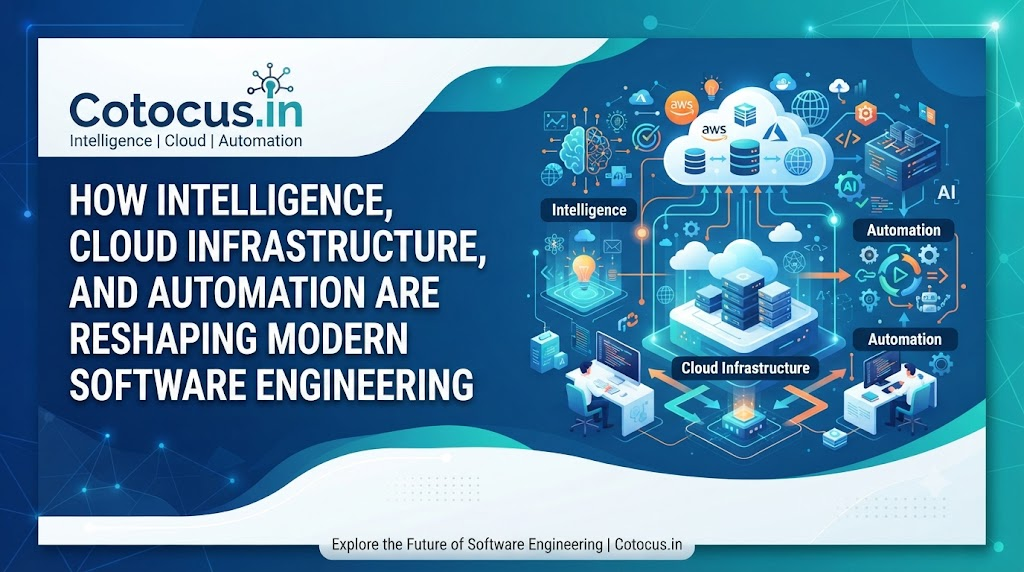
The approach to designing, building, and scaling digital systems has shifted dramatically across India. Today’s commercial environment requires far more than a basic web presence or an isolated desktop program. Enterprises are actively incorporating machine intelligence, scalable cloud platforms, automated workflows, subscription software, mobile solutions, and continuous delivery methods to maintain their competitive edge. Yet, adopting these advancements demands a cohesive, unified strategy rather than a patchwork of disconnected utilities.
Many enterprises quickly realize that individual tools cannot resolve sophisticated operational hurdles independently. Achieving sustainable digital growth necessitates a synchronized framework that ties together software creation, deployment security, system scalability, and team proficiency. Selecting an appropriate technology collaborator based on verified operational needs rather than short-lived industry fads remains vital for enduring success.
Understanding Contemporary Software Engineering
Software engineering has moved far beyond legacy application development models. Contemporary digital products depend heavily on cloud-native structures, integrated intelligence, automated workflows, and standardized application programming interfaces. Development squads construct systems utilizing microservices and containerized environments to guarantee flexibility and fault tolerance.
To deliver functional value quickly and securely, modern creation relies on several core pillars:
- Automated pipelines that handle continuous integration and continuous deployment to streamline testing and releases
- Infrastructure as code principles to provision environments consistently
- Containers and orchestration platforms to ensure uniform execution across different systems
- Comprehensive observability platforms to monitor overall system health and execution speed
- Security practices embedded directly into every phase of the development lifecycle
Technical groups achieve optimal results when development and operations units collaborate from the earliest planning stages. Eliminating traditional barriers between these fields allows companies to release updates swiftly while preserving high standards of stability and protection.
AI Software Development Company India
Artificial intelligence has evolved from an exploratory research discipline into a fundamental element of enterprise software. Businesses collaborate closely with an AI Software Development Company India to embed smart functionalities straight into their flagship products. These integrations assist organizations in automating repetitive administrative tasks, personalizing user interactions, and unearthing valuable insights from massive data reserves.
Key areas where artificial intelligence generates practical value include:
- Automated handling of routine data entry and paperwork
- Recommendation systems that curate content and tailor product suggestions
- Advanced text and document processing pipelines
- Predictive modeling for strategic business planning
- Conversational interfaces designed for responsive customer support
- AI-assisted internal operational workflows
When assessing external partners within this domain, leaders must look past simple coding proficiency. A dependable ally should display profound competence in data protection, smooth system integration, scalability management, governance, and a clear grasp of specific commercial requirements.
Generative AI Development Services
Generative intelligence operates on principles entirely distinct from classical software automation or standard machine learning models. Instead of simply classifying information or following rigid logical rules, generative systems synthesize fresh media, distill complex documents, and assist with intricate problem-solving tasks. Enterprises utilize specialized Generative AI Development Services to construct functional business solutions.
Typical corporate implementations include smart assistants, automated content creation tools, internal knowledge retrieval systems, and custom search engines. Deploying these capabilities requires meticulous planning regarding model selection, data confidentiality, prompt architecture, and retrieval-augmented generation techniques. Organizations must also institute robust evaluation frameworks, ongoing telemetry tracking, cost control measures, and responsible governance structures to minimize hallucinations and protect data integrity.
AI Agent Development Services
Autonomous digital assistants represent the next major progression in smart computing. Unlike basic conversational bots that reply to isolated user inputs, autonomous agents unite reasoning engines, planning mechanisms, external utilities, APIs, and business logic to execute multi-step procedures independently.
Implementing AI Agent Development Services demands careful attention to architectural safety and operational boundaries. Businesses must establish stringent access permissions, mandatory human approval checkpoints for sensitive transactions, and transparent context memory management. Because these agents can manipulate external systems, comprehensive monitoring, failure recovery protocols, and strict security governance are essential. Organizations should avoid treating autonomous agents as completely independent entities without adequate oversight and control mechanisms.
Custom Software Development Company India
Off-the-shelf software packages frequently fall short when enterprises face unique operational workflows or specialized industry demands. Partnering with a Custom Software Development Company India enables companies to construct bespoke applications mapped precisely to their organizational targets.
Custom solutions prove especially valuable for integrating legacy systems, designing proprietary analytics dashboards, building unique enterprise applications, and establishing internal automation platforms. When selecting a development ally, decision-makers should scrutinize architecture expertise, testing methodologies, security measures, technical documentation, and long-term maintenance support to guarantee that the final software remains adaptable and scalable over time.
SaaS Product Development Services
The software-as-a-service model has fundamentally altered how organizations distribute and monetize digital utilities. Constructing a successful cloud platform requires rigorous architectural planning alongside a strong dedication to product strategy and software engineering.
Crucial SaaS development considerations involve:
- Multi-tenant architecture designed to guarantee absolute data isolation
- Robust authentication frameworks and user permission controls
- Scalable subscription management and automated billing linkages
- Clean API layouts to support third-party integrations
- Continuous performance monitoring and automated backup recovery procedures
- Detailed product analytics to monitor user interaction patterns
Building a resilient subscription product requires a deep appreciation of user experience, cloud resource expenditure, and continuous deployment workflows to roll out features without disrupting active users.
DevOps Consulting Services India
As software release schedules accelerate, managing server environments manually quickly becomes unsustainable. Engaging for DevOps Consulting Services India assists companies in optimizing their delivery pipelines and elevating operational reliability.
Primary focal points for DevOps consulting typically comprise:
- Designing automated build and release pipelines
- Implementing infrastructure as code methodologies
- Establishing containerization strategies and release management frameworks
- Deploying centralized monitoring and telemetry systems
- Fostering a culture of shared responsibility between development and operations teams
Effective advisory engagements always align with an organization’s existing technological footprint, team maturity level, and specific business targets rather than imposing a generic template onto every project.
Cloud Migration Services India
Moving applications and infrastructure to cloud environments empowers businesses to scale computing resources dynamically, minimize upfront capital expenses, and strengthen disaster recovery preparedness. Organizations routinely pursue Cloud Migration Services India to modernize their aging information technology infrastructure.
A successful cloud transition demands a disciplined procedure:
- Comprehensive application auditing and dependency mapping
- Strategic workload categorization and structured migration waves
- Designing secure identity and access management policies
- Implementing dependable networking, backup, and cost-tracking controls
- Thorough performance testing before executing final cutovers
Migration should rarely be treated as a simple lift-and-shift exercise. Assessing whether legacy applications require modernization prior to relocation helps enterprises maximize the long-term advantages of cloud architectures.
Kubernetes Consulting Services
Containerization has streamlined how software packages are bundled, but administering containers at massive scale introduces fresh operational hurdles. Kubernetes has established itself as the baseline standard for container orchestration, helping technical squads automate the deployment, scaling, and lifecycle management of application containers across distributed clusters.
Specialized Kubernetes Consulting Services assist enterprises in implementing container orchestration efficiently. Core areas of concentration involve automated rollouts, horizontal scaling, service discovery, configuration handling, and cluster-level security. Nonetheless, Kubernetes introduces considerable operational complexity and is not inherently the right choice for every enterprise. Businesses should embrace it only when their scale and technical maturity justify the overhead.
Mobile App Development Company India
Mobile applications function as critical engagement channels for consumers, field technicians, and internal staff alike. Partnering with a Mobile App Development Company India allows companies to develop high-performance applications spanning Android, iOS, and cross-platform frameworks.
Contemporary mobile engineering demands reliable backend APIs, secure identity verification mechanisms, dependable push notifications, and seamless cloud integration. Furthermore, modern mobile applications increasingly link with artificial intelligence utilities and enterprise backend networks, making performance optimization and strict mobile security critical priorities.
Corporate AI and DevOps Training
Technology transforms at an extraordinary pace, making continuous team upskilling indispensable for sustained organizational success. Corporate AI and DevOps Training programs assist technical groups in closing knowledge gaps, adopting modern engineering standards, and navigating cloud and artificial intelligence adoption responsibly.
Effective educational initiatives should be tailored around an organization’s specific technical stack, employee roles, and current proficiency levels. Upgrading internal skills enhances collaboration, reinforces security protocols, and ensures that staff can independently maintain and evolve digital products long after initial development concludes.
How Intelligence, Cloud Infrastructure, and Automation Intersect
Constructing resilient digital systems requires a harmonious relationship between artificial intelligence, cloud environments, delivery pipelines, container orchestration, and application layers.
A modern technological lifecycle typically follows a continuous cycle:
- Business requirements analysis guides system architecture and software design
- Engineers construct intelligence features and application logic
- Automated testing routines validate functionality within release pipelines
- Code is deployed securely onto scalable cloud platforms utilizing container orchestration
- Observability tools track system behavior and security postures in real time
- Continuous feedback loops feed operational insights back into ongoing product enhancement
When these disciplines function cohesively, organizations can innovate rapidly while upholding stringent operational stability.
How to Choose the Right Technology Partner
Selecting an appropriate technology ally stands out as a critical milestone for any digital initiative. Decision-makers should look past marketing slogans and evaluate prospective partners using concrete criteria.
Important evaluation benchmarks encompass:
- Proven technical competence and relevant project history
- Robust software architecture and secure coding disciplines
- Deep familiarity with cloud platforms and DevOps maturity standards
- Practical background in artificial intelligence and modern application design
- Comprehensive testing methodologies alongside transparent documentation
- Dependable post-launch support and educational capabilities
Evaluating these attributes guarantees that the selected collaborator can deliver scalable, protected, and maintainable software assets.
How Cotocus Supports Modern Technology Initiatives
Navigating the complexities of modern software engineering, cloud migration, artificial intelligence, and DevOps requires seasoned guidance. Cotocus assists businesses across these essential domains by providing expert software development, cloud infrastructure consulting, DevOps implementation, Kubernetes orchestration, and professional technology training.
By concentrating on engineering discipline and practical business alignment, Cotocus helps enterprises build scalable, secure, and reliable digital solutions customized to their distinct operational needs.
The Future of AI and Cloud-Based Software Engineering
The technological horizon continues to evolve rapidly alongside the rise of agentic artificial intelligence, advanced generative utilities, platform engineering, and secure software supply chains. Emerging developer productivity tools and sophisticated observability solutions are reshaping how technical groups construct and maintain software systems.
However, successful adoption will always rest upon sound engineering fundamentals, strict data governance, robust security practices, and a clear dedication to delivering measurable business value rather than chasing temporary technology hype.
Conclusion
Artificial intelligence, custom software engineering, subscription platforms, mobile applications, cloud migration, Kubernetes, and DevOps are no longer isolated specialties. They constitute an interconnected ecosystem that drives modern digital engineering. Organizations that evaluate their current technical maturity, outline precise objectives, and select the appropriate blend of external guidance and internal capacity will remain best positioned for enduring success in an increasingly digital environment.
