MOTOSHARE 🚗🏍️
Turning Idle Vehicles into Shared Rides & Earnings

From Idle to Income. From Parked to Purpose.
Earn by Sharing, Ride by Renting.
Where Owners Earn, Riders Move.
Owners Earn. Riders Move. Motoshare Connects.

With Motoshare, every parked vehicle finds a purpose. Owners earn. Renters ride.
🚀 Everyone wins.

Start Your Journey with Motoshare

Flutter: Conditional Statements If-Else

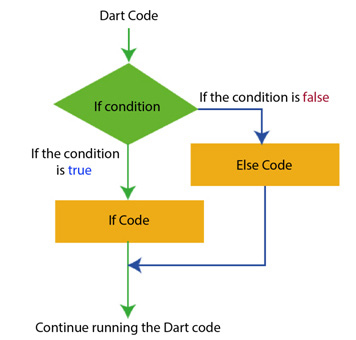
The if-else statement is a fundamental construct in programming that allows you to execute different blocks of code based on specific conditions. In Flutter, if-else statements are used extensively to control the flow of your application’s logic and user interface.

Syntax of If-Else Statements in Dart (Flutter’s Programming Language):

The syntax of an if-else statement in Dart is as follows.

if (condition) {
  // Code to execute if the condition is true
} else {
  // Code to execute if the condition is false
}

In this syntax:

  • condition is a boolean expression that evaluates to either true or false.
  • The code block inside the if statement is executed if the condition is true.
  • The code block inside the else statement is executed if the condition is false.

Example: Using If-Else Statements in Flutter Widgets:

Let’s consider a simple example where we want to display a message based on whether a user is logged in or not. We can achieve this using if-else statements in Flutter widgets.

import 'package:flutter/material.dart';

class HomePage extends StatelessWidget {
  final bool isLoggedIn = true;

  @override
  Widget build(BuildContext context) {
    return Scaffold(
      appBar: AppBar(
        title: Text('Conditional Statements in Flutter'),
      ),
      body: Center(
        child: isLoggedIn
            ? Text('Welcome, User!')
            : Text('Please log in to continue.'),
      ),
    );
  }
}

void main() {
  runApp(MaterialApp(
    home: HomePage(),
  ));
}

We define a boolean variable isLoggedIn that determines whether the user is logged in.

Inside the build method of the HomePage widget, we use an if-else statement to conditionally display different messages based on the value of isLoggedIn.

If isLoggedIn is true, we display a welcome message. Otherwise, we prompt the user to log in.

Related Posts

Master in JavaScript with AngularJS and NodeJS for DevOps

Introduction: Problem, Context & Outcome In modern software development, many teams struggle to deliver dynamic web applications efficiently. Traditional development approaches often result in slow releases, fragmented…

Master in Java with Springboot for Modern Microservices

Introduction: Problem, Context & Outcome Modern software teams are under constant pressure to deliver features faster while keeping applications stable, secure, and scalable. Many engineers struggle with…

Master Golang with Gin for High Performance APIs

Introduction: Problem, Context & Outcome Modern software teams are under constant pressure to build fast, scalable, and reliable backend services. Many engineers struggle with slow application performance,…

Become a GitLab Expert for Modern DevOps Teams

Introduction: Problem, Context & Outcome In today’s fast-paced software development environment, teams are under constant pressure to deliver high-quality applications quickly and efficiently. Traditional software delivery practices…

Become a DevOps Engineer: Skills, Tools, Roadmap

Introduction: Problem, Context & Outcome Modern engineering teams are pushed to release faster, but many still depend on manual deployment steps, unclear handoffs, and environments that behave…

Become Deep Learning Ready: Comprehensive Guide for DevOps

Introduction: Problem, Context & Outcome In the age of artificial intelligence and big data, the demand for professionals who can design and implement cutting-edge machine learning models…

5 2 votes
Article Rating
Subscribe
Notify of
guest
0 Comments
Oldest
Newest Most Voted
Inline Feedbacks
View all comments
0
Would love your thoughts, please comment.x
()
x