Modern information technology moves at a pace that often leaves traditional operational structures struggling to keep up. For a growing technology company, success brings rapid user adoption, expanding datasets, and a constant demand for new features. However, beneath the excitement of business growth, engineering teams frequently hit an invisible operational ceiling.
Consider the daily reality of a mid-sized SaaS provider. Its development squads push out application updates multiple times a week, but the infrastructure team finds itself buried under a mountain of manual provisioning requests, firewall rule approvals, and environment troubleshooting. Every deployment introduces subtle configuration drift between staging and production environments. A minor patch applied manually on a Tuesday afternoon breaks cluster scaling during peak traffic hours on Thursday, leading to emergency fire drills, delayed releases, and frustrated developers.
When infrastructure management relies heavily on manual intervention, operations inevitably become a bottleneck. Organizations realize that adding more human staff to review tickets and provision servers only scales linear costs without solving core inefficiencies. To break this cycle, modern enterprises are looking beyond traditional DevOps toward a more autonomous operational paradigm. This evolution is where the philosophy of NoOps enters the modern enterprise landscape.
The Turning Point: Rethinking the Role of Operations
Organizations rarely shift their operational strategies overnight. The transformation usually begins after a major incident or a prolonged release delay exposes the fragility of manual workflows. Leadership starts questioning why highly skilled software engineers spend hours clicking through cloud consoles or writing custom bash scripts to handle routine environment setups.
The quest to eliminate repetitive manual work drives teams toward comprehensive automation. Leaders begin asking how they can automate infrastructure provisioning, continuous deployment, health monitoring, and automated recovery. This search for zero-touch operational workflows is not about abandoning operations entirely; rather, it represents a fundamental shift in how operational capabilities are delivered.
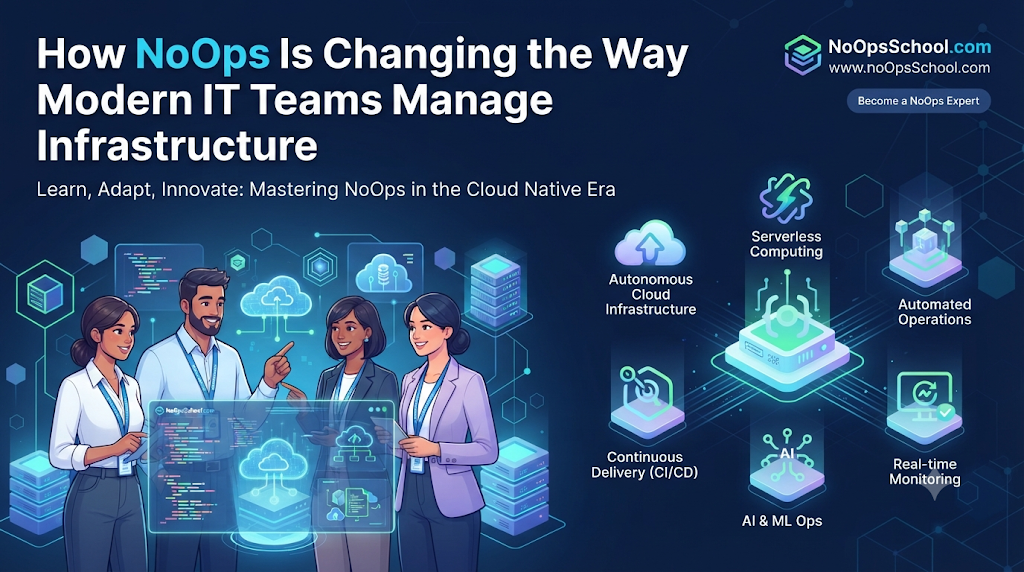
Through this organizational transformation, companies discover the principles of NoOps. Instead of treating infrastructure management as an ongoing series of manual administrative tasks, the NoOps model embeds operational best practices directly into self-service platforms and automated pipelines. Developers can provision resources, deploy code, and monitor performance without filing tickets or waiting for manual approvals from a separate systems administration team.
A Closer Look at the NoOps Operating Model
To understand what is NoOps, one must look at how it redefines the relationship between software developers, infrastructure platforms, and operational guardrails. NoOps envisions an environment where infrastructure management is abstracted away from application development teams through advanced automation and platform engineering.
In a mature NoOps model, developers interact with internal developer platforms rather than raw cloud infrastructure. These platforms provide standardized environments, automated deployment workflows, and built-in security compliance. When a developer pushes code to a repository, automated systems handle building, testing, security scanning, infrastructure provisioning, and deployment without requiring manual intervention from operations personnel.
Self-service capabilities sit at the heart of this operational model. Rather than acting as gatekeepers, operations engineers transition into platform engineers who build and maintain the underlying automation tools, guardrails, and templates that developers use safely and independently.
The DevOps Connection: Where NoOps Takes a Different Direction
A common discussion in engineering circles centers on NoOps vs DevOps. While both movements aim to bridge the historical gap between software development and IT operations, their operational scopes and execution models differ.
DevOps focuses heavily on collaboration, cultural alignment, shared ownership, and bridging silos between development and operations teams. It integrates operations early into the software lifecycle, encouraging developers and sysadmins to work closely together on deployment pipelines, monitoring, and infrastructure code.
NoOps takes the automation principles established by DevOps to their logical evolution. Where DevOps relies on continuous collaboration between dev and ops personnel to manage releases and infrastructure, NoOps removes the operational friction entirely by fully automating routine tasks, provisioning, and incident remediation.
Crucially, NoOps is not simply the replacement of DevOps or an excuse to ignore system reliability. Engineering accountability remains essential. Someone must still design the automation pipelines, define security boundaries, and architect resilient systems. NoOps eliminates repetitive manual toil, freeing engineers to focus on architectural innovation, reliability engineering, and platform enhancement.
Rebuilding the Infrastructure Workflow
Moving toward a NoOps-ready environment requires a complete redesign of technical workflows. Companies must replace ad-hoc administrative changes with declarative, code-driven processes.
Infrastructure as Code and GitOps
Modern infrastructure workflows rely heavily on Infrastructure as Code (IaC) tools like Terraform to define cloud resources in version-controlled configuration files. When combined with containerization technologies like Docker and orchestration platforms like Kubernetes, applications and their underlying environments become portable, reproducible, and consistent across development, staging, and production.
GitOps further streamlines this process by using Git repositories as the single source of truth for declarative infrastructure and application deployments. Automated reconciliation agents continuously compare the desired state stored in Git with the actual state running in the cluster, automatically applying fixes if drift occurs.
What Happens When Routine Tasks Become Automated?
Automating repetitive operations transforms every phase of the software lifecycle. Organizations implementing these workflows experience significant changes across several core domains:
- Infrastructure provisioning and configuration: Environments spin up in minutes using pre-approved Terraform modules rather than manual cloud console clicks.
- Application deployment and rollback: Continuous delivery pipelines test and deploy applications automatically, rolling back instantly if telemetry detects anomalies.
- Automatic scaling and resource management: Cloud workloads scale up or down dynamically based on real-time demand, optimizing resource utilization.
- Monitoring, alerting, and incident detection: Observability tools track system health continuously, generating actionable insights rather than noise.
- Self-healing infrastructure: Automated remediation scripts restart failed containers, replace unhealthy nodes, or reroute traffic around degraded network segments.
- Security and compliance checks: Policy-as-code frameworks scan infrastructure definitions for vulnerabilities before deployment occurs.
While these automated workflows dramatically increase deployment velocity and configuration consistency, they also introduce specific limitations. Automation scripts cannot anticipate novel architectural edge cases, and poorly designed automation can propagate configuration errors across environments at unprecedented speeds.
The Technology Decisions That Shape NoOps
Selecting the right NoOps automation tools is a critical responsibility for IT leaders and platform architects. Organizations must evaluate tools based on their specific cloud workloads, security compliance requirements, and existing technology stack.
Technology evaluation typically covers several key categories:
- Infrastructure automation: Tools for provisioning cloud resources declaratively.
- Orchestration and container management: Platforms for managing containerized workloads at scale.
- CI/CD pipelines: Systems automating build, test, and release workflows.
- Observability platforms: Solutions providing comprehensive logging, metrics, and tracing.
- Configuration management: Tools enforcing desired state across servers and clusters.
- AI-powered operations (AIOps): Advanced systems utilizing machine learning to predict anomalies and automate incident response.
Platforms like NoOpsSchool.com help engineering leaders and practitioners navigate these technology choices by offering structured insights into modern automation stacks and operational patterns.
Measuring Whether the Transformation Is Actually Working
Adopting automation without measurement leads to misplaced confidence. Organizations must evaluate their automation outcomes using concrete, quantitative metrics rather than subjective impressions.
Key performance indicators include:
- Deployment frequency: How often new code reaches production.
- Lead time for changes: The duration required for code to move from commit to deployment.
- Mean time to recovery (MTTR): How quickly systems recover from outages.
- Change failure rate: The percentage of deployments causing production degradation.
- Configuration consistency: The reduction of drift between environments.
- Resource utilization: Efficiency gains in cloud spending.
Focusing on these metrics ensures that automation genuinely improves operational resilience and business agility.
The People Behind the Automated Environment
As routine administrative tasks become automated, professional roles within IT undergo a profound evolution. System administrators and operations engineers no longer spend their days responding to Paging alerts for disk space issues or manually provisioning virtual machines.
Instead, engineers focus on building robust platforms, writing automation scripts, designing resilient cloud architectures, and establishing security guardrails. Despite the high degree of automation, professionals still require deep expertise in cloud architecture, scripting, troubleshooting, security principles, and system reliability.
Creating Different Career Paths in NoOps
As the industry matures, professionals are specializing to meet the demands of automated environments. Career paths now span specialized technical and leadership domains:
- NoOps engineers: Focus on writing infrastructure code, building CI/CD pipelines, and maintaining platform workflows.
- NoOps architects: Design scalable, secure, and resilient automated cloud environments.
- NoOps managers: Coordinate cross-functional teams, govern operational strategy, and guide digital transformation initiatives.
For professionals looking to validate their expertise, structured credentials such as a NoOps engineer certification, NoOps architect training, and NoOps manager certification provide recognized pathways to career advancement.
From Learning Concepts to Demonstrating Practical Skills
Transitioning theoretical knowledge into practical capability requires hands-on experience. A comprehensive NoOps training course must go beyond slide decks, immersing learners in real-world scenarios.
Effective training programs emphasize:
- Practical labs involving infrastructure-as-code projects.
- Kubernetes deployment and cluster management exercises.
- CI/CD pipeline construction and GitOps workflow implementation.
- Observability setup and automated recovery simulation.
For continuous professional development, practitioners turn to specialized providers like NoOpsSchool.com, which offers role-based learning opportunities tailored to modern cloud-native operations. Earning a recognized NoOps certification validates an engineer’s ability to design, implement, and maintain autonomous IT systems.
When Internal Teams Need Additional Expertise
Even highly skilled internal teams occasionally encounter complex transformation challenges that exceed their current bandwidth or specialized experience. Organizations frequently seek external support for automation strategy, cloud modernization, infrastructure provisioning, and CI/CD implementation.
Engaging specialized NoOps consulting services allows enterprises to accelerate their automation journeys, avoid common architectural pitfalls, and implement industry best practices rapidly. External consultants work alongside internal staff to transfer knowledge and establish sustainable operational frameworks.
Building a Flexible Technical Workforce
Scaling an automation initiative often requires specialized temporary talent. Businesses frequently bring in external specialists for project-based automation requirements, such as migrating legacy architectures to Kubernetes or establishing GitOps pipelines.
When looking to hire NoOps freelancers, engineering leaders evaluate candidates based on practical experience with IaC tools, cloud platforms, and automation frameworks. Clear project scoping, effective technical communication, and demonstrable portfolio projects ensure successful collaboration between internal teams and external experts.
What Automation Cannot Decide on Its Own
While automation removes routine toil, it cannot replace human judgment. Adopting autonomous operations introduces distinct risks, including automation errors that propagate failures rapidly, security misconfigurations, compliance oversights, and architectural complexity.
Furthermore, relying on poor monitoring practices in an automated environment can obscure critical failures until widespread impact occurs. Human oversight, rigorous code reviews, ethical governance, and strategic architectural decisions remain indispensable. Automation executes instructions efficiently, but humans define the intent, boundaries, and ethical standards of the system.
The Next Chapter: Moving Toward More Autonomous IT
The evolution of IT operations points toward increasingly intelligent automation, self-service infrastructure platforms, and AI-assisted operations. As cloud-native ecosystems mature, the boundary between application code and infrastructure management will continue to blur.
Organizations and professionals who embrace continuous learning, rigorous engineering practices, and practical automation frameworks will lead this transformation. By partnering with specialized platforms like NoOpsSchool.com for education and consulting, forward-thinking teams can build resilient, highly scalable IT operations ready for the demands of modern business.
