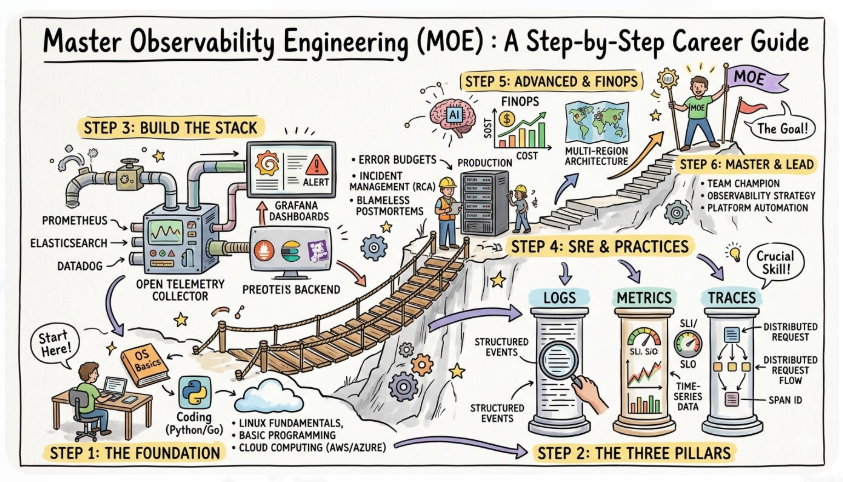
The tech world has reached a breaking point. We are building systems so complex that no single human can fully understand them. We have thousands of microservices, global clusters, and real-time data streams. When things go wrong—and they always do—the old way of “checking the logs” simply isn’t enough anymore.
If you are an engineer or a manager today, you are likely feeling the pressure. You aren’t just expected to build features; you are expected to ensure they work perfectly, every second of every day. This is why Observability Engineering has moved from a niche topic to the most important skill in the modern technical stack.
This guide is designed to help you move past basic monitoring and become a true master of system clarity.
From Passive Monitoring to Active Observability
In the past, we practiced “monitoring.” We looked for “known- knowns.” We set an alert to tell us if a server was down. But in a modern environment, a system might be “up” but still failing for 10% of your users in a specific region.
Observability is the next level. It is the practice of instrumenting your systems so you can ask any question, at any time, about why something is happening. It transforms you from a person who waits for an alarm into a professional who understands the internal heartbeat of the business.
Having seen the industry transition from physical racks to ephemeral clouds, I can tell you: Observability is the only way to stay sane in a distributed world.
The Path to Excellence: Master in Observability Engineering
To lead in this new era, you need more than a few tutorials. You need a structured, expert-led path that covers the entire lifecycle of system visibility. The “Master in Observability Engineering” is the industry-standard program for this.
What it is
This is a comprehensive, master-level program that focuses on the architecture of transparency. It moves beyond simple dashboards and teaches you how to build a robust data pipeline that captures every important event in your system. It is about turning “noise” into “actionable intelligence.”
Who should take it
This program is built for those who are already working in the field and want to reach the top 1% of their profession.
- Software Engineers who want to build services that are easy to debug.
- SREs and DevOps Engineers who want to master incident response.
- Platform Engineers designing the foundation for other teams.
- Managers who want to lead high-performing, reliable engineering organizations.
Skills you’ll gain
You will gain a deep, technical understanding of how to make the invisible visible. It is about mastering the data that runs your company.
The curriculum focuses on the practical application of telemetry. You will learn how to implement structured logging that machines can read, high-cardinality metrics that show precise trends, and distributed tracing that follows a user’s journey across 50 different services. You will also learn the culture of observability—how to get teams to care about reliability as much as they care about new features.
- Advanced Telemetry: Mastery of OpenTelemetry (OTel) for vendor-neutral instrumentation.
- Metric Architecture: Building high-performance Prometheus and Grafana stacks.
- Log Management: Designing scalable ELK/EFK pipelines for real-time analysis.
- Reliability Math: Defining and tracking SLIs, SLOs, and Error Budgets.
- AIOps Integration: Using machine learning to identify patterns and predict failures.
- Dashboard Design: Creating views that provide immediate clarity for both engineers and business leaders.
Real-world projects you should be able to do after it
The value of a master-level certification is what you can do on Monday morning at the office.
This program ensures you can handle the most difficult operational challenges. You will be able to take a system that is currently “dark” and light it up with full tracing and metrics. You will be the person who finds the “ghost in the machine” that has been causing intermittent errors for months.
- Zero-to-Hero Instrumentation: Take a complex microservices app and implement full tracing without manual code changes for every service.
- The Alert Noise Eraser: Redesign an entire alerting strategy to reduce “page fatigue” while increasing the detection of real issues.
- Kubernetes Deep-Dive: Set up an observability stack that monitors not just your app, but the K8s control plane and network.
- The Cost-Effective Pipeline: Implement trace sampling and log rotation to keep storage costs low while keeping diagnostic power high.
Preparation plan (Choose your speed)
Mastery takes time, but a good plan makes it manageable.
- 7–14 Days (The Intensive Sprint): If you are already an expert in Linux and basic containers, focus 100% on the core modules of the DevOpsSchool curriculum. Spend 5 hours a day on hands-on labs.
- 30 Days (The Professional Pace): The ideal path for working engineers. Spend 1-2 hours a day. Two weeks on theory (OTel, SLIs), and two weeks on the major implementation projects.
- 60 Days (The Complete Transformation): Best for those new to SRE concepts. This allows you to build a project, break it, and fix it multiple times. This is how true expertise is built.
Common mistakes when pursuing this
I have seen many brilliant engineers fail to master this field because they get distracted by the wrong things.
A major mistake is falling in love with a specific tool instead of the data. Tools change every three years; the principles of telemetry are forever. Another mistake is “over-observing”—collecting so much data that you can’t find the truth, and your cloud bill explodes. You must learn the balance between visibility and efficiency.
- The Tool Trap: Spending weeks learning a specific UI instead of learning how the underlying data is structured.
- Ignoring the Human Factor: Building a dashboard that no one uses because it’s too complicated.
- Lack of Sampling: Trying to save every single trace, which is unnecessary and expensive.
- Ignoring SLOs: Having great graphs but no clear goal of what “good” looks like for the customer.
Best Next Certification After This
Once you have mastered Observability, where should you go? Here are three powerful options from the industry experts at GurukulGalaxy.
- Same Track (Deep Dive): Master SRE Practitioner. If you love the “reliability” side of things, this is the natural next step to master incident management and toil reduction.
- Cross-Track (Broaden Skills): Master DevSecOps Practitioner. Security is just another form of observability. Use your data skills to find attackers.
- Leadership Path: Master FinOps Practitioner. For those who want to move into management, learning to manage the cost of the cloud using observability data is a high-value skill.
Master Certification Overview Table
| Track | Level | Who it’s for | Prerequisites | Skills Covered | Recommended Order |
| Observability | Master | Sr. Devs, SREs | K8s, Cloud | OTel, SLIs, Tracing | 2nd |
| DevOps | Master | Platform Engineers | Linux, Scripting | CI/CD, IaC, GitOps | 1st (Foundation) |
| DevSecOps | Master | Security Engineers | DevOps Basics | Sec Scanning, IAM | 3rd |
| FinOps | Master | Managers, Architects | Cloud Knowledge | Cost ROI, Analytics | 4th |
Choose Your Path: 6 Learning Journeys
Where does your passion lie? Choose the track that fits your career goals.
- The DevOps Path: Focus on the speed of delivery. Use observability to prove that your new code isn’t slowing down the system before it reaches the customer.
- The DevSecOps Path: Focus on integrity. Use your telemetry data to spot unauthorized access or unusual behavior in your application logs.
- The SRE Path: Focus on the user experience. Use SLIs and SLOs to manage your error budgets and keep the site stable under pressure.
- The AIOps/MLOps Path: Focus on the future. Use machine learning to analyze your observability data and automatically fix problems before they happen.
- The DataOps Path: Focus on the pipeline. Track how data flows through your system to ensure that your analytics and reports are always accurate.
- The FinOps Path: Focus on the bottom line. Use metrics to find wasted resources and save your company thousands of dollars on their cloud bill.
Role → Recommended Master Certifications Mapping
- DevOps Engineer: Master DevOps + Master Observability.
- SRE: Master SRE + Master Observability.
- Platform Engineer: Master DevOps + CKAD.
- Cloud Engineer: Master SRE + Cloud Provider Professional Cert.
- Security Engineer: Master DevSecOps + CKS.
- Data Engineer: Master DataOps + Big Data Cert.
- FinOps Practitioner: Master FinOps + Master Observability.
- Engineering Manager: Master Observability + Master DevOps.
The Foundation: Why You Need CKAD (Certified Kubernetes Application Developer)
You cannot build a house without a foundation. In the modern world, Kubernetes is that foundation. Almost all observability work happens inside a Kubernetes cluster.
The Certified Kubernetes Application Developer (CKAD) is the essential proof that you understand the environment you are monitoring. If you don’t know how a Pod works or how traffic flows through a Service, you will never be able to properly observe it.
Top Institutions for CKAD Training and Certification
If you are looking to build your Kubernetes foundation, these institutions provide the best training in the world.
DevOpsSchool
This is the premier choice for those who want a master-level education. They provide an intensive, lab-focused CKAD program that ensures you can handle real-world Kubernetes challenges, not just pass an exam. Their mentors are experts who help you understand the “why” behind every command.
Cotocus
Cotocus specializes in corporate and high-impact training. They offer immersive bootcamps that are perfect for teams or individuals who need to get certified quickly while gaining practical, hands-on experience in a production-like environment.
Scmgalaxy
Known for its massive community and practical resources, Scmgalaxy offers training that is deeply rooted in industry experience. Their CKAD program focuses on the day-to-day tasks that a developer actually performs in a high-velocity environment.
BestDevOps
This school focuses on the “Best Practices” of the industry. They teach you the most efficient ways to use Kubernetes, ensuring that your applications are not just running, but are scalable, secure, and easy to monitor.
devsecopsschool
For those who care about security from the start, this is the right place. They integrate security into every part of the CKAD curriculum, teaching you how to build applications that are secure by design.
sreschool
Their CKAD program is built with a focus on reliability. They teach you how to deploy applications so they are resilient to failure and easy to maintain over the long term.
aiopsschool
As we move toward automated operations, this institution shows you how Kubernetes serves as the base for AI-driven infrastructure, making it a great choice for future-focused engineers.
dataopsschool
If you work with big data, this is your school. They tailor the CKAD curriculum to focus on how to manage data-heavy and stateful applications on Kubernetes clusters.
finopsschool
This institution teaches you how to be a “cost-conscious” developer. Their CKAD training includes insights into resource management so you can build apps that don’t waste expensive cloud resources.
Master in Observability Engineering – FAQs
- What is the core difference between Monitoring and Observability? Monitoring tells you when something is wrong based on rules. Observability allows you to figure out why it happened by asking new questions of your data.
- Is this program suitable for remote workers? Yes, the DevOpsSchool program is designed for global engineers and can be taken entirely online with virtual labs.
- How much coding is required? You need to be comfortable with YAML and have basic scripting skills in Python or Go to instrument your code.
- Will this help me move into a Management role? Absolutely. Managers who understand observability can lead their teams with data rather than guesswork.
- Is the certification recognized in the US and Europe? Yes, the curriculum follows global standards set by the CNCF and Google SRE principles.
- Do I need to be a Kubernetes expert? No, but having a CKAD-level understanding will help you get much more out of the program.
- What is the “7-day plan” for? It is for senior engineers who already know the tools but need the “Master” level framework and certification projects.
- Does the course cover AIOps? Yes, there is a dedicated section on using AI to find patterns in massive telemetry datasets.
- Are the labs included in the price? Yes, all training via DevOpsSchool includes access to the necessary cloud labs.
- What is the most difficult part of the course? Most students find “Distributed Tracing” the most challenging because it requires understanding how requests flow across many different systems.
- How does this affect my salary? Observability specialists are in high demand and often command higher salaries than generalist DevOps engineers.
- Can I retake the assessment? Yes, there are options for retakes if you do not pass the master-level projects on your first try.
Certified Kubernetes Application Developer (CKAD) – FAQs
- What does the CKAD exam look like? It is a 2-hour, performance-based exam where you must solve real problems in a live terminal.
- Is there any multiple-choice? No. It is 100% hands-on.
- What is the best way to prepare? Practice, practice, practice. You must be fast with the
kubectlcommand. - Can I use the Kubernetes documentation during the test? Yes, you can have one tab open to the official docs.
- How often do I need to renew it? The CKAD is valid for two years.
- Is it better than the CKA? It’s not better, just different. CKA is for administrators; CKAD is for developers and engineers who build the apps.
- Do I need a strong Docker background? Yes, you should understand how containers work before trying to learn Kubernetes.
- Why is it important for Observability? Because you can’t monitor what you don’t understand. CKAD gives you the map of the cluster.
Conclusion
The evolution of engineering has led us to a place where visibility is our most valuable asset. Mastering Observability Engineering is not just about learning a few new tools; it is about adopting a professional mindset that values clarity, evidence, and reliability above all else. By following the roadmap laid out in this guide—from building your Kubernetes foundation with the CKAD to specializing in the Master in Observability Engineering program—you are ensuring that you remain at the cutting edge of the global tech industry. Whether you are an engineer looking to solve the world’s most complex bugs or a manager looking to build a resilient, world-class team, these skills are your competitive advantage. The future belongs to those who can see through the complexity. Choose your path, commit to the preparation, and start your journey toward true technical mastery today.
