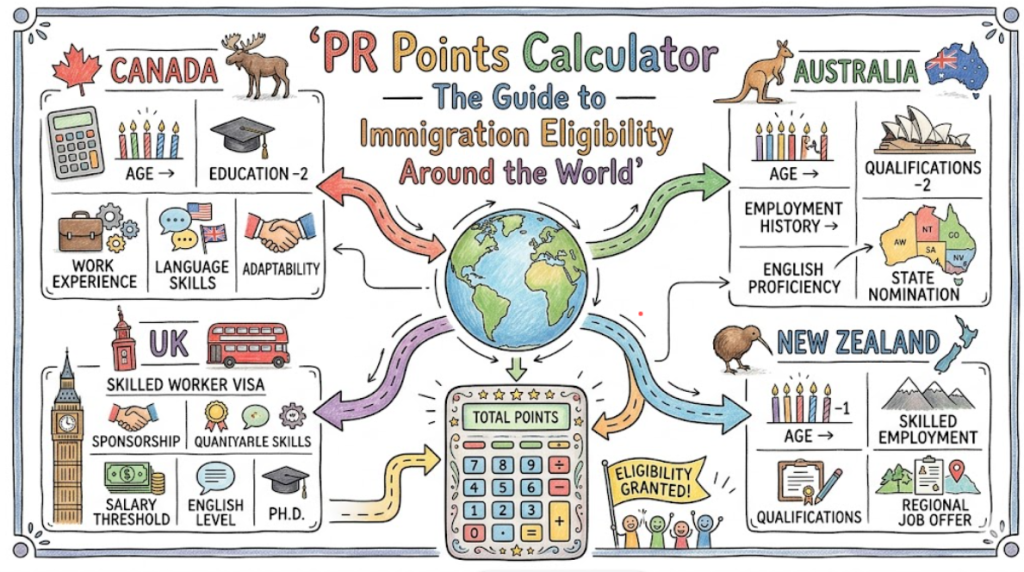
Have you ever looked at a map and wondered, “Where could I truly build a better life?” For millions of people, the dream of moving to a country like Canada, Australia, or New Zealand isn’t just about a change of scenery. It’s about better healthcare, world-class education for their children, safety, and a career that rewards hard work.
However, the path to Permanent Residency (PR) often feels like a maze of legal jargon and confusing requirements. This is where the PR Points Calculator becomes your most valuable tool.
In this comprehensive guide, we will pull back the curtain on how immigration systems work. Whether you are a student, a skilled professional, or a family looking for a fresh start, this guide will help you understand your eligibility and show you exactly how to turn your immigration dreams into a reality.
What Is a PR Points Calculator?
At its core, a PR Points Calculator is an assessment tool used by immigration departments to rank and select candidates based on their “human capital.”
In the old days, immigration was often subjective. Today, most developed nations use a Points-Based System (PBS). It’s a meritocracy—the more value you bring to a country’s economy and society, the higher your score.
Definition and Purpose
A PR points calculator takes your personal data—age, education, work history, and language skills—and converts it into a numerical score. The primary purpose is to provide a transparent, objective way to manage high volumes of applications.
How It Works
Think of it like a university entrance exam. The government sets a “cut-off” score. If your score meets or exceeds this threshold, you are invited to apply for residency.
Eligibility Score vs. Invitation Score
This is where beginners often get confused:
- Eligibility Score: The minimum points needed to enter the “pool” or system (e.g., 67 points for Canada’s Federal Skilled Worker program).
- Invitation Score: The actual score needed to receive an Invitation to Apply (ITA). This fluctuates based on competition.
Example: Imagine Sarah, a 28-year-old Graphic Designer.
- Her Eligibility Score is 70/100 (She is allowed to apply).
- Her Invitation Score (CRS) is 480.
- If the current draw is 475, Sarah gets her PR invitation!
How PR Points Systems Work
While every country has its own specific math, most follow a similar logic. Here is a breakdown of the universal “Big Five” factors that determine your points.
1. Age
Most countries prefer younger immigrants who can contribute to the workforce for decades. Points usually peak between ages 25 and 32 and begin to decline after 40.
2. Education
The higher your degree, the higher your points. A Master’s degree or a PhD is worth significantly more than a Bachelor’s.
3. Language Proficiency
This is the most “controllable” factor. High scores in IELTS (English), PTE (English), or TEF (French) can skyrocket your total.
4. Work Experience
“Skilled” work experience is key. Most calculators look at the number of years you’ve worked in a professional role (often classified by codes like NOC in Canada or ANZSCO in Australia).
5. Adaptability (Spouse & Relatives)
If you are moving with a spouse, their education and language skills can add points. Having a sibling or close relative already living in the country also provides a “safety net” bonus.
General Comparison Table: Factor Weights
| Factor | Typical Impact | Why It Matters |
| Age | High | Economic longevity. |
| Education | High | Skill level and adaptability. |
| Language | Very High | Integration into the local economy. |
| Work Exp. | Medium/High | Proven ability to perform. |
| Job Offer | Bonus | Immediate economic contribution. |
Canada PR Points Calculator: The Express Entry System
Canada is arguably the most popular destination for skilled workers. Their primary system is Express Entry, which uses the Comprehensive Ranking System (CRS).
The Two-Step Math
To get Canada PR, you must first pass the 67-point grid (Federal Skilled Worker Program) to enter the pool. Once inside, you are ranked by the CRS score (out of 1,200 points).
CRS Score Breakdown Table
| Category | Max Points (With Spouse) | Max Points (Without Spouse) |
| Age | 100 | 110 |
| Level of Education | 140 | 150 |
| Official Languages | 150 | 160 |
| Canadian Work Exp. | 70 | 80 |
| Skill Transferability | 100 | 100 |
| Additional Points | 600 | 600 |
Real-World Candidate Example: “The Tech Professional”
- Name: Rahul, 29 years old.
- Education: Master’s Degree.
- Language: IELTS 8.0 (Listening), 7.5 (others).
- Experience: 3 years outside Canada.
- Estimated CRS: ~475–485.
- Verdict: Very strong candidate for a general draw or STEM-specific draw.
Australia PR Points Calculator
Australia uses a points-based system for its General Skilled Migration (GSM) program. The most common visas are Subclass 189 (Independent), 190 (State Nominated), and 491 (Regional).
The SkillSelect System
You must score at least 65 points to submit an Expression of Interest (EOI). However, for competitive occupations like IT or Engineering, you often need 85–95 points.
Australia Points Table (Quick Guide)
| Criteria | Points Range |
| Age (25–32) | 30 Points (Max) |
| English (Superior) | 20 Points (IELTS 8/PTE 79) |
| Overseas Work (8+ yrs) | 15 Points |
| Australian Work (1 yr) | 5 Points |
| Education (PhD) | 20 Points |
| Study in Regional Aus | 5 Points |
| Single Applicant | 10 Points |
Pro Tip: Australia rewards “State Nomination” heavily. Getting a Subclass 190 nomination adds 5 points, while a 491 Regional nomination adds 15 points!
New Zealand PR Points Calculator
New Zealand recently overhauled its Skilled Migrant Category (SMC) to a “6-point system.” It is designed to be simpler but more focused on highly skilled professionals and “Green List” occupations.
How the 6-Point System Works:
You need a total of 6 points from:
- Professional Status: (Registration, Qualification, or Income) – 3 to 6 points.
- Work Experience in NZ: 1 to 3 points.
Example: If you are a Registered Nurse with a Bachelor’s degree, your professional registration might give you 3 points. If you then work in NZ for 3 years, you gain the remaining 3 points to reach the 6-point threshold.
PR Systems in Other Countries
As the global hunt for talent intensifies, other nations are adopting points-based systems.
| Country | System Name | Key Feature |
| Germany | Opportunity Card (Chancenkarte) | 6 points needed to enter and look for work. |
| Japan | Highly Skilled Professional | Fast-track to PR in as little as 1 year if you score 80+. |
| UK | Skilled Worker Visa | Points based on salary, English, and job “sponsorship.” |
Benefits of Using a PR Points Calculator
Why should you use an online calculator before talking to a lawyer?
- Instant Reality Check: You’ll know immediately if you’re eligible or if you need to work on your profile.
- Cost-Free Planning: Most calculators are free. Don’t pay a consultant hundreds of dollars just to tell you your age.
- Country Comparison: You might find that while you don’t qualify for Canada, you are a perfect fit for Australia.
- Strategic Goal Setting: If you are at 440 points and need 470, the calculator shows you exactly where those 30 points can come from (e.g., retaking an English test).
Step-by-Step Guide to Calculate Your PR Points
Ready to find your score? Follow these steps for the most accurate result:
Step 1: Gather Documents
Don’t guess. Have your transcripts, employment contracts, and birth certificate ready. Dates matter!
Step 2: Take a Mock Language Test
Your “perfect English” doesn’t matter; your “IELTS score” does. Use a practice score for your initial calculation.
Step 3: Evaluate Your Education (ECA)
For Canada, you must have an Educational Credential Assessment (ECA). A 4-year degree in India might be evaluated as a 3-year degree in Canada.
Step 4: Calculate Skilled Work Experience
Exclude internships or part-time work unless they meet the specific country’s criteria. Focus on full-time, paid employment.
Step 5: Factor in Your Spouse
Calculate your score both as a single applicant and with a spouse. Sometimes, if a spouse has low language scores, it can actually lower your total.
Step 6: The Final Tally
Enter the data into a reliable tool like the DesiNRI PR Points Calculator to get your final number.
How to Increase Your PR Score
Stuck with a low score? Don’t lose hope. Here is how the “Pros” boost their points:
- The “CLB 9” Miracle: In the Canadian system, hitting CLB 9 (Listening 8.0, others 7.0) triggers a “Skill Transferability” bonus that can add up to 50 points.
- Learn French: Canada offers massive bonus points for bilingual candidates. Even basic French can be a tie-breaker.
- Get a Second Degree: If you have a 3-year Bachelor’s, a 1-year Post-Graduate Diploma can count as “Two or more certificates,” significantly increasing your CRS.
- State/Provincial Nomination: This is the “Golden Ticket.” A nomination essentially guarantees an invitation by adding 600 points (Canada) or up to 15 points (Australia).
Common Mistakes to Avoid
- Overestimating Work Experience: Don’t count years where you don’t have a “Reference Letter” in the exact format required by immigration.
- Using the Wrong NOC/ANZSCO Code: If your job duties don’t match the government’s description, your points are invalid.
- Ignoring Expiry Dates: English tests expire after 2 years. If your test expires while you are in the pool, your score drops to zero.
- Miscalculating Age: In many systems, you lose points on your birthday. If you are turning 30 next month, calculate your score based on age 30, not 29.
Real-Life Case Studies
Case 1: The Young Software Engineer (Canada)
- Profile: Arjun, 26, Single, Bachelor’s Degree, 3 years experience.
- Initial Score: 435 (IELTS 7.0).
- Weakness: Low language score.
- Improvement: Arjun studied for 2 months and achieved IELTS 8.0 (L) and 7.5 (others).
- Final Result: Score jumped to 481. He received an ITA in the next STEM draw.
Case 2: The Married Couple (Australia)
- Profile: Maria (Primary, Accountant) and David (Spouse, Teacher).
- Initial Score: 75 (Subclass 190).
- Improvement: David took the PTE and got “Proficient” English (adds 5 points). Maria applied for a Regional state nomination (491) instead of 190.
- Final Result: Total score reached 95. They are now living in Adelaide.
Case 3: The Healthcare Worker (New Zealand)
- Profile: Sarah, Occupational Therapist.
- Initial Score: 3 points (Registration).
- Improvement: Sarah secured a job offer from an NZ hospital. This allowed her to apply under the “Green List” straight-to-residence pathway.
- Final Result: PR granted in 4 months.
FAQs
1. What is a “good” CRS score for Canada?
Currently, a score above 500 is considered very strong for general draws. However, for Category-based draws (STEM, Healthcare, Trades), scores in the 450-480 range are often successful.
2. Does age affect my PR eligibility?
Yes, significantly. Most systems start deducting points after age 30 or 35. If you are over 40, you usually need a Provincial Nomination or a Job Offer to compensate.
3. Which country is easiest for PR right now?
Canada remains the most systematic, but Germany’s new Opportunity Card and Australia’s focus on Regional areas (Subclass 491) are excellent alternatives.
4. Can I calculate my points without an official IELTS score?
Yes, you can use an estimate to see your “potential” score, but you cannot submit an official application without the actual test results.
5. How accurate are online PR points calculators?
They are very accurate if you provide honest data. They follow the same mathematical algorithms used by the governments.
6. Do I need a job offer to get PR?
Not always. Many Canada and Australia pathways are “Independent,” meaning you can get PR based solely on your skills without a job offer.
7. Can a spouse’s education help my score?
Yes. In Canada’s CRS, a spouse’s degree can add up to 10 points.
8. What is the difference between IELTS Academic and General?
For PR, you almost always need IELTS General Training. Using an Academic result will lead to a rejection.
9. How long does the PR process take?
Once you receive an invitation, processing can take anywhere from 6 months (Canada Express Entry) to 18 months (Australia).
10. Can I improve my score after entering the pool?
Absolutely. You can update your profile anytime with new test scores, higher education, or more years of work experience.
11. What is an ECA?
An Educational Credential Assessment (ECA) verifies that your foreign degree is equal to a local one. It is mandatory for Canada.
12. Is there a maximum age limit for PR?
Technically no, but after age 45, most points-based systems award 0 points for age, making it nearly impossible to qualify without a job offer or nomination.
Conclusion
Navigating the world of immigration can feel overwhelming, but the PR Points Calculator turns a complex process into a clear roadmap. Remember, your score isn’t just a number—it’s a reflection of your potential to succeed in a new country.
Even if your score is low today, there are always ways to improve. Whether it’s retaking a language test, gaining another year of experience, or looking into regional nominations, the power is in your hands.
The most important step you can take is the first one: know where you stand. —
Call To Action
Don’t leave your future to chance.
- Try the PR Points Calculator today to see your current score.
- Compare different countries to find where your skills are in highest demand.
- Start gathering your documents early—it’s the best way to avoid delays once you get your invitation.
- Book your language test and aim for the highest possible band!
Your new life is waiting. Let’s get calculating!
