Introduction
The modern IT landscape has shifted dramatically toward cloud-native architectures, making DevOps an essential discipline for organizations aiming to deliver software at speed and scale. As the demand for skilled engineers rises, so does the influx of educational content. However, not all training is created equal. The quality of your learning experience depends heavily on the person standing at the front of the classroom or guiding you through your virtual workspace.
Choosing one of the most significant decisions you will make for your professional development. Poor training often leads to a surface-level understanding of tools, leaving engineers struggling when they encounter real-world production outages or complex configuration issues. In contrast, effective mentorship provides the foundational knowledge, problem-solving frameworks, and industry insights required to thrive. For those seeking a path built on practical engineering principles, DevOpsSchool provides resources designed to align academic learning with the rigors of modern enterprise environments.
Why DevOps Training Quality Matters
DevOps is not merely a collection of tools; it is a cultural and technical philosophy. The complexity of modern stacks—involving distributed systems, ephemeral containers, and multi-cloud environments—demands a depth of knowledge that simple tutorials cannot provide.
The Theory vs. Production Gap
Many training programs focus on “happy path” scenarios. They show you how to spin up a single server or run a basic container. Real-world DevOps, however, happens when things break at 3 AM. A high-quality trainer bridges this gap by sharing experiences from actual production environments, teaching you how to troubleshoot, manage technical debt, and ensure system reliability under pressure.
Enterprise Expectations
Organizations today look for engineers who understand the lifecycle of a product. They need professionals who can integrate security, automate infrastructure, and optimize costs. If your training lacks this enterprise focus, you may find yourself with a certificate but without the ability to solve the architectural challenges employers actually care about.
What Makes a Great DevOps Trainer?
A top-tier trainer is more than just a subject matter expert; they are an experienced practitioner who can translate complex concepts into actionable engineering steps.
- Real Industry Experience: They have walked the walk. They have survived major outages and led successful migrations, bringing stories from the trenches into the lesson plan.
- Teaching Simplicity: They can explain complex orchestration like Kubernetes using analogies that resonate with beginners without oversimplifying the technical nuance.
- Problem-Solving Ability: Instead of providing the answer, they teach you the methodology to find it. They encourage debugging, log analysis, and architectural thinking.
- Cloud & Kubernetes Expertise: They understand the “why” behind cloud-native services, not just the “how” to click buttons in a console.
- Continuous Learning Mindset: Since the DevOps landscape changes weekly, a great trainer is someone who is actively learning and sharing the latest industry trends.
The Difference Between Trainers and Real Mentors
| Feature | Classroom Trainer | Real-World Mentor |
| Focus | Curriculum coverage | Skill application |
| Methodology | One-way instruction | Interactive guidance |
| Perspective | Textbook examples | Production-grade scenarios |
| Outcome | Course completion | Professional readiness |
| Relationship | Time-bound | Long-term career support |
A trainer teaches you how to pass an exam. A mentor teaches you how to navigate a career. Mentors focus on “why” a technology is chosen and how it integrates into the broader business ecosystem.
Technical Skills a DevOps Trainer Should Have
- Linux & Networking: The foundation of everything. A trainer must have deep knowledge of kernel tuning, bash scripting, and network protocols.
- Cloud Platforms: Proficiency in AWS, Azure, or GCP is mandatory, specifically regarding IAM, VPC, and cost management.
- Docker & Kubernetes: Expertise in container orchestration, service meshes, and ingress controllers.
- Infrastructure as Code (IaC): Mastery of tools like Terraform or Pulumi to manage stateful and stateless resources.
- CI/CD Pipelines: Experience building robust, secure, and automated delivery pipelines that handle automated testing and deployment strategies.
- Security & DevSecOps: Integrating security scanning and compliance as code early in the pipeline.
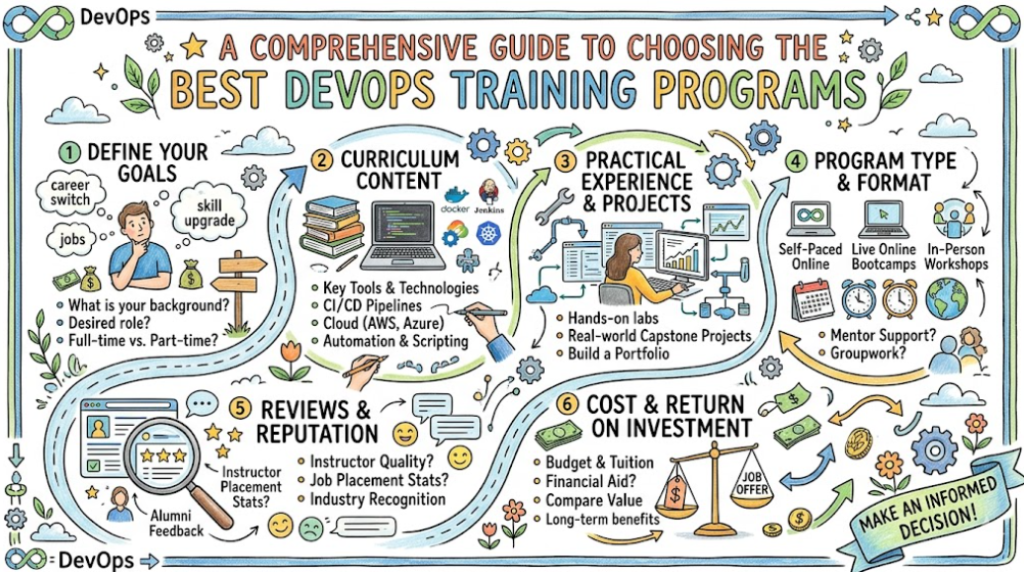
How to Evaluate a DevOps Training Program
When selecting a program, use this checklist:
- Trainer Portfolio: Look for verifiable experience in engineering roles, not just training roles.
- Lab Environment: Do you get access to a sandbox environment, or are you just watching slides?
- Real-World Projects: Does the curriculum include end-to-end projects like deploying a microservices architecture?
- Community Support: Is there a platform to ask questions and interact with peers?
- Curriculum Relevance: Is the course updated to include current tools like AI-driven observability or FinOps?
Red Flags to Avoid
- Theoretical Monopolies: If the course has zero hands-on labs, run away.
- Outdated Curriculums: If they are teaching tools that have been deprecated for years without mentioning modern alternatives.
- Unrealistic Promises: Beware of programs promising “100% job placement” or “Master DevOps in 7 days.” DevOps is a deep field that requires time and practice.
- Tool-Focused Isolation: Learning a tool without understanding the underlying concepts (like networking or storage) is a recipe for failure.
Real-World Learning Scenarios
A Great DevOps Trainer will move beyond the basics. For example:
- Instead of just showing how to write a Dockerfile, they teach you how to reduce image size for security and efficiency.
- Instead of just showing a Terraform script, they show you how to manage multiple environments using remote state and locking.
- When a pipeline fails, they demonstrate how to use observability tools like Prometheus or ELK to identify the bottleneck.
Role of Mentorship in DevOps Careers
Mentorship accelerates the learning curve. In a field as vast as DevOps, beginners often suffer from “analysis paralysis.” A mentor helps you filter out the noise, guiding you toward the tools and practices that actually move the needle in the industry. They provide critical feedback on your architecture decisions, helping you develop the confidence to speak up in team meetings and lead technical initiatives.
How Organizations Choose DevOps Trainers
When enterprise organizations hire trainers, they prioritize:
- Enterprise Experience: Can the trainer handle large-scale, legacy-to-modern migration discussions?
- Scalability: Can the training methodology be adapted for teams of varying skill levels?
- Consultative Approach: Can the trainer act as a consultant to help solve internal blockers during the training process?
Certifications & Practical Learning
While certifications validate your knowledge, projects demonstrate your capability.
| Certification | Best For | Skill Level | Focus Area |
| CKA | Infrastructure Pros | Advanced | Kubernetes Admin |
| AWS Solutions Architect | Cloud Engineers | Intermediate | Cloud Design |
| HashiCorp Terraform | Automation Pros | Intermediate | IaC |
Use these as milestones, but never let them replace hands-on work.
Common Mistakes Beginners Make
- Chasing Hype: Learning every new tool that hits the market instead of mastering the fundamentals.
- Ignoring Linux: You cannot be a DevOps engineer if you are afraid of the terminal.
- Skipping Projects: Watching videos is not learning; building something and breaking it is.
- Avoiding Version Control: If you aren’t using Git for everything, you aren’t doing DevOps.
Future of DevOps Training
The future is shifting toward Platform Engineering and AI-Assisted DevOps. Future-proof training programs are now incorporating AI for code generation and automated testing while focusing on building internal developer platforms (IDPs). The focus is moving away from “managing tools” to “building developer experiences.”
FAQs
1. What should I look for in a DevOps trainer?
Look for a blend of deep technical experience in production environments and the ability to articulate complex concepts clearly.
2. Is hands-on training important?
Essential. You cannot learn DevOps theory alone; it is a practical discipline.
3. Can beginners learn DevOps easily?
It is a challenging field, but with a structured roadmap and proper mentorship, it is very achievable.
4. Which DevOps skills matter most today?
Kubernetes, IaC, Cloud Security, and Observability are currently top priorities.
5. Is certification enough for jobs?
No. Certifications get you past HR filters, but projects and technical understanding get you the job.
6. How do I verify trainer experience?
Check their LinkedIn, public contributions (GitHub, blogs), and testimonials from past students.
7. Are live projects important?
Yes, they allow you to experience the friction of integration and debugging.
8. How long does training take?
Quality training is a continuous process, usually involving a 3-6 month intensive period followed by lifelong learning.
9. Does DevOps require coding?
Scripting (Python, Go, Bash) is critical for automation.
10. What is the difference between DevOps and SRE?
They are closely related; SRE is the practical implementation of DevOps principles focusing on reliability.
11. Can I learn DevOps for free?
You can find information for free, but structured mentorship and lab access save you thousands of hours of frustration.
12. Is DevOps dying?
No, it is evolving into specialized roles like Platform Engineering and FinOps.
13. What is the most important soft skill?
Communication. You must be able to explain the “why” to stakeholders.
14. Do I need a degree?
No, industry skills and portfolios matter much more than formal degrees.
15. How do I start?
Start by mastering Linux, then move to cloud basics and simple CI/CD pipelines.
Final Thoughts
Becoming a DevOps engineer is a marathon, not a sprint. The guidance you receive during your formative learning stages determines how effectively you handle the complexities of the modern cloud. Always prioritize depth over breadth. Seek out mentors who challenge your assumptions and encourage you to build, break, and refine your work. A professional career is built on the foundation of the skills you acquire today.
