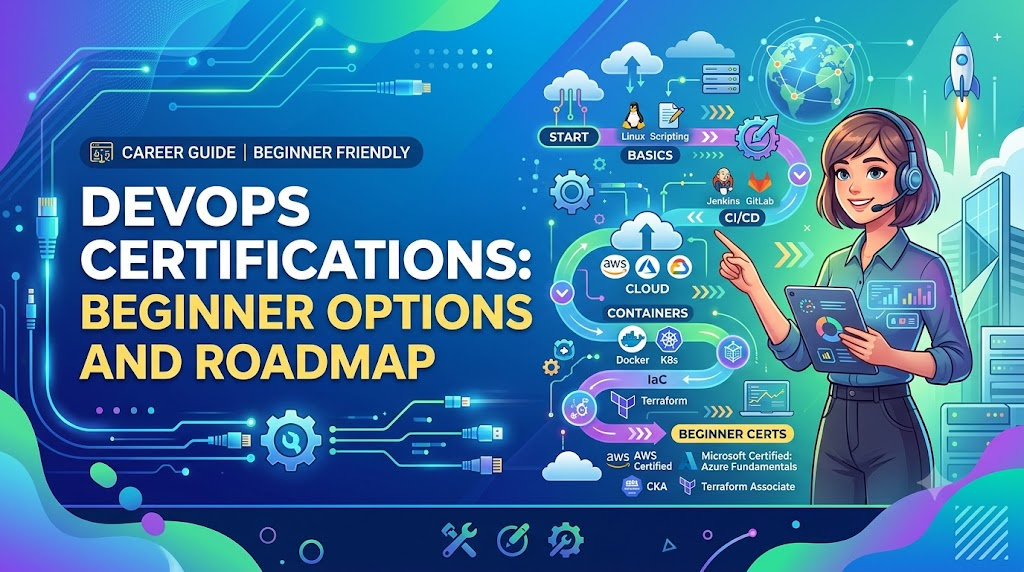
Starting a career in DevOps can feel overwhelming. DevOps is not an individual software application, a programming language, or a single server configuration; it is an operating philosophy combining cultural practices, software development workflows, and system operations. Its primary goal is shortening the systems development life cycle while delivering features, fixes, and updates reliably.
Because DevOps spans software engineering, systems administration, cloud architecture, and security, newcomers often struggle to identify where to begin. Earning a targeted certification is one of the most effective ways to establish structured learning, gain exposure to industry tooling, and demonstrate foundational competence to prospective employers.
However, selecting an entry-level credential requires careful evaluation. Some certifications evaluate high-level cultural frameworks, while others test hands-on terminal commands and infrastructure automation. This guide outlines the best beginner DevOps certifications, reviews essential foundational skills, examines realistic learning pathways, and explains how to balance exam preparation with practical portfolio projects.
What Is a DevOps Certification?
A DevOps certification is a formal credential awarded by a software vendor, industry association, or technical training organization verifying that an individual possesses a defined level of knowledge in DevOps concepts, cloud architecture, or specific automation technologies.
Unlike traditional IT certifications that often focus strictly on a single operating system or networking standard, DevOps credentials validate competencies across several integrated domains:
- Collaborative Methodologies: Principles such as continuous feedback, shared operational responsibility, and Agile development integration.
- Continuous Integration and Continuous Delivery (CI/CD): Automating software build, test, and release pipelines.
- Infrastructure as Code (IaC): Managing and provisioning infrastructure using declarative configuration files rather than manual server setup.
- Containerization and Orchestration: Packaging applications into standardized units and managing their lifecycles.
- Observability and Monitoring: Collecting telemetry, tracking system health, and troubleshooting runtime failures.
Understanding Credential Types
Before choosing an exam, beginners should understand the four main types of credentials available across the industry:
- Vendor-Neutral Methodology Certifications: These focus on cross-team collaboration, value stream delivery, and operational philosophy rather than specific software tools. They are typically multiple-choice exams issued by industry bodies such as the DevOps Institute (PeopleCert).
- Cloud and Tool-Specific Vendor Certifications: These evaluate practical knowledge of specific platforms, such as Amazon Web Services (AWS), Microsoft Azure, Google Cloud Platform (GCP), Docker, or HashiCorp Terraform.
- Open-Source and Foundation Credentials: Managed by non-profit industry consortia such as the Linux Foundation and the Cloud Native Computing Foundation (CNCF), focusing on vendor-neutral standards like Linux and Kubernetes.
- Training Completion Certificates: Provided by specialized technical institutes and educational platforms—such as DevOpsSchool—confirming that a student has completed structured, guided coursework, practical lab assignments, and mentor-led projects.
Why Should Beginners Consider Earning a Certification?
While certifications alone do not guarantee a job, they serve several distinct purposes for individuals entering the industry:
- Curriculum Structure: Self-directed learners often fall into “tutorial paralysis,” jumping between random tools without understanding how they integrate. A reputable certification syllabus outlines exactly what industry experts consider essential baseline knowledge.
- Professional Terminology: Working in modern engineering environments requires fluency in concepts like idempotency, immutable infrastructure, artifact repositories, and rolling deployments. Exam study builds confidence in speaking this shared technical language.
- Resume Screening Support: Hiring managers and automated applicant tracking systems look for verifiable indicators of interest and competence. An entry-level credential demonstrates initiative and commitment to career transition.
- Measurable Milestones: Breaking down the vast DevOps ecosystem into discrete certifications provides achievable goals that keep learners motivated during multi-month study routines.
Top Beginner DevOps Certifications and Pathways
Entering DevOps rarely begins with an advanced, end-to-end credential. Instead, successful learners build momentum through foundational certifications covering operating systems, cloud environments, containers, and core DevOps methodology.
1. Operating System Fundamentals: LPI Linux Essentials
Linux powers the vast majority of cloud infrastructure, public web servers, and containerized workloads. Attempting to automate infrastructure without knowing how to navigate a Linux file system or manage processes leads to constant frustration.
The Linux Professional Institute (LPI) Linux Essentials certification is an outstanding starting point for absolute beginners.
- What It Covers: Basic command-line navigation, file editing, user permissions, package management, text-processing utilities, and open-source licensing.
- Target Audience: Beginners with no prior command-line experience.
- Difficulty Level: Low to Moderate.
- Next Steps: After mastering Linux basics, learners can progress to basic Bash scripting or intermediate certifications such as CompTIA Linux+ or LPIC-1.
2. Cloud Platform Foundations: AWS Certified Cloud Practitioner or Azure Fundamentals (AZ-900)
DevOps practices are deeply intertwined with cloud infrastructure. Rather than provisioning physical hardware, DevOps engineers manage virtualized compute instances, software-defined networks, and managed storage services through cloud platforms.
Both the AWS Certified Cloud Practitioner (CLF-C02) and the Microsoft Certified: Azure Fundamentals (AZ-900) offer accessible introductions to cloud infrastructure.
- What They Cover: Core cloud concepts (scalability, high availability, elasticity), primary compute and storage architectures, identity and access management (IAM), basic networking security groups, and cloud pricing models.
- Target Audience: Individuals seeking a high-level architectural understanding of cloud ecosystems before learning command-line deployment tools.
- Difficulty Level: Beginner-friendly.
- DevOps Relevance: Understanding how cloud services interconnect provides the context needed to automate them later using Infrastructure as Code.
3. Culture and Methodology: DevOps Foundation (DevOps Institute / PeopleCert)
For learners who want to understand the organizational and workflow principles that define DevOps, the DevOps Foundation certification provides a formal grounding in methodology.
- What It Covers: The historical context of DevOps, the Three Ways (Flow, Feedback, and Continual Learning), the relationship between Agile, Lean, and ITSM, business value delivery, and common team organizational models.
- Target Audience: IT support specialists, project managers, and junior developers transitioning into collaborative engineering cultures.
- Difficulty Level: Moderate (conceptual and vocabulary-focused).
- Limitations: The exam does not evaluate hands-on command-line skills or configuration code. It must be paired with practical technical study.
4. Cloud-Native and Containers: Kubernetes and Cloud Native Associate (KCNA)
Containerization using Docker and orchestration using Kubernetes are core DevOps pillars. However, the advanced Certified Kubernetes Administrator (CKA) exam is performance-based and far too demanding for absolute beginners.
The Cloud Native Computing Foundation (CNCF) and the Linux Foundation developed the Kubernetes and Cloud Native Associate (KCNA) exam as a multiple-choice alternative designed specifically for entry-level learners.
- What It Covers: Cloud-native architecture, container engineering principles, Kubernetes pods and deployments, service discovery, cloud-native storage, and basic observability frameworks.
- Target Audience: Beginners who understand basic Linux and cloud concepts and want to grasp how modern microservices operate.
- Difficulty Level: Moderate.
- DevOps Relevance: It establishes conceptual clarity in the cloud-native ecosystem without requiring complex, real-time command-line troubleshooting under exam pressure.
5. Infrastructure as Code: HashiCorp Certified: Terraform Associate
Terraform has become the industry standard for declarative infrastructure provisioning across AWS, Azure, and Google Cloud.
The HashiCorp Certified: Terraform Associate exam is an entry-to-intermediate level multiple-choice test that evaluates a candidate’s understanding of Infrastructure as Code principles.
- What It Covers: Terraform syntax (HCL), state management, execution plans, resource creation, variable configuration, and Terraform modules.
- Target Audience: Learners who already understand cloud compute and networking basics and want to learn automated provisioning.
- Difficulty Level: Intermediate for true beginners; accessible with focused hands-on lab practice.
- DevOps Relevance: This is one of the most directly practical certifications available for entry-level professionals seeking exposure to everyday DevOps workflows.
6. Comprehensive Foundational Tracks: Guided Academy Programs
In addition to independent vendor exams, many aspiring engineers benefit from structured programs offered by specialized training providers such as DevOpsSchool. These programs, including foundational DevOps engineering certificates, package Linux administration, Git version control, Jenkins CI/CD, Docker, and cloud deployments into a single coordinated learning curriculum.
These certificate tracks serve as guided stepping stones. They allow beginners to complete supervised hands-on labs and receive feedback on real-world projects before sitting for formal, vendor-issued examinations.
Beginner DevOps Certifications Comparison
The following table compares relevant entry-level certifications and learning pathways to help you match options with your current knowledge:
| Certification or Pathway | Main Learning Focus | Recommended Starting Knowledge | Relative Difficulty | Suitable Learning Objective |
| LPI Linux Essentials | Terminal navigation, file management, permissions, and basic commands. | Basic computer literacy. | Beginner | Establishing operating system fundamentals required for all DevOps tools. |
| AWS Cloud Practitioner / Azure AZ-900 | Cloud architecture, virtualization, security groups, and storage services. | Basic understanding of internet concepts and servers. | Beginner | Learning how cloud platforms work before using automation tools. |
| DevOps Foundation (PeopleCert) | DevOps culture, Agile alignment, Lean principles, and continuous workflows. | Basic familiarity with general software development processes. | Beginner to Intermediate | Understanding high-level DevOps vocabulary and team dynamics. |
| CNCF KCNA | Container concepts, Kubernetes architecture, and cloud-native observability. | Linux basics and general container awareness. | Intermediate | Validating foundational knowledge of containerized ecosystems. |
| Terraform Associate | Declarative infrastructure provisioning, state files, and cloud resource management. | Fundamental knowledge of at least one major cloud provider. | Intermediate | Demonstrating practical Infrastructure as Code configuration skills. |
| DevOpsSchool Foundation Track | Coordinated multi-tool workflows: Linux, Git, CI/CD pipelines, and Docker. | General IT background or interest in automation. | Beginner to Intermediate | Gaining guided, hands-on lab experience across an integrated DevOps toolset. |
How to Choose the Right Certification Path
Choosing a certification path depends on your existing technical background, career goals, and immediate learning needs.
       [Your Current Background]
                   |
     +-------------+-------------+
     |                           |
[Non-Technical /           [Developer /
 IT Support]              Junior Admin]
     |                           |
     v                           v
1. Linux Essentials        1. Cloud Fundamentals
2. Cloud Fundamentals      2. Terraform Associate
3. KCNA or DevOps Basics   3. KCNA & CI/CD Pipelines
If You Come From a Non-Technical or IT Support Background
Start with foundational computing concepts. Prioritize LPI Linux Essentials, followed immediately by AWS Certified Cloud Practitioner or Azure Fundamentals. Attempting to study complex automation tools like Kubernetes or Terraform before mastering file permissions, IP addresses, and virtual machines usually results in confusion.
If You Have Basic Programming or Development Experience
Software developers usually understand Git version control and code logic. Your gap is likely in systems operations and infrastructure. Start with Cloud Fundamentals, followed by Terraform Associate and KCNA. This equips you to package your applications into containers and automate deployment infrastructure.
If You Come From Traditional Systems Administration
System administrators often understand Linux and networking, but lack exposure to software development cycles, version control, and declarative automation. Focus on Git workflows, Terraform Associate, and the DevOps Foundation curriculum to shift your approach from manual server maintenance to automated, reproducible code.
Essential Skills to Build Alongside Certifications
A certification certificate is only as valuable as the underlying technical capabilities it represents. Aspiring DevOps engineers must develop competencies across several core areas concurrently with exam preparation:
- Linux and Shell Navigation: Familiarity with process management (
ps,top), text filtering (grep,awk,sed), disk management, and secure remote access (ssh). - Version Control with Git: Mastery of branching strategies, commits, pull requests, resolving merge conflicts, and managing code repositories on platforms like GitHub or GitLab.
- Basic Scripting: Writing straightforward automation scripts in Bash or Python to parse JSON, manipulate configuration files, and automate repetitive tasks.
- Networking Fundamentals: A solid grasp of the OSI model, DNS resolution, TCP/IP, HTTP/HTTPS protocols, load balancing, firewalls, and subnets.
- Continuous Integration and Continuous Deployment (CI/CD): Understanding how code commits trigger automated build steps, unit testing, vulnerability scanning, and environment staging.
- Container Basics: Writing efficient Dockerfiles, managing container lifecycles, and configuring persistent storage volumes.
- Basic Observability: Reading application log streams, configuring health checks, and understanding basic metric dashboards.
A Practical 4-Stage DevOps Learning Roadmap
To prevent burnout, structure your preparation into four manageable phases spanning approximately six months of disciplined study:
[Phase 1] Core Systems & Version Control (Weeks 1-6)
       ↓
[Phase 2] Cloud Computing & Containers (Weeks 7-12)
       ↓
[Phase 3] Automated CI/CD Pipelines (Weeks 13-18)
       ↓
[Phase 4] Infrastructure as Code (Weeks 19-24)
Phase 1: Core Systems and Source Control (Weeks 1–6)
- Set up a local Linux virtual machine or use Windows Subsystem for Linux (WSL).
- Practice daily command-line navigation and shell scripting.
- Learn Git by tracking a sample repository from the terminal.
- Milestone: Sit for the LPI Linux Essentials exam.
Phase 2: Cloud Computing and Containers (Weeks 7–12)
- Open a free-tier cloud account on AWS or Azure.
- Manually launch compute instances, configure security groups, and attach storage.
- Install Docker and learn to build, run, and tag container images locally.
- Milestone: Sit for AWS Cloud Practitioner or Azure Fundamentals (AZ-900).
Phase 3: Automated Pipelines and CI/CD (Weeks 13–18)
- Connect your Git repository to an automation tool like GitHub Actions or GitLab CI.
- Configure pipelines that build container images and run automated tests on every push.
- Study the theoretical frameworks covered in the DevOps Foundation syllabus.
- Milestone: Build a fully automated code-to-container pipeline.
Phase 4: Infrastructure as Code and Orchestration (Weeks 19–24)
- Learn Terraform syntax to declare cloud virtual machines and networking rules as code.
- Study container orchestration concepts and the Kubernetes API architecture.
- Milestone: Sit for the HashiCorp Certified: Terraform Associate or CNCF KCNA exam.
Hands-On Projects to Reinforce Certification Preparation
Certifications prove you can pass an exam; practical portfolio projects demonstrate that you can solve real-world engineering problems. Complete these four realistic projects during your studies:
Project 1: Automated CI Pipeline for a Static Web Application
- Description: Create a repository containing a basic HTML/JavaScript application. Write a GitHub Actions or GitLab CI workflow that triggers whenever code is merged into the main branch. The pipeline should run a code linter, test formatting, and automatically push static assets to a cloud storage bucket configured for web hosting.
- What You Learn: Event triggers, build runners, secrets management, and basic cloud deployment automation.
Project 2: Containerizing a Multi-Service Application
- Description: Take a simple open-source application consisting of a web backend (such as Node.js or Python) and a database (such as PostgreSQL). Write Dockerfiles to containerize the services and use Docker Compose to define environment variables, persistent volumes, and custom network bridges connecting them.
- What You Learn: Image optimization, multi-stage builds, port mapping, data persistence, and service-to-service communication.
Project 3: Provisioning Cloud Environments with Terraform
- Description: Write declarative Terraform files that deploy a Virtual Private Cloud (VPC), two subnets, a security group permitting HTTP traffic, and a virtual machine running a web server. Store your configuration in GitHub and practice using
terraform plan,apply, anddestroy. - What You Learn: State file lifecycle management, input/output variables, declarative syntax, and cloud resource architecture.
Project 4: Automated System Health Check and Alerting Script
- Description: Write a Bash or Python script that runs on a remote Linux server. The script should monitor disk space, memory utilization, and the status of a web service daemon. If any threshold is breached, the script formats an alert message and sends a notification to a webhook endpoint or email address.
- What You Learn: Linux scheduling via cron, log parsing, command output formatting, and basic error handling.
Common Mistakes Beginners Should Avoid
Navigating entry-level DevOps certification options is easy when you avoid these frequent pitfalls:
- Accumulating Certifications Without Building Projects: Earning three or four credentials without writing a single line of code or deploying an actual application raises red flags during technical interviews. Certifications must always be backed by a demonstrable GitHub portfolio.
- Skipping Operating System and Networking Fundamentals: Attempting to learn Kubernetes or service meshes before understanding how subnets, DNS, and file permissions function will cause critical gaps in troubleshooting ability.
- Relying Exclusively on Exam Dumps: Memorizing exam answer keys might produce a passing score, but it leaves you entirely unprepared for technical interviews and live troubleshooting scenarios. Focus on conceptual comprehension and hands-on lab reproduction.
- Attempting Advanced Performance Exams Too Early: The Certified Kubernetes Administrator (CKA) or AWS Certified DevOps Engineer – Professional exams are rigorous, high-level credentials designed for engineers with extensive production experience. Starting with these often leads to burnout and exam failure.
- Over-Tooling Early On: The DevOps landscape contains hundreds of competing technologies. Rather than trying to learn Ansible, Chef, Puppet, Helm, ArgoCD, and Jenkins simultaneously, master one tool per category: Git for version control, Docker for containers, Terraform for IaC, and GitHub Actions for CI/CD.
Frequently Asked Questions
Which DevOps certification is best for an absolute beginner?
For someone with zero command-line or cloud experience, the best starting point is LPI Linux Essentials combined with a fundamental cloud exam such as AWS Certified Cloud Practitioner or Microsoft Azure Fundamentals (AZ-900). These credentials establish the foundational operating system and cloud hosting literacy required to understand specialized DevOps tooling.
Can I learn DevOps without prior professional experience?
Yes. Many professionals enter junior DevOps, cloud support, or junior site reliability engineering roles from non-traditional backgrounds. However, it requires a deliberate commitment to mastering systems administration, networking, version control, and scripting alongside structured certification study.
Should I learn Linux before pursuing a DevOps certification?
Yes. Linux is the underlying operating system for most production servers, cloud compute instances, and containers. Without a solid comfort level using the Linux command line, navigating directory trees, managing file permissions, and debugging running processes, learning advanced tools like Docker, Kubernetes, and Terraform will be exceptionally difficult.
Is an entry-level certification enough to get a DevOps job?
An entry-level certification is rarely sufficient on its own. While it validates your dedication and foundational literacy, hiring managers look for evidence of practical problem-solving. Combining one or two recognized certifications with a well-documented GitHub repository featuring real automation scripts, CI/CD pipelines, and infrastructure templates creates a much stronger candidacy.
How long does it take to prepare for a beginner DevOps certification?
Preparation time varies by background. An individual studying 8 to 10 hours per week can typically prepare for a foundational exam like Linux Essentials or AWS Cloud Practitioner in 4 to 6 weeks. More technically demanding associate exams, such as the Terraform Associate or KCNA, generally require 8 to 12 weeks of combined theoretical study and hands-on laboratory practice.
Building a career in DevOps is a gradual process of compounding technical knowledge. Start by securing your baseline skills in Linux and cloud fundamentals, validate your progress with targeted entry-level certifications, and continually reinforce your theoretical knowledge by writing code, building pipelines, and publishing your work.
Conclusion
Earning an entry-level DevOps certification offers a clear, structured roadmap through a vast technical ecosystem, but a credential delivers its greatest value when paired with deliberate, hands-on execution. By anchoring your study in core Linux and cloud principles, choosing a certification pathway that aligns with your current technical background, and actively reinforcing exam concepts through real-world automation projects in a public code repository, you translate theoretical knowledge into genuine operational capability and establish a solid, credible foundation for your career.
