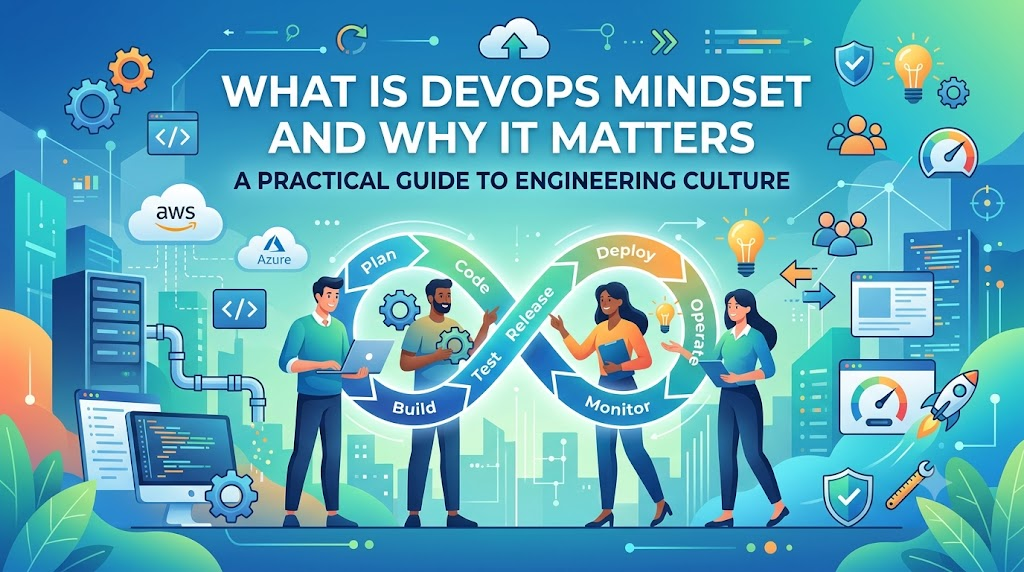
A software team completes a sprint, packages a release, and hands the build artifact over to operations. Hours later, the deployment fails in staging due to an unaligned environment variable. Developers claim the application passed all unit tests on their local machines. Operations engineers argue that the configuration requirements were never documented. Security teams flag hardcoded credentials in the repository, stopping the rollout entirely. Everyone involved did their specific job according to their departmental boundaries, yet the software failed to reach production.
This scenario plays out across many engineering organizations. Companies invest heavily in Kubernetes clusters, modern continuous integration pipelines, multi-cloud platforms, and automated test suites. Yet releases remain stressful, outages lead to finger-pointing, and feature delivery crawls. Adopting modern infrastructure tools without changing foundational engineering behaviors rarely solves delivery friction. Tools automate workflows, but culture and shared attitudes dictate how teams handle ownership, risk, communication, and failure. This cultural foundation is the DevOps mindset.
What Is a DevOps Mindset?
A DevOps mindset is an engineering philosophy and operational culture where cross-functional teams share end-to-end responsibility for the software they build, deploy, and run. Rather than treating development, quality assurance, security, and operations as separate phases managed by distinct departments, a DevOps mindset treats software delivery as a single continuous system.
Practicing a DevOps mindset means teams:
- Share accountability for system reliability, security, and user experience rather than isolating responsibility within functional roles.
- Eliminate silos by collaborating early and continuously across product management, engineering, security, and operations.
- Treat automation as a standard practice to eliminate toil, reduce human error, and establish consistent operational environments.
- Establish tight feedback loops via continuous testing, proactive monitoring, and real-time observability.
- Treat failures as learning opportunities rather than occasions for personal blame.
- Focus on customer outcomes, evaluating success by service availability and business value rather than line-of-code output or ticket closure rates.
+-----------------------------------------------------------------------------------+
|                                THE DEVOPS MINDSET                                 |
|                                                                                   |
|   Shared Ownership  <--->  Systems Thinking  <--->  Continuous Learning          |
|          ^                         ^                         ^                    |
|          |                         |                         |                    |
|   Early Feedback    <--->  Automation First  <--->  Blameless Culture             |
+-----------------------------------------------------------------------------------+
Tool Adoption vs. Mindset Adoption
Using DevOps tools does not mean an organization has adopted DevOps principles. Installing a continuous integration server or containerizing applications creates technical capability, but mindset determines how engineers use that capability day to day.
- Tool Approach: Writing Terraform scripts to provision cloud infrastructure, but requiring a three-week manual change approval board (CAB) review before running the script.
- Mindset Approach: Writing Infrastructure as Code with peer reviews, automated security scanning, policy validation, and automated canary deployments to verify safety dynamically.
DevOps Mindset vs. DevOps Tools
Tools support automation and infrastructure management, but mindset governs human interactions and engineering decisions.
| Functional Area | DevOps Tools (The Enablers) | DevOps Mindset (The Behavior) |
| Delivery Pipelines | CI/CD platforms | Committing small changes frequently and fixing broken builds immediately |
| Application Packaging | Containers and registries | Ensuring reproducible, consistent environments across development and production |
| Infrastructure | Infrastructure as Code (IaC) | Treating infrastructure as software: versioned, tested, peer-reviewed, and automated |
| System Visibility | Dashboards, logs, and APM tools | Analyzing telemetry to understand system behavior and user experience proactively |
| Cloud Computing | Cloud providers and APIs | Designing scalable, fault-tolerant architectures optimized for resilience and cost efficiency |
| Security Controls | Static/Dynamic scanners and vaults | Sharing security responsibility across all engineering stages rather than at the final gate |
| Work Execution | Scripting, runbooks, and schedulers | Actively identifying and eliminating repetitive, error-prone manual toil |
Why a DevOps Mindset Matters
Adopting a DevOps mindset changes how engineering organizations manage complexity, deliver software, and handle operational risk.
- Improved Cross-Team Collaboration: Shared operational goals reduce the friction caused by competing priorities (such as development prioritizing delivery velocity while operations prioritizes system stability).
- Faster, Predictable Delivery: Breaking changes down into smaller, incremental batches reduces deployment risk and simplifies debugging.
- Higher System Reliability: When developers understand how their code behaves in production and operations engineers contribute to deployment designs, production incidents decrease.
- Proactive Security (DevSecOps): Integrating vulnerability checks and compliance guardrails into early development stages prevents costly late-stage architectural fixes.
- Greater Engineering Productivity: Automating mundane provisioning and testing tasks frees engineers to focus on architectural resilience and core business capabilities.
- Enhanced Customer Experience: Faster defect resolution and consistent service uptime maintain customer trust and satisfaction.
Actual outcomes vary based on organizational size, legacy architecture, technical debt, and governance requirements. A DevOps mindset provides the cultural baseline necessary to make continuous delivery practical.
Core Principles of a DevOps Mindset
+-----------------------------------------------------------------------------------------+
|                                  CORE PILLARS                                           |
|                                                                                         |
| [Shared Ownership] ----> [Cross-Team Collaboration] ----> [Automation First]            |
|          |                                                       |                      |
|          v                                                       v                      |
| [Continuous Improvement] <--- [Fast Feedback] <--- [Blameless Learning]                 |
|          |                                                       |                      |
|          v                                                       v                      |
| [Customer Focus] ---------> [Built-In Security] ---------> [Systems Thinking]           |
+-----------------------------------------------------------------------------------------+
1. Shared Ownership
Traditional models assign developers responsibility for code up to the merge point, while operations teams bear sole responsibility for runtime failures. A DevOps mindset replaces this division with shared accountability across the entire software lifecycle.
Shared ownership does not mean every engineer manages every single operational task. It means:
- Developers write maintainable code, configure health endpoints, write unit/integration tests, and participate in on-call rotations for their services.
- Operations and platform engineers build reusable platforms, deployment primitives, and monitoring frameworks that enable self-service workflows.
- Quality, security, and uptime are shared team responsibilities, eliminating the handoff mentality of “throwing code over the wall.”
2. Collaboration Over Silos
Physical co-location or shared communication channels do not guarantee collaboration. True cross-functional collaboration requires aligned incentives.
When development, quality assurance, platform engineering, and security share common performance metrics—such as lead time for changes and service availability—they solve problems collectively. Silos encourage teams to protect departmental boundaries; a DevOps mindset encourages cross-discipline pairing, joint architectural reviews, and shared operational runbooks.
3. Automation First
A DevOps mindset views manual, repetitive engineering tasks as technical debt and operational risk.
       Is this task performed repeatedly?
                     |
            +--------+--------+
            |                 |
           Yes                No
            |                 |
            v                 v
   Can automation make it   Document clear,
   safer and more reliable? repeatable steps
            |
      +-----+-----+
      |           |
     Yes          No
      |           |
      v           v
  Implement   Refactor the underlying
  Automation  process to reduce complexity
Engineers apply automation to:
- Build, lint, test, and package applications via CI pipelines.
- Provision cloud infrastructure consistently using declarative templates.
- Execute regression, integration, and security checks automatically on pull requests.
- Deploy changes using progressive release patterns (such as canary or blue-green rollouts).
Automation must solve concrete problems. Automating an unstable or poorly understood process amplifies failures rather than preventing them.
4. Continuous Improvement
Continuous improvement (kaizen) requires teams to evaluate their processes and architectures regularly. Instead of waiting for massive multi-year refactoring programs, teams implement small, iterative adjustments:
- Conducting retrospectives after major milestones or release cycles.
- Refactoring brittle tests that generate false positives.
- Refining pipeline stages to reduce lead times.
- Paying down operational debt systematically during regular development cycles.
5. Fast and Continuous Feedback
The later an issue is detected in the software delivery cycle, the more expensive it is to fix. A DevOps mindset prioritizes early, actionable feedback loops.
- Late Feedback: Finding an architectural flaw, performance bottleneck, or security vulnerability during a pre-release staging audit months after code was written.
- Early Feedback: Identifying unit regressions in local test runs, security flaws via static code analysis during pull requests, and performance regressions via automated staging tests within minutes of committing code.
Real-time telemetry, structured application logging, and synthetic monitoring extend feedback into production, giving engineers immediate visibility into runtime behavior.
6. Learning From Failure
Complex distributed systems fail in unpredictable ways. A mature DevOps culture embraces blameless postmortems and structured incident retrospectives.
Traditional Reaction vs. DevOps Mindset Reaction

Traditional:  "Who pushed this broken configuration change to production?"
DevOps:       "What automated validation gaps allowed this configuration error
               to bypass staging and reach production undetected?"
Blameless retrospectives focus on:
- Understanding the system conditions, missing guardrails, and context that led to an incident.
- Identifying preventive actions, such as improved automated verification, better monitoring thresholds, or safer rollback mechanisms.
- Documenting incident timelines openly to share lessons across teams.
Accountability remains vital, but it focuses on thorough investigation and preventive engineering rather than individual punishment.
7. Customer Focus
Engineers with a DevOps mindset measure work by its value to the end user. High deployment frequency and test pass rates mean little if the application is slow, unstable, or difficult to use.
A customer-centric mindset connects technical decisions to real-world impact:
- Evaluating whether a database optimization improves page load times for users.
- Prioritizing bug fixes based on their effect on user workflows.
- Treating service availability, performance, and data integrity as fundamental customer-facing features.
8. Security as a Shared Responsibility (DevSecOps)
In traditional environments, security functions as an external gate at the end of the delivery cycle, often causing release delays or rushed exceptions.
A DevOps mindset integrates security practices throughout the entire lifecycle:
- Developers practice secure coding and manage third-party dependencies actively.
- Automated dependency vulnerability scanners run within CI pipelines.
- Infrastructure code enforces least-privilege access policies and secure baselines automatically.
- Security teams build automated guardrails, reference architectures, and developer training rather than manual approval queues.
9. Reliability Matters
Reliability is an essential feature of any software system. A DevOps mindset treats operational concerns as primary design requirements rather than post-launch fixes.
Key reliability practices include:
- Observability: Emitting structured logs, metrics, and distributed traces to diagnose unknown system states.
- Service Level Objectives (SLOs) and Error Budgets: Establishing agreed-upon reliability targets between product and engineering to balance innovation speed with operational stability.
- Resilience Engineering: Designing systems to handle dependency failures gracefully via retries, timeouts, circuit breakers, and automated health checks.
10. Systems Thinking
Systems thinking requires engineers to optimize the end-to-end delivery flow rather than individual local stages.
+--------+     +---------+     +----------+     +------------+     +-----------+
| Code   | --> | Build   | --> | Test     | --> | Deploy     | --> | Operate   |
|        |     |         |     |          |     |            |     | & Monitor |
+--------+     +---------+     +----------+     +------------+     +-----------+
     \___________________________________________________________________/
                           End-to-End System Flow
Optimizing only one stage often creates bottlenecks elsewhere:
- Accelerating development speed without automated testing creates a testing bottleneck.
- Increasing deployment frequency without production observability causes incident backlogs.
- Implementing rigid security gates without automated tooling stalls release flow.
A DevOps mindset looks at the entire path from idea to customer value, eliminating global constraints rather than celebrating local efficiencies.
11. Transparency and Visibility
Open operational data fosters trust and enables faster problem-solving. A DevOps culture makes delivery status, operational health, and incident tracking accessible across the organization:
- Public dashboards displaying build statuses, deployment pipelines, and environment health.
- Shared visibility into open incidents, system performance metrics, and operational SLOs.
- Transparent documentation of architectural decisions and system runbooks.
12. Experimentation and Controlled Learning
Innovation requires safe experimentation. Teams with a DevOps mindset design their systems and processes to support controlled risk:
- Using feature flags to decouple code deployment from feature activation.
- Applying canary releases to test new changes on a small subset of production traffic before full rollouts.
- Executing controlled proofs of concept to evaluate new architectures or tools before broad adoption.
13. Adaptability
Modern cloud ecosystems and security landscapes evolve rapidly. A DevOps mindset prioritizes modularity, learning agility, and pragmatic adaptation over rigid adherence to legacy workflows. Adaptability means selecting the right tool for a specific problem and updating processes as organizational needs change.
How Different Roles Practice the DevOps Mindset
The DevOps mindset influences daily behavior across every engineering discipline.
+------------------------------------------------------------------------------------+
|                      DEVOPS MINDSET ACROSS DISCIPLINES                             |
|                                                                                    |
|  Developers:              Operations / SRE:         Security Teams:                |
|  * Maintainable code      * Self-service platforms  * Policy as Code               |
|  * Comprehensive tests    * Automated provisioning  * Automated scans in CI/CD     |
|  * Production telemetry   * Incident analysis       * Collaborative threat models  |
|                                                                                    |
|                           Engineering Leadership:                                  |
|                           * Blameless postmortems                                  |
|                           * Shared organizational goals                            |
|                           * Investment in tooling & toil reduction                 |
+------------------------------------------------------------------------------------+
Development Teams
- Write modular, testable, and maintainable code accompanied by automated unit and integration suites.
- Instrument code with structured logging, distributed tracing, and health metrics before pushing to production.
- Participate in deployment activities, monitor production releases, and join incident troubleshooting.
Operations and Platform Teams
- Transition from manual server configuration to managing declarative Infrastructure as Code.
- Build internal developer platforms and self-service CI/CD tooling that allow developers to deploy and manage applications safely.
- Focus on system architecture, disaster recovery automation, and reliability engineering.
Security Teams
- Embed automated security scanners, secret-detection tools, and compliance checks directly into developer workflows.
- Provide secure base container images, infrastructure templates, and automated policy enforcement (Policy as Code).
- Collaborate with engineering teams during early design phases via lightweight threat modeling.
Engineering Leadership
- Establish psychological safety, ensuring failures lead to system improvements rather than personal reprimands.
- Allocate engineering time to eliminate operational toil and pay down technical debt.
- Align incentives across teams by measuring shared operational and delivery outcomes.
DevOps Mindset vs. Traditional IT Mindset
The transition to a DevOps mindset requires fundamental shifts in operational philosophy.
| Dimension | Traditional IT Mindset | DevOps Mindset |
| Team Ownership | Fragmented; developers write code, operations manages production | Shared end-to-end responsibility across all disciplines |
| Communication | Ticket-driven, formal handoffs between isolated departments | Direct cross-functional collaboration and shared channels |
| Release Strategy | Infrequent, large-batch releases during maintenance windows | Frequent, small-batch releases during regular working hours |
| Automation Focus | Task-based scripts maintained locally by individuals | End-to-end automated pipelines managed via version control |
| Testing Approach | Manual QA testing conducted near the end of the project | Continuous automated testing integrated throughout pipelines |
| Security Handling | Final security review gate before scheduled launch | Continuous security checks integrated into early development |
| System Monitoring | Basic uptime checks; reactive responses to user complaints | Proactive observability, actionable metrics, and SLO tracking |
| Incident Response | Focused on finding fault and assigning individual blame | Blameless retrospectives analyzing systemic contributing factors |
| Process Improvement | Periodic, top-down process overhauls | Incremental, ongoing refinement driven by engineering feedback |
| Success Metrics | Departmental outputs (tickets resolved, features coded) | Holistic business outcomes (system reliability, lead time) |
Evaluating DevOps Mindset: Strengths and Warning Signs
Signs of a Strong DevOps Mindset
- Developers and operations engineers collaborate directly during architecture and deployment design.
- Engineers actively identify manual tasks and prioritize automated solutions.
- Post-incident reviews focus on system safety margins and preventive controls.
- Security and compliance requirements are automated within the CI/CD pipeline.
- Code is deployed to production in small, manageable batches with clear rollback strategies.
- Operational metrics and telemetry are accessible to all engineering teams.
- Engineers demonstrate a clear understanding of how system uptime affects end users.
Warning Signs of a Weak DevOps Mindset
- Postmortems focus on identifying and reprimanding individual engineers.
- Development teams have no visibility into how their code runs in production environments.
- Deployments rely on long, manual step-by-step checklists executed during off-hours.
- Security audits happen right before launch, resulting in recurring release delays.
- Teams optimize for their own internal metrics rather than shared delivery outcomes.
- Operational knowledge is siloed within a few senior engineers without documentation.
- Teams build automated scripts that only run on individual local workstations.
How to Build a DevOps Mindset as an Individual
Developing a DevOps mindset is an active, ongoing learning process for engineers at any career stage.
  [1. Learn Lifecycle]  -->  [2. Study Production]  -->  [3. Automate Toil]
           |                                                      |
           v                                                      v
  [6. Customer Focus]   <--  [5. Analyze Incidents]  <--  [4. Communicate]
           |
           v
  [7. Better Questions] -->  [8. Document Systems]  -->  [9. Collaborate]
                                                                  |
                                                                  v
                                                        [10. Continuous Kaizen]
- Understand the Full Software Lifecycle: Look beyond your primary role. If you are a developer, learn how your application is packaged, routed, and managed in production. If you work in operations, learn standard software architecture and version control patterns.
- Learn What Happens After Deployment: Investigate how your code behaves in production. Study your service’s telemetry, error rates, resource usage, and traffic patterns under peak load.
- Practice Automation Daily: Eliminate repetitive tasks in your everyday workflow. Replace manual setup commands with clean scripts, Makefile targets, or declarative configurations.
- Improve Technical Communication: Document your design decisions clearly. Write concise pull request descriptions, update runbooks when processes change, and participate constructively in code reviews.
- Learn From Incidents: Read incident retrospectives, even for systems you do not directly manage. Understand the cascading failures, human factors, and technical constraints that caused past downtime.
- Focus on Customer Impact: Ask how your daily tasks affect the real user experience. Prioritize work that improves system reliability, page speed, or functional stability.
- Ask Better Questions: Move from asking “Can we ship this feature fast?” to asking “How will we monitor, secure, deploy, and debug this feature safely in production?”
- Document What You Learn: Maintain clear operational runbooks, architectural decision records (ADRs), and onboarding guides. Transparent documentation reduces institutional knowledge silos.
- Collaborate Across Disciplines: Pair with QA engineers, security analysts, or SREs to understand their operational constraints and incorporate their feedback into your workflows.
- Pursue Continuous Self-Improvement: Keep pace with evolving industry standards, architectural patterns, and reliability practices through hands-on practice, reading, and structured study.
How Organizations Can Build a DevOps Culture
Transforming organizational culture requires deliberate leadership, structural support, and continuous practice.
Step 1: Assess Current Bottlenecks & Silos
  └── Map the value stream from code commit to production deployment.

Step 2: Establish Shared Engineering Goals
  └── Align dev, ops, QA, and security under shared operational and delivery metrics.

Step 3: Break Down Organizational Walls
  └── Encourage cross-functional pairing, joint design reviews, and shared on-call duties.

Step 4: Enable Self-Service Platforms
  └── Build internal developer platforms that provide automated, standardized deployment paths.

Step 5: Prioritize Toil Reduction
  └── Allocate dedicated engineering capacity every sprint to eliminate manual operational tasks.

Step 6: Shorten Feedback Loops
  └── Integrate automated testing, static analysis, and performance checks early in pipelines.

Step 7: Shift Security Left (DevSecOps)
  └── Embed vulnerability scans, policy checks, and secrets management into developer workflows.

Step 8: Invest in Modern Observability
  └── Standardize metrics, structured logs, and tracing across all microservices and platforms.

Step 9: Normalize Blameless Postmortems
  └── Focus incident reviews on system design, process gaps, and automated safety nets.

Step 10: Iterate Continuously
  └── Review team workflows regularly, using metrics as diagnostic tools rather than punitive targets.
Common Misconceptions About the DevOps Mindset
- Misconception 1: “DevOps mindset means adopting as many tools as possible.”
- Reality: Tool proliferation often creates unnecessary operational complexity. A DevOps mindset focuses on choosing simple, effective tools that support team collaboration and automation.
- Misconception 2: “DevOps eliminates dedicated operations teams.”
- Reality: Operations expertise remains critical. Instead of executing manual deployments, modern operations and SRE teams build reliable infrastructure platforms and delivery pipelines for the entire engineering organization.
- Misconception 3: “DevOps means prioritizing deployment speed above all else.”
- Reality: Speed without safety causes recurring production downtime. DevOps balances velocity with reliability, security, and maintainability.
- Misconception 4: “DevOps means developers must master every infrastructure discipline.”
- Reality: Developers do not need to become expert cloud architects. They need to understand how their code runs in production and use self-service platforms responsibly.
- Misconception 5: “DevOps means documentation is no longer needed.”
- Reality: Clear documentation, Architecture Decision Records (ADRs), and actionable runbooks are essential for maintaining operational clarity and team scalability.
- Misconception 6: “DevOps means everything must be automated immediately.”
- Reality: Automation should be applied pragmatically to stable, well-understood tasks where manual toil creates operational bottlenecks or risks.
Practical Example: DevOps Mindset in Action
Consider an engineering team supporting an e-commerce checkout service. During a seasonal traffic surge, several database connections saturate, causing transactions to time out and preventing customers from completing purchases.
Traditional Response vs. DevOps Mindset Response

+-------------------------------------+  +-------------------------------------+
|         TRADITIONAL RESPONSE        |  |        DEVOPS MINDSET RESPONSE      |
|                                     |  |                                     |
| 1. Ops restarts database servers.   |  | 1. Team stabilizes system via runbook|
| 2. Incident report attributes fault |  |    and investigates root factors.   |
|    to "unoptimized developer code." |  | 2. Identifies missing connection    |
| 3. Developers claim infrastructure  |  |    pooling and lack of read-replicas|
|    was under-provisioned.           |  | 3. Adds automated connection pool   |
| 4. Ticket closed; no preventive     |  |    limits and load tests in staging.|
|    engineering work scheduled.      |  | 4. Configures predictive database   |
|                                     |  |    saturation alerts.               |
| Result: Outage repeats during next  |  | 5. Updates runbooks and shares      |
|         traffic spike.              |  |    learnings across engineering.    |
|                                     |  | Result: System withstands future    |
|                                     |  |         traffic surges safely.      |
+-------------------------------------+  +-------------------------------------+
In the DevOps scenario, the team treats the outage as an opportunity to improve application resilience, automated testing, and observability together.
Measuring DevOps Mindset and Operational Health
While cultural mindset cannot be measured with a single metric, organizations can evaluate its impact by tracking key delivery and operational indicators:
- Deployment Frequency: How often the organization successfully deploys changes to production.
- Lead Time for Changes: The time required for a code commit to pass verification and reach production.
- Change Failure Rate: The percentage of production deployments requiring hotfixes, rollbacks, or immediate remediation.
- Mean Time to Restore (MTTR): How quickly an engineering team recovers from an unplanned production service degradation.
- Automation Coverage: The proportion of repetitive build, test, and provisioning tasks handled by automated pipelines versus manual intervention.
- Incident Learning Adoption: The consistency with which blameless retrospectives produce concrete system and process improvements.
These metrics should serve as team diagnostic tools to identify systemic bottlenecks, never as individual performance rankings.
Developing Engineering Capabilities with DevOpsSchool
Developing a strong DevOps culture requires both technical competence and an understanding of collaborative operational practices. Engineers and leadership teams often need structured learning paths to bridge the gap between individual tool usage and cohesive, production-ready workflows.
Comprehensive training programs provided by platforms like DevOpsSchool help engineering professionals and organizations build practical skills across the entire software delivery lifecycle.
Their curriculum covers fundamental and advanced disciplines, including:
- Continuous Integration and Continuous Delivery (CI/CD) pipelines
- Cloud infrastructure management and architecture
- Containerization and orchestration platforms like Docker and Kubernetes
- Infrastructure as Code (IaC) and configuration management
- Monitoring, observability, and Site Reliability Engineering (SRE) principles
- DevSecOps practices and automated security integration
Hands-on training gives engineers the practical foundation needed to implement robust automation while fostering the collaborative habits that underpin a mature DevOps culture.
The Future of the DevOps Mindset
The landscape of software delivery continues to evolve, introducing new paradigms and operational abstractions:
- Platform Engineering & Internal Developer Platforms (IDPs): Centralized platform teams build internal products that allow application developers to provision infrastructure, run tests, and deploy services safely using clear self-service abstractions.
- AIOps and Intelligent Telemetry: Machine learning models assist engineering teams by correlating vast streams of logs, metrics, and traces to detect anomalies and identify potential system degradations before outages occur.
- Software Supply Chain Security: Hardening build pipelines, generating Software Bills of Materials (SBOMs), and signing artifacts cryptographically have become integral to the delivery process.
- FinOps & Resource Efficiency: Cloud cost optimization is shifting left, making engineers mindful of architecture costs alongside latency and uptime.
- Resilience Engineering & Chaos Testing: Teams proactively inject controlled faults into distributed systems to identify structural weaknesses before they manifest as production incidents.
Tools, orchestration layers, and AI assistants will continue to automate lower-level operational tasks. However, the foundational principles of the DevOps mindset—systems thinking, blameless learning, cross-functional collaboration, customer focus, and shared ownership—will remain essential to building reliable software systems.
Frequently Asked Questions
What is the core idea behind a DevOps mindset?
A DevOps mindset is a way of working where cross-functional teams share end-to-end responsibility for the entire software lifecycle—from initial architecture and development through testing, deployment, operational maintenance, and continuous improvement.
How does a DevOps mindset differ from simply using DevOps tools?
DevOps tools (such as CI/CD engines, container orchestrators, and IaC frameworks) provide the technical capability to automate tasks. A DevOps mindset provides the cultural willingness, collaborative habits, and shared ownership required to use those tools effectively to improve software delivery and system reliability.
Can an organization practice DevOps without complete automation?
Yes. While automation helps eliminate human error and manual toil, DevOps starts with cultural changes: shared ownership, blameless incident reviews, cross-functional communication, and continuous learning. Automation is an essential enabler that teams implement incrementally as their processes mature.
Why are blameless postmortems important in a DevOps culture?
Blameless postmortems focus on identifying systemic vulnerabilities, missing automated checks, and process gaps rather than punishing individuals. This encourages engineers to report problems transparently, leading to stronger, more resilient architectures.
How does a DevOps mindset improve system security?
Rather than treating security as an isolated approval gate at the end of a project, a DevOps mindset integrates security practices (DevSecOps) directly into developer workflows, CI/CD pipelines, and infrastructure provisioning from the beginning.
Does adopting a DevOps mindset mean developers must do all operations work?
No. It means developers write observable, maintainable code, write automated tests, and understand how their services behave in production. Operations and platform engineers focus on building robust infrastructure, self-service delivery platforms, and reliability guardrails that enable safe, autonomous delivery.
What is the first step an individual engineer should take to adopt a DevOps mindset?
An individual engineer should start by understanding the entire delivery pipeline beyond their direct role. If you are a developer, study your application’s production telemetry and deployment process. If you work in operations, learn standard software engineering patterns, version control workflows, and automated testing frameworks.
Final Thoughts
A true DevOps transformation cannot be bought through a suite of modern cloud tools or achieved by simply renaming an operations team; tools merely amplify the strengths or weaknesses of the underlying culture. Engineering maturity ultimately relies on a DevOps mindset that replaces departmental silos with shared ownership, turns operational failures into blameless learning opportunities, systematically eliminates toil through pragmatic automation, and applies systems thinking to optimize the entire delivery lifecycle. In practice, this mindset is about fundamentally transforming how teams communicate, collaborate, and take collective responsibility for delivering secure, reliable, and high-value software to their customers.
