When a product team manages to plan sprint cycles smoothly, gather valuable customer feedback, and write clean code, everything feels under control. Yet, friction often emerges right after code is checked in. Developers hand features over to operations teams, manual handoffs stall releases, and staging environments break unexpectedly.
Speedy iteration alone cannot guarantee reliable software delivery if the operational pipeline remains slow and disconnected. This challenge illustrates why organizations increasingly look at how Agile methodology and DevOps practices intersect.
Agile methodology shapes how teams plan, prioritize, and build software iteratively through close collaboration and customer feedback. DevOps extends automation and operational stability across the entire software development lifecycle, bridging the gap between development, operations, and security. Combining both approaches helps engineering teams move from isolated planning to continuous, reliable software delivery.
What Is Agile?
Agile is an iterative approach to project management and software development that helps teams deliver value to customers incrementally rather than waiting for a monolithic final release. Instead of mapping out an entire year-long project upfront, Agile teams break work down into short development cycles—commonly called sprints—lasting between one to four weeks.
Core concepts that drive Agile include:
- Iterative and Incremental Delivery: Building software in small, usable pieces so users receive value continuously.
- Adaptive Planning: Adjusting priorities based on real-world usage and changing requirements.
- Customer Feedback: Regularly reviewing working software with stakeholders to ensure it meets actual needs.
- Frameworks like Scrum and Kanban: Organizing workflows through product backlogs, sprint planning sessions, daily standups, and retrospectives.
Agile focuses heavily on human collaboration, trust, and flexibility. However, Agile by itself primarily addresses planning, scoping, and code creation. It does not automatically solve infrastructure bottlenecks, release friction, or production monitoring.
What Is DevOps?
DevOps is a cultural and technical movement that unites software development and IT operations to shorten the software delivery lifecycle while improving reliability.
At its core, DevOps goes far beyond simply adopting a toolset. It requires a cultural shift toward shared ownership, where developers care about how code runs in production, and operations teams engage early in the development process.
Key pillars of DevOps include:
- Automation: Removing manual toil from builds, testing, and infrastructure provisioning.
- CI/CD (Continuous Integration and Continuous Delivery): Automatically merging code changes, running tests, and preparing releases for rapid deployment.
- Infrastructure as Code (IaC): Managing and provisioning computing environments through code scripts rather than manual configuration.
- Observability and Monitoring: Tracking application performance metrics, logs, and traces to detect and resolve incidents quickly.
- DevSecOps: Integrating security practices into every stage of the pipeline rather than treating security as an afterthought.
Agile vs. DevOps: Understanding the Relationship
While people often mention them in the same breath, Agile and DevOps target different parts of the software delivery lifecycle.
| Feature | Agile | DevOps |
| Primary Focus | How teams plan, organize, and build software iteratively. | How teams automate, test, secure, and deliver software to production. |
| Core Problem Solved | Misalignment with customer requirements and rigid project planning. | Release bottlenecks, manual deployments, and operational silos. |
| Process Style | Sprint-based cycles, user stories, and backlog refinement. | Automated pipelines, CI/CD, and continuous feedback loops. |
| Team Dynamic | Cross-functional product and development teams. | Integrated software, operations, QA, and security engineers. |
| Release Cadence | End of sprint or on-demand feature readiness. | Continuous delivery or continuous deployment. |
Agile governs how teams build the right thing through feedback and adaptation, while DevOps governs how teams build the thing right through automation, reliability, and continuous deployment.
How Agile and DevOps Work Together
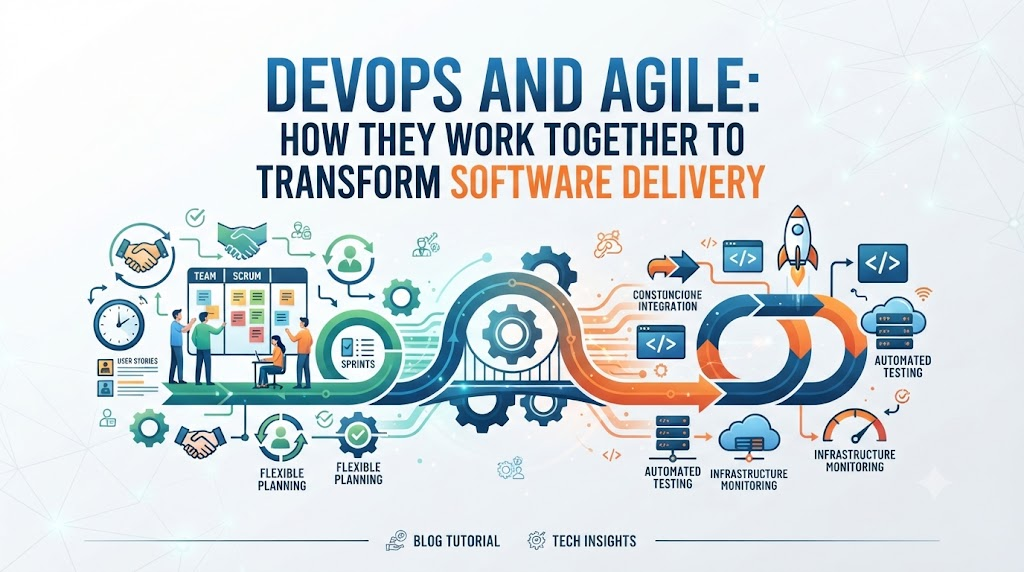
When combined, Agile and DevOps create a seamless pipeline from initial user story creation to production deployment and monitoring.
Iterative Development Meets Continuous Delivery
Agile thrives on short feedback loops and small feature increments. However, if releasing those increments requires weeks of manual approvals and manual testing, the value of Agile diminishes. DevOps CI/CD pipelines automate the build, test, and deployment phases, allowing Agile teams to push small, tested increments straight to production with minimal friction.
Expanding Collaboration Across Silos
Agile breaks down silos between product owners, developers, and testers. DevOps expands this collaborative mindset outward to include system administrators, infrastructure engineers, and security teams. Everyone shares responsibility for the health of the software from inception to retirement.
Connecting Feedback Loops
Agile gathers feedback from sprint reviews and user testing to refine future backlog items. DevOps adds production telemetry, error tracking, and performance metrics into the mix. Combining sprint feedback with real-time operational insights gives product teams a complete picture of user behavior and application health.
DevOps Practices That Support Agile
Specific technical practices make Agile delivery workflows truly scalable and efficient:
- Continuous Integration (CI): Developers merge code changes into a shared repository frequently throughout the day. Automated builds and unit tests run instantly, catching bugs when they are cheap and easy to fix.
- Automated Testing: Replaces slow, manual regression testing with automated test suites integrated directly into the pipeline, supporting Agile’s requirement for high quality in short cycles.
- Infrastructure as Code (IaC): Allows developers and operations engineers to spin up testing and staging environments instantly using configuration scripts, eliminating delays caused by waiting for hardware.
- Containerization: Packages applications and dependencies together so they run reliably across development, testing, and production environments.
Practical Workflow: Agile + DevOps in Action
Consider a typical feature lifecycle combining both methodologies:
- Product Requirement: A product owner defines a new feature based on user research.
- User Story & Sprint Planning: The team breaks the requirement into user stories and schedules them during sprint planning.
- Development & Code Review: A developer writes the code and opens a pull request, triggering peer review.
- Continuous Integration (CI): Merging the code triggers automated builds and test suites.
- Automated Deployment: Once tests pass, the CI/CD pipeline deploys the feature to a staging environment using Infrastructure as Code.
- Monitoring & Feedback: Production monitoring tools track performance metrics, while customer usage data flows back into the product backlog for future enhancements.
Benefits of Combining Agile and DevOps
Organizations that successfully integrate Agile and DevOps realize significant operational and business advantages:
- Faster Time to Market: Features reach users in days or hours rather than months.
- Higher Software Quality: Automated testing and continuous integration catch regressions early.
- Reduced Burnout: Automation eliminates tedious manual deployments and repetitive operational tasks.
- Enhanced Adaptability: Teams can pivot quickly when market conditions or customer requirements shift.
Common Challenges and How to Address Them
- Cultural Resistance: Siloed teams may resist sharing responsibilities. Solution: Foster a blame-free culture, encourage cross-functional shadowing, and celebrate shared wins.
- Treating DevOps Only as Tools: Buying automation software without changing processes fails. Solution: Focus first on team workflow and culture before selecting toolchains.
- Inadequate Testing Automation: Slow test suites stall pipelines. Solution: Invest in robust test automation frameworks and prioritize unit and integration test coverage.
Best Practices for Combining Agile and DevOps
- Establish Shared Objectives: Align development velocity metrics with operational stability metrics.
- Keep Releases Small: Break large features into minor increments to reduce deployment risk.
- Integrate Security Early: Shift security checks left into the development phase rather than auditing at the end.
- Leverage Retrospectives: Use regular review meetings to evaluate both team collaboration and pipeline performance.
Modern Practices: DevSecOps, SRE, and Platform Engineering
As engineering practices mature, Agile and DevOps intersect with broader disciplines. DevSecOps embeds security compliance directly into automated pipelines. Site Reliability Engineering (SRE) applies software engineering principles to IT operations to ensure high availability. Meanwhile, Platform Engineering builds internal developer platforms that empower Agile teams to self-serve infrastructure securely.
Role of DevOps Training and Skill Development
Mastering the intersection of Agile and DevOps requires continuous learning. Professionals looking to elevate their career often explore specialized training covering CI/CD pipelines, containerization, Infrastructure as Code, and monitoring. Organizations such as DevOpsSchool offer structured programs designed to help engineers and teams build practical, real-world competencies in modern software delivery workflows.
Future Trends
Looking ahead, the synergy between Agile and DevOps continues to evolve. AI-assisted software development and AIOps are streamlining code generation, automated testing, and incident remediation. Platform engineering is reducing cognitive load for developers, while data-driven engineering decisions help teams optimize both sprint velocity and pipeline efficiency in real time.
Frequently Asked Questions
What is the difference between Agile and DevOps?
Agile focuses on iterative planning, collaboration, and how software is built. DevOps focuses on automation, CI/CD, deployment, and operational reliability across the delivery lifecycle.
Can Agile and DevOps be used together?
Yes. They complement each other naturally. Agile ensures teams build the right features based on feedback, while DevOps ensures those features reach production reliably and fast.
How does DevOps support Agile development?
DevOps removes release bottlenecks through automated testing, continuous integration, infrastructure automation, and rapid feedback loops, making frequent sprint releases practical.
Is DevOps an Agile methodology?
No. DevOps originated from the IT operations and systems administration side, whereas Agile originated from software development management. However, both share core values of collaboration, feedback, and continuous improvement.
How does an organization start combining Agile and DevOps?
Start by aligning development and operations teams around shared goals, automating basic CI/CD pipelines, and integrating retrospectives that cover both planning and operational feedback.
Final Thoughts
Agile and DevOps are not competing methodologies; they are two halves of a comprehensive modern software delivery engine. While Agile guides how teams plan and iterate toward customer needs, DevOps provides the technical automation and cultural foundation needed to deliver software reliably at scale. By combining disciplined sprint planning with robust CI/CD automation, organizations can foster a culture of continuous learning, high quality, and sustainable innovation.
