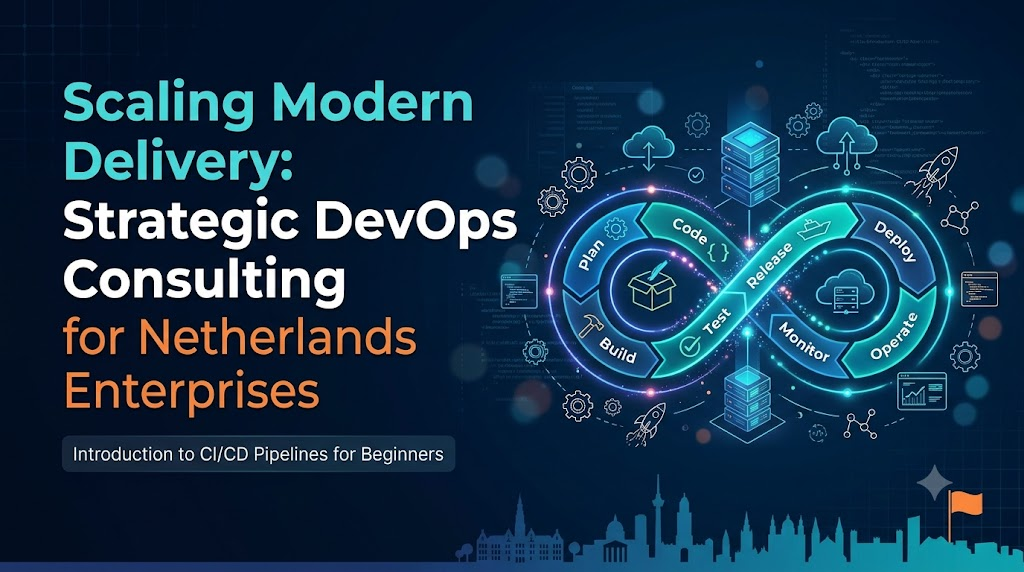
The Dutch digital ecosystem—anchored by data hubs in Amsterdam, tech corridors in Eindhoven, and rapid financial modernization in Utrecht—moves at high velocity. Organizations across the Netherlands face severe engineering talent crunches alongside strict European data privacy, NIS2 security mandates, and escalating multi-cloud bills.
In this landscape, adopting DevOps is no longer about scripting a few Jenkins jobs or standardizing Dockerfiles. Modern teams struggle with fractured deployment pipelines, uncontrolled cloud consumption, production reliability gaps, and security bottlenecks. Bridging this maturity gap requires strategic alignment across culture, platform engineering, and automation. Enterprise teams seeking hands-on architectural guidance and upskilling frequently engage specialized partners offering dedicated DevOps Consulting Netherlands to establish robust delivery foundations.
Key Delivery Bottlenecks Facing Dutch Engineering Teams
Building software quickly is meaningless if systems fail under load or violate regulatory standards. Engineering leaders across Europe consistently encounter four systemic friction points:
[ Traditional Delivery Pitfalls ]
┌─────────────────────────┐     ┌─────────────────────────┐
│     Siloed Hand-offs    │ ──> │ Manual Security Reviews │
└─────────────────────────┘     └─────────────────────────┘
             │                               │
             ▼                               ▼
┌─────────────────────────┐     ┌─────────────────────────┐
│ Runaway Multi-Cloud Cost│ ──> │  Ad-Hoc Incident Triage │
└─────────────────────────┘     └─────────────────────────┘
- Toolchain Sprawl Without Platform Ownership: Adopting diverse CI/CD engines, disparate infrastructure-as-code (IaC) templates, and fragmented repository setups creates cognitive overload. Developers spend hours fighting configurations instead of delivering business value.
- Late-Stage Security Testing: When security audits happen just prior to deployment, releases stall. In an EU regulatory environment governed by GDPR, DORA, and NIS2, retrofitting compliance into pipelines causes significant delays.
- Cluster Complexity & Drift: Organizations shifting workloads to containerized environments quickly encounter Day-2 operational challenges, configuration drift, and observability blind spots across multi-tenant clusters.
- Opaque Cloud Financial Governance: Elastic cloud architectures often lead to unbudgeted billing surprises when infrastructure provisioning lacks visibility, chargeback models, and automated resource quotas.
Core Pillars of a Mature DevOps Operating Model
Overcoming these operational hurdles requires establishing resilient, self-service platforms rather than isolated tool hacks.
+---------------------------------------------------------------------------+
|                   Modern DevOps Engineering Framework                     |
+---------------------+---------------------+-------------------------------+
| Discipline          | Target Objective    | Core Practices                |
+---------------------+---------------------+-------------------------------+
| Platform & Delivery | Developer Velocity  | GitOps, Golden Paths, IaC     |
| Continuous Security | Shift-Left Defense  | SAST/DAST, SBOM, Policy-as-Code|
| Reliability & SRE   | Predictable Uptime  | SLOs, Error Budgets, Tracing  |
| Cloud Optimization  | Unit Economics      | Rightsizing, Tagging, FinOps  |
+---------------------+---------------------+-------------------------------+
1. Self-Service Developer Platforms (IDPs)
Internal Developer Platforms standardize how microservices are provisioned, monitored, and scaled. By deploying reproducible blueprints via tools like Backstage, Terraform, and Crossplane, operations teams deliver “golden paths” that allow developers to ship code safely without requiring deep infrastructure expertise.
2. Shifting Security Left with DevSecOps
Security cannot remain a manual review gate. Embedding dynamic and static analysis, automated container image scanning, software bill of materials (SBOM) checks, and policy-as-code engines (such as Open Policy Agent or Kyverno) directly into commit hooks and CI stages catches vulnerabilities at source:
YAML
# Example pipeline guardrail validating deployment compliance
apiVersion: policy.bridge/v1
kind: SecurityAssertion
metadata:
  name: enforce-read-only-fs
spec:
  validation:
    failOnCriticalVulnerabilities: true
    requireRunAsNonRoot: true
    enforceReadOnlyRootFilesystem: true
3. Reliability Engineering over Reactive Firefighting
System stability is governed by data, not guesswork. Teams transitioning to Site Reliability Engineering (SRE) establish clear Service Level Objectives (SLOs) and Service Level Indicators (SLIs). Managing an “error budget” changes the conversation between product managers and engineers: if the error budget is depleted, feature work pauses to focus on system resilience and operational hardening.
4. FinOps: Unifying Finance, Product, and Engineering
As microservices scale across hybrid architectures, unallocated cloud spend drains margins. Mature engineering units implement FinOps practices—tagging infrastructure by business domain, automating node pool scaling, leveraging spot instances where appropriate, and attributing cost directly to distinct engineering teams.
Implementing Production-Grade Kubernetes Workflows
Organizations adopting microservices rely on Kubernetes as the de facto control plane. However, running Kubernetes in enterprise production environments requires strict discipline across storage, networking, and release automation.
[ Git Repository ] ──────> [ GitOps Controller (ArgoCD/Flux) ]
                                      │
                                      ▼
                        [ Declarative Cluster State ]
                         ├── Production Namespaces
                         ├── Ingress & Service Mesh
                         └── Policy & Pod Security
GitOps as the Single Source of Truth
Managing clusters via imperative CLI scripts invites configuration drift. Declarative GitOps architectures (using engines like ArgoCD or Flux) ensure that the cluster continuously reflects version-controlled definitions stored in Git:
YAML
apiVersion: argoproj.io/v1alpha1
kind: Application
metadata:
  name: core-payments-service
  namespace: argocd
spec:
  project: default
  source:
    repoURL: 'git@github.com:enterprise/infra-manifests.git'
    targetRevision: HEAD
    path: clusters/production/payments
  destination:
    server: 'https://kubernetes.default.svc'
    namespace: payments-prod
  syncPolicy:
    automated:
      prune: true
      selfHeal: true
Operationalizing Enterprise Kubernetes
To keep production clusters secure and reliable:
- Enforce Resource Quotas: Always specify memory and CPU requests/limits to prevent noisy-neighbor starvation.
- Segregate Traffic via Network Policies: Default-deny intra-namespace ingress unless explicit paths are permitted.
- Automate Scaling with KEDA: Scale deployments based on real event streams (Kafka offsets, queue lengths) rather than crude CPU thresholds.
Solving the Delivery Puzzle with DevOpsSchool.nl
Navigating cloud modernization, GitOps orchestration, and strict operational security requires pragmatic engineering leadership. While many enterprises attempt to overhaul these systems organically, lack of specialized in-house experience often leads to delayed timelines, fragile clusters, and high burn rates.
This is where partnering with seasoned implementation specialists creates immediate business leverage. As a technology consulting and enablement organization serving enterprises across the Netherlands and Europe, DevOpsSchool.nl provides strategic advisory, hands-on engineering, and organizational enablement across the modern stack.
Whether your organization requires senior Kubernetes Consulting Services to architect zero-drift multi-tenant platforms, Site Reliability Engineering Consulting to establish operational SLOs, or DevSecOps Consulting Services to embed continuous compliance into production pipelines, their consultants work directly alongside your teams.
Furthermore, true transformation depends on team capability. Through targeted Corporate DevOps Training and specialized Kubernetes programs, DevOpsSchool.nl helps internal engineering organizations build long-term autonomy, bridging the tech talent gap through structured, production-tested curricula.
Best Practices for Structuring Your DevOps Roadmap
To build a sustainable delivery lifecycle, structure your transformation into manageable phases:
| Phase | Strategic Focus | Deliverables | Key Metric |
| Phase 1: Baseline | Audit & Visibility | Infrastructure as Code (IaC) audit, CI/CD assessment, security scan baselines | Lead Time to Change |
| Phase 2: Standardization | Platform Foundations | Golden path templates, automated GitOps controllers, artifact registries | Deployment Frequency |
| Phase 3: Resiliency | SRE & DevSecOps | Policy-as-code enforcement, SLO/SLI dashboards, automated rollback | Change Failure Rate (CFR) |
| Phase 4: Optimization | FinOps & Autonomy | Cost attribution per service, autoscaling governance, team upskilling | Time to Restore Service (MTTR) |
Frequently Asked Questions (FAQs)
What is the difference between hiring a consultancy and upskilling through corporate training?
Consulting engagements typically focus on solving immediate architectural bottlenecks, building infrastructure frameworks, and establishing operational baselines. Training focuses on long-term organizational sustainability, empowering existing software and operations engineers to maintain and iterate on those platforms autonomously. The most successful initiatives pair hands-on implementation with structured team mentoring.
How do European compliance rules (NIS2, GDPR, DORA) impact DevOps roadmaps?
Regulatory standards mandate auditable pipelines, strict access controls, rapid patch cadence, and documented disaster recovery mechanisms. Modern DevOps integrates automated compliance directly into pipelines through policy-as-code and signed container provenance, replacing lengthy retrospective audits with real-time verification.
When should an enterprise adopt FinOps alongside DevOps?
FinOps should be introduced as soon as multiple teams provision dynamic cloud resources independently. Without real-time spending visibility, automated tagging, and team-level chargebacks, cloud bills scale unpredictably as teams spin up container clusters and parallel staging environments.
Moving Your Platform Strategy Forward
Transforming software delivery is an iterative journey that requires equal attention to tooling, architectural governance, and team culture. By focusing on developer self-service, declarative infrastructure, proactive security, and reliability engineering, organizations turn software delivery from an operational bottleneck into a core competitive advantage.
If your organization is evaluating its infrastructure posture, scaling container infrastructure, or planning an enterprise-wide cloud modernization program, exploring dedicated training and consulting engagements with DevOpsSchool.nl can help chart a clear, production-tested path forward.
