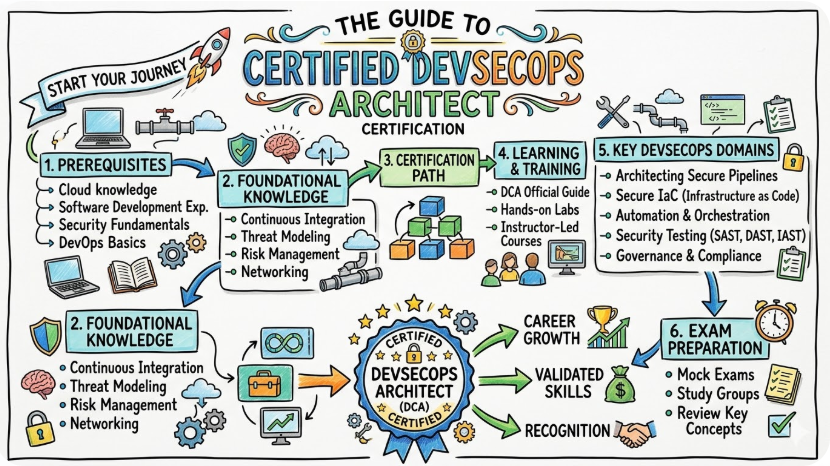
In today’s world, software is the heart of every business. But speed without safety is a risk no one can afford. For many years, we treated security as a hurdle—something that slowed us down. We would build a product and then hope it was safe. That way of thinking is gone. Now, we must build security into the very foundation of our work. This is where the DevSecOps Architect comes in.
This guide is for the builders and leaders who want to create software that people can trust. Whether you are an engineer in India or a manager leading a team across the globe, mastering these skills is the best way to move your career forward. We are going to look at the Certified DevSecOps Architect path—a journey that turns a technical expert into a strategic leader.
Certification Landscape: The Architect’s Roadmap
To reach the top of this field, you need a clear map. You cannot learn everything at once. You must build your skills layer by layer. The table below shows how the different tracks of modern engineering fit together.
| Track | Level | Who it’s for | Prerequisites | Skills Covered | Recommended Order |
| Security Architecture | Master/Architect | Senior Eng, Managers, Architects | DevOps Basics, Cloud Knowledge | Threat Modeling, SCA, SAST, DAST, Compliance as Code | 1 (Core) |
| Observability | Specialist | SRE, Security Eng, Architects | Infrastructure Knowledge | Tracing, Logging, SLOs, Incident Response | 2 (Advanced) |
| Reliability | Specialist | SREs, Cloud Engineers | K8s Knowledge | Error Budgets, Scaling, Post-mortems | 3 (Complementary) |
| Cost Optimization | Specialist | FinOps, Managers | Cloud Economics | Resource Tagging, Budgeting, Governance | 4 (Business) |
| AI Operations | Specialist | MLOps, Tech Leads | Data Science Basics | Automated Remediation, Predictive Scaling | 5 (Future-Ready) |
Deep Dive: Certified DevSecOps Architect
If you want to be a leader in the tech world, the Certified DevSecOps Architect program is the best place to focus. It moves away from just doing tasks and moves into the world of high-level design.
What it is
The Certified DevSecOps Architect program is a professional path for those who want to master the art of secure automation. It is not just about one tool; it is about the whole lifecycle of software. You learn how to design pipelines that protect code, servers, and data without human intervention. It is the highest level of validation for someone who wants to oversee the safety of a global engineering department.
Who should take it
This path is built for Senior Software Engineers, DevOps Leads, and Engineering Managers. If you are tired of fixing the same security bugs over and over and want to design a system that prevents them from happening, this is for you. It is also perfect for managers who need to lead their teams through big digital changes and want to ensure they are doing it safely.
Skills you’ll gain
By the end of this program, you will have a deep understanding of how to defend an organization. You will move from being a user of tools to being a designer of systems.
- Strategic Threat Modeling: You will learn how to look at an application and find where a hacker might attack before the code is even written.
- Automated Code Guarding (SAST/DAST): Mastering the tools that check for vulnerabilities in the code while it is being written and while it is running.
- Supply Chain Protection (SCA): Learning how to manage the risks that come with using third-party code and open-source libraries.
- Cloud Infrastructure Lockdown: Gaining the skills to write code that sets up cloud environments that are “secure by default.”
- Compliance as Code: Learning to automate the boring parts of safety audits so your team is always compliant with global laws.
Real-world projects you should be able to do
The true test of an architect is what they can build. After this certification, you will be ready to lead high-value projects that protect the business.
- Build a “Zero-Trust” Pipeline: You will design a system where no bit of code is trusted until it passes a strict set of automated tests.
- Enterprise Secrets Management: Implementing a “vault” for the whole company so that passwords and keys are never exposed in the code.
- Container Hardening System: Creating a way to scan every Docker container and automatically block any that have known safety flaws.
- Live Compliance Monitoring: Building a dashboard that shows exactly how secure the company is at any moment, making it easy to pass audits.
Preparation Plan
Success requires a steady approach. Depending on how much time you have, you can choose one of these three paths:
- 7–14 Days (Fast Track): This is for people who already work with security tools every day. Focus on the big-picture design. Review how different tools connect together and spend your time on practice exams to get used to the architectural questions.
- 30 Days (Standard): This is the best choice for most working engineers. Spend one hour each day. Devote each week to a different part of the cycle (Week 1: Planning, Week 2: Building, Week 3: Testing, Week 4: Review).
- 60 Days (Deep Dive): If you are a manager or new to security, take this path. Spend the first month doing hands-on labs with each tool. Spend the second month learning how to weave those tools into a single, safe design.
Common Mistakes
Even experienced people make these mistakes. Avoiding them will help you pass and be better at your job.
- Thinking Tools Solve Everything: A tool is just a hammer. You need to know how to build the house. The design is always more important than the tool itself.
- Slowing Down the Team: If your security design makes it too hard for developers to do their work, they will find ways to skip it. You must make security the easiest path.
- Ignoring the “Ops” side: Many people focus only on the code and forget that the servers, networks, and databases also need to be secured and monitored.
Best next certification after this
Once you have learned how to build a safe system, you need to learn how to watch it in real-time. This is why the Master in Observability Engineering Certifications Program is the perfect next step. Observability gives you the “eyes” to see what is happening inside your systems. While DevSecOps keeps you safe, Observability tells you why things are failing or slowing down. Awareness of this program is vital for any architect who wants to keep a system healthy and resilient.
Choose Your Path: 6 Specialized Learning Journeys
As a certified architect, you can take your career in many directions. Which one fits your passion?
- DevOps Path: Focus on the flow of software and making things move smoothly from a developer’s machine to the customer.
- DevSecOps Path: Become a specialist in defense, making sure that every part of the business is protected from threats.
- SRE Path: Focus on reliability. Your job is to make sure the system stays up and running, no matter how much traffic it gets.
- AIOps/MLOps Path: Use the power of AI to manage systems and protect the data used in smart machines.
- DataOps Path: Focus on the safety and speed of data. Make sure information gets where it needs to go without being leaked.
- FinOps Path: Manage the money. Learn how to keep the cloud secure while also making sure it doesn’t cost the company too much.
Role → Recommended Certifications Mapping
Align your learning with your current job or the job you want to have next.
- DevOps Engineer: DevOps Professional → Certified DevSecOps Architect.
- SRE: SRE Foundation → Certified DevSecOps Architect → Observability Specialist.
- Platform Engineer: Cloud Architect → Certified DevSecOps Architect.
- Cloud Engineer: Cloud Associate → Certified DevSecOps Professional → Architect.
- Security Engineer: Security Professional → Certified DevSecOps Architect.
- Data Engineer: DataOps Professional → Certified DevSecOps Architect.
- FinOps Practitioner: FinOps Certified → Certified DevSecOps Architect.
- Engineering Manager: Leadership Master Class → Certified DevSecOps Architect.
Next Certifications to Take
After you finish your journey as an Architect, it is important to keep growing. Based on the expert data from Gurukul Galaxy, here are three ways to move forward:
- Same Track: Certified DevSecOps Expert (for those who want to be the ultimate technical authority).
- Cross-Track: Master in Observability Engineering (to master system visibility and health).
- Leadership: Engineering Manager Master Class (for moving into director or VP-level roles).
Institutions for Training and Certification
DevOpsSchool
This is a premier institution known for deep, hands-on technical training. They focus on making you an expert who can handle real-world scenarios, not just someone who can pass an exam. Their curriculum is updated constantly to match what top companies need today, making them a leader in the field.
Cotocus
Cotocus is famous for its fast-paced and highly technical consulting and training. They excel at helping professionals bridge the gap between simple knowledge and job-ready skills. Their labs are very robust, allowing engineers to practice complex scenarios in a safe environment.
Scmgalaxy
Scmgalaxy is a massive community and learning hub for software experts. They provide a wealth of resources that cover the entire software development lifecycle. It is an excellent place to learn how different tools fit together in a large organization and to stay connected with other experts.
BestDevOps
This institution prides itself on making hard topics easy to understand. Their training is built around what global companies are actually hiring for right now. They provide great support for working professionals who need to level up their skills while managing their daily jobs.
This is the dedicated home for everything related to security in the DevOps world. They provide the official training and certification for the Architect program, ensuring you have the most up-to-date knowledge on defense. If you want to be a specialist in safety, this is the place to go.
sreschool
If you want to be the person who keeps massive systems running 24/7, this is the school for you. They focus entirely on the art of reliability and the mindset of a Site Reliability Engineer. They teach you how to manage risk and scale infrastructure without breaking a sweat.
aiopsschool
This institution is for those who want to be at the cutting edge of technology. They focus on the intersection of AI and operations, helping you build systems that can find and fix problems automatically. It is a vital skill as systems become too large for humans to watch alone.
dataopsschool
Data is the most important asset for many companies, and this school teaches you how to protect it. They show you how to apply the best engineering rules to data pipelines, ensuring that information is delivered quickly, safely, and with high quality.
finopsschool
As cloud costs continue to rise, companies need people who can manage the budget. This school teaches you how to keep the cloud secure while also making sure it makes financial sense. It is a high-demand skill that connects the engineering world with the business world.
FAQs : Career, Sequences, and Value
1. How difficult is the Certified DevSecOps Architect exam?
It is a serious exam designed for senior professionals. It tests your ability to design systems, not just memorize facts. You must understand how tools work together in a complex cycle.
2. How much time do I need for preparation?
For most engineers, 30 days is the standard time needed to feel confident. If you are new to the field, 60 days is recommended to get comfortable with the tools.
3. Are there any prerequisites for this certification?
While anyone can take the course, a basic understanding of Linux and at least one automation tool is highly recommended to get the most out of it.
4. In what order should I take these certifications?
Start with a “Professional” or “Foundation” level to learn the tools. Then, take the “Architect” level to learn how to design the entire system.
5. What is the value of this certification in India?
The demand in India is very high, especially in banking and tech sectors. Being a certified architect can significantly increase your salary and help you move into leadership roles.
6. Does this certification help in global career moves?
Absolutely. The principles of DevSecOps are the same everywhere in the world. This certification is recognized globally and follows international standards for security.
7. Can a manager benefit from this technical certification?
Yes. Managers who understand the technical design can lead their teams more effectively, make better decisions about tools, and set more realistic deadlines.
8. What are the career outcomes after getting certified?
Common roles include Lead DevSecOps Engineer, Security Architect, and Engineering Manager. It often leads to roles with more responsibility and better pay.
9. Is this certification worth it for a Software Engineer?
Yes. Modern developers are expected to know how their code is secured. This knowledge helps you write better code and work more effectively with other teams.
10. How long is the certification valid?
The certification is typically valid for two to three years. This ensures that you stay up-to-date with the latest threats and technology changes.
11. Are the labs included in the training?
Most providers like DevOpsSchool include cloud-based labs, so you don’t have to worry about setting up your own servers or paying for cloud resources during your study.
12. Does this cover more than one cloud platform?
Yes, the program is designed to be cloud-neutral. It teaches you principles that you can apply to AWS, Azure, Google Cloud, or even your own data centers.
FAQs : Certified DevSecOps Architect Specifics
1. What is the main focus of the Architect level?
The focus is on design, strategy, and integration. It is about building a complete security system rather than just using a single scanner.
2. Do I need to be a coding expert to be an architect?
You don’t need to be a senior developer, but you should be comfortable reading code and writing scripts for automation using languages like Python or Bash.
3. What specific security tools are covered?
The program covers a wide range of tools, including SonarQube for code quality, Snyk for third-party checks, and HashiCorp Vault for keeping secrets safe.
4. Is there a focus on automated rules?
Yes. A major part of the architect role is “Compliance as Code,” which helps you automate the process of meeting safety laws and company rules.
5. How is the certification exam structured?
The exam consists of scenario-based questions that test your ability to solve real-world problems. You have to choose the best architectural solution for a specific challenge.
6. Can I take the exam online?
Yes, most institutions offer proctored online exams, allowing you to get certified from your home or office anywhere in the world.
7. Is there community support available for students?
Institutions like Scmgalaxy have large communities where you can talk to other learners, share knowledge, and get help even after you finish the course.
8. Will this help me with SRE roles?
Definitely. Security and reliability are very closely linked. A secure system is usually more stable, and an SRE who knows security architecture is a massive asset to any team.
Conclusion
Becoming a Certified DevSecOps Architect is one of the smartest moves you can make for your career. As the world moves further into the cloud, the bridge between speed and safety will only become more important. By following this guide, choosing the right training partners like DevOpsSchool or Scmgalaxy, and committing to a solid plan, you are not just getting a certificate—you are gaining the vision to lead the future of engineering. This path turns you from a builder into a designer, and from a technician into a leader. It ensures that you are ready for the complex challenges of modern software while keeping your organization safe. Whether you are in India or working globally, now is the time to embrace this shift and build the secure foundations that our digital world depends on.
