Introduction
Moving to a new country is a life-changing decision. Over the last few years, Austria has quietly emerged as one of the most attractive, stable, and rewarding destinations for global professionals, ambitious students, and skilled tradespeople. Nestled in the heart of Europe, this beautiful country offers a rare combination of economic prosperity, stunning alpine landscapes, safety, and an exceptional social security system.
Whether you dream of walking through the historic streets of Vienna, working for a cutting-edge engineering firm in Linz, or raising a family in the safe environment of Salzburg, Austria presents an incredible pathway to a high quality of life. The country consistently ranks at the very top of global quality-of-life indexes, with Vienna regularly named the world’s most livable city. For professionals looking to build a sustainable, long-term career while enjoying a premium European lifestyle, excellent work-life balance, and robust healthcare, Austria is an ideal choice.
However, the Austrian government does not open its doors purely by chance. To maintain its high standards of living and manage economic growth, Austria relies on a structured, merit-based selection system. The country faces a significant demographic shift, with an aging population creating urgent talent shortages across multiple industries—particularly in Information Technology (IT), engineering, healthcare, and specialized technical trades. To fill these gaps, the Austrian government actively invites qualified individuals from outside the European Union (EU) through a points-based immigration model.
This is where the Austria PR Points Calculator becomes your most vital tool.
Navigating immigration laws can feel overwhelming, especially when confronted with complex legal jargon, visa categories, and varying criteria. The points calculator simplifies this journey by translating your personal and professional life—your education, work history, language skills, and age—into a clear numerical score.
Checking your eligibility before you submit an application, spend money on document legalization, or apply for jobs is critical. It gives you a clear reality check. It shows you exactly where you stand, helps you avoid immediate rejection, and allows you to build a strategic plan to maximize your score.
This comprehensive guide is designed to remove the guesswork from your immigration journey. We will break down every aspect of the Austria points-based immigration system, explain the mechanism of the famous Red-White-Red Card (Rot-Weiß-Rot – Karte), detail how points are allocated, and provide real-world profiles to help you calculate your own score accurately. Let’s explore how you can unlock your future in Austria.
What Is an Austria PR Points Calculator?
The Austria PR Points Calculator is an objective evaluation tool used to determine whether a non-EU/EEA citizen (known as a third-country national) possesses the qualifications, work history, and language capabilities required to integrate successfully into the Austrian labor market.
Instead of relying on arbitrary quotas or subjective interviews, Austria uses a transparent, points-based immigration framework. This framework assigns specific point values to different aspects of your profile. Think of it as a professional scorecard. If your total score meets or exceeds the minimum threshold established by the Austrian Federal Ministry for Labor and Economy, you become legally eligible to apply for the Red-White-Red Card.
Who Should Use This Calculator?
The calculator is specifically designed for individuals outside the European Union who want to live and work in Austria long-term. You should use this calculator if you are:
- Highly Qualified Professionals: Data scientists, software developers, research scientists, and corporate executives.
- Skilled Workers in Shortage Occupations: Mechanical engineers, electrical technicians, nurses, physicians, and certified construction specialists.
- International Graduates: Non-EU students currently completing or who have recently finished a Bachelor’s, Master’s, or PhD program at an Austrian university.
- Other Key Workers: Professionals who have a valid job offer in Austria that meets specific minimum salary thresholds.
The Role of the Red-White-Red Card System
It is important to clarify a common misconception: you do not apply directly for “Permanent Residency” (PR) on day one. Instead, your entry point is the Red-White-Red Card.
Named after the vibrant colors of the Austrian flag, the Red-White-Red Card is a combination of a residence permit and a work permit. It grants you the right to reside in Austria and work for a specific employer who has offered you a job matching your qualifications.
The points system is the gatekeeper for this card. Once you hold the Red-White-Red Card and work in the country for a set period, you can transition to a Red-White-Red Card Plus (which offers unrestricted labor market access) and eventually secure full Permanent Residency (Daueraufenthalt EU) and citizenship.
Eligibility Score vs. Visa Approval
Meeting the minimum score on the Austria PR Points Calculator is a foundational milestone, but it does not guarantee an automatic visa approval.
The points score proves your eligibility to apply. Actual visa approval depends on verifying your physical documentation, passing background and security checks, showing a clean criminal record, and possessing a legitimate, legally binding job offer from an employer registered in Austria. The points calculator ensures you don’t waste time and money applying for a visa you are fundamentally unqualified to receive.
How the Austria Immigration Points System Works
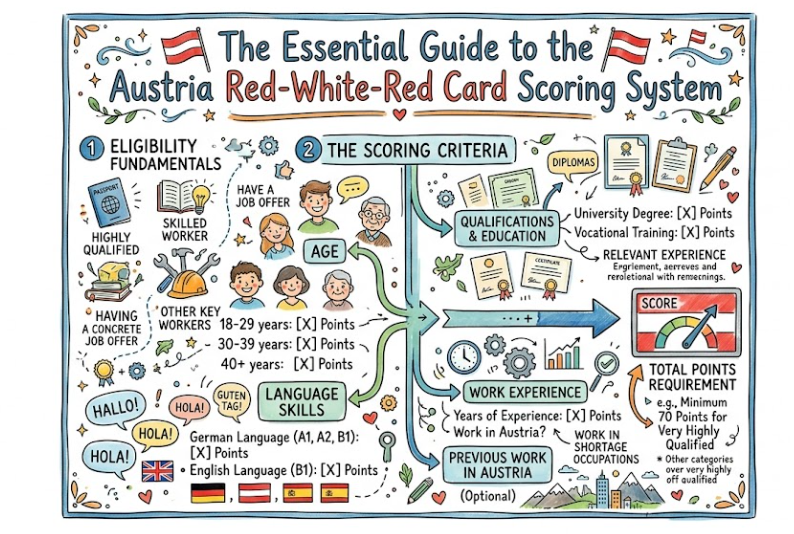
The points system divides your profile into several distinct categories. To gain a complete picture of your eligibility, let’s look closely at how points are awarded across these core pillars.
Age Points
Austria allocates higher points to younger applicants to counter its aging workforce and ensure that incoming professionals can contribute to the national social security and tax systems for decades. As you grow older, the points allocated for age naturally decrease.
- Under 30 years: Highest points allocation.
- 30 to 40 years: Mid-level points allocation.
- 41 to 50 years: Lower points allocation.
- Above 50 years: Zero points for age (though eligibility can still be achieved through high scores in education and experience).
Education Points
Your academic and professional training is highly valued in Austria’s knowledge-driven economy. Points are awarded progressively based on the depth, duration, and specialization of your studies.
- Vocational Training / Trade Diplomas: Validated trade qualifications or completed apprenticeships that match Austrian standards.
- Bachelor’s Degree: A completed university degree requiring a minimum of three years of full-time study.
- Master’s Degree: Advanced postgraduate education. For specific categories like “Very Highly Qualified Workers,” degrees focusing on STEM subjects (Science, Technology, Engineering, and Mathematics) receive significant bonus points.
- PhD / Doctorate: The highest tier of academic achievement, demonstrating deep research capability.
Language Skills
Communication is critical for integration. The Austrian points system awards points for both the local language (German) and the primary global business language (English). You can claim points for both languages combined, provided you possess valid, recognized language certificates.
- German Language Advantage: Knowing German is a massive advantage. Points are structured around the Common European Framework of Reference for Languages (CEFR), starting from basic survival German (A1) up to intermediate business German (B1 or B2).
- English Proficiency: For many IT and multinational corporate roles, English is the primary language of instruction. Points are awarded for conversational to advanced proficiency, verified via standardized tests like IELTS or TOEFL.
Work Experience
Your professional history proves you can apply your knowledge in real-world settings. Austria divides experience into two main types:
- International Work Experience: General experience gained in your home country or outside Austria.
- Local Austrian Experience: Work experience gained specifically within Austria. The system highly rewards individuals who have already spent time working within the Austrian economic ecosystem, as it demonstrates immediate employability.
- Relevance: To claim these points, your past work experience must directly match the field of the job offer you are pursuing in Austria.
Salary & Job Offer
For the majority of applicant streams, a concrete job offer from an Austrian employer is mandatory. The points system analyzes:
- Sponsorship: The employer must agree to pay you according to local collective agreements (Kollektivvertrag) and file the necessary paperwork with the Public Employment Service (Arbeitsmarktservice or AMS).
- Shortage Occupations: If your job offer falls within an officially designated shortage occupation (published annually by the government), your minimum points threshold is lowered, making the visa much easier to secure.
Adaptability Factors
Adaptability points reward elements that indicate you will blend into Austrian society seamlessly. This includes:
- Having completed a full degree program at an Austrian school or university.
- Possessing documented research track records or internationally recognized patents.
- Prior extended legal stays in the country.
Austria Red-White-Red Card Explained
The immigration framework is divided into five distinct pathways, each tailored to a specific type of worker or background. To calculate your points correctly, you must first identify which pathway applies to your situation.
1. Very Highly Qualified Workers
This stream is designed for top-tier global professionals, executives, scientists, and high-tech innovators. It is unique because it is the only stream that allows you to move to Austria without a job offer initially. If you score high enough, you can get a 6-month Job Seeker Visa to find a position inside the country.
- Minimum Points Required: 70 out of 100 points.
- Key Requirement: Exceptionally high marks in education (such as a STEM PhD or holding a senior management role in a listed company).
- Visa Validity: 24 months once a job offer is secured.
2. Skilled Workers in Shortage Occupations
If you work in a field where Austria has an acute deficit of workers, this is your pathway. The government updates this list every year, covering roles like software engineers, mechanical technicians, certified nurses, roofers, and electrical installers.
- Minimum Points Required: 55 out of 90 points.
- Key Requirement: A binding job offer in Austria that pays the legally mandated minimum salary, and a qualification that matches the shortage list.
- Visa Validity: 24 months.
3. Other Key Workers
If your profession is not on the official shortage occupation list, you can still immigrate as an “Other Key Worker.” This category depends heavily on your employer paying you a premium salary that justifies bringing in talent from outside the EU.
- Minimum Points Required: 55 out of 90 points.
- Key Requirement: The job offer must meet strict minimum gross monthly salary thresholds, which are updated annually based on national averages.
- Labor Market Test: The AMS will conduct a “regional workforce test” to see if any qualified Austrian or EU citizen is available to do the job before approving your application.
4. Graduates from Austrian Universities
This is a streamlined, points-free pathway designed to retain international talent trained within the country. If you complete a Bachelor’s, Master’s, or PhD at an accredited Austrian university, you do not need to use the points calculator.
- Minimum Points Required: Exempt from the points system.
- Key Requirement: You have 12 months after graduation to find a job that matches your educational level and pays the statutory minimum wage for university graduates.
- Visa Validity: 24 months.
5. Self-Employed Key Workers
For entrepreneurs and business owners looking to establish a company or branch in Austria. This pathway does not use a personal points calculator; instead, it evaluates the economic impact of your business.
- Key Requirement: The business must involve a sustained transfer of investment capital (usually a minimum of €100,000) or create new, permanent jobs for Austrian citizens.
Austria PR Points Calculator Breakdown
To provide a clear understanding of your potential score, let’s review how points are allocated across the two primary frameworks: the Very Highly Qualified Workers track (100-point scale) and the Skilled Workers / Shortage Occupations track (90-point scale).
Table 1: Points System for Very Highly Qualified Workers (Max 100 Points)
| Evaluation Criteria | Specific Profile Sub-Category | Maximum Points Allowed |
| Education & Qualification | Graduation from a university (Min 4-year program) | 20 Points |
| Specialization in a STEM subject (Science, Tech, Eng, Math) | 30 Points | |
| Habilitation or full PhD / Doctorate | 40 Points | |
| Special Achievements | Gross annual salary in a senior role > €70,000 prior year | 20 Points |
| Research activities, recognized patents, or awards | 20 Points | |
| Work Experience | Per year of documented professional experience | 2 Points (Max 20) |
| Per year of work experience gained within Austria | 10 Points | |
| Language Ability | Elementary German (A1 level) or Fluent English (IELTS 6.5+) | 10 Points |
| Age Group | Up to 35 years old | 20 Points |
| 36 to 40 years old | 15 Points | |
| 41 to 45 years old | 10 Points | |
| Study in Austria | Completed a full second stage of study or degree in Austria | 10 Points |
Table 2: Points System for Shortage Occupations & Key Workers (Max 90 Points)
| Evaluation Criteria | Specific Profile Sub-Category | Maximum Points Allowed |
| Education & Qualification | Completed vocational training / trade school qualification | 20 Points |
| General university entrance qualification (Matura equivalent) | 25 Points | |
| Completed university degree (Min 3-year program) | 30 Points | |
| Work Experience | Per year of general professional experience (relevant to job) | 2 Points (Max 20) |
| Per year of professional work experience inside Austria | 4 Points (Max 20) | |
| Language Ability | German A1 Level | 5 Points |
| German A2 Level | 10 Points | |
| German B1 Level | 15 Points | |
| German B2 Level | 20 Points | |
| English B2 Level (IELTS 5.5 – 6.5) | 10 Points | |
| Age Group | Up to 30 years old | 15 Points |
| Up to 40 years old | 10 Points | |
| Bonus Factor | Professional athlete or coach (for specific streams) | 20 Points |
Step-by-Step Example of Austria PR Score Calculation
To see how these numbers translate to real life, let’s evaluate three realistic applicant profiles using the Austria PR Points Calculator.
Profile 1: The International Software Engineer
- Applicant Name: Rahul
- Target Stream: Skilled Worker in a Shortage Occupation (Software Development is a persistent shortage role in Austria).
- Personal Profile: 28 years old, holds a 4-year Bachelor’s degree in Computer Science from an international university, has 4 years of verified work experience in his home country, holds an IELTS English certificate score of 7.5 (B2/C1 equivalent), and speaks no German (A0).
Let’s calculate Rahul’s points using the Shortage Occupation matrix:
- Age: 28 years old = 15 Points
- Education: Completed university degree = 30 Points
- Work Experience: 4 years of international experience (4 x 2 points) = 8 Points
- Language Skills: English B2/C1 level achieved = 10 Points (0 points for German)
- Total Points Score: 15 + 30 + 8 + 10 = 63 Points
Verdict: The minimum threshold for this stream is 55 points. With 63 points, Rahul comfortably passes the eligibility criteria. Once he secures a valid job offer from an Austrian tech company that meets the minimum salary standard, he can confidently apply for his Red-White-Red Card.
Profile 2: The Healthcare Professional (Registered Nurse)
- Applicant Name: Elena
- Target Stream: Skilled Worker in a Shortage Occupation (Nursing is highly sought after across all Austrian provinces).
- Personal Profile: 34 years old, holds a 3-year Diploma in Nursing, has 6 years of international nursing experience, and has dedicated time to learning the local language, achieving a certified ÖSD German B1 certificate. She speaks basic English.
Let’s calculate Elena’s points:
- Age: 34 years old = 10 Points
- Education: Completed recognized vocational/diploma qualification = 20 Points
- Work Experience: 6 years of international experience (6 x 2 points) = 12 Points
- Language Skills: German B1 level certified = 15 Points
- Total Points Score: 10 + 20 + 12 + 15 = 57 Points
Verdict: Elena scores 57 points, which clears the 55-point minimum threshold. Her investment in learning the German language was the deciding factor that made her eligible. Once her nursing diploma is recognized (Nostrifizierung) by the Austrian health authorities and she receives a job offer, she is ready to move.
Profile 3: The International Student Transitioning to the Labor Market
- Applicant Name: Mei
- Target Stream: Graduates from Austrian Universities.
- Personal Profile: 25 years old, moved from Asia to Vienna, and recently graduated with a Master’s degree in Supply Chain Management from the University of Vienna. She has just received a job offer as a logistics analyst from a firm in Graz.
Let’s look at Mei’s path:
- Points Calculation: Exempt (0 Points required)
Verdict: Because Mei successfully graduated from an accredited Austrian university, she does not need to go through the points calculator. Her pathway is direct. As long as her job offer matches her degree level and meets the minimum wage required for university graduates, she bypasses the points barrier entirely and transitions directly to a Red-White-Red Card.
Austria PR Eligibility Requirements
Beyond achieving a passing score on the points calculator, every applicant must meet a baseline set of general requirements. These serve as the foundation of your application. If these are missing, even a perfect points score will result in a visa denial.
1. Proof of Clean Legal Record
You must present an official police clearance certificate (Führungszeugnis) from your home country and any country where you have lived for more than six months over the past five years. The record must show no major criminal offenses.
2. Valid Employment Contract or Binding Job Offer
For all streams except the Very Highly Qualified Job Seeker track, you must present a signed, legally binding contract from a company registered in Austria. The document must clearly state your job title, detailed duties, location of work, and your exact gross annual or monthly salary.
3. Local Salary Threshold Compliance
Austria does not allow companies to underpay foreign talent to protect the local labor market. Your offered salary must match or exceed:
- The minimum amount set by the specific industry’s Austrian Collective Agreement (Kollektivvertrag).
- The statutory minimum limits for “Other Key Workers” if you are applying through that specific path.
4. Comprehensive Health Insurance
You must show proof of comprehensive health insurance coverage (Krankenversicherung) that protects you from day one of your arrival in Austria until your registration in the national public insurance system begins.
5. Local Housing & Accommodation Proof
You must demonstrate that you have secure, adequate living arrangements in Austria. This requires providing a signed residential lease agreement (Mietvertrag) or proof of property ownership. The property size must be appropriate for your family size according to local municipal codes.
6. Financial Self-Sufficiency
You must prove that you can support yourself and any dependents without relying on Austrian welfare or public assistance funds. This is verified by showing your employment contract or presenting personal bank statements that show sufficient savings to cover your initial relocation and living costs.
Benefits of Using an Austria PR Points Calculator
Why should you spend time using an immigration points calculator before beginning your application process? Taking this simple step offers several strategic advantages:
- Instant Reality Check: It provides an immediate assessment of your profile. Within minutes, you know whether you meet the legal baseline or if your application would be rejected immediately.
- Cost and Time Savings: Preparing an official application involves expensive translation services, document apostilles, university verification fees, and non-refundable visa fees. The calculator ensures you only invest your money when you have a high probability of success.
- Clear Strategic Roadmap: If you run your profile through the calculator and discover you score 50 points—just 5 points shy of the target—you know exactly what to do. It highlights your weak areas and tells you precisely where to focus your energy to bridge the gap.
- Targeted Job Searching: Understanding your eligible stream helps you tailor your job hunt. If you know you qualify easily as a Skilled Worker in a Shortage Occupation, you can focus on employers who are actively looking to hire foreign talent through that specific pathway.
Step-by-Step Guide to Calculate Your Austria PR Points
To calculate your score accurately without making common mistakes, follow this structured, six-step process:
Step 1: Collect and Verify Academic Records
Gather your high school diplomas, trade certificates, and university degrees. You must verify that your university is fully recognized by the Austrian government. You can check your institution’s status using the official European educational database (Anabin). If your university is classified as H+, your degree is fully recognized.
Step 2: Confirm Your Certified Language Levels
Do not guess your language ability. To claim points, you must possess an official certificate from an approved testing body that is less than two years old.
- For German: Certificates from ÖSD, Goethe-Institut, Telc, or TestDaF are accepted.
- For English: Academic or General IELTS or TOEFL certificates are recognized.
Step 3: Audit and Document Your Work History
Review your employment history. You need reference letters from past employers written on official company letterhead. These letters must explicitly detail your job titles, your precise daily responsibilities, and your exact start and end dates. This proof is essential to confirm that your experience matches the job offer in Austria.
Step 4: Analyze Your Job Offer against Local Lists
Look at your job offer or target role. Compare it to the official Austrian Shortage Occupation list. If your occupation appears on that national list, write down your target score based on the 55-point Shortage Occupation matrix. If it is not on the list, evaluate it using the Other Key Workers matrix.
Step 5: Check for Bonus and Adaptability Points
Check if you qualify for any special bonus categories. Did you complete a semester abroad or graduate from a university in Austria? Do you have documented research publications or patents? Add these points to your total.
Step 6: Calculate Your Final Score
Add up the scores from all the categories. Compare your final number against the minimum threshold required for your specific pathway (70 points for Very Highly Qualified, or 55 points for Shortage/Key Workers).
How to Increase Your Austria PR Points Score
If your initial score falls below the required passing mark, do not be discouraged. Your points score is not permanent. There are practical steps you can take to strengthen your profile and reach your immigration goals.
Strategy 1: Learn the German Language
This is the single most effective way to boost your score. If you speak only English, you are missing out on significant point opportunities. Moving your German proficiency from zero to a certified A2 or B1 level can add 10 to 15 points to your scorecard. This effort pays off twice: it secures your visa eligibility and makes you far more attractive to Austrian employers.
Strategy 2: Accumulate More Relevant Work Experience
If you are close to the threshold, remaining in your current professional role for another year or two can provide the extra points you need. Each year of documented experience adds 2 points to your profile. Ensure your duties are documented clearly so they align perfectly with your target Austrian occupation.
Strategy 3: Target a Shortage Occupation
Look at your skills and see if you can transition into a related field that is on the official Shortage Occupation list. Because the passing threshold for shortage roles is lower (55 points instead of 70 points for highly qualified tracks), moving into a shortage specialty can make you immediately eligible.
Strategy 4: Pursue Advanced Academic or Professional Certifications
Completing a relevant post-graduate diploma, an advanced Master’s degree, or earning recognized international professional certifications can move you into a higher educational points tier, giving your profile a valuable boost.
Common Mistakes to Avoid
Many applicants face unnecessary rejections because of simple, avoidable errors when calculating their points or submitting documentation. Keep these pitfalls in mind:
- Overestimating Unverified Language Skills: Assuming that because you speak fluent English at work everyday, you can claim points without an official IELTS or TOEFL certificate is a major mistake. The immigration authorities will instantly deduct those points if a valid certificate is missing from your package.
- Miscalculating Experience Fields: Claiming points for general work experience that does not match the field of your Austrian job offer will lead to disappointment. If you have five years of experience in retail sales but receive a job offer in Austria as an IT support specialist, your sales experience points will be rejected by the AMS.
- Using Outdated Shortage Lists: Austria updates its official shortage occupation lists every year to reflect shifting economic needs. An occupation that was on the shortage list two years ago might be removed today. Always verify your role against the most recent, officially published list.
- Counting Unfinished Degrees: You can only claim points for academic qualifications that have been fully completed and awarded. If you are two months away from finishing your Master’s degree, you can only claim points for your completed Bachelor’s degree until your final diploma is in hand.
Real-Life Case Studies
Let’s look at three case studies that show how real professionals assessed, adjusted, and successfully navigated the Austrian immigration journey.
Case Study 1: The Young IT Professional
- Initial Profile: Amit was a 26-year-old Cloud Engineer from Mumbai. He held a 3-year Bachelor’s degree and had 2 years of work experience. He scored a 7.0 on the IELTS exam but had no knowledge of German.
- The Problem: When Amit ran his numbers through the calculator for the Shortage Occupation list, he scored 15 (Age) + 30 (Education) + 4 (Experience) + 10 (Language) = 59 Points. While 59 points technically cleared the 55-point minimum, he struggled to get responses from Austrian employers because his experience was brief and he lacked any local language skills.
- The Turnaround: Amit decided to delay his job search by six months to focus on language skills. He enrolled in intensive evening classes and successfully passed the Goethe-Institut A2 German exam, adding 10 points to his profile and raising his score to 69 Points.
- The Outcome: With an A2 German certificate on his resume, Austrian employers saw his commitment to relocating. He secured a cloud engineer role with a tech firm in Vienna, and his Red-White-Red Card was approved within eight weeks.
Case Study 2: The Experienced Mechanical Engineer
- Initial Profile: Marcus was a 42-year-old Senior Mechanical Designer from South Africa. He had 15 years of experience and a Master’s degree in Engineering. He spoke fluent English but no German.
- The Problem: Marcus applied under the Very Highly Qualified Workers track. His score was 10 (Age) + 30 (Education) + 20 (Max Experience) + 10 (English) = 70 Points. He was exactly at the minimum limit. However, because his age points were low, any minor documentation issue during the official review risked dropping him below 70 points, resulting in an immediate denial.
- The Turnaround: Recognizing the risk of applying with a borderline score, Marcus proactively studied basic German and passed his A1 level exam before submitting his paperwork. This added 5 valuable safety points to his profile.
- The Outcome: He applied with a stable score of 75 points. The AMS verified his senior engineering credentials, and he was granted a Job Seeker Visa, which he used to secure a senior design position at an industrial automation company in Upper Austria.
Case Study 3: The Healthcare Worker Adjusting Strategy
- Initial Profile: Sarah was a 31-year-old specialized nurse from the Philippines. She possessed a verified Nursing Degree and 5 years of hospital experience.
- The Problem: Sarah wanted to move to Europe but discovered her nursing degree could not be recognized instantly in Austria without going through a local validation process (Nostrifizierung). This requirement temporarily blocked her from claiming full educational points for nursing.
- The Turnaround: Instead of giving up, Sarah partnered with an Austrian healthcare recruitment agency. She moved to Austria on a structured educational visa designed specifically for nurses completing their validation courses, while simultaneously studying German up to the B2 level.
- The Outcome: As soon as she finished her local validation program and passed her language exam, she recalculated her points. Her score soared past the threshold, and she transitioned smoothly onto a Red-White-Red Card while working at a premier hospital network in Graz.
Frequently Asked Questions (FAQs)
What is the Austria PR points calculator?
The points calculator is an objective evaluation matrix used by the Austrian government. It assigns numerical values to key parts of your background—such as age, education, work experience, and language proficiencies—to determine if you qualify for a Red-White-Red Card.
How many points do I need to qualify for Austria immigration?
The passing score depends on your specific application pathway. If you are applying as a Very Highly Qualified Worker, you must score at least 70 out of 100 points. If you are applying as a Skilled Worker in a Shortage Occupation or an Other Key Worker, you need at least 55 out of 90 points.
What exactly is the Red-White-Red Card?
The Red-White-Red Card is a work permit and residence visa combined into one document. Issued for an initial duration of 24 months, it legally permits you to live in Austria and work for a specific employer who has offered you a job that fits your qualifications.
Is knowing the German language mandatory to immigrate to Austria?
No, German is not legally mandatory for every visa pathway. For example, if you are an IT professional who speaks fluent English and your score meets the threshold, you can qualify. However, learning German is highly recommended. It adds substantial points to your calculator score and expands your career opportunities in the local market.
Can I move to Austria without a job offer in hand?
Yes, but this option is reserved exclusively for individuals who qualify under the Very Highly Qualified Workers category and score at least 70 points. If you meet this high standard, you can apply for a 6-month Job Seeker Visa, which allows you to live in Austria while looking for a long-term position. All other tracks require a valid job offer before you can apply.
How does my age impact my eligibility score?
The Austrian immigration points framework favors younger applicants. Individuals under the age of 30 or 35 receive the highest points allocation. As you move into older brackets, your age points decrease. If you are over 50, you receive 0 points for age, meaning you must score higher in education, experience, and language skills to qualify.
Can international students stay and settle permanently in Austria?
Yes. Non-EU students who graduate from an accredited Austrian university with a Bachelor’s, Master’s, or PhD are given a 12-month post-study visa extension. This time allows them to look for a full-time position. Once they secure a job offer related to their degree that meets the graduate salary minimum, they can bypass the points system entirely and receive a Red-White-Red Card.
How can I verify if my university degree is recognized in Austria?
You can check the status of your university using the official German/Austrian educational database known as Anabin. If your institution has an H+ classification, your degree is fully recognized for points calculation. For complex professional degrees, you can request a formal assessment through ENIC-NARIC Austria.
What is the difference between the Red-White-Red Card and the Red-White-Red Card Plus?
The standard Red-White-Red Card links your residency to one specific employer. If you want to change jobs, you must apply for a new permit. After working under this card for at least 21 months within a 24-month window, you can upgrade to the Red-White-Red Card Plus, which grants you unrestricted access to work for any employer anywhere in Austria.
How long does it take to get a decision on a Red-White-Red Card application?
Once you submit your complete application along with all verified documents to the Austrian embassy or local authority, processing generally takes between 8 to 12 weeks. The timeline depends heavily on how quickly the Public Employment Service (AMS) reviews your employer’s job offer.
Are online eligibility calculators completely accurate?
Online calculators serve as excellent self-assessment tools to estimate your points, but they are unofficial. The final evaluation is performed exclusively by the Austrian immigration authorities and the AMS when they review your physical, certified documents.
How do I transition from a work visa to full Permanent Residency (PR) in Austria?
To secure full Permanent Residency (known as Daueraufenthalt EU), you must live in Austria legally and continuously for five consecutive years, hold a stable income that covers your expenses, maintain clean background records, and pass the Integration Agreement Exam, which confirms you have achieved intermediate B1 level German proficiency.
Conclusion
The path to moving to Austria is structured, clear, and fair. By using a merit-based immigration model, Austria gives you total control over your journey. You do not have to wonder where you stand or guess if your background is valued. The Austria PR Points Calculator gives you a clear look at your professional standing, showing you exactly how your age, studies, language skills, and experience match up with Austria’s economic needs.
Securing your place in Austria’s high-performing economy is a step-by-step process. If your initial score is high enough to qualify, your next step is to look for a job and build a strong professional network. If your score falls short of the passing mark, you now have a strategic roadmap. You know exactly how to close that gap—whether that means taking a few months to study German, gaining another year of experience at your current job, or earning a new professional certification.
Relocating to one of the safest, most stable, and most beautiful countries in Europe requires preparation, attention to detail, and patience. Do not leave your plans to chance. Use the points calculator as your foundation, gather your documents carefully, and begin your journey toward a new career and life in Austria today.
