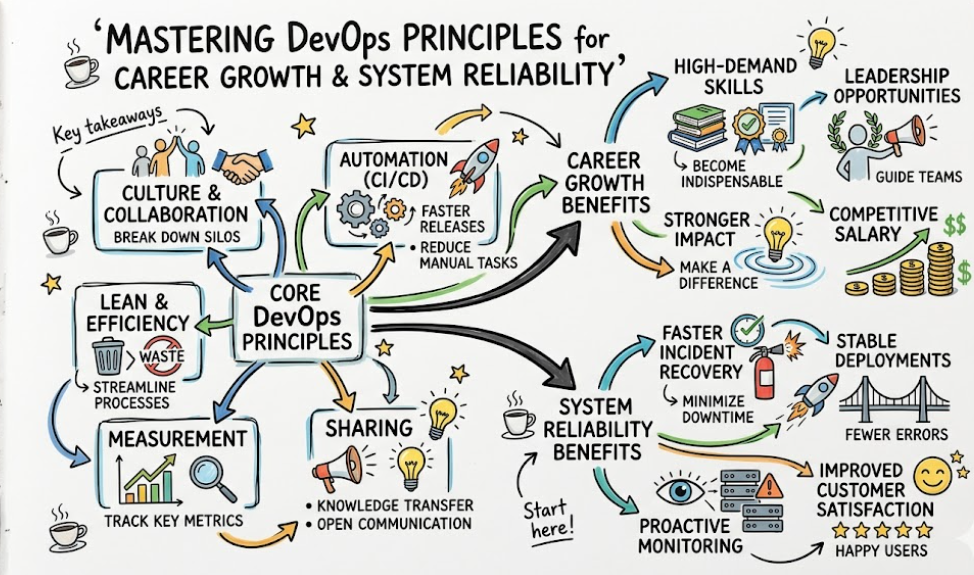
Introduction
The landscape of software development has shifted dramatically over the last two decades. We have moved away from the slow, fragmented cycles of the past, where developers and operations teams lived in separate worlds—often called silos. In those traditional environments, developers focused on feature creation, while operations teams prioritized system stability, leading to constant friction during deployment.
These challenges led to the birth of a new philosophy. DevOps emerged not just as a set of tools, but as a cultural and technical bridge designed to align these teams toward a common goal: delivering high-quality software faster and more reliably. By adopting these methods, modern enterprises have fundamentally changed how they build, test, and maintain applications. Understanding these concepts is essential for anyone looking to excel in the current engineering climate. For those starting their journey, platforms like DevOpsSchool provide structured pathways to master these essential skills. Whether you are in a fast-paced startup or a large-scale enterprise, the principles remain the same, acting as a roadmap for sustainable software delivery.
What Are DevOps Principles?
At its core, DevOps principles represent a combination of philosophies, practices, and tools that increase an organization’s ability to deliver applications and services at high velocity. It is a shift away from manual, error-prone tasks toward a mindset of shared responsibility.
The fundamental goal is to remove barriers between the people who write code and the people who keep systems running. Instead of “throwing code over the wall,” teams work together throughout the entire lifecycle. This includes everything from planning and coding to deployment and monitoring. Automation acts as the backbone of this approach, ensuring that repeatable tasks are handled by machines rather than humans, thereby reducing the margin for error.
Why DevOps Principles Matter
Adopting these principles is no longer optional for organizations aiming to stay competitive. The benefits touch every aspect of the business:
- Faster Software Delivery: By automating repetitive steps, teams can move from code commit to production in minutes rather than weeks.
- Improved Scalability: Infrastructure is treated as code, making it trivial to scale resources up or down based on demand.
- Better Collaboration: When developers and operations staff share the same goals, communication breakdowns disappear.
- Reduced Downtime: Automated testing and robust monitoring detect issues long before they impact the end user.
- Operational Efficiency: Automation frees up engineers to focus on innovation rather than performing mundane, manual updates.
Evolution of DevOps Principles
To understand where we are, we must look at where we started. Traditional IT relied on the Waterfall model, a sequential process where one phase had to finish before the next could begin. This caused massive bottlenecks. If a deployment failed, debugging was a nightmare because the development and operations teams lacked shared context.
As the industry moved toward Agile, the need for faster feedback cycles became obvious. However, Agile solved the development speed problem but left the deployment side lagging. DevOps evolved to fill this gap, extending Agile principles into the operations and infrastructure domain. Today, with the rise of cloud-native technologies, these principles have evolved further to embrace microservices and ephemeral infrastructure.
Core DevOps Principles Overview
| Principle | Purpose | Business Impact | Technical Impact |
| Collaboration | Break down silos | Faster decision making | Shared ownership of issues |
| Automation | Reduce manual work | Higher productivity | Consistency and speed |
| CI/CD | Frequent delivery | Shorter time-to-market | Early bug detection |
| Monitoring | Gain system visibility | Higher uptime | Faster incident resolution |
| IaC | Manage infrastructure via code | Scalable operations | Reproducible environments |
Principle 1: Collaboration and Communication
DevOps is 50% culture and 50% tooling. The primary cultural shift is breaking down silos. In a healthy DevOps culture, developers have visibility into the production environment, and operations engineers participate in design discussions. This cross-functional teamwork ensures that code is written with operational reality in mind, leading to fewer surprises during deployment.
Principle 2: Automation Everywhere
Manual intervention is the enemy of stability. Automation encompasses everything from infrastructure provisioning and configuration management to testing and security scanning. By automating “everywhere,” you ensure that the deployment process is identical every single time, which is the only way to achieve true reliability at scale.
Principle 3: Continuous Integration (CI)
Continuous Integration is the practice of merging code changes into a central repository frequently. Each merge triggers an automated build and test sequence. This allows teams to detect integration errors early. If the tests fail, the feedback is immediate, allowing the developer to fix the issue while the context is still fresh in their mind.
Principle 4: Continuous Delivery & Continuous Deployment
These terms are often used interchangeably, but there is a distinction:
| Continuous Delivery | Continuous Deployment |
| Code is always in a deployable state. | Every change is automatically released to production. |
| Human intervention is usually required for production release. | No human intervention required. |
| Focuses on business readiness. | Focuses on extreme velocity. |
Principle 5: Infrastructure as Code (IaC)
Infrastructure as Code (IaC) means managing servers, networks, and load balancers through machine-readable definition files rather than manual hardware configuration. Tools like Terraform and Ansible allow you to version-control your infrastructure, making it easy to recreate or scale environments in seconds.
Principle 6: Monitoring and Observability
Monitoring is about knowing when something is wrong; observability is about understanding why it is wrong. By using tools like Prometheus for metrics and the ELK stack for logs, teams can gain deep insights into system performance. This enables proactive maintenance rather than reactive troubleshooting.
Principle 7: Fast Feedback Loops
A fast feedback loop is the heartbeat of a DevOps workflow. Whether it is a failing test in the CI pipeline or a latency spike in production, the goal is to get information to the right person as fast as possible. This allows for constant iteration and optimization of both the product and the process.
Principle 8: Customer-Centric Thinking
All technical work should ultimately serve the customer. DevOps principles encourage teams to prioritize features that provide real value, reduce latency, and improve reliability. By aligning engineering metrics with business outcomes, companies can ensure they are building the right things, not just building things quickly.
Principle 9: Continuous Learning and Improvement
A culture of “blameless post-mortems” is vital. When failures occur, the focus should not be on “who” made the mistake, but “how” the process failed to catch it. This mindset fosters innovation and encourages engineers to experiment safely.
Principle 10: Shared Responsibility
In a mature DevOps environment, the phrase “it works on my machine” is obsolete. Developers share responsibility for the uptime and performance of their code in production. This shift in mindset encourages developers to write better, more robust code and enables operations teams to become more involved in the architecture phase.
DevOps Principles in Cloud-Native Environments
Cloud-native environments rely heavily on containers (Docker) and orchestration (Kubernetes). These technologies are designed to support DevOps principles by providing immutable infrastructure. When you use microservices, you are essentially creating small, independent units of code that can be deployed, monitored, and scaled separately, which perfectly aligns with the DevOps goals of agility and resilience.
DevOps Principles and CI/CD Pipelines
A CI/CD pipeline is the literal manifestation of DevOps principles. It automates the journey of code from a local laptop to the cloud. By integrating automated unit tests, integration tests, and security scans into the pipeline, teams ensure that only high-quality code reaches the user.
Popular Tools Supporting DevOps Principles
| Tool | Purpose | DevOps Principle Supported | Difficulty Level |
| Jenkins | CI/CD Orchestration | Continuous Integration | Moderate |
| Terraform | Infrastructure Provisioning | IaC | Advanced |
| Prometheus | Monitoring & Alerting | Observability | Advanced |
| Docker | Containerization | Automation | Beginner |
| Git | Version Control | Collaboration | Beginner |
Real-World DevOps Principles Example
Imagine a team working on an e-commerce platform:
- Commit: A developer pushes code to Git.
- CI: Jenkins automatically triggers a build and runs unit tests.
- Provisioning: Terraform updates the cloud environment to match the new configuration.
- Deployment: Kubernetes performs a rolling update to deploy the new container.
- Monitoring: Datadog monitors the new release; if errors occur, it triggers an automatic rollback.
- Feedback: The team reviews the logs and metrics, learns from the performance data, and plans the next sprint.
Benefits of Following DevOps Principles
The most significant benefit is the shift from “firefighting” to “value creation.” When systems are stable and deployments are automated, engineers spend less time resolving outages and more time building features that delight customers. This improves both the bottom line and the internal culture of the engineering department.
Challenges Organizations Face
- Cultural Resistance: Change is hard. People often fear that automation will replace them.
- Legacy Infrastructure: It is difficult to apply modern principles to outdated, monolithic systems.
- Skill Gaps: DevOps requires a broad skillset, spanning coding, cloud, and networking.
- Tool Fatigue: Trying to use too many tools without a clear strategy.
Common Beginner Mistakes
- Tooling Over Process: Buying expensive tools before fixing broken workflows.
- Ignoring Linux Fundamentals: You cannot automate what you don’t understand at the OS level.
- Manual Testing: Relying on humans to check code will always be the bottleneck.
- Lack of Documentation: DevOps requires clear, documented processes to be repeatable.
Best Practices for Applying DevOps Principles
- Start Small: Pick one project or service to automate first.
- Embrace Version Control: If it isn’t in Git, it doesn’t exist.
- Prioritize Observability: You cannot improve what you cannot measure.
- Foster Psychological Safety: Make it safe to fail so the team learns fast.
DevOps Principles vs Traditional IT Practices
| Feature | Traditional IT | DevOps Principles |
| Collaboration | Siloed teams | Cross-functional units |
| Deployment Speed | Slow, manual releases | Rapid, automated delivery |
| Automation | Minimal | High |
| Feedback | Delayed | Immediate |
| Infrastructure | Manual configuration | Infrastructure as Code |
Career Benefits of Understanding DevOps Principles
The industry is hungry for talent that understands how to glue together cloud, code, and operations. Whether you are a developer looking to become a DevOps engineer or a system administrator transitioning into SRE (Site Reliability Engineering), these principles are the common language of modern technology.
Certifications & Learning Paths
Hands-on experience is the gold standard. While certifications help validate your knowledge, they must be backed by real-world project work. Explore the curated learning ecosystem at DevOpsSchool to find structured paths ranging from basic CI/CD to advanced Kubernetes orchestration.
| Certification | Best For | Skill Level | Focus Area |
| CKA | Kubernetes Admins | Advanced | Container Orchestration |
| AWS DevOps Pro | Cloud Architects | Advanced | Cloud Implementation |
| Foundational DevOps | Beginners | Beginner | General Principles |
Future of DevOps Principles
The future is heading toward AI-assisted operations (AIOps), where machine learning helps predict failures before they happen. GitOps is also gaining traction, treating Git as the single source of truth for everything—not just code, but infrastructure and cluster state. The core principles of collaboration and automation will remain, but the tools will become increasingly intelligent.
FAQs
- What are DevOps principles?They are a set of cultural and technical practices designed to integrate development and operations for faster, more reliable software delivery.
- Why are DevOps principles important?They minimize bottlenecks, reduce human error through automation, and align engineering efforts with business goals.
- Is DevOps only about automation?No. While automation is key, DevOps is primarily about culture, communication, and shared responsibility.
- What is CI/CD in DevOps?It stands for Continuous Integration and Continuous Delivery/Deployment, the automated process of moving code to production.
- Why is monitoring important in DevOps?It provides the data needed to understand system health and identify problems early.
- What is Infrastructure as Code?The practice of managing infrastructure through code files, enabling automated, repeatable, and versioned environments.
- Is Kubernetes required for DevOps?Not required, but highly recommended for managing modern, containerized applications at scale.
- How long does it take to learn DevOps principles?It is a continuous journey. You can understand the concepts in weeks, but mastering the implementation takes months of practice.
- Can DevOps work in a small team?Yes, even a team of two can benefit from automation and shared responsibility.
- What is the difference between DevOps and SRE?DevOps is the culture; SRE (Site Reliability Engineering) is a specific way of implementing that culture using engineering to solve operations problems.
- Do I need to be a programmer to do DevOps?You need to understand code and scripting, even if you are not a professional software developer.
- Is DevOps a job title?It is a methodology, though many companies hire “DevOps Engineers” to lead these initiatives.
- How do I start my DevOps journey?Start by learning Linux, a version control system like Git, and basic scripting.
- What is the biggest challenge in DevOps?Changing the internal culture and overcoming resistance to new ways of working.
- Does DevOps replace IT Operations?No, it evolves IT operations into a more integrated, automated, and strategic function.
Final Thoughts
Mastering DevOps principles is a long-term investment in your engineering career. There are no shortcuts; it requires a blend of technical curiosity and a willingness to collaborate. By focusing on automation, observability, and, most importantly, the people you work with, you will be well-equipped to handle the challenges of modern software delivery. Remember that tools will come and go, but the core principles of reliability, feedback, and collaboration remain the true pillars of success.
