Modern enterprises are no longer defined solely by their products, but by the efficiency and speed of their engineering organizations. As organizations attempt to move away from rigid, legacy-bound delivery models, the complexity of modern cloud ecosystems often creates significant friction. Navigating these transitions requires more than just tool adoption; it demands a fundamental shift in how teams architect, deploy, and secure their digital infrastructure. Organizations seeking to bridge the gap between current state and operational excellence often partner with a specialized DevOps Consulting Company like Cotocus to accelerate their modernization journey.
Enterprise Challenges Driving Modernization
The drive for digital transformation is usually triggered by the limitations of traditional operational models. Many organizations find themselves burdened by legacy systems that cannot support the agility required for modern market demands. These systems often lead to prolonged deployment cycles, where manual interventions and siloed workflows become the norm rather than the exception.
Operational complexity is another critical hurdle. As businesses expand their cloud footprint, managing fragmented infrastructure leads to increased security risks and technical debt. Furthermore, the persistent skill gap remains a primary barrier. Even with advanced tools, teams often struggle to integrate security, automation, and observability effectively, leading to inconsistent development experiences and reduced team velocity.
Why Organizations Need Experienced Consulting Partners
Transformation is rarely a straightforward technical upgrade; it is a complex balancing act of people, process, and technology. Experienced consulting partners provide the necessary framework to navigate this change without disrupting core business functions. They help organizations avoid common pitfalls, such as premature tool adoption or unscalable architecture designs.
Beyond technical implementation, consultants focus on establishing industry-standard best practices that are tailored to the specific context of the enterprise. By embedding senior architects and engineers into the workflow, partners accelerate adoption timelines. More importantly, they prioritize knowledge transfer, ensuring that internal teams possess the expertise to maintain and evolve their systems long after the engagement concludes.
Characteristics of a Mature DevOps Consulting Company
A mature consulting partner operates as an extension of the internal team rather than an external observer. They utilize proven assessment methodologies to baseline current capabilities, identifying bottlenecks in the delivery pipeline. Their approach is rooted in architecture expertise, focusing on resilient, scalable, and modular designs that accommodate future growth.
Automation is central to their service delivery, yet it is applied with a focus on governance. A high-performing partner establishes frameworks that ensure security, compliance, and cost management are baked into every automated process. Most importantly, they place heavy emphasis on knowledge-sharing, utilizing documentation, pair programming, and mentorship to build sustainable internal engineering capabilities.
Understanding DevOps Consulting Services
DevOps consulting is fundamentally about optimizing the path from code commitment to production deployment. This involves deep implementation work on CI/CD pipelines to remove manual dependencies and reduce cycle times. Effective consulting requires a holistic view of the ecosystem, including infrastructure as code, automated testing, and release management.
Operational optimization is equally critical. Consultants focus on observability, ensuring that teams have the telemetry needed to identify and resolve issues proactively. By shifting the focus from reactive firefighting to proactive system health, consulting services transform IT departments into engines of business innovation.
Cloud Consulting and Migration Services
Cloud migration requires a deliberate strategy that goes beyond “lift and shift.” Modern cloud consulting services focus on cloud readiness assessments, determining which workloads are best suited for public, private, or hybrid environments. This involves complex migration planning that minimizes downtime and ensures data integrity.
Modernization strategies often include refactoring monolithic applications into microservices and leveraging cloud-native services. Cost optimization is a continuous thread throughout these engagements, ensuring that the cloud footprint aligns with actual business usage. This discipline prevents the common issue of ballooning cloud expenditures following a migration effort.
Kubernetes Consulting Services
Kubernetes has become the de facto standard for container orchestration, but its operational overhead is substantial. Kubernetes consulting services focus on platform standardization, ensuring that clusters are secure, scalable, and manageable. This includes defining production-readiness practices such as namespace isolation, resource quotas, and robust ingress management.
Workload modernization is another core component, where consultants assist teams in containerizing applications and defining clear deployment strategies. By standardizing cluster operations, enterprises can provide a consistent environment for developers, reducing the time spent on environment-related troubleshooting and increasing overall system reliability.
SRE Consulting Services
Site Reliability Engineering (SRE) bridges the gap between development and operations by applying software engineering principles to infrastructure challenges. SRE consulting services help organizations move away from manual task management toward highly automated incident response and proactive system health monitoring.
The implementation of Service Level Objectives (SLOs) and error budgets is a core part of this discipline. These frameworks provide a data-driven approach to reliability, allowing teams to balance the need for rapid feature delivery with the absolute necessity of system uptime. This approach fosters a culture of operational excellence where reliability is treated as a core product feature.
DevSecOps Consulting Services
Security can no longer be a final hurdle before production. DevSecOps consulting services focus on integrating security controls directly into the delivery pipeline. This involves automating policy enforcement, vulnerability scanning, and compliance checks so that developers receive immediate feedback on the security posture of their code.
Consultants work to build a culture of shared responsibility, where security is integrated into every phase of the development lifecycle. By adopting practices like infrastructure as code security and secret management, organizations can move faster while simultaneously reducing their overall risk profile.
GitOps and Platform Engineering Consulting
GitOps has transformed infrastructure management by treating environment configuration like source code. Consulting in this area helps teams transition to declarative management styles, where the desired state of the infrastructure is maintained in version control. This provides auditability, versioning, and simplified disaster recovery.
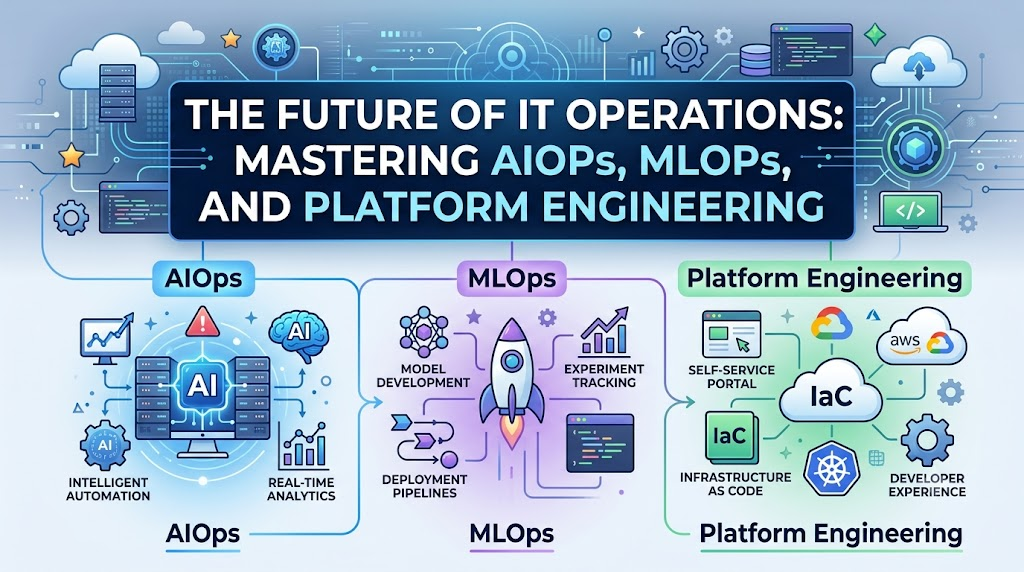
Platform Engineering services take this a step further by creating internal developer platforms (IDP). These platforms provide self-service capabilities that allow developers to provision resources and deploy code without waiting for operations tickets. This increases developer productivity, reduces cognitive load, and standardizes engineering workflows across the enterprise.
AIOps, MLOps, and DataOps Consulting Services
As enterprise systems generate unprecedented volumes of data, intelligent automation becomes a necessity. AIOps consulting services help teams leverage machine learning to analyze logs and metrics, identifying patterns and anomalies that human operators might miss.
MLOps and DataOps focus on the lifecycle of models and data pipelines. Consulting in this space ensures that machine learning experiments can be tracked, reproduced, and deployed with the same rigor as traditional software. By automating data ingestion and model retraining, organizations can ensure that their data platforms remain accurate and actionable at scale.
Corporate Training for Engineering Teams
Consulting is ineffective without long-term capability development. Corporate training programs are designed to provide teams with the hands-on skills required to operate modern technology stacks. These sessions move beyond theory, utilizing lab-driven approaches where engineers solve real-world problems.
Customized learning paths ensure that training is relevant to the specific challenges the organization faces. Whether it is learning to manage Kubernetes clusters or implementing CI/CD security policies, continuous training programs ensure that the team’s skills evolve alongside the technology, preventing long-term dependency on external consultants.
Selecting the Right Consulting Partner
When selecting a partner, look for a proven track record of implementation rather than just advisory capability. Assess their experience in environments similar to your own in terms of scale and complexity. A strong partner should prioritize knowledge transfer and possess a clear methodology for engagement that culminates in the client being self-sufficient.
Request references and deep dives into previous projects to understand their approach to architecture and problem-solving. Ensure that their philosophy aligns with your organizational culture, particularly regarding open communication and long-term support. The ideal engagement model is one that gradually shifts responsibility to internal staff as their proficiency grows.
Recommended Learning and Adoption Paths by Role
- Developers: Focus on CI/CD pipeline integration, containerization basics, and self-service deployment workflows.
- DevOps/Platform Engineers: Prioritize Kubernetes cluster internals, infrastructure as code automation, and GitOps methodologies.
- Security Professionals: Concentrate on policy automation, DevSecOps pipeline integration, and automated compliance frameworks.
- Operations/SRE Teams: Focus on observability, incident management automation, and defining meaningful SLOs.
- Architects: Emphasize system design for scalability, cloud-native architecture patterns, and standardized technology stacks.
- Engineering Leaders: Focus on aligning technical strategy with business outcomes, managing cultural change, and measuring delivery metrics.
Industry-Specific Focus: Financial Services
In highly regulated industries like financial services, modernization must be balanced with strict compliance and security mandates. The implementation of GitOps and DevSecOps is particularly beneficial here, as it creates an immutable audit trail for every change made to the infrastructure.
Consultants working in this sector emphasize automated compliance testing, ensuring that security policies are enforced as code. This allows financial institutions to innovate rapidly while maintaining the integrity and security of their data, providing a competitive advantage in a fast-paced market.
Frequently Asked Questions
How does DevOps consulting differ from traditional IT consulting? DevOps consulting focuses specifically on the intersection of development and operations, emphasizing automation, continuous delivery, and cultural shifts toward collaboration rather than just infrastructure maintenance.
What is the role of Kubernetes in a modern enterprise? Kubernetes provides a standardized abstraction layer for infrastructure, allowing applications to be deployed consistently across diverse environments while enabling efficient resource utilization.
How does DevSecOps improve security? By shifting security to the left, teams can identify vulnerabilities early in the development process and automate compliance, reducing the risk of security issues reaching production.
Why is GitOps becoming the standard for infrastructure management? GitOps leverages version control as the source of truth for infrastructure, which provides superior visibility, easier rollbacks, and stronger compliance through immutable audit logs.
Can small teams benefit from Platform Engineering? Yes, Platform Engineering reduces the cognitive load on small teams by providing self-service tools, allowing them to focus on feature development rather than managing complex infrastructure.
What distinguishes SRE from traditional operations? SRE applies engineering and software development expertise to solve operational challenges, focusing on system reliability, observability, and data-driven decision-making.
How is AIOps used in the enterprise? AIOps uses machine learning to process large datasets from infrastructure and applications to detect anomalies and automate incident resolution.
What is the best way to handle the cultural shift required for DevOps? Successful cultural change is best achieved through small, visible wins, consistent leadership support, and a commitment to continuous learning and mentorship.
Final Thoughts
Modernization is a continuous journey that requires both the right strategy and the right execution. By leveraging external expertise, organizations can effectively manage the complexities of cloud-native systems, automation, and security. The ultimate goal of any consulting engagement is not merely the delivery of a project, but the development of a self-sustaining engineering culture. Through mentorship, hands-on training, and disciplined architectural practices, teams can build the capabilities required to thrive in a digital-first economy.
