Introduction
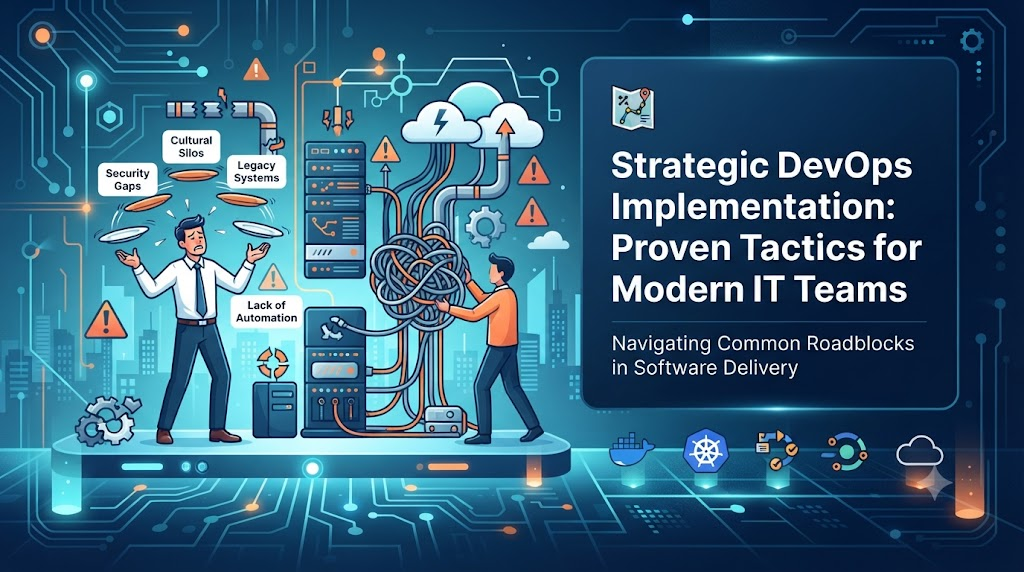
DevOps is frequently mistaken for a mere transition to new tools—such as adopting cloud infrastructure or automation scripts—but true transformation is deeply rooted in how people collaborate and deliver value. After two decades in the enterprise trenches, I have observed that the real battle is not purely technical; it is cultural. Successful adoption requires a fundamental realignment of mindsets, processes, and governance to overcome common hurdles like siloed communication, legacy technical debt, and resistance to change. Rather than viewing these inevitable obstacles as failures, forward-thinking teams treat them as critical milestones for engineering greater reliability and velocity. Navigating this roadmap requires both practical experience and the right learning resources, which is where the expertise offered at DevOpsSchool becomes invaluable for aligning your team’s skills with modern software delivery standards. This article dismantles the most common DevOps implementation challenges and provides actionable strategies to help you turn your biggest roadblocks into sustainable competitive advantages.
What Is DevOps Transformation?
At its core, DevOps transformation is the process of breaking down the traditional barriers between software development (Dev) and IT operations (Ops). It is not a job title or a single software package. It is a cultural and technical approach that emphasizes:
- Collaboration: Developers and operations staff work together throughout the entire product lifecycle, from design to production.
- Automation: Manual, repetitive tasks are replaced by automated workflows to reduce human error.
- Continuous Delivery: Code changes are prepared for release at any time, ensuring the system is always in a deployable state.
- Shared Ownership: Every team member is responsible for the performance, security, and quality of the software, not just their specific segment of the code.
- Continuous Feedback: Real-time data informs future development, allowing for rapid course correction.
Why Organizations Face DevOps Challenges
DevOps failure is rarely due to a lack of technology. It is almost always a human or structural problem. Common reasons include:
- Organizational Inertia: Changing how people work requires moving them out of their comfort zones.
- Legacy Systems: Trying to force modern CI/CD practices on brittle, monolithic architectures.
- Skill Shortages: A lack of expertise in modern cloud-native tools and practices.
- Cultural Resistance: The “we have always done it this way” mentality.
- Process Complexity: Over-engineering workflows before the culture is ready to support them.
Major DevOps Challenges and Solutions
| Challenge | Business Impact | Practical Solution |
| Cultural Resistance | Stalled adoption and low morale | Top-down leadership support; small, cross-functional pilot teams |
| Lack of Automation | High toil; human error; slow time-to-market | Focus on high-value manual tasks first; adopt Infrastructure as Code (IaC) |
| Legacy Infrastructure | High maintenance; slow deployment cycles | Adopt the Strangler Fig pattern; modernize in increments |
| Skill Gaps | Reliance on “hero” engineers; bottlenecks | Invest in training programs; foster mentorship; hire for growth |
| Poor CI/CD | Unstable releases; slow feedback loops | Implement automated testing; standardize pipelines; prioritize fast feedback |
| Security Silos | Compliance failures; vulnerability exposure | Shift-left security; integrate security scanning into the pipeline |
| Tool Sprawl | Confusion; increased cost; security risks | Standardize tools; implement a platform engineering approach |
Detailed Analysis of DevOps Challenges
Cultural Resistance
This is the single biggest barrier to transformation. DevOps requires transparency and shared responsibility. Organizations often have silos where Dev teams want speed and Ops teams want stability.
- The Fix: Start with small, cross-functional squads that have end-to-end responsibility for a service. Celebrate “blameless post-mortems” to remove the fear of failure.
Lack of Automation
If you are still SSH-ing into servers to manually deploy code, you are not doing DevOps. Manual intervention is the enemy of consistency.
- The Fix: Adopt the “automate everything” mindset. Start by automating the most repetitive, low-risk tasks to show quick wins, then move to complex infrastructure provisioning using tools like Terraform or Ansible.
Legacy Infrastructure
You cannot ignore your history. Legacy monolithic applications are hard to deploy and harder to test.
- The Fix: Do not try to rewrite everything at once. Use the Strangler Fig pattern: slowly carve out pieces of the legacy system into microservices, wrapping the old monolith in modern APIs until it can be retired.
Skill Gaps
The industry moves fast. Your team might know how to manage a data center, but they may struggle with Kubernetes or service meshes.
- The Fix: Build an internal learning culture. Allocate time for training and certification. Create internal brown-bag lunch sessions where engineers teach each other new technologies.
Poor CI/CD Pipelines
A pipeline that takes four hours to run will not be used. If developers have to wait hours for feedback, they will context switch, losing productivity.
- The Fix: Optimize for speed. Parallelize tests, use caching effectively, and ensure that the pipeline fails fast. If a test fails, the developer should know within minutes.
Security Integration
Security is often treated as a final check before release, causing major delays when issues are found.
- The Fix: Practice DevSecOps. Security scans, dependency checks, and compliance policies should be automated within the CI/CD pipeline, not as a separate manual gate.
Monitoring and Observability
Many teams confuse “monitoring” (is the server up?) with “observability” (why is the application slow?).
- The Fix: Implement structured logging, distributed tracing, and real-time metrics. You need to know the state of your system before your users report a problem.
Communication Challenges
Even with the best tools, if the teams don’t talk to each other, the process breaks.
- The Fix: Standardize documentation. Ensure that Agile ceremonies (stand-ups, retrospectives) are meaningful and focused on removing blockers, not just reporting status.
Tool Sprawl
When every team chooses their own CI tool, cloud provider, or monitoring stack, you lose the ability to scale and standardize.
- The Fix: Adopt a Platform Engineering approach. Create an internal “golden path” of tools that are pre-approved and supported, making it easier for developers to do the right thing than the wrong thing.
Measuring Success
Without data, you are just guessing. Many companies measure the wrong things, like “number of lines of code written,” which adds no business value.
- The Fix: Focus on DORA metrics: Deployment Frequency, Lead Time for Changes, Change Failure Rate, and Time to Restore Service.
Building a Successful DevOps Culture
Culture isn’t a poster on the wall. It is the sum of how people interact under pressure. To build a successful DevOps culture, focus on:
- Psychological Safety: People must be able to report errors without fear of retribution. Without this, you will never get to the root cause of systemic failures.
- Leadership Buy-in: If management does not model the behavior (e.g., valuing learning over blame), the team will not either.
- Knowledge Sharing: Eliminate the “hero” culture where one person holds all the knowledge. Use documentation, pair programming, and rotation to spread expertise.
Role of Automation
Automation is the engine of DevOps. It allows organizations to scale without linearly increasing headcount. Key areas include:
- Infrastructure as Code (IaC): Treat infrastructure definition files like application code. Version control it, test it, and deploy it.
- Automated Testing: Unit tests, integration tests, and end-to-end tests should be mandatory in the build pipeline.
- Self-Service Platforms: Give developers the ability to spin up their own environments. This removes the “ticket-based” bottleneck where developers wait on Ops teams for infrastructure.
Security Without Slowing Delivery (DevSecOps)
The old model of “Security at the end” is dead. In modern DevOps, security is a shared responsibility.
- Shift-Left: Run vulnerability scanners on code commits, not just before deployment.
- Secrets Management: Never hardcode passwords or API keys. Use tools like HashiCorp Vault.
- Compliance as Code: Automate the auditing process. If your infrastructure is built from tested code, it is easier to prove it meets security standards.
Measuring DevOps Success: The KPI Framework
| Metric | Why It Matters | Business Value |
| Deployment Frequency | Measures agility | Faster time-to-market |
| Lead Time for Changes | Measures efficiency | Rapid feature delivery |
| Change Failure Rate | Measures quality | Stability and reliability |
| Mean Time to Recovery (MTTR) | Measures resilience | Minimized downtime costs |
| Automation Coverage | Measures scalability | Reduced manual toil |
Common Mistakes During DevOps Adoption
| Mistake | Impact | Recommended Solution |
| Tool-First Mindset | Wasted budget on unused tools | Process first, tools second |
| Ignoring Culture | High attrition; stalled projects | Invest in team trust and communication |
| Weak Documentation | Tribal knowledge silos | Treat documentation as a core product |
| Limited Testing | High production failure rates | Automate testing from the start |
| Unrealistic Expectations | Burnout; abandonment of project | Start small; aim for continuous improvement |
Best Practices Checklist
- Focus on Culture First: Ensure teams are aligned on goals before buying new software.
- Automate Gradually: Don’t try to automate 100% on day one. Start with the “low-hanging fruit.”
- Standardize Workflows: Create a common language and set of processes across teams.
- Monitor Continuously: Visibility into your system is non-negotiable.
- Invest in Learning: Dedicate time for upskilling your engineers.
Real-World Example: An Enterprise Case Study
The Challenge: A large retail bank had a 3-month release cycle, manual deployments that took two days, and a failure rate of 40% per release.
The Transformation:
- Phase 1 (Assessment): Identified that the manual handover between Dev and Ops was the bottleneck.
- Phase 2 (Automation): Implemented CI/CD pipelines. Standardized the build environment using Docker.
- Phase 3 (Culture): Created “Product Squads” consisting of both Dev and Ops members.
- Phase 4 (Security): Integrated automated security scanning into the pipeline.
The Outcome: Release cycle dropped from 3 months to 2 weeks. Deployment time dropped from 2 days to 30 minutes. Change failure rate dropped from 40% to 5%.
Future DevOps Challenges
- AI-Assisted DevOps: Using AI to predict system failures and optimize deployment pipelines.
- Platform Engineering: Moving toward internal developer platforms (IDP) to hide complexity from developers.
- Supply Chain Security: As dependencies grow, securing the software supply chain becomes critical.
- Multi-Cloud Management: Balancing the cost and complexity of running services across different cloud providers.
Certifications & Learning Paths
Continuous learning is the hallmark of a high-performing engineer. The following areas are critical for modern DevOps professionals.
| Certification | Best For | Skill Level | Focus Area |
| Kubernetes (CKA) | Orchestration | Advanced | Container Management |
| Cloud Professional (AWS/Azure/GCP) | Cloud Infrastructure | Intermediate | Cloud-native Arch |
| Terraform Associate | Infrastructure as Code | Intermediate | IaC Standards |
| DevSecOps Professional | Security | Advanced | Pipeline Security |
Practical DevOps Improvement Checklist
- Audit: Identify the most painful, manual, and repetitive process in your current workflow.
- Define: Set a specific, measurable goal for improving that process (e.g., “Reduce deployment time by 50%”).
- Automate: Script the process using standard tools.
- Validate: Ensure the automated process includes error handling and logs.
- Iterate: Document the process and share it with the team for feedback.
- Measure: Track the impact and move to the next bottleneck.
FAQs
1. What is the biggest DevOps challenge?
Culture. Tools are easy to buy; changing how humans communicate and collaborate is hard.
2. Why do DevOps transformations fail?
They fail because organizations treat it as a project with a start and end date rather than a culture of continuous improvement.
3. How long does DevOps adoption take?
There is no fixed timeline. It is an iterative process. You can see improvements in weeks, but “maturity” is a multi-year journey.
4. Is automation enough for DevOps success?
No. Automation without communication just accelerates the creation of bad code and processes.
5. How does DevSecOps help?
It moves security to the start of the development cycle, reducing the cost and time of fixing vulnerabilities found late.
6. Which KPIs should organizations monitor?
Focus on DORA metrics: Deployment Frequency, Lead Time for Changes, Change Failure Rate, and Time to Restore Service.
7. Can small businesses implement DevOps?
Absolutely. DevOps practices are actually easier to implement in smaller, agile teams with less legacy technical debt.
8. How should beginners contribute?
Start by mastering Linux, a scripting language (Python/Bash), and basic cloud concepts. Focus on understanding the “why” before the “how.”
9. Is DevOps just for cloud-native apps?
No. While it thrives in the cloud, the principles of automation, collaboration, and feedback apply to any software development environment.
10. What is Platform Engineering?
It is the discipline of designing and building self-service tools that allow developers to manage their own infrastructure, reducing cognitive load.
11. Does DevOps eliminate the need for QA?
No. It evolves QA from a “testing gate at the end” to a continuous process of automated testing embedded in the pipeline.
12. How do I handle legacy code in DevOps?
Use the Strangler Fig pattern to replace chunks of it slowly. Don’t rewrite the whole thing in one go.
13. What is “Shift Left”?
It means performing tasks like testing and security scanning earlier in the development lifecycle to catch issues sooner.
14. Are there DevOps “rules”?
There are no strict rules, only principles (like the CAMS model: Culture, Automation, Measurement, Sharing).
15. How do I start?
Assess your current process, identify the biggest bottleneck, and automate that one specific pain point.
Final Thoughts
Successful DevOps transformation is not about achieving perfection; it is about achieving agility. It is about building a system where feedback is immediate, failures are learning opportunities, and the team is empowered to ship value to customers reliably.
Do not get hung up on the latest shiny tool. Focus on your people. Start by breaking down one silo, automating one manual step, and fostering one conversation between Dev and Ops. Your goal should be to create a sustainable, scalable, and resilient engineering organization. The tools will change, but the culture of continuous improvement is what will sustain your business for the long term.
