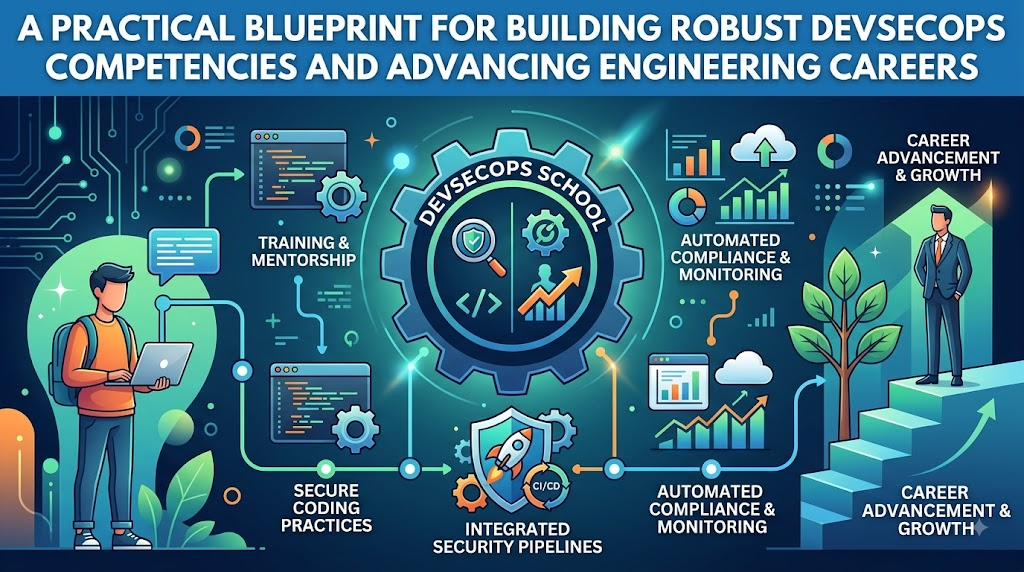
Engineering velocity has reached unprecedented heights. Automated deployment pipelines, distributed cloud estates, and containerized architectures allow technical teams to roll out new features in hours rather than months. Yet, this acceleration often strains conventional security models. Relying on late-stage manual sign-offs creates severe deployment friction, strains cross-team collaboration, and risks letting critical system exposures slip into production unnoticed.
To solve this dilemma, high-performing engineering organizations are institutionalizing DevSecOps. This operational methodology weaves defensive validation, policy-as-code, and automated quality gates directly into everyday continuous delivery pipelines. For IT specialists, software creators, and system operators, navigating this technical domain requires developing a balanced skill set that unifies systems engineering, platform resilience, and continuous threat mitigation.
Below is an in-depth breakdown of core pipeline security concepts, technical proficiencies, progressive training approaches, credential preparation frameworks, and practical career navigation strategies for modern application protection.
Core Principles of Continuous Security Integration
DevSecOps represents the pragmatic unification of Development, Security, and System Operations into a continuous feedback loop. Rather than treating security as an isolated, late-stage audit conducted by an external body, this methodology positions protective guardrails as an active, automated aspect of ongoing software construction.
Historically, functional development moved along strict, sequential paths. Programmers authored application logic, infrastructure teams configured deployment targets, and information security analysts executed isolated assessments right before release. Whenever high-severity defects surfaced during these eleventh-hour reviews, organizations faced a costly trade-off between delaying release schedules or pushing vulnerable assets live.
The modern paradigm eliminates this friction through Shift-Left Security. By introducing automated tests, configuration linters, and verification checks into early development stages, engineering squads obtain immediate feedback. This enables developers to address source-level bugs and configuration flaws during routine coding, dramatically lowering remediation costs and operational overhead.
The Strategic Value of Continuous Security Architecture
Modern enterprise systems increasingly depend on public package ecosystems, containerized services, complex infrastructure templates, and fully automated deployment workflows. While these technologies accelerate digital innovation, they also introduce distinct attack vectors that manual processes cannot govern.
- Open-Source Supply Chain Protection: Software solutions routinely integrate extensive third-party libraries and container foundations. Uninspected components can easily introduce severe known vulnerabilities straight into live production clusters.
- Declarative Infrastructure Verification: Misconfigured access boundaries and public storage settings in infrastructure scripts can compromise enterprise assets within moments of deployment.
- Continuous Delivery Alignment: Traditional security questionnaires cannot keep pace with pipelines releasing code multiple times a day. Automated pipeline validation ensures that protective policies scale seamlessly alongside build volume.
- Standardized Audit Readiness: Verifiable compliance frameworks demand transparent, auditable records regarding access control, configuration hardening, and patch management across all runtime nodes.
Integrating programmatic validation directly into delivery tooling allows organizations to preserve high development velocity while enforcing rigorous defensive baselines.
Technical Competencies for Modern Pipeline Engineering
Building proficiency in this domain requires developing practical capabilities across multiple operational areas:
+-------------------------------------------------------------------------+
|                  Integrated Security Engineering Stack                  |
+------------------------------------+------------------------------------+
| Pipeline Automation & Source Code  | Static Analysis, Software Bills of |
| Verification                       | Materials (SBOM), Secret Discovery |
+------------------------------------+------------------------------------+
| Cloud Infrastructure & Identity    | Policy as Code, Least-Privilege    |
| Governance                         | Access Control, Security Posture   |
+------------------------------------+------------------------------------+
| Container Infrastructure & Runtime | Image Hardening, Admission Checks, |
| Hardening                          | Network Isolation, Syscall Tracing |
+-------------------------------------------------------------------------+
Linux Platforms and Network Architecture
A thorough understanding of Unix-based operating system internals, user space isolation, system call inspection, and filesystem permissions forms the baseline for defensive operations. Engineers must also command fundamental networking concepts—such as transport layer security (TLS), name resolution (DNS), subnet routing, and packet filtering—to maintain secure communication across distributed networks.
Source Control Integrity and CI/CD Automation
Source repositories serve as the authoritative root for modern digital operations. Practitioners must master branch governance rules, multi-stage pipeline configuration, and build environment isolation. Securing the pipeline infrastructure entails protecting runner environments, rotating integration credentials, and preventing unauthorized tampering with automated deployment scripts.
Cloud Architecture and Identity Administration
Navigating major public cloud platforms requires deep familiarity with Identity and Access Management (IAM) role boundaries, network access lists, object storage access policies, and encrypted storage configurations. Ensuring least-privilege permissions across machine-to-machine integrations is a critical component of platform resilience.
Containerization and Orchestration Hardening
Container technologies introduce unique operational boundaries. Engineers must understand how to construct minimal container configurations, enforce non-privileged execution contexts, audit parent base layers, implement cluster role-based access mechanisms, and define granular traffic policies across internal service communications.
Automated Vulnerability Identification Techniques
Embedding automated testing into continuous delivery workflows provides instant visibility into software health:
- Static Application Security Testing (SAST): Scrutinizes uncompiled code to detect logical weaknesses such as unvalidated inputs, insecure parsing, and code injection vulnerabilities.
- Software Composition Analysis (SCA): Catalogs open-source dependencies and package trees to highlight documented Common Vulnerabilities and Exposures (CVEs) and licensing non-compliance.
- Credential Exposure Scanning: Inspects commit histories and repository files to stop API keys, digital certificates, and system tokens from leaking into code repositories.
- Dynamic Application Security Testing (DAST): Probes staging deployments to observe how running web services react to simulated external attack payloads.
Declarative Infrastructure Auditing
When provisioning cloud platforms via declarative formats like Terraform, OpenTofu, or Ansible, engineers must inspect template declarations prior to deployment. Automated linters intercept public storage settings, unsegmented administrative ports, and excessive network exposure before infrastructure is created.
Step-by-Step Practical Skill Progression
Developing practical expertise is most effective when approached through sequential milestones:
  Stage 1: Core Fundamentals (Linux Environments, Networking, Scripting)
      │
      ▼
  Stage 2: Delivery Mechanics (Git Workflows, CI/CD Engine Setup, Containers)
      │
      ▼
  Stage 3: Automated Quality Controls (Static Linters, Dependency Audits, Secret Scans)
      │
      ▼
  Stage 4: Platform Hardening (Kubernetes RBAC, Cloud IAM, Policy Engines)
      │
      ▼
  Stage 5: Live System Observability (Runtime Detection, Audit Logs, Event Monitoring)
- Consolidate Systems Fundamentals: Establish fluency in basic shell scripting (Bash, Python, or Go), system administration utilities, and core networking protocols.
- Master Continuous Delivery Workflows: Learn how code moves through automated compilation, unit testing, packaging, and deployment stages.
- Adopt Container Engineering: Practice authoring optimized Dockerfiles, managing multi-stage compilation, and minimizing runtime attack surfaces.
- Embed Automated Security Scanners: Integrate open-source vulnerability checkers and credential scanners into personal deployment pipelines to observe automated feedback.
- Advance into Platform Hardening: Configure container orchestration controls, implement network boundaries, and refine cloud authorization frameworks.
- Implement Continuous Telemetry: Explore runtime security auditing tools and event log aggregators to evaluate how operational platforms monitor active workloads.
Criteria for Evaluating DevSecOps Educational Programs
Choosing an appropriate technical curriculum requires assessing how effectively the program mirrors actual production requirements. When reviewing an intensive DevSecOps Course, look for programs that prioritize live implementation over purely theoretical slide presentations.
Critical evaluation factors include:
- Interactive Sandbox Environments: The coursework should pair every theoretical model with hands-on lab exercises in fully functional system environments.
- Comprehensive Workflow Construction: Training should demonstrate how to assemble and defend a complete deployment lifecycle rather than reviewing isolated tools in a vacuum.
- Practical Policy Engineering: Instruction should teach learners how to configure realistic vulnerability thresholds and gate rules to prevent developer fatigue from false positives.
- Modern Cloud-Native Coverage: The curriculum must thoroughly cover contemporary container isolation, orchestration mechanisms, and modern cloud architectures.
- Practitioner-Led Instruction: Look for courses taught by active technical professionals who have navigated real-world enterprise infrastructure challenges.
Educational platforms such as DevSecOps School offer structured curriculums structured around these core competencies, providing immersive sandbox environments and guided technical workflows.
Comparing Virtual and Corporate Training Delivery Models
Depending on organizational scale or personal career goals, different learning formats address specific professional requirements.
| Dimension | DevSecOps Online Training | Corporate DevSecOps Training |
| Primary Audience | Individual technical specialists, career pivoters, remote engineers | Dedicated engineering squads, platform teams, security divisions |
| Schedule Structure | Self-directed schedules or scheduled interactive cohorts | Structured corporate bootcamps and intensive technical workshops |
| Program Scope | Broad industry practices and standardized open tooling | Aligned with internal tech stacks, enterprise workflows, and compliance mandates |
| Core Advantage | Flexible pacing that adapts around regular professional commitments | Establishes shared security vocabularies and standardized workflows across teams |
| Primary Consideration | Demands disciplined personal study and independent lab execution | Requires coordination across multiple departments and project schedules |
DevSecOps Online Training
DevSecOps Online Training provides flexible, accessible upskilling for individual practitioners. It allows participants to access dedicated remote lab environments, review instructional assets on demand, and experiment across diverse tool ecosystems from any location. This format is ideal for systems administrators, developers, and QA engineers working to pivot into specialized security engineering roles.
Corporate DevSecOps Training
Corporate DevSecOps Training is built for technology organizations seeking to align cross-functional departments. Rather than upskilling engineers in isolation, corporate programs help bridge operational gaps between software creators, operations engineers, and security reviewers. This targeted approach allows organizations to configure labs that directly reflect their internal technology stacks, compliance rules, and delivery pipelines.
Demystifying Professional Credentials in DevSecOps
Earning a recognized DevSecOps Certification confirms that a technical professional understands how to merge rapid delivery cycles with defensive technical policies. These examinations typically evaluate a practitioner’s grasp of automated vulnerability scanning, secure pipeline configuration, infrastructure auditing, and container posture.
It is helpful to view credentials through an objective lens:
- The Value of Formal Verification: A formal qualification provides structured learning milestones, signals personal dedication, and demonstrates validated baseline competencies during hiring processes.
- The Necessity of Applied Experience: Credentials do not replace hands-on diagnostic ability, live platform configuration experience, or practical system troubleshooting skills.
Pursuing credentials such as a DevSecOps Engineer Certification or qualifying as a Certified DevSecOps Professional offers meaningful validation when supported by strong, demonstrable sandbox experience.
Strategic Preparation for Professional Certifications
Succeeding in a structured DevSecOps Certification Training curriculum requires focused study alongside extensive practical lab work:
- Deconstruct the Technical Syllabus: Map every core objective in the official curriculum to a functional lab configuration.
- Construct a Personal Sandbox: Build a functional CI/CD pipeline in a test repository and integrate automated linting, SCA, and SAST scanners.
- Interpret Vulnerability Telemetry: Practice reviewing scan results, filtering out low-impact alerts, and applying appropriate code or configuration fixes.
- Fine-Tune Failure Conditions: Experiment with configuring automated pipeline policies that flag critical risks without unnecessarily halting routine builds.
- Execute Timed Lab Scenarios: Solve practical system hardening challenges under realistic time constraints to build operational confidence.
Career Trajectories in Pipeline Security Engineering
As businesses continue to migrate mission-critical applications to public clouds, technical professionals who understand both rapid software delivery and defensive engineering are in high demand across finance, enterprise software, healthcare, and retail sectors.
Software Engineering / QA Automation / Systems Administration / IT Security
                                  │
                                  ▼
                         DevSecOps Engineer
                                  │
                                  ▼
                     Senior Platform Security Lead
                                  │
                                  ▼
           Cloud Security Architect / Director of AppSec
Common transitional pathways include:
- Application Developers expanding into security by mastering pipeline governance, code review practices, and threat modeling.
- DevOps Practitioners and SREs integrating declarative policy controls, container hardening, and access governance into their automation stacks.
- Security Analysts learning software development concepts and CI/CD tools to move from post-deployment auditing to proactive engineering.
Typical daily workflows include configuring automated scanning policies, authoring infrastructure compliance templates, collaborating with development squads on vulnerability remediation, securing orchestration platforms, and improving delivery visibility.
The Critical Role of Container Orchestration Defense
As Kubernetes continues to anchor modern cloud-native infrastructures, comprehensive Kubernetes Security Training has become an essential pillar of contemporary technical education.
Orchestration platforms present complex operational layers that require methodical defensive measures:
  +-------------------------------------------------------------------+
  |                  Kubernetes Platform Defense                      |
  +---------------------------------+---------------------------------+
  | API Server & Control Plane      | TLS Everywhere, etcd Data       |
  | Integrity                       | Encryption, Restricted Access   |
  +---------------------------------+---------------------------------+
  | Container Execution Boundaries  | Non-Root Enforcement, Immutable |
  |                                 | Filesystems, Capability Drops   |
  +---------------------------------+---------------------------------+
  | In-Cluster Traffic Governance   | Strict Network Policies, Ingress|
  |                                 | Validation, Mutual TLS          |
  +---------------------------------+---------------------------------+
  | Policy & Dynamic Admission      | Image Signing Audits, Admission |
  | Controls                        | Controllers, Behavioral Tracing |
  +---------------------------------+---------------------------------+
- Control Plane Fortification: Ensuring administrative API server endpoints are protected, enabling at-rest encryption for underlying key-value datastores, and monitoring audit logs.
- Workload Isolation Enforcement: Applying Pod Security Standards to prevent containers from requesting privileged capabilities, enforcing read-only root filesystems, and rejecting unauthorized user IDs.
- Access Governance (RBAC): Setting fine-grained role permissions for administrative users and automated service accounts following least-privilege principles.
- East-West Network Segmentation: Implementing declarative Kubernetes Network Policies to restrict inter-pod communications and block unauthorized lateral movement within clusters.
- Automated Admission Governance: Using validating and mutating admission webhooks to dynamically reject deployments that violate organizational security standards.
Applied Engineering Projects for Practical Mastery
Constructing self-guided projects in an isolated lab is one of the most effective ways to solidify technical concepts:
- Project 1: Automated Multi-Stage Defense PipelineConstruct a complete build pipeline that automatically compiles an application, executes static source analysis, scans dependencies for vulnerabilities, audits commit records for exposed credentials, and produces a structured risk report.
- Project 2: Infrastructure as Code Policy GateWrite modular declarative infrastructure templates for a public cloud environment. Configure automated pre-deployment scanning within your version control hooks to detect unencrypted storage volumes and open network routes before provisioning.
- Project 3: Hardened Container Image LifecycleAuthor a multi-stage container build file that packages application binaries into a minimal execution image, enforces a non-root execution context, and runs automated image scans prior to artifact publishing.
- Project 4: Automated Kubernetes Cluster Policy EnforcementProvision a local sandbox cluster and deploy policy enforcement rules to automatically reject pods lacking explicit resource limits or attempting to execute with elevated privileges.
Navigating Typical Learning Obstacles
Mastering pipeline defense involves overcoming several common educational hurdles:
- Ecosystem Complexity: The sheer number of open-source and proprietary security tools can feel overwhelming. Recommendation: Prioritize learning functional domains (SAST, SCA, IaC auditing, access management) rather than attempting to master every individual brand tool simultaneously.
- Managing Alert Fatigue: Poorly calibrated security scanners frequently produce large volumes of low-priority alerts. Recommendation: Learn how to filter scan findings by actionable severity and configure policy thresholds that focus remediation on critical issues first.
- Overcoming Inter-Team Friction: Development, security, and operations groups often operate with different priorities. Recommendation: Focus on clear communication, understand developer workflows, and deliver actionable, low-friction remediation advice.
- Setting Up Local Test Environments: Running comprehensive platform stacks locally can require significant system resources. Recommendation: Rely on lightweight local engines like Kind or Minikube alongside low-cost cloud sandboxes for targeted experimentation.
Recommended Practices for Educational Success
To build durable, scalable technical skills:
- Focus on Foundational Principles: Individual tools evolve constantly, but underlying paradigms like least privilege, process isolation, network routing, and cryptographic verification remain constant.
- Introduce Automations Incrementally: Start by integrating a single check, such as secret scanning, into your build workflow. Once stable, gradually introduce SCA, SAST, and container inspection.
- Adopt a Defensive Mindset: When reviewing system designs, evaluate underlying assumptions regarding user inputs, identity tokens, network boundaries, and component trust.
- Prioritize Sustainable Remediation: Identifying a flaw is only the starting point. Take time to understand the root cause and refactor configurations or source logic to prevent similar issues in the future.
- Participate in Open-Source Communities: Track open-source cloud-native projects, study shared policy templates, and engage with technical peers to stay informed on emerging protective methods.
Emerging Horizons in Continuous Security
As infrastructure platforms and software architectures advance, the DevSecOps discipline continues to introduce new capabilities:
- Software Bill of Materials (SBOM) Implementation: Organizations are systematically cataloging machine-readable inventories of every software component and dependency across their estates to rapidly pinpoint emerging zero-day vulnerabilities.
- Assisted Remediation Workflows: Intelligent analysis engines are increasingly helping developers draft configuration patches, identify root causes, and refine scanning accuracy within daily code review tools.
- Internal Developer Platforms (IDPs) with Baked-In Guardrails: Platform engineering teams are embedding pre-approved, compliant infrastructure templates directly into self-service portals, giving developers secure-by-default scaffolding.
- Unified Runtime and Pipeline Visibility: Forward-looking teams are connecting shift-left scan data with real-time runtime monitoring, maintaining comprehensive visibility from source commits all the way to production processes.
Clarifying Common Inquiries
What does comprehensive DevSecOps training involve?
DevSecOps training is an educational pathway focused on teaching engineers how to integrate automated security controls throughout the entire software lifecycle. It covers continuous testing methods, cloud and container configuration hardening, pipeline automation, and defensive architecture.
How does formal certification benefit an IT career?
A structured certification validates that an engineer understands core security practices, automation techniques, and cloud-native concepts. While valuable on a resume, credentials provide the greatest career benefit when backed by verifiable hands-on project experience.
What baseline knowledge is recommended before beginning?
Learners benefit from having a working familiarity with Linux system commands, foundational networking, Git version control, and basic scripting logic, along with an understanding of basic cloud concepts.
How effective is online learning for this field?
Online instruction is highly effective when paired with practical sandbox labs, live pipeline configurations, and realistic troubleshooting scenarios. Because the work is digital, hands-on virtual environments provide an ideal training ground.
Why is container orchestration security essential?
Container orchestrators manage modern microservice architectures. Securing access controls, cluster control planes, network communications, and runtime workloads within these environments is a fundamental responsibility of platform defense teams.
Where can professionals access DevSecOps training in India?
Engineers seeking dedicated DevSecOps Training in India or through remote channels can review offerings from specialized platforms like DevSecOps School, which provides structured learning paths, practical exercises, and instructor-guided courses focused on cloud-native security.
Summary
Modern application security is not an isolated tool or a temporary trend; it is a foundational transformation in how software is architected, tested, and maintained. As release cycles accelerate and systems expand across hybrid environments, building secure, automated delivery pipelines has become an essential engineering capability.
Whether you are an individual practitioner looking to broaden your technical reach or an enterprise engineering team updating deployment workflows, mastering continuous verification, container hardening, and cloud identity management is critical. By anchoring your study in hands-on labs, focusing on core architectural principles, and following structured educational roadmaps, you can successfully build and defend resilient modern cloud systems.
