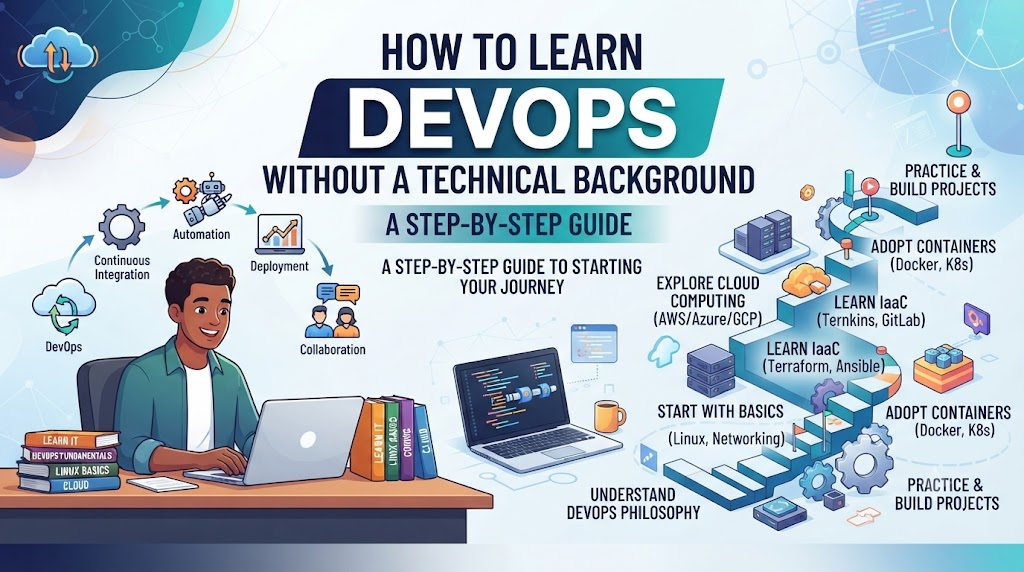
Stepping into the tech sector can feel overwhelming, particularly when specialized fields like DevOps appear weighed down by complex code, dense infrastructure terms, and endless software stacks. However, the common concern of whether someone without a technical background can actually master DevOps is met with a clear and encouraging affirmative. While the discipline is inherently technical, its core revolves around collaboration, process automation, and continuous improvement. By adopting a structured strategy, exercising patience, and utilizing the right resources, individuals with zero prior programming or IT experience can successfully transition into this dynamic field.
Can You Learn DevOps Without a Technical Background?
Yes, absolutely. A non-technical background—whether you come from marketing, sales, customer support, human resources, or the arts—is not a permanent roadblock. In fact, many non-technical professionals possess strong problem-solving skills, clear communication, and process-oriented thinking, which are core pillars of the DevOps culture.
Beginners often worry about learning programming, navigating Linux environments, understanding cloud computing, or configuring complex networks. The secret lies in realizing that nobody learns these things overnight. Technical skills are layers built upon basic computer literacy. By breaking down the learning curve, anyone can start to learn DevOps for beginners step by step.
What Is DevOps?
To understand how to master DevOps without coding, you must first understand what DevOps actually is.
Traditionally, software development teams wrote code, and operations teams managed the servers where that code ran. These two teams often worked in silos, leading to friction, delays, and finger-pointing when things broke in production.
DevOps (Development + Operations) bridges this gap. It is a cultural philosophy and set of practices that unifies software development and IT operations. Organizations use DevOps to:
- Automate repetitive tasks.
- Accelerate software delivery cycles.
- Improve collaboration between teams.
- Enhance system reliability and security.
Do You Need a Technical Background to Learn DevOps?
You do not need a computer science degree or years of software engineering experience to begin exploring DevOps for non-technical people.
While technical competencies like coding, networking, and system administration are eventually necessary, they are not prerequisites for day one. Instead, treat them as subjects to study sequentially. Non-technical learners can bridge the gap by starting with core computer concepts and gradually layering technical skills through hands-on practice.
Basic Skills to Learn Before Starting DevOps
Before jumping into advanced tools like Kubernetes or Terraform, you need a solid grasp of foundational concepts. These fundamental DevOps skills for beginners include:
- Basic computer concepts: Understanding how hardware, software, files, and file systems interact.
- Operating systems: Knowing how files are organized and managed on Windows and Unix-like systems.
- Networking fundamentals: Grasping how computers communicate over the internet.
- Command-line basics: Moving past graphical user interfaces (GUIs) to text-based control.
- Basic programming concepts: Understanding logic, variables, and loops.
- Version control concepts: Learning how changes to files are tracked over time.
- Cloud computing fundamentals: Understanding remote servers and data storage.
Learn Linux and Command-Line Fundamentals
Linux is the invisible engine driving modern cloud infrastructure and containerization. Nearly all cloud servers, Docker containers, and Kubernetes clusters run on Linux.
Do not let this intimidate you. You do not need to become a Linux kernel developer. Focus on mastering basic operations:
- Navigating directories using commands like
cd,ls, andpwd. - Creating, moving, and deleting files and folders.
- Managing user permissions and ownership.
- Inspecting running processes.
- Installing and managing software packages.
Understand Networking Basics
Because DevOps deals heavily with distributed systems, servers, and cloud environments, a basic understanding of computer networking is non-negotiable. Essential networking concepts to study include:
- IP Addresses & Subnets: How devices identify each other on a network.
- DNS (Domain Name System): How human-readable web addresses translate into machine-readable IP addresses.
- HTTP/HTTPS & Ports: The protocols that power the web and the communication doorways used by applications.
- Firewalls: Basic rules governing network security and traffic flow.
- Clients and Servers: How requests and responses flow across the internet.
Learn Git and Version Control
In a DevOps environment, tracking changes and collaborating safely is vital. Git is the industry-standard version control system used to track code and configuration changes.
Beginners should focus on core concepts: repositories, commits, branches, merging, and remote hosting platforms like GitHub. Learning Git teaches you how to safely experiment, roll back mistakes, and collaborate with team members seamlessly.
Learn Basic Scripting and Programming
A common fear among career changers is the DevOps without coding dilemma. Do you need to be a software developer? No. You do not need to build complex software applications. However, you do need to automate repetitive administrative tasks.
This is where lightweight scripting languages come in. Bash scripting (for Linux) and Python are the most beginner-friendly options. Learning how to write a simple script that automates file backups or checks server health will instantly boost your confidence and technical competence.
Understand CI/CD Fundamentals
Continuous Integration and Continuous Delivery/Deployment (CI/CD) form the beating heart of DevOps pipelines.
- Continuous Integration (CI): Automatically testing and merging code changes into a shared repository frequently.
- Continuous Delivery/Deployment (CD): Automatically pushing those tested changes to staging or production environments.
Understanding how code flows from a developer’s laptop to a live user application through automated pipelines is a core milestone in any DevOps course for beginners.
Explore Essential DevOps Tools
The DevOps toolchain can look overwhelming with hundreds of options available. Instead of trying to learn everything, focus on the industry standards grouped by their primary purpose:
- Version Control: Git & GitHub
- CI/CD: Jenkins, GitHub Actions, or GitLab CI
- Containerization: Docker
- Orchestration: Kubernetes
- Infrastructure as Code (IaC): Terraform
- Configuration Management: Ansible
- Cloud Platforms: AWS, Microsoft Azure, or Google Cloud Platform (GCP)
- Monitoring & Observability: Prometheus, Grafana, or Datadog
Learn Cloud Computing Fundamentals
Traditional IT required companies to buy physical servers, rack them in data centers, and manage physical cooling and power. Today, cloud computing lets teams rent computing power on-demand.
To master a DevOps career for beginners, you must understand cloud concepts such as:
- Compute (virtual servers)
- Storage (object and block storage)
- Networking (virtual private clouds, subnets, load balancers)
- Databases and identity/access management (IAM)
Practice DevOps Through Hands-On Projects
Reading books and watching tutorials will only take you so far. True learning happens when things break and you have to fix them. Practical, hands-on projects bridge the gap between theory and real-world competence.
Start with beginner-friendly projects:
- Containerize a simple static website using Docker.
- Push your code to GitHub and set up an automated CI/CD pipeline.
- Provision virtual cloud infrastructure using Terraform.
- Deploy your containerized application to a cloud provider.
Follow a Step-by-Step DevOps Learning Roadmap
A clear DevOps learning roadmap prevents burnout and keeps your momentum steady:
- Stage 1: Computer and networking fundamentals
- Stage 2: Linux and command line basics
- Stage 3: Git and version control
- Stage 4: Basic scripting (Bash or Python)
- Stage 5: CI/CD concepts and pipelines
- Stage 6: Docker containerization
- Stage 7: Cloud computing fundamentals (AWS/Azure/GCP)
- Stage 8: Infrastructure as Code (Terraform)
- Stage 9: Kubernetes orchestration
- Stage 10: Monitoring and observability basics
- Stage 11: Real-world portfolio projects
How Long Does It Take to Learn DevOps?
There is no single timeline, as learning speed depends on your prior exposure, daily study commitment, and hands-on practice consistency. Generally, a dedicated beginner with zero technical background can become job-ready in 6 to 12 months by investing 15–20 hours per week into structured learning and practical labs.
Common Challenges Beginners Face While Learning DevOps
Transitioning into DevOps comes with hurdles:
- Tool overload: Trying to learn fifty tools at once. Solution: Master one tool per category before moving on.
- Intimidating terminology: Feeling lost in technical jargon. Solution: Keep a glossary and look up terms as you encounter them.
- Fear of coding: Worrying that lack of programming skill will block progress. Solution: Focus on automation scripting rather than software engineering.
Mistakes to Avoid When Starting DevOps
- Focusing only on tools: Tools change rapidly; core principles and problem-solving skills endure.
- Skipping fundamentals: Trying to learn Kubernetes without understanding Linux or networking leads to endless frustration.
- Avoiding hands-on practice: Passive video-watching does not build muscle memory.
- Collecting certificates without skills: Employers value practical capability over unapplied paper credentials.
How DevOps Training Can Help Beginners
Navigating the vast ocean of DevOps resources independently can lead to confusion and wasted time. This is where structured DevOps training for beginners proves invaluable. A guided program provides curated learning paths, hands-on lab environments, mentorship, and structured project reviews.
Platforms like DevOpsSchool offer tailored programs designed to take learners learn DevOps from scratch, transforming complete beginners into confident professionals through practical instruction and real-world simulations.
Career Opportunities After Learning DevOps
Once you build your foundational skills and a strong portfolio of projects, multiple career paths open up:
- Junior DevOps Engineer
- Cloud Engineer
- DevOps Automation Engineer
- Site Reliability Engineer (SRE)
- Platform Engineer
- Infrastructure Engineer
Tips for Successfully Learning DevOps Without a Technical Background
- Maintain consistency by studying daily, even if only for an hour.
- Always prioritize understanding why something works rather than just memorizing commands.
- Document your learning journey on platforms like GitHub or LinkedIn to showcase growth.
- Embrace troubleshooting errors as your primary teacher.
Frequently Asked Questions
Can a non-technical person learn DevOps?
Yes. With structured learning, patience, and step-by-step guidance, anyone can transition into DevOps from a non-technical background.
Do I need coding skills to learn DevOps?
You do not need to be a software developer, but learning basic scripting (like Bash or Python) is necessary for automation tasks.
How much Linux should I know for DevOps?
You should be comfortable navigating the command line, managing files, setting permissions, and checking system processes.
Can beginners learn DevOps without IT experience?
Yes, by starting with basic computer concepts, networking fundamentals, and operating system basics before moving to advanced cloud tools.
How long does it take to become job-ready in DevOps?
For beginners studying consistently, it typically takes between 6 to 12 months to build the required skills and portfolio.
Which DevOps tools should beginners learn first?
Start with Git for version control, Linux for system management, Docker for containerization, and basic CI/CD tools like Jenkins or GitHub Actions.
Is DevOps difficult for beginners?
It can feel challenging due to the breadth of technologies, but breaking the journey down into logical stages makes it completely manageable.
Can DevOps training help someone from a non-technical background?
Structured professional training programs provide clear roadmaps, mentorship, and practical labs that significantly accelerate the learning curve.
Conclusion
Learning DevOps without a technical background is an achievable and rewarding career goal. By letting go of the fear of code, mastering fundamentals one step at a time, and focusing heavily on hands-on practice, you can transform your career trajectory.
If you are looking for structured guidance, expert mentorship, and industry-aligned programs to help you begin your journey, explore professional learning paths at DevOpsSchool and take your first step toward an exciting career in cloud and automation engineering.
