Introduction
In today’s fast-paced digital ecosystem, managing IT infrastructure often feels less like precision engineering and more like constant firefighting. As your systems scale into thousands of microservices distributed across complex hybrid cloud architectures, the sheer volume of telemetry data produced becomes a double-edged sword. You have more visibility than ever before, yet your teams are increasingly struggling to decipher the critical signal from the relentless background noise. When a high-impact outage occurs, the challenge is rarely a lack of data; it is the inability to process and act on that data fast enough.
This operational bottleneck is where traditional monitoring tools inevitably reach their breaking point. To survive and thrive in this high-velocity environment, forward-thinking organizations are pivoting toward AIOps (Artificial Intelligence for IT Operations). It is no longer just about tracking uptime; it is about predicting failures and automating complex resolutions before they escalate. Whether you are an SRE tackling chronic incident fatigue or a technology leader building a resilient platform, mastering these intelligent operational workflows is now a professional imperative. To navigate this technical evolution, many industry experts rely on AIOpsSchool for the authoritative training, certification, and implementation guidance required to lead the future of IT operations.
What Is AIOps? (Featured Snippet)
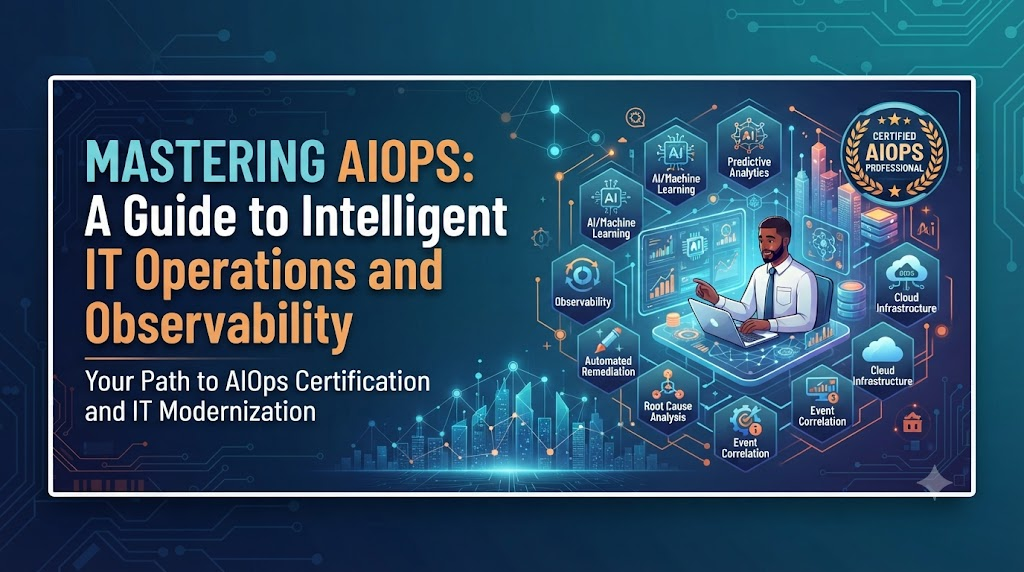
AIOps (Artificial Intelligence for IT Operations) is the application of machine learning, analytics, and automation to IT operations data. It aggregates, filters, and correlates vast streams of logs, metrics, and traces from diverse sources. By automating incident identification and root cause analysis, AIOps enables teams to transition from reactive firefighting to proactive, autonomous system management.
Understanding AIOps
In Simple Terms
Think of AIOps as a high-powered filter and analyst for your IT data. Instead of looking at 10,000 separate alerts, AIOps groups them into one “incident.” It ignores the “noise” and tells you exactly what is broken and why, often before the customer even notices an issue.
Real-World Example
A global e-commerce platform experiences a checkout latency spike. Traditional monitoring triggers alerts for the CPU, the database, the network, and the load balancer. AIOps correlates all those individual events, recognizes the pattern from a similar incident six months ago, and identifies a faulty API deployment as the root cause—all in seconds.
Why It Matters
AIOps eliminates “alert fatigue.” It reduces the Mean Time to Detection (MTTD) and Mean Time to Resolution (MTTR). For the business, this translates directly to higher uptime, improved developer velocity, and reduced operational costs.
Key Takeaways
- AIOps turns data noise into actionable insights.
- It correlates events across siloed infrastructure stacks.
- It serves as the foundation for self-healing systems.
| Traditional Operations | AIOps-Driven Operations |
| Manual alert triage | Automated incident correlation |
| Reactive troubleshooting | Predictive anomaly detection |
| Tool-specific silos | Holistic cross-stack visibility |
| High MTTR | Rapid automated remediation |
Why AIOps Skills Are Becoming Essential
In Simple Terms
As systems grow larger, more distributed, and more complex, they become impossible to manage with manual scripts and static dashboards. Companies are aggressively hiring people who know how to build, maintain, and “train” these intelligent systems.
Real-World Example
An SRE team managing 500+ microservices realizes their current monitoring setup is failing. They cannot hire 50 more engineers to watch dashboards. They need a specialist who can integrate AIOps platforms to automate anomaly detection across the entire cluster.
Why It Matters
Technical skills in cloud and Kubernetes are now baseline requirements. Adding AIOps expertise to your portfolio separates you from generalists; you become an “Operations Architect” capable of scaling systems efficiently without scaling headcount.
Key Takeaways
- Cloud-native complexity outpaces manual monitoring.
- AIOps is the only way to manage distributed, high-scale systems.
- Professional certification proves you can handle these enterprise-grade challenges.
AIOps Certification Explained
In Simple Terms
An AIOps Certification is a formal verification that you understand how to design, implement, and operate AI-driven monitoring environments. It covers the logic, the tools, and the architectural patterns required to make AI work in production.
Real-World Example
A hiring manager at a Fortune 500 company has two candidates: one with general DevOps experience and one with an AIOps Certification. The certified candidate demonstrates an understanding of “Event Correlation” and “Automated RCA” (Root Cause Analysis), making them the immediate choice for the role.
Why It Matters
Certifications provide a standardized benchmark. They validate that you possess not just tool knowledge, but the strategic methodology required to implement AI operations that actually deliver ROI, rather than just adding more software to the stack.
Key Takeaways
- Validates expertise in AI/ML for IT operations.
- Provides a competitive edge in a saturated job market.
- Signals to employers that you understand modern reliability engineering.
AIOps Training and Courses
In Simple Terms
These are structured learning paths that move you from basic monitoring (looking at numbers) to intelligent operations (understanding system behavior). Courses focus on machine learning algorithms, data engineering for IT, and observability frameworks.
Real-World Example
An IT manager enrolls their team in an AIOps course. The engineers stop spending 4 hours a day on “on-call” triage and instead spend that time building “Auto-Remediation” playbooks, directly impacting the company’s bottom line.
Why It Matters
Technology moves faster than self-teaching allows. Structured training provides the “why” and “how” behind complex implementations, preventing expensive trial-and-error mistakes in production.
Key Takeaways
- Courses accelerate your path to becoming a specialist.
- Focuses on practical skills: Alert suppression, predictive analytics, and observability.
- Covers the full stack: from data ingestion to automated response.
AIOps Engineer Certification Path
In Simple Terms
The path to becoming a certified AIOps engineer is like leveling up in a game. You start with the fundamentals of data and monitoring, move into correlation and automation, and end with full architectural mastery.
Real-World Example
A junior engineer starts at the “Beginner” level learning metrics and logs. After 18 months of practice, they achieve “Advanced” status, where they are now responsible for designing the AI-driven incident response architecture for their entire organization.
Why It Matters
A structured path prevents “tutorial hell.” It provides a clear target for skill acquisition, ensuring you don’t miss critical foundational knowledge while trying to learn advanced topics.
Key Takeaways
- Levels build upon one another logically.
- Ensures a comprehensive understanding of the operational lifecycle.
- Provides clear career progression milestones.
| Level | Skills | Outcome |
| Beginner | Monitoring, Log Basics, Data Types | Ability to manage basic alerts |
| Intermediate | Event Correlation, Anomaly Detection | Ability to filter noise and fix RCA |
| Advanced | Predictive Analytics, Auto-Remediation | Ability to architect self-healing systems |
AIOps Engineer Career Roadmap
In Simple Terms
This is your career blueprint. It maps out the specific technologies and behaviors you need to master to move from a standard operator to an AIOps Architect.
Real-World Example
You are a Cloud Engineer. To reach an AIOps Architect role, you need to master Python for data manipulation, understand how Kubernetes events work, and learn to configure AI-based observability tools.
Why It Matters
Without a roadmap, your learning is fragmented. A roadmap ensures you are building the right stack of skills: Linux fundamentals, cloud-native networking, coding, and specialized AI/Ops knowledge.
Key Takeaways
- Requires a blend of Ops, Dev, and Data Science.
- Automation and scripting are mandatory foundations.
- Observability expertise is the bridge to AIOps.
AI Observability Training
In Simple Terms
If Monitoring asks “Is the system up?”, Observability asks “Why is the system behaving this way?” AI Observability adds the “intelligence” layer, using machine learning to parse logs, metrics, and traces to answer complex questions automatically.
Real-World Example
Your user login service is slow. Monitoring tells you the CPU is high. AI Observability tells you that the CPU is high specifically for requests originating from the Singapore region due to a recent code update—all without you manually querying databases.
Why It Matters
Modern systems are too “ephemeral” for static dashboards. You need to understand the internal state of your services, not just the output. AI Observability gives you that “X-ray vision.”
Key Takeaways
- Observability > Monitoring.
- Focuses on the “Pillar” data: Logs, Metrics, and Traces.
- OpenTelemetry is the industry standard foundation.
| Monitoring | Observability |
| Static dashboards | Dynamic exploration |
| Known unknowns | Unknown unknowns |
| Symptom-based | Cause-based |
| Traditional threshold alerts | Contextual intelligence |
AIOps for SRE and DevOps Engineers
In Simple Terms
SREs and DevOps Engineers are the primary beneficiaries of AIOps. By automating the “boring” part of operations (like clearing alerts and manual restarts), they get to spend time on what matters—innovating and building.
Real-World Example
An SRE team uses AIOps to suppress 90% of their “noise” alerts. Instead of manually restarting a service that hits a memory cap, the AIOps platform detects the trend, restarts the service, and generates a ticket for the dev team with the stack trace attached.
Why It Matters
Reliability is a business requirement. SREs cannot guarantee 99.99% uptime if they are manually investigating every single alert. AIOps provides the automation required to reach high-availability targets.
Key Takeaways
- Drastically reduces alert fatigue.
- Automates incident triage and prioritization.
- Enables true continuous delivery by improving release safety.
Enterprise AIOps Consulting
In Simple Terms
Consulting is about “Strategy-as-a-Service.” An AIOps consultant helps an organization figure out which tools to buy, how to structure their data, and how to change their culture to adopt AI-driven practices successfully.
Real-World Example
A bank wants to implement AIOps but has 15 different monitoring tools. A consultant helps them consolidate these tools, establishes a standard for log formatting, and builds an adoption roadmap that doesn’t disrupt their core banking services.
Why It Matters
Buying software is easy; making it work is hard. Consulting saves organizations millions in wasted licensing fees by ensuring they implement the right solution the first time.
Key Takeaways
- Avoids vendor lock-in.
- Aligns AIOps strategy with business goals.
- Facilitates cultural transformation and change management.
AIOps Implementation Services
In Simple Terms
Implementation services are the “do-it-for-you” (or with-you) engineering execution. It is the tactical work of connecting systems, configuring AI models, setting up event correlation rules, and fine-tuning the automation.
Real-World Example
You purchase an AIOps platform. The implementation team comes in, connects your AWS, Kubernetes, and SQL databases, trains the model on your “normal” behavior, and sets up your first automated incident workflow.
The Implementation Workflow:
- Assessment: Audit existing infrastructure and observability maturity.
- Design: Blueprint the data flow and tool integrations.
- Tool Selection: Choose the right AIOps stack.
- Integration: Connect data sources (Logs, Metrics, Traces).
- Automation: Develop “Self-Healing” playbooks.
- Optimization: Continuous feedback loop and model tuning.
Key Takeaways
- Moves from concept to production.
- Ensures seamless tool integration.
- Creates “Auto-Remediation” workflows.
Real-World Enterprise Use Cases
Banking
- Challenge: Detecting fraudulent transaction spikes amidst normal traffic.
- AIOps Solution: Anomaly detection baselining transaction patterns.
- Outcome: Instant identification of fraud, preserving customer trust.
Healthcare
- Challenge: Ensuring 100% uptime for patient record systems.
- AIOps Solution: Predictive analytics to detect storage latency before disk failure.
- Outcome: Zero downtime during critical operations.
E-Commerce
- Challenge: Managing flash sale traffic surges.
- AIOps Solution: Intelligent capacity planning based on historical trends.
- Outcome: No service degradation during peak shopping events.
Benefits of AIOps Adoption
In Simple Terms
Adopting AIOps is like hiring an invisible, tireless staff of analysts who work 24/7. It reduces the stress on your engineers and increases the reliability of your services.
Why It Matters
Operational efficiency is a direct competitive advantage. If your competitors are using AI to solve issues faster than you, they will have better uptime and happier customers.
Key Takeaways
- Drastically reduced MTTR and MTTD.
- Lower operational costs through automation.
- Better user experience due to increased uptime.
Common Challenges in AIOps Adoption
In Simple Terms
AIOps isn’t a “magic wand.” It requires clean data. If you feed the AI bad logs and disorganized metrics, it will give you bad insights. The biggest hurdles are usually data quality and resistance to change.
How to Overcome Them
- Data Quality: Implement consistent logging standards across all teams before applying AI.
- Integration: Start small with a single use case (e.g., incident correlation) rather than boiling the ocean.
- Resistance: Demonstrate “quick wins” to the team to build trust in the new tools.
Common Mistakes Professionals Make
Checklist for Success:
- Focusing Only on Tools: Remember, AIOps is about methodology, not just buying software.
- Ignoring Fundamentals: Do not skip observability basics (logs/metrics/traces).
- Poor Data Hygiene: Garbage in, garbage out—invest in data quality first.
- Skipping Strategy: Don’t automate without a plan; know why you are automating.
- Static Learning: Technology evolves; stay updated with continuous education.
Future of AIOps
In Simple Terms
The future is “Self-Healing Infrastructure.” We are moving toward a world where your system detects its own bugs, rolls back bad code, provisions its own resources, and updates its own configurations—all without human interaction.
Why It Matters
As systems become massive, manual operations will become an antique concept. Being a leader in this transition means becoming an architect of these autonomous systems.
Key Takeaways
- Shift toward autonomous, self-healing systems.
- AI-driven incident management becomes the default.
- Predictive reliability is the new standard.
Why Learn with AIOpsSchool
In Simple Terms
We don’t just teach theory; we teach reality. Our curriculum is built by practitioners, for practitioners. Whether you need certification to boost your career, training for your team, or consulting to fix a broken production environment, we provide the enterprise expertise that makes a difference.
Key Takeaways
- Real-World Curriculum: Designed for industry challenges.
- Expert Consulting: We help you implement what we teach.
- Certification: Globally recognized validation of your skills.
FAQ Section
1. What is AIOps Certification?
It is a professional validation that confirms your ability to architect, deploy, and manage AI-driven IT operations, focusing on event correlation, anomaly detection, and automation.
2. Who should learn AIOps?
DevOps engineers, SREs, Cloud Architects, IT Managers, and anyone responsible for the uptime and reliability of complex, distributed software systems.
3. What skills are required for AIOps Engineers?
You need a solid foundation in Linux, networking, cloud platforms (AWS/Azure/GCP), Kubernetes, scripting (Python/Go), and observability fundamentals (OpenTelemetry).
4. How does AIOps help DevOps teams?
It removes the “noise” of daily alerts, allowing DevOps teams to focus on continuous delivery rather than spending hours on manual incident triage.
5. What is AI Observability?
It is the use of AI to analyze the internal state of a system based on telemetry data (logs, metrics, traces), allowing teams to understand “why” a system is behaving a certain way.
6. What is OpenTelemetry?
It is the industry-standard, vendor-neutral framework for collecting telemetry data. It is the essential foundation for any modern AIOps strategy.
7. How long does it take to learn AIOps?
It depends on your background, but with a structured path, foundational mastery can take 3–6 months, with continuous learning required to keep up with industry advancements.
8. What are AIOps Implementation Services?
These are professional services that assist organizations in integrating AIOps tools, configuring data pipelines, and developing automated incident playbooks to ensure ROI.
9. Is AIOps a good career choice?
Yes. As businesses increasingly depend on digital infrastructure, the demand for experts who can manage that infrastructure efficiently is growing rapidly.
10. What is the future of AIOps?
The future is moving toward autonomous operations, where systems will be capable of self-healing and predictive maintenance, fundamentally changing the role of IT operators.
Final Summary
The modern IT landscape is evolving at a breakneck speed, and the old ways of manual monitoring are no longer enough to maintain the reliability your business demands. Mastering AIOps is not just about keeping the lights on—it is about building the systems that allow your organization to innovate safely and effectively.
By investing in professional certification, focusing on robust observability, and leveraging expert consulting, you position yourself at the forefront of this shift. Start your journey toward mastering intelligent IT operations and explore our comprehensive programs at AIOpsSchool today.
