Introduction
The software industry moves at breakneck speed. As organizations race to release features faster and maintain high availability, DevOps has emerged as the industry standard for bridging the gap between development and operations. However, with this popularity comes a significant amount of noise. Many organizations struggle to adopt these practices not because they lack technical skill, but because they are guided by fundamental misunderstandings of what the philosophy actually entails.
Misconceptions act as a barrier to innovation. When teams treat DevOps as a box to be checked rather than a cultural shift, they often encounter friction, stalled projects, and reduced morale. At DevOpsSchool, we have spent years helping teams navigate these transitions, and we consistently see that separating myths from reality is the most critical first step toward success. Understanding the core principles of DevOps allows businesses to move beyond the hype and achieve measurable improvements in delivery speed and service stability.
What Is DevOps?
At its heart, DevOps is not a product you buy; it is a philosophy. It is a set of cultural practices, technical processes, and mindsets designed to shorten the systems development life cycle and provide continuous delivery with high software quality.
- Culture: It is about breaking down silos between departments.
- Collaboration: Developers and operations professionals work together as a single unit rather than passing tickets back and forth.
- Automation: Manual, repetitive tasks are replaced by automated pipelines to reduce human error.
- Continuous Improvement: The goal is to learn from every deployment and iterate rapidly.
- Shared Responsibility: Everyone involved in the software delivery process takes ownership of the product’s performance and reliability.
Why DevOps Myths Exist
The rapid evolution of cloud technology has outpaced many people’s ability to digest the nuances of these changes. Several factors contribute to the proliferation of myths:
- Marketing Hype: Tool vendors often label their software as “DevOps tools” to increase sales, leading many to believe that purchasing a tool is equivalent to “doing” DevOps.
- Industry Growth: As the demand for talent skyrocketed, many rushed to learn the surface-level mechanics without understanding the underlying cultural requirements.
- Organizational Resistance: Change is difficult. It is often easier to blame a tool or a team structure than to address deep-rooted cultural issues.
- Incomplete Understanding: Many view DevOps through the lens of a single role, such as a sysadmin who learned to code, ignoring the broader impact on product management and security.
Top DevOps Myths Busted
| Myth | Reality |
| DevOps is just a set of tools | DevOps is primarily about culture and communication |
| DevOps eliminates operations teams | Operations roles evolve into SRE and Platform Engineering |
| Only large enterprises need DevOps | Startups and SMBs benefit significantly from early adoption |
| DevOps is only for developers | It requires buy-in from QA, Security, Ops, and Leadership |
| Automation solves everything | Bad processes, when automated, just fail faster |
| DevOps means continuous deployment | It is a broader shift in culture and lifecycle management |
| DevOps is too expensive | It reduces waste and increases long-term ROI |
| Security slows down DevOps | DevSecOps integrates security into the pipeline early |
| DevOps can be implemented overnight | It is a continuous, long-term cultural transformation |
| Certification makes you an expert | Real-world application is the only path to mastery |
Myth 1: DevOps Is Just a Set of Tools
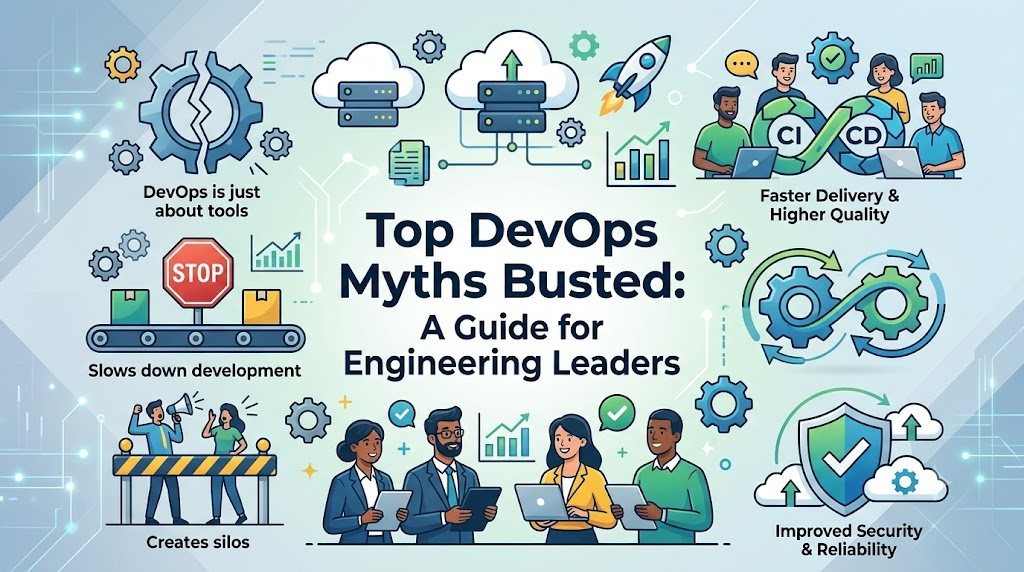
People often believe that buying a license for a CI/CD tool or a configuration management suite solves their delivery problems. In reality, tools are merely enablers. If you apply advanced automation to a team that refuses to communicate, you will simply automate your existing dysfunction.
Myth 2: DevOps Eliminates Operations Teams
There is a fear that automation will replace human operators. The truth is that operations professionals are more valuable than ever. Their role shifts from manual server patching to designing scalable infrastructure and reliability frameworks.
Myth 3: Only Large Enterprises Need DevOps
Startups often think they are “too small” for DevOps. On the contrary, adopting these practices early prevents the accumulation of technical debt and allows small teams to punch above their weight class by automating routine tasks.
Myth 4: DevOps Is Only for Developers
DevOps requires a holistic approach. If the Security team is not involved early, they become a bottleneck at the end of the pipeline. If Product Managers do not understand the delivery cycle, expectations will never align with output.
Myth 5: Automation Solves Every Problem
Automation is a force multiplier. If your internal communication is broken and your documentation is non-existent, automation will not fix those systemic issues. First, streamline the process; then, automate it.
Myth 6: DevOps Means Continuous Deployment Only
While continuous deployment is a common goal, many organizations are not ready for it due to regulatory or business constraints. Continuous Integration (CI) and Continuous Delivery (CD) are often sufficient starting points.
Myth 7: DevOps Is Too Expensive
The upfront cost of training, cultural shifts, and infrastructure changes can be intimidating. However, the cost of downtime, manual errors, and developer burnout far outweighs the investment in a proper DevOps transformation.
Myth 8: Security Slows Down DevOps
Security is often seen as a final “check” that slows down releases. DevSecOps advocates for “shifting left”—embedding security testing into the pipeline so that issues are caught before they reach production.
Myth 9: DevOps Can Be Implemented Overnight
DevOps is not a “plug-and-play” solution. It is a journey of continuous improvement. Teams must be prepared for trial and error and a long-term commitment to changing how they work.
Myth 10: Certification Alone Makes You a DevOps Expert
Certifications provide a great framework and theoretical knowledge, but DevOps is highly contextual. An expert is someone who has applied these principles in a live environment, navigated outages, and improved team velocity.
Common Business Consequences of Believing These Myths
| Misconception | Business Impact |
| Focusing solely on tools | Low adoption rates and wasted license costs |
| Excluding Operations | Critical reliability and infrastructure oversights |
| Ignoring Culture | Persistent silos and high team turnover |
| Delaying Security | Massive regulatory risks and production vulnerabilities |
| Rushing Implementation | Increased system instability and deployment failures |
Real-World Examples
- Startup Example: A growing e-commerce startup relied on one developer to deploy code manually. When they implemented basic CI/CD, they reduced deployment time from 4 hours to 10 minutes, allowing them to iterate on features daily.
- Mid-sized Company Example: A firm struggled with “Dev vs. Ops” tension. By integrating SRE practices and shared KPIs, they reduced their Mean Time to Recovery (MTTR) by 60% within six months.
- Enterprise Example: A large bank adopted DevSecOps to comply with regulations. By automating compliance checks, they didn’t slow down their releases; they actually sped them up because manual audits were no longer required.
Best Practices for Successful DevOps Adoption
- Focus on Culture: Prioritize psychological safety and open communication.
- Encourage Collaboration: Create cross-functional teams that share project goals.
- Automate Gradually: Don’t try to automate everything at once; start with the most painful, manual tasks.
- Measure Continuously: Use metrics to guide improvements, not to punish employees.
- Build a Learning Culture: Encourage team members to learn new technologies and share knowledge.
- Include Security Early: Integrate vulnerability scanning and compliance checks into your pipeline.
Measuring DevOps Success
| Metric | Why It Matters | Business Value |
| Deployment Frequency | Measures agility | Faster time to market |
| Lead Time for Changes | Measures efficiency | Faster feedback loop |
| Mean Time to Recovery | Measures resilience | Reduced downtime costs |
| Change Failure Rate | Measures quality | More stable products |
Common Beginner Mistakes
- Chasing Tools: Spending months choosing between tools without defining the process.
- Ignoring Fundamentals: Trying to implement Kubernetes before having a stable, automated build process.
- Poor Communication: Expecting a ticket system to replace human conversations.
- Weak Documentation: Relying on tribal knowledge that vanishes when an employee leaves.
- Lack of Continuous Learning: Assuming that once a pipeline is built, the work is done.
Future of DevOps
The landscape is shifting toward Platform Engineering, where internal developer platforms reduce cognitive load for developers. AI-assisted DevOps is becoming prevalent, helping teams predict incidents before they happen. Furthermore, GitOps has changed how we manage infrastructure as code, ensuring that the state of our systems is always consistent and auditable.
Certifications & Learning Paths
Continuous education is vital for a successful career. Platforms like DevOpsSchool offer comprehensive paths to gain these skills.
| Certification | Best For | Skill Level | Focus Area |
| DevOps Foundation | Beginners | Entry | Culture & Concepts |
| Kubernetes CKA | Engineers | Intermediate | Orchestration |
| AWS/Azure/GCP Cloud | Architects | Intermediate | Infrastructure |
| DevSecOps Expert | Senior Leads | Advanced | Security Integration |
Practical DevOps Success Checklist
- Establish a shared goal between Dev and Ops.
- Implement a version control strategy.
- Automate build and test processes.
- Set up automated monitoring and alerting.
- Conduct regular blameless post-mortems.
- Foster an environment where learning is rewarded.
FAQs (15 Questions)
- Is DevOps only about automation? No, it is primarily about culture and communication; automation is just a tool to support those goals.
- Can small businesses adopt DevOps? Yes, it helps them scale efficiently and avoid technical debt.
- Does DevOps replace operations? No, it evolves operations into roles like SRE and Platform Engineering.
- Are certifications enough? No, practical, hands-on experience is essential.
- Is DevOps expensive? The initial investment is high, but the ROI from efficiency and stability is significant.
- How long does implementation take? It is a continuous process that takes months or years to fully mature.
- How does DevSecOps fit in? It integrates security practices throughout the CI/CD pipeline.
- What is the biggest DevOps misconception? The idea that you can “buy” DevOps by purchasing tools.
- Should developers manage infrastructure? With modern platforms, developers should have visibility and control, but specialized engineers remain necessary.
- What is a blameless post-mortem? A review process that focuses on system failures rather than human error.
- Do I need to be a coder to do DevOps? Scripting and automation knowledge are crucial for most modern roles.
- Is DevOps only for cloud environments? It is easier in the cloud, but the principles apply to any infrastructure.
- How do I measure DevOps success? Through DORA metrics like deployment frequency and MTTR.
- Is Platform Engineering part of DevOps? Yes, it is an evolution of DevOps focused on developer experience.
- Can legacy systems use DevOps? Yes, through incremental modernization and CI/CD wrappers.
Final Thoughts
DevOps is not a destination; it is a way of working. By busting these common myths, we can shift our focus from chasing the latest tool to building resilient, collaborative teams. Remember, people and processes will always trump technology. Start small, iterate often, and keep learning. Success in this field requires patience, clear communication, and a willingness to embrace change as a constant companion.
