In the current technology landscape, migrating to the cloud is no longer an option for most businesses; it is an inevitability. As workloads move to AWS, the attack surface changes radically. The traditional perimeter is gone. Identity, data protection, and automated compliance are the new firewalls.
This shift has created an massive demand for engineers who don’t just understand the cloud, but who know how to secure it fundamentally.
As someone who has guided countless engineers and teams through the evolution of DevOps, DevSecOps, and platform engineering over the last two decades, I have seen certification trends come and go. However, the need for verified, deep security expertise remains constant.
In the AWS ecosystem, one certification stands out as the gold standard for proof of competence: The AWS Certified Security – Specialty (SCS-C02).
This guide is not just about passing an exam. It is about understanding the value of this training, how it shapes your career, and the practical steps to mastering cloud security. Whether you are a software engineer looking to shift left, or an infrastructure manager needing to secure your platforms, this guide is for you.
Why Cloud Security Training is Non-Negotiable Today
A few years ago, security was often a final checkbox at the end of a development cycle—the “department of ‘no’.” Today, in high-performing organizations, security is baked into every step of the software delivery lifecycle (SDLC).
If you are in DevOps, SRE, or Platform Engineering, you are already making security decisions daily, whether you realize it or not. You are configuring S3 bucket permissions, setting up security groups, managing IAM roles for EC2 instances, or encrypting database secrets.
Without structured training, these decisions are often based on guesswork or outdated on-premises knowledge. This leads to misconfigurations, which remain the number one cause of cloud security breaches.
The AWS Certified Security – Specialty training forces you to stop guessing. It provides a structured, deep understanding of the shared responsibility model and the native tools AWS provides to protect your environment. Earning this certification proves you have moved beyond the basics and can handle complex security challenges at scale.
Deep Dive: AWS Certified Security – Specialty (SCS-C02)
This certification is designed to validate your expertise in securing data and workloads in the AWS Cloud. It is considered a difficult, specialized exam that requires hands-on experience.
Below is a detailed breakdown of what this certification entails and how to approach it.
What it is
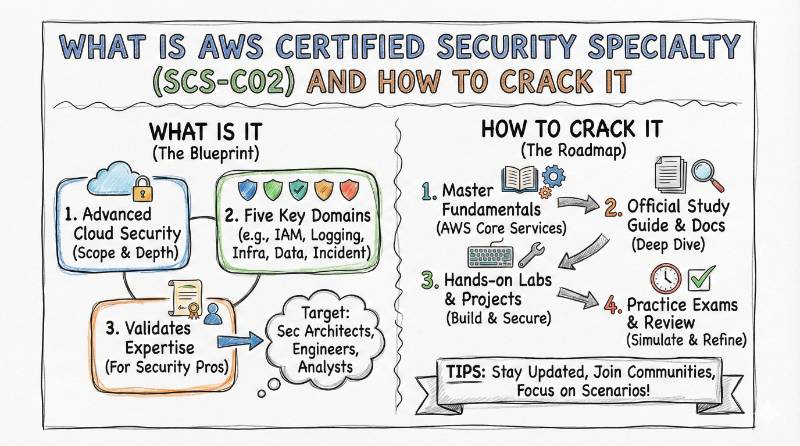
The AWS Certified Security – Specialty (SCS-C02) is a validation of advanced technical skills and experience in designing and implementing security solutions on the AWS platform. It goes far beyond the security concepts covered in associate-level exams like the Solutions Architect. It tests your ability to secure applications, networks, and data using native AWS tools and best practices. It requires understanding both the “how” (configuration) and the “why” (architectural strategy) of cloud security.
Who should take it
This certification is not for absolute beginners to the cloud. It is targeted at experienced IT professionals who already have a solid grasp of core AWS services.
You should consider this training if:
- You are a Security Engineer looking to validate your cloud-specific skills.
- You are a DevOps or Platform Engineer responsible for securing CI/CD pipelines and infrastructure.
- You are a Cloud Architect who needs to design secure-by-default systems.
- You have at least 2–5 years of IT security experience and substantial hands-on experience securing AWS workloads.
Skills you’ll gain
The training for SCS-C02 is intense and highly practical. You don’t just learn the names of services; you learn the intricate details of how they interact to create a secure environment. The focus is heavily on automation, logging, identity management, and incident response.
By the end of your training, you will possess the following key skills:
- Advanced Identity and Access Management (IAM): Mastering complex IAM policies, cross-account roles, identity federation, and AWS Organizations Service Control Policies (SCPs) to enforce least privilege.
- Data Protection & Encryption: Deep knowledge of AWS Key Management Service (KMS), managing customer-managed keys (CMKs), and enforcing encryption at rest (S3, EBS, RDS) and in transit (TLS/SSL).
- Infrastructure Security: Designing secure VPC architectures, utilizing Security Groups and Network ACLs effectively, and implementing AWS Web Application Firewall (WAF) and Shield for edge protection.
- Threat Detection and Incident Response: Utilizing services like Amazon GuardDuty, AWS Security Hub, and Amazon Macie to detect threats automatically. You will learn how to automate responses using EventBridge and Lambda functions.
- Logging and Monitoring: Centralizing logs using CloudTrail and CloudWatch Logs, and analyzing them for security auditing and compliance purposes.
Real-world projects you should be able to do after it
Certification is useless without application. After completing rigorous training for SCS-C02, you should be able to confidently execute complex, real-world security projects. The exam tests your ability to handle scenarios, not just define terms.
You will be capable of delivering projects like:
- Building a Multi-Account Security Strategy: Designing an AWS Organization structure using SCPs to prevent member accounts from disabling security features like CloudTrail or GuardDuty, and setting up centralized logging in a dedicated security account.
- Automating Remediation of Non-Compliant Resources: Creating a system where AWS Config detects an unencrypted S3 bucket and automatically triggers a Lambda function to encrypt the bucket and notify the security team via SNS.
- Designing a Secure CI/CD Pipeline: Implementing a DevSecOps pipeline where static code analysis (SAST) checks for hardcoded secrets, and IAM roles for build servers are scoped strictly to minimum required permissions.
- Executing an Incident Response Drill: Simulating a compromised EC2 instance scenario, using GuardDuty findings to identify the threat, isolating the instance using security groups, and performing forensic analysis using EBS snapshots.
Preparation plan (7–14 days / 30 days / 60 days)
Your preparation time depends heavily on your starting point. Here are three common timelines.
The “Expert Refresher” Plan (7–14 Days)
- Who this is for: You already work in AWS security daily and hold other AWS certifications. You just need to align your knowledge with the exam guide.
- Focus: Take practice exams immediately to find weak spots. Read whitepapers on specific services where you scored low (e.g., KMS deep dive or complex IAM policy evaluation logic). Review new features added in the C02 version.
The “Steady Practitioner” Plan (30 Days)
- Who this is for: You are a DevOps or Cloud engineer with good general AWS knowledge but need to deepen your security focus.
- Focus: Dedicate 1-2 hours daily. Go through a structured video course. Spend significant time in the AWS console doing hands-on labs. Focus heavily on IAM, KMS, and networking. Take one practice exam per week to track progress.
The “Deep Dive” Plan (60 Days)
- Who this is for: You have foundational AWS knowledge (perhaps Solutions Architect Associate level) but are relatively new to advanced security concepts.
- Focus: This requires a methodical approach. Spend the first 30 days covering all video training modules and official AWS documentation. Spend the next 30 days focusing purely on hands-on labs, building out scenarios, and taking multiple rigorous practice tests until you consistently score over 80%.
Common mistakes
Many capable engineers fail this exam on the first try because they underestimate the depth required. It is very different from Associate-level exams.
Avoid these common pitfalls during your preparation and the exam:
- Relying only on console knowledge: The exam tests JSON policy structures, CLI commands, and API interactions. You cannot just click your way through. You must be able to read and debug complex IAM policies and KMS key policies raw.
- Ignoring the “why”: Don’t just memorize that GuardDuty does threat detection. Understand what data sources it uses (VPC Flow Logs, DNS logs, CloudTrail events) and what it cannot detect.
- Time Management during the exam: The scenario questions are long and wordy. You must learn to identify the key constraints in the question quickly (e.g., “most cost-effective,” “fastest implementation,” or “highest availability”).
- Overlooking “non-security” services: You need to understand how services like Systems Manager Parameter Store, Secrets Manager, and Auto Scaling groups interact with security controls.
Best next certification after this
Once you have achieved the SCS-C02, you have proven deep technical competence. Where you go next depends on your career goals.
- Leadership Track: If you want to move into high-level architecture or management, the AWS Certified Solutions Architect – Professional is the logical next step. It combines your security depth with broad architectural breadth.
- Specialization Track: If you deal heavily with networking infrastructure, the AWS Certified Advanced Networking – Specialty pairs nicely with the security cert, as networking is the foundation of cloud security.
- DevSecOps Track: To solidify your skills in the automation side of security, consider the AWS Certified DevOps Engineer – Professional.
Certification Overview Table
Here is a quick reference for the SCS-C02 certification details.
| Feature | Details |
| Certification Name | AWS Certified Security – Specialty (SCS-C02) |
| Track | Specialty |
| Level | Advanced / Expert |
| Who it’s for | Experienced security engineers, cloud architects, and DevOps professionals with significant hands-on AWS security experience. |
| Prerequisites | None officially required, but 2–5 years of IT security experience and broad AWS knowledge are highly recommended. |
| Skills covered | Advanced IAM, KMS encryption, Incident Response automation, Logging & Monitoring (CloudTrail/Watch/Config), Infrastructure Security (VPC/WAF/Shield), Data Protection. |
| Recommended order | Take after achieving Associate-level certifications (Solutions Architect or SysOps Administrator) and gaining real-world experience. |
Choose Your Path: Learning Tracks in Modern Ops
The technology world is broadening into specialized “Ops” disciplines. Security is not a silo; it connects to all of them. Here is how security training fits into different career paths.
1. DevOps Track
- Focus: Speed, automation, and CI/CD.
- Security’s Role: Security cannot slow down the pipeline. You need to integrate automated security testing (SAST/DAST) into Jenkins or GitLab CI. You must manage infrastructure as code (IaC) security using tools designed for Terraform or CloudFormation. The SCS-C02 helps you build secure base images and manage deployment roles securely.
2. DevSecOps Track
- Focus: “Shifting left”—making security everyone’s responsibility early in the SDLC.
- Security’s Role: This is the core track for the SCS-C02. You are the bridge between developers and security requirements. You provide the tooling and guardrails that allow developers to ship fast without breaking security compliance. You automate policy enforcement.
3. SRE (Site Reliability Engineering) Track
- Focus: Reliability, scalability, and system health.
- Security’s Role: A system that is compromised is not reliable. SREs need security training to ensure that scaling events don’t open security holes, and that monitoring tools (like Datadog or Prometheus) are secure. Incident response is a shared responsibility between SRE and Security teams.
4. AIOps / MLOps Track
- Focus: Managing data and lifecycles for Artificial Intelligence and Machine Learning models.
- Security’s Role: AI/ML models depend on massive datasets. Securing this data (often in S3 data lakes) using tight IAM policies and KMS encryption is crucial. You also need to secure the training environments (like SageMaker) to prevent model poisoning or data exfiltration.
5. DataOps Track
- Focus: Ensuring data quality, availability, and flow for analytics.
- Security’s Role: Data is the new oil, and it needs protection. DataOps engineers must understand intricate S3 bucket policies, database encryption (RDS/DynamoDB), and secure data transfer mechanisms (like AWS Glue security configurations). Compliance frameworks like GDPR or HIPAA rely heavily on DataOps security.
6. FinOps Track
- Focus: Managing and optimizing cloud spend.
- Security’s Role: Security and cost are linked. A compromised account often leads to massive bills due to crypto-jacking. Furthermore, many security services (like GuardDuty, Config, and Macie) have costs associated with them. A FinOps practitioner needs to understand these services to balance risk versus cost effectively.
Role → Recommended Certifications Mapping
Where do you sit right now, and what should you aim for? Here is a mapping based on common industry roles.
| Current Role | Primary Goal | Recommended Certifications Path |
| Software Engineer | Shift Left & Secure Code | AWS Developer Associate → AWS Security Specialty |
| DevOps Engineer | Secure CI/CD & Infra | AWS SysOps Associate → AWS DevOps Professional → AWS Security Specialty |
| Cloud Engineer | Secure Platform Build | AWS Solutions Architect Associate → AWS Security Specialty → AWS Advanced Networking Specialty |
| Security Engineer | Validate Cloud Skills | AWS Security Specialty (Priority 1) → AWS Solutions Architect Professional |
| SRE | Reliable & Secure Systems | AWS SysOps Associate → AWS DevOps Professional → AWS Security Specialty |
| Data Engineer | Secure Data Lakes | AWS Data Analytics Specialty → AWS Security Specialty |
| FinOps Practitioner | Cost/Risk Balance | AWS Cloud Practitioner → AWS Solutions Architect Associate → AWS Security Specialty (Foundational knowledge) |
| Engineering Manager | Strategic Oversight | AWS Solutions Architect Associate (for technical context) → AWS Security Specialty (high-level concepts) |
Top Training Institutions for SCS-C02
Choosing the right training partner is crucial for a difficult exam like this. You need providers that offer deep, hands-on labs, not just theoretical slides.
Here are some top institutions providing help in training and certifications for AWS Security Specialty:
- DevOpsSchool: Known for comprehensive, bootcamp-style training that focuses heavily on real-world implementation and getting students job-ready. Their security track is deep and practical.
- Cotocus: Focuses on cutting-edge cloud technologies and consulting-led training approaches, ensuring materials are aligned with current market needs.
- Scmgalaxy: Excellent resource for configuration management and DevOps workflows, offering training that integrates security into the broader software supply chain.
- BestDevOps: Provides curated paths for DevOps professionals looking to specialize, with strong modules on DevSecOps and cloud security integration.
- devsecopsschool: As the name implies, a highly specialized institution focused purely on the intersection of development, security, and operations.
- sreschool: Tailors its security training through the lens of reliability engineering, focusing on how security impacts system stability and incident management.
- aiopsschool & dataopsschool: These institutions focus on the specific security challenges related to managing large datasets and AI/ML pipelines in the cloud.
- finopsschool: Provides unique insights into the cost implications of security services and how to manage cloud risk within a budget.
Frequently Asked Questions (FAQs)
Part 1: General Certification Questions
Q1: Are certifications really necessary to get a job in cloud security?
While not strictly mandatory, they act as a powerful filter for recruiters. In a stack of resumes, the one with a Specialty certification stands out as proven, validated expertise. It gets you the interview.
Q2: How difficult are AWS Specialty exams compared to Associate exams?
Significantly harder. Associate exams test breadth; Specialty exams test extreme depth. The questions are complex, scenario-based, and often require choosing the “best” solution among several correct options based on specific constraints.
Q3: Do I need programming skills for the AWS Security Specialty?
You don’t need to be a developer, but you must be comfortable reading code snippets (like JSON for policies or Python for Lambda functions) and using the Command Line Interface (CLI).
Q4: How long does the SCS-C02 certification last?
AWS certifications are valid for three years. To renew, you must pass the current version of the exam again or pass a relevant Professional-level exam.
Q5: Can I take the Security Specialty without any other AWS Certs?
Yes, there are no formal prerequisites. However, it is highly discouraged. Attempting this without first passing an Associate-level exam (like Solutions Architect) is usually a path to failure due to lacking foundational knowledge.
Q6: What is the best way to gain the required hands-on experience if my current job doesn’t use AWS?
Use the AWS Free Tier. Build your own projects. Set up a multi-account structure using AWS Organizations. Attack your own infrastructure (safely) and see if your GuardDuty setup detects it. You must build to learn.
Q7: How much of the exam is theoretical vs. practical scenarios?
It is almost entirely scenario-based. Very few questions will simply ask “What does service X do?” They will present a business problem and a security constraint and ask you to architect the solution.
Q8: Is this certification recognized globally?
Yes, AWS certifications are the most recognized cloud credentials globally. The standard is equal regardless of where you take the exam in India, the US, or Europe.
Q9: Will this certification increase my salary?
Generally, yes. Cloud security specialists are among the highest-paid roles in IT. This certification validates that specialization, giving you significant leverage in salary negotiations.
Q10: How does this compare to vendor-neutral security certs like CISSP?
CISSP is broad and focused on security management and policy across all domains. SCS-C02 is deep, technical, and specific to implementing security within AWS. They complement each other; they don’t replace each other.
Q11: What if I fail the exam?
You must wait 14 days before you can retake the exam. There is no limit to the number of attempts, but you must pay the exam fee each time.
Q12: Are there labs in the actual exam?
As of the C02 version, AWS has introduced exam labs in some specialty exams where you must perform tasks in a live AWS console. You should be prepared for this possibility.
Part 2: AWS Certified Security Specialty (SCS-C02) Specific FAQs
Q1: What is the heaviest weighted domain in SCS-C02?
The exam changes, but typically “Infrastructure Security” and “Identity and Access Management (IAM)” make up a massive portion of the exam. You cannot pass if you are weak in IAM.
Q2: Do I need to know services outside of the ‘Security’ category in the AWS console?
Absolutely. You need to know EC2 networking, S3 storage classes and bucket policies, RDS encryption options, and how Lambda triggers work. Security is applied to these services.
Q3: How deep do I need to know KMS (Key Management Service)?
Very deep. You need to understand key policies versus IAM policies applied to keys, key rotation mechanisms, the difference between symmetric and asymmetric keys in AWS, and cross-account key usage.
Q4: Is knowing the AWS CLI necessary for the exam?
Yes. You will likely see questions where the answer options are CLI commands. You need to recognize the correct syntax for common security tasks, like encrypting an EBS volume snapshot.
Q5: How important is AWS Organizations and SCPs?
Crucial. Modern AWS security is multi-account. You must understand how Service Control Policies (SCPs) filter permissions down to member accounts and how they interact with local IAM policies.
Q6: Do I need to understand compliance standards like PCI-DSS or HIPAA?
You don’t need to memorize the standards themselves, but you need to know which AWS services help you achieve compliance (like AWS Artifact, AWS Config rules, and Audit Manager).
Q7: What is the trickiest part of the IAM section?
The policy evaluation logic. Understanding the exact flow of how AWS decides to allow or deny a request when multiple policies (Identity, Resource, SCP, Boundary) conflict is the hardest part.
Q8: What are the best resources for studying the newest services mentioned in the C02 exam guide?
Always rely on official AWS documentation, AWS whitepapers on security, and the AWS Security Blog. Third-party courses sometimes lag behind the official changes.
Conclusion
In my two decades in this industry, I have seen many trends, but the necessity for robust, integrated security remains paramount. Earning the AWS Certified Security – Specialty (SCS-C02) is more than just adding a logo to your LinkedIn profile. It is a rigorous journey that forces you to deeply understand how to protect data and applications in the modern cloud era. It signals to employers and peers that you possess the disciplined, specialized knowledge required to handle high-stakes environments. Whether you desire to become a dedicated Security Engineer or aim to be a more complete DevOps professional or SRE, this certification provides the essential knowledge base to build securely on the world’s leading cloud platform. The effort required to pass is significant, but the career rewards and the confidence you gain in your technical decision-making are immeasurable. Start your journey, go deep into the labs, and commit to mastering the craft of cloud security.
