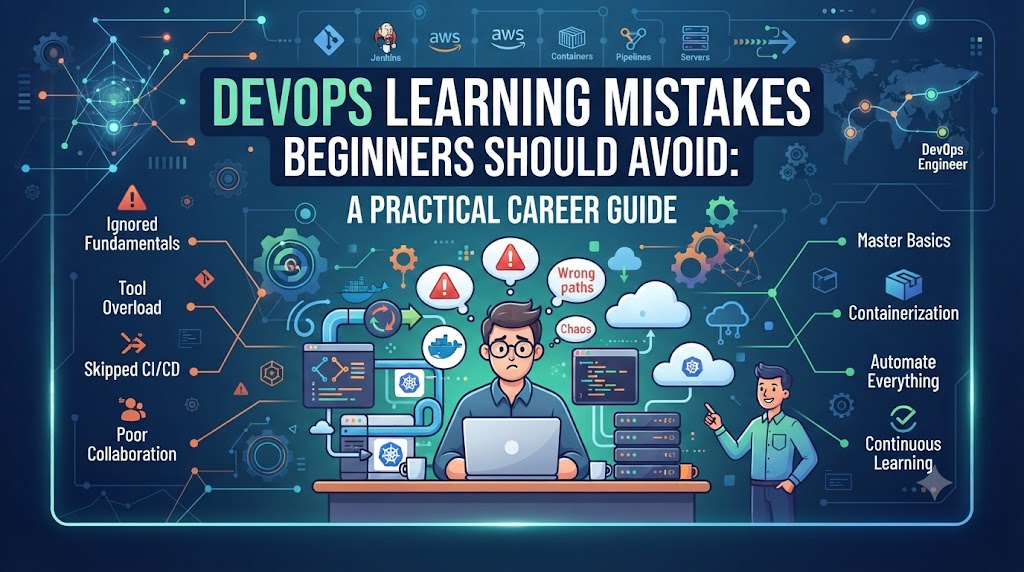
Introduction
The promise of a high-growth, high-impact career makes DevOps one of the most sought-after paths in the tech industry. It sits at the intersection of development, operations, and security, offering a unique vantage point over the entire software delivery lifecycle. However, for every success story, there are countless aspiring engineers who find themselves trapped in a cycle of tutorial fatigue, overwhelmed by the sheer volume of tools, or stalled by a lack of fundamental knowledge.
The reality is that DevOps is not just a collection of tools; it is a culture and a methodology. Beginners often struggle because they treat it as a checklist of software to install rather than a set of principles to master. To help you navigate this transition, we have compiled this guide to help you recognize and sidestep the hurdles that slow down most learners. For those seeking a structured path, DevOpsSchool provides comprehensive resources to help bridge the gap between theory and industry-ready skills. By adopting a structured approach, you can transform an overwhelming journey into a manageable, progressive career path.
Why Beginners Struggle With DevOps
The struggle is often not a reflection of the learner’s intelligence, but rather the nature of the domain. You are entering a landscape that is remarkably broad, moving at an incredibly fast pace.
- Information Overload: A simple search for “DevOps tools” returns hundreds of results. Beginners often don’t know what is essential versus what is niche.
- Context Switching: You are expected to be proficient in networking, Linux, cloud architecture, and coding simultaneously.
- Constant Evolution: The “best” tool today might be replaced by a more efficient alternative tomorrow.
- The “Gap”: There is often a significant disconnect between what a course teaches (a “Hello World” project) and what an enterprise environment demands (security, scalability, and observability).
Understanding the DevOps Learning Journey
Progression in DevOps is linear in concept but requires deep recursive learning. Think of this as a building process:
- Computer Fundamentals: Understand how software talks to hardware.
- Linux: The backbone of all server infrastructure.
- Networking: Understanding IP, DNS, and how traffic flows.
- Git: Version control is non-negotiable.
- Scripting (Bash/Python): Automating your first tasks.
- Cloud Fundamentals: Understanding AWS, Azure, or GCP.
- Containers: Learning Docker to package applications.
- CI/CD: Building the pipelines that deliver code.
- Infrastructure as Code (IaC): Managing systems like code (Terraform).
- Kubernetes: Orchestrating those containers at scale.
- Monitoring & Observability: Knowing when things break.
- DevSecOps: Integrating security into the pipeline.
- Portfolio Development: Proving you can do the work.
Top DevOps Learning Mistakes Beginners Should Avoid
| Mistake | Impact | Recommended Solution |
| Skipping Fundamentals | Fragile knowledge base | Prioritize Linux & Networking basics |
| Tool Obsession | Burnout/Temporary skill | Focus on core concepts/methodologies |
| Avoiding Hands-On | Lack of practical capability | Build a home lab or use cloud sandboxes |
| Chasing Certs Only | “Paper” engineer syndrome | Balance certs with project building |
| Ignoring Networking | Inability to troubleshoot | Spend time learning TCP/IP, DNS, HTTP |
| No Documentation | Inability to showcase work | Keep a blog or GitHub project READMEs |
| Inconsistency | Knowledge decay | Set daily/weekly time-blocked study |
| Peer Comparison | Imposter syndrome | Measure progress against yourself |
Mistake #1: Skipping the Fundamentals
Many beginners want to jump straight to Kubernetes or complex CI/CD pipelines. This is like trying to build a skyscraper without laying a foundation. If you do not understand how a process runs in Linux, or how a packet travels through a network, you will be unable to troubleshoot when your “automated” system fails. Spend at least 20% of your total study time on Linux command-line proficiency and basic networking protocols.
Mistake #2: Tool Obsession
Do not fall in love with a tool; fall in love with the problem it solves. Tools like Jenkins, Ansible, or Terraform are just ways to achieve a goal. If you understand the concept of Infrastructure as Code, moving from Terraform to Pulumi or CloudFormation becomes a matter of syntax, not a total restart. Focus on why a tool is used, not just the commands to run it.
Mistake #3: Avoiding Hands-On Practice
Passive learning—watching videos or reading books—gives a false sense of security. You must get your hands dirty. If you learn about Docker, don’t just watch a video. Spin up a container, configure a custom network, map volumes, and try to break it. Building a small “home lab” on your laptop or a cloud provider’s free tier is the most effective way to learn.
Mistake #4: Chasing Certifications Without Skills
Certifications are excellent for proving you have attained a baseline of knowledge, but they are not a substitute for experience. Recruiters want to see that you can deploy an application, secure a server, and handle an outage. A certification provides the badge; a portfolio of projects provides the proof.
Mistake #5: Ignoring Networking and Infrastructure Concepts
DevOps engineers spend a massive amount of time solving network issues—firewalls, load balancing, and DNS resolution. If you assume the network will “just work,” you will eventually hit a wall that you cannot cross. Learn the OSI model and practice configuring basic network interfaces and firewall rules.
Mistake #6: Not Building a Portfolio
Your GitHub profile is your resume in the DevOps world. Instead of just pushing homework, build end-to-end projects. For example, “Deploy a website on an AWS EC2 instance using Terraform, with Nginx configured via Ansible, and a monitoring agent tracking CPU usage.” This is a tangible demonstration of your skills.
Mistake #7: Learning Without a Roadmap
Without a structured plan, you will wander aimlessly through tutorials. Use a roadmap to sequence your learning. Don’t start Kubernetes if you don’t understand Docker. Don’t start Terraform if you don’t understand the cloud environment you are automating.
Mistake #8: Inconsistent Learning Habits
DevOps is too complex for “binge-learning.” Two hours of practice every day for a month is significantly more effective than a 20-hour weekend marathon once a month. Consistency allows your brain to retain technical concepts and develop muscle memory for the terminal.
Mistake #9: Comparing Yourself to Experienced Engineers
The senior DevOps architect you admire on LinkedIn likely has 10+ years of experience. You are comparing their “Chapter 20” to your “Chapter 1.” Focus on your own growth trajectory. Set milestones based on your starting point, not the industry standard.
Mistake #10: Not Participating in Communities
Tech is a team sport. Join Discord servers, attend local meetups, or participate in open-source projects. Being exposed to how others approach problem-solving will accelerate your learning faster than any single book.
Measuring Learning Progress
Use this KPI framework to track your actual development:
| Metric | Why It Matters | Learning Benefit |
| Labs Completed | Proves hands-on ability | Builds operational muscle memory |
| Projects Built | Demonstrates end-to-end knowledge | High interview value |
| Git Commits | Tracks daily consistency | Develops professional workflow |
| Study Hours | Ensures volume of work | Helps in time management |
| Certifications | Validates fundamental knowledge | Industry recognition |
| Documentation | Improves communication skills | Essential for senior roles |
Best Practices for Effective DevOps Learning
- Follow a Roadmap: Stick to a structured learning path.
- The 70/30 Rule: Spend 30% of your time on theory and 70% on practical application.
- Document Everything: Write a “ReadMe” for every project you complete.
- Fail Forward: When a script fails, don’t delete it. Debug it until you understand why it failed.
- Join Communities: Engage with others to get peer feedback.
Real-World Example
Case Study: The “Tutorial Hell” Learner
- The Mistake: A learner spent six months taking high-level certification courses but couldn’t configure a simple web server on a Linux VM.
- Corrective Action: The learner stopped buying new courses, wiped their local machine, installed Linux, and began a project to host a personal blog using Nginx, Docker, and a basic shell script for backups.
- The Result: Within three months, they had a functioning, documented project on GitHub. They could speak to the technical challenges of permissions, networking, and automation during interviews, leading to a junior-level DevOps role.
Building a Sustainable Learning Plan
- Weekly Goals: Assign one core topic per week (e.g., Week 1: Linux Permissions, Week 2: Git Branches).
- Monthly Milestones: Complete one major project per month.
- Skill Tracking: Use a spreadsheet to mark off core competencies.
- Continuous Improvement: Review your past projects every three months to see how you would improve them now.
Future of DevOps Learning
As we move toward 2026 and beyond, DevOps is evolving into Platform Engineering. This shifts the focus from managing individual tools to creating internal developer platforms. Future learners should keep an eye on:
- AI-Assisted Development: Using LLMs to generate boilerplate IaC code.
- Cloud-Native Security: DevSecOps is becoming a standard, not an “extra.”
- Automated Observability: Relying more on AI-driven insights to manage system health.
Certifications & Learning Paths
| Certification Area | Best For | Skill Level | Career Relevance |
| Linux (LPIC/RHCSA) | Foundation | Beginner | High (Must-have) |
| Cloud (AWS/Azure/GCP) | Cloud Arch | Intermediate | High (Required) |
| Docker/Kubernetes | Orchestration | Advanced | Very High |
| Terraform (HashiCorp) | IaC | Intermediate | High |
DevOps Learning Checklist
- Master the Linux terminal and file system.
- Understand how to configure a static IP and DNS entry.
- Master Git: Branching, merging, and pull requests.
- Build a project that uses Docker to run a multi-service application.
- Create a basic cloud environment on AWS/Azure/GCP.
- Document your projects on a public GitHub repository.
- Set a consistent study schedule (e.g., 90 minutes daily).
- Track your projects and learning progress monthly.
FAQs
- What is the biggest mistake beginners make?Attempting to learn tools without understanding the underlying OS and networking fundamentals.
- Should I learn Linux first?Yes. It is the language of the cloud.
- Are certifications enough?No. They are an entry point, but your projects prove your skill.
- How many projects should I build?Focus on quality over quantity. Two end-to-end, well-documented projects are better than ten simple scripts.
- Is Kubernetes required for beginners?Not immediately. Learn containers (Docker) thoroughly before moving to orchestration.
- How do I create a portfolio?Use GitHub to host your code and write a README file explaining what the project does and how to deploy it.
- How long does it take to learn DevOps?It is a continuous journey. You can reach “job-ready” status in 6–12 months with dedicated, structured practice.
- What should I learn first?Linux fundamentals and Git.
- Do I need to be a developer?You need to understand the development lifecycle, but you do not need to be a software engineer. Knowing a scripting language is essential.
- How do I stay updated?Follow tech blogs, industry newsletters, and communities like those found at DevOpsSchool.
- Should I learn every tool?No, focus on industry standards. Pick one tool per category and master it.
- Is DevOps only for IT professionals?No, but it requires a solid technical mindset.
- How do I handle burnout?Break your learning into small, achievable daily tasks.
- Is DevOps dying?No, it is evolving into Platform Engineering and SRE, becoming more important than ever.
- How do I find a mentor?Engage in professional forums and online learning communities.
Final Thoughts
DevOps is a marathon, not a sprint. The most successful engineers are those who prioritize deep understanding over rapid tool-collecting. Avoid the temptation to skip the hard stuff; Linux, networking, and consistent documentation are the pillars that will support your career long after the current “trending” tool has faded. Stay curious, stay practical, and remember that every mistake is an opportunity to learn how a system truly works.
