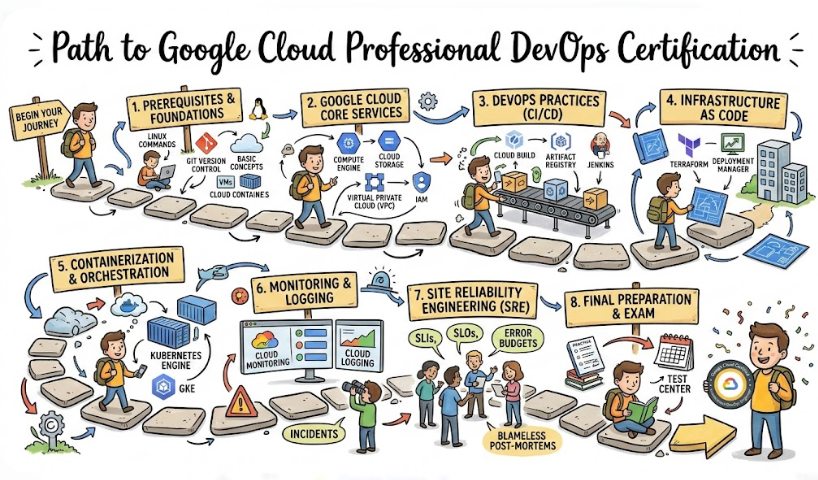
In the current tech world, building an application is only half the battle. The real challenge starts when that application goes live and has to handle thousands of users without crashing. Over the many years I have spent in this industry, I have seen that the most successful engineers are not just those who write the best code, but those who understand how to keep that code running smoothly.
Google Cloud Platform (GCP) has changed the game by bringing the secret sauce of their internal operations—known as Site Reliability Engineering (SRE)—to the public. If you want to stay relevant in today’s market, whether you are an engineer in India or a manager overseeing global teams, mastering these principles is the best move you can make. This guide is your blueprint for the Google Cloud Professional Cloud DevOps Engineer certification.
Overview of Google Cloud Certifications
Before we focus on the DevOps track, it is important to see how Google structures its learning paths. This table provides a clear view of the different tracks available and where you should start based on your career goals.
The Professional Certification Matrix
| Track | Level | Who it’s for | Prerequisites | Skills Covered | Recommended Order |
| Cloud DevOps | Professional | SREs & DevOps Pros | 3+ Years Experience | CI/CD, SRE, Monitoring | 3rd |
| Cloud Architect | Professional | System Architects | 3+ Years Experience | Design, Security, Compliance | 2nd |
| Cloud Security | Professional | Security Leads | 3+ Years Experience | IAM, Network Security | 4th |
| Data Engineer | Professional | Data Analysts | 3+ Years Experience | Big Data, ML, Pipelines | 3rd |
| Cloud Developer | Professional | Software Engineers | 3+ Years Experience | App Testing, Debugging | 2nd |
| Cloud Network | Professional | Network Admins | 3+ Years Experience | Hybrid Cloud, DNS, VPC | 4th |
| Cloud Database | Professional | Database Admins | 3+ Years Experience | Spanner, SQL, Migrations | 3rd |
Master Class: Professional Cloud DevOps Engineer
This certification is widely regarded as one of the most practical and respected credentials in the cloud world. It doesn’t just ask you to memorize tools; it asks you to solve problems like a seasoned professional.
What it is
The Professional Cloud DevOps Engineer certification is Google’s way of verifying that you know how to build and manage a reliable delivery pipeline. It focuses on the balance between “velocity” (how fast you can release code) and “reliability” (making sure the code doesn’t break everything). It is deeply rooted in SRE culture, which means it covers things like managing system health, automating manual work (toil), and creating a culture where teams learn from failures instead of blaming each other.
Who should take it
If you are a Software Engineer tired of “throwing code over the wall” to operations, this is for you. If you are a manager who wants to lead a team that actually delivers on its promises without constant firefighting, you need this knowledge. It is also the natural next step for anyone already working in infrastructure who wants to prove they can handle the high-level automation required by modern tech giants.
Skills you’ll gain
By studying for this, you are effectively downloading a new operating system for your brain. You will learn to look at infrastructure through the lens of a developer.
- Implementing SRE Culture: You will learn how to set meaningful goals for your system using Service Level Objectives (SLOs). You will understand how to use an “Error Budget” to manage risk—meaning you will know exactly when it is safe to push a new feature and when you need to stop and fix bugs.
- Building Automated Pipelines: You will master tools like Cloud Build and Artifact Registry. This allows you to create a system where code is automatically tested, scanned for security issues, and deployed without any human intervention.
- Deep System Visibility: You will learn to use the Cloud Operations suite to monitor the health of your services. You’ll gain the ability to set up alerts that actually mean something, so you aren’t woken up at 3 AM for a minor issue that doesn’t affect users.
- Handling Incidents with Grace: You will learn the industry-standard way to respond to outages. This includes how to communicate during a crisis and how to write a post-mortem report that helps the whole company improve.
Real-world projects you should be able to do
Once you pass this exam, you will have the technical muscles to build systems that scale effortlessly.
- Canary and Blue-Green Deployments: You will be able to set up complex deployment strategies where new code is slowly rolled out to users, ensuring that if something goes wrong, only a tiny fraction of people are affected.
- Self-Healing Clusters: Using Google Kubernetes Engine (GKE), you can build infrastructure that detects when a part of it is failing and automatically replaces it with a healthy version.
- Scaling for Global Traffic: You will know how to use Google’s global load balancing to direct users to the closest healthy server, keeping your app fast and responsive even during a massive traffic spike.
- Cloud Cost Optimization: You will be able to design your infrastructure so it only uses the resources it needs, helping your company save a significant amount of money on its monthly cloud bill.
Your Path to Success: Preparation Timelines
Everyone learns at a different pace. Choose the plan that matches your current workload and experience.
The Sprint: 7–14 Days
This is strictly for the veterans who live and breathe GCP.
- Strategy: Focus on the “Google-specific” terminology. Even if you use Jenkins or GitLab at work, you need to know how Google Cloud Build handles the same tasks.
- Action: Take several full-length practice exams to find your weak spots. Read the “SRE Workbook” chapters on monitoring and incident response.
The Professional Plan: 30 Days
This is the most common path for working engineers who want a solid foundation.
- Strategy: Spend your weekends on hands-on labs and your weekdays on theory.
- Action: Go through the official exam guide point by point. Build a multi-tier application on GCP and try to break it, then see how the monitoring tools report the failure.
The Mentor’s Path: 60 Days
This is for managers or those transitioning from other fields who want to truly master the material.
- Strategy: Deep dives and documentation reading. Don’t rush the concepts of SRE culture.
- Action: Enroll in a structured program through a provider like DevOpsSchool. Dedicate one week to each major service (GKE, Monitoring, CI/CD, etc.) to ensure the knowledge sticks for the long term.
Common Pitfalls to Watch For
Avoid these mistakes that often trip up even the smartest candidates:
- Focusing only on the “How” and not the “Why”: Google doesn’t just want to know you can set an alert; they want to know why that specific metric is the right one to alert on.
- Neglecting the SRE Book: Many questions are straight out of the Google SRE philosophy. If you haven’t read the core concepts of “Toil” and “Error Budgets,” you will find the exam very difficult.
- Over-complicating Solutions: On the exam, the best answer is usually the simplest one that uses a native Google Cloud tool. Don’t look for a complex third-party solution if a GCP service can do it.
Choose Your Future: 6 Specialized Paths
The DevOps certification is just the beginning. From here, you can specialize in areas that match your passion:
- The DevOps Path: Perfect for those who love automation and making the software lifecycle as fast as possible.
- The DevSecOps Path: Focuses on shifting security to the left. You ensure that every piece of code is secure before it ever reaches a user.
- The SRE Path: For those who enjoy the “detective work” of finding why systems fail and building automation to prevent it from happening again.
- The AIOps/MLOps Path: The future of infrastructure. You use machine learning to manage systems and help data scientists deploy their models.
- The DataOps Path: Bridges the gap between data engineering and operations, ensuring that big data pipelines are as reliable as web apps.
- The FinOps Path: Ideal for senior leads and managers. You focus on the financial health of the cloud, making sure every dollar spent on GCP provides real value.
Role → Recommended Certifications Mapping
Use this list to plan your next two or three years of professional growth:
- DevOps Engineer: Professional Cloud DevOps Engineer → Professional Cloud Architect.
- SRE: Professional Cloud DevOps Engineer → Professional Cloud Security Engineer.
- Platform Engineer: Professional Cloud Architect → Professional Cloud Developer.
- Cloud Engineer: Associate Cloud Engineer → Professional Cloud DevOps Engineer.
- Security Engineer: Professional Cloud Security Engineer → Professional Cloud DevOps Engineer.
- Data Engineer: Professional Data Engineer → Professional Cloud DevOps Engineer.
- FinOps Practitioner: Cloud Digital Leader → Professional Cloud Architect.
- Engineering Manager: Cloud Digital Leader → Professional Cloud DevOps Engineer.
What Comes Next? (Future Growth)
After you’ve earned your DevOps badge, you shouldn’t stop learning. Based on the latest insights for software engineers found at GurukulGalaxy, here are three ways to move forward:
- Same Track (Deep Expertise): Take the Security Engineer exam. Knowing how to secure a pipeline is a massive advantage in today’s world.
- Cross-Track (Versatility): Look at the Data Engineer certification. As companies collect more data, they need people who can manage those complex systems.
- Leadership (Career Advance): Move toward the Professional Cloud Architect. This shows you can design systems from scratch, not just run them.
Top Institutions for Training and Certification
Getting the right help can significantly shorten your learning curve. These institutions are well-regarded for their ability to help you master the Google Cloud Professional Cloud DevOps Engineer (CDE) requirements:
- DevOpsSchool: A leading name in the training world, providing very practical and deep-dive workshops. They focus on making sure you understand the logic behind the tools, which is vital for passing the Google exam.
- Cotocus: They offer specialized training that is highly technical. If you are a working professional who needs a focused environment to master complex cloud concepts, they are a great choice.
- Scmgalaxy: Known for its huge library of resources and community support. They provide structured paths that help engineers move from basic knowledge to expert-level skills.
- BestDevOps: They provide coaching that is tailored to current industry needs, ensuring that what you learn is directly applicable to your daily job.
- devsecopsschool: The place to go if you want to integrate security into your DevOps workflow. They offer specialized modules that are essential for modern cloud environments.
- sreschool: Since the Google exam is so heavy on SRE, this institution is perfect. They focus entirely on the reliability and scalability aspects of the cloud.
- aiopsschool: If you are interested in using AI to manage your infrastructure, this school provides the forward-thinking curriculum you need.
- dataopsschool: They specialize in managing data pipelines, a critical skill for any modern cloud professional working with large datasets.
- finopsschool: Essential for anyone moving into a leadership role where they need to manage the financial side of cloud infrastructure.
FAQs: General DevOps Career Guidance
1. Is the DevOps exam harder than the Architect exam?
Many find the DevOps exam more difficult because it is much more technical and requires a deep understanding of SRE philosophy, whereas the Architect exam is more about high-level design.
2. How much time should I dedicate each day?
If you are working full-time, spending about 1 to 2 hours a day is a sustainable way to prepare without burning out.
3. Do I need to be an expert in Kubernetes?
You don’t need to be a world-class expert, but you must understand how Google Kubernetes Engine (GKE) works, including how to manage clusters and deploy apps.
4. What is the most important part of the SRE book to read?
Focus on the chapters regarding Service Level Objectives (SLOs), eliminating toil, and incident management. These are high-yield topics for the exam.
5. Are these certifications recognized in India?
Yes, Google Cloud is growing very fast in India, and top tech companies and startups are actively looking for certified professionals.
6. Can I take the exam in languages other than English?
Yes, the exam is available in several languages, including Japanese and Spanish, but most people in tech find the English version most relevant to the tools.
7. Is it worth it for a manager?
Absolutely. It gives you the technical credibility to lead your team and helps you understand why certain processes (like testing and automation) are non-negotiable.
8. Does this certification help with remote jobs?
Definitely. Proving you can manage cloud infrastructure means you can work for a company anywhere in the world from your home.
9. What is the pass mark for the exam?
Google does not publish the exact passing score, but generally, you need to show a high level of competency across all the exam sections.
10. Can I use a calculator during the exam?
No, but any math involved (like calculating an error budget) is usually simple enough to do in your head.
11. Is there a lab portion in the actual exam?
Currently, the exam is multiple-choice and multiple-select, but the questions are written in a way that you must have hands-on experience to answer them.
12. How often do the exam questions change?
Google updates its exams regularly to reflect new services and best practices, so it’s important to use up-to-date study materials.
FAQs: Google Cloud Professional Cloud DevOps Engineer Specifics
1. What is the main tool I should focus on?
Cloud Operations (Monitoring and Logging) is the most important service for this specific exam.
2. How do I practice without spending a lot of money?
Google offers a free tier and a trial credit for new accounts. You can also use platforms like Qwiklabs for guided practice.
3. Will I need to write code in the exam?
You won’t have to write code from scratch, but you must be able to read and understand YAML files, Dockerfiles, and simple scripts.
4. What is an “Error Budget” in the context of the exam?
It is the amount of downtime or errors your system is allowed to have. The exam will ask how to use this budget to make business decisions.
5. How are the questions structured?
They are scenario-based. For example: “A company’s app is crashing every Friday. They have X tool and Y goal. What should the DevOps engineer do first?”
6. Is Binary Authorization on the exam?
Yes, it is often mentioned as a way to ensure that only trusted code is deployed to your clusters.
7. Should I take the Associate exam first?
If you are new to GCP, yes. It builds the foundational knowledge you need so you don’t get overwhelmed by the Professional level.
8. How do I renew my certification?
You have to retake the exam every two years to ensure your skills are up to date with the latest cloud advancements.
Conclusion
Making the decision to become a Google Cloud Professional Cloud DevOps Engineer is a defining step for anyone serious about a career in modern technology. It represents a shift from being someone who just manages servers to being a strategic partner who ensures business success through reliability and automation. The path isn’t necessarily easy—it requires a deep understanding of both technical tools and cultural shifts like SRE—but the rewards are immense. You will gain the confidence to lead high-stakes projects, the skills to build world-class infrastructure, and a certification that is respected by the best tech companies across the globe. Whether you are aiming for a promotion, a higher salary, or simply the satisfaction of mastering your craft, this roadmap provides you with the clear, actionable steps to get there. The future of the cloud belongs to those who can bridge the gap between development and operations, and there is no better time than now to start that journey.
