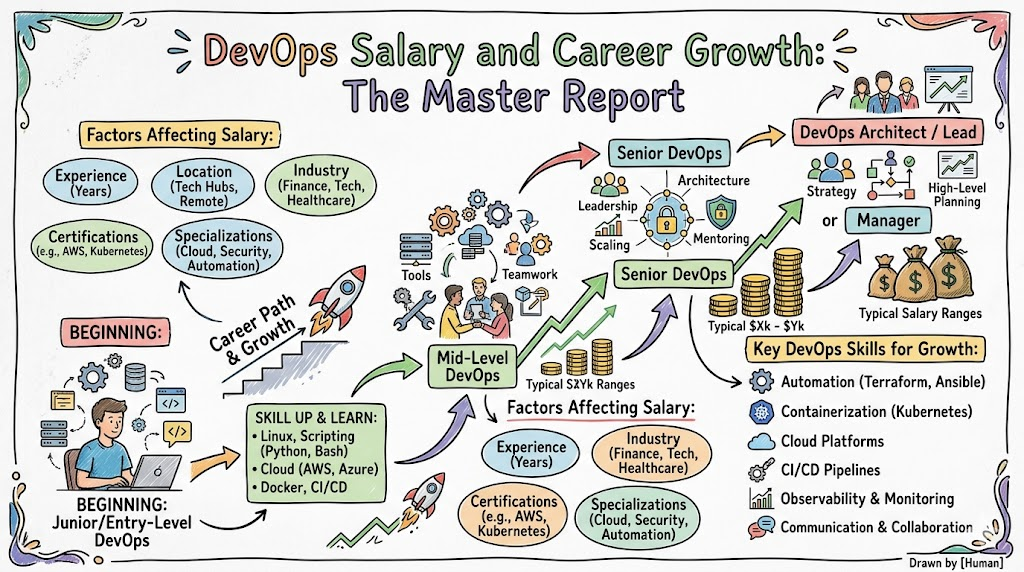
DevOps has cemented its position as one of the most critical and highest-paying domains in the IT landscape. As organizations shift toward cloud-native architectures, the reliance on automation, security, and infrastructure resilience has skyrocketed. Companies are not just looking for individuals who can manage tools; they are seeking professionals who can bridge the gap between software development, infrastructure, and business risk.
The compensation landscape for DevOps professionals is currently shifting, driven by a greater emphasis on reliability, cost engineering, and security. Organizations are increasingly tying compensation to operational outcomes—such as platform adoption metrics, incident response capabilities, and the reduction of manual toil. This shift means that professionals who demonstrate impact beyond basic tool configuration are seeing significantly higher growth in their salary potential.
Cloud computing, Kubernetes, and the evolution of DevSecOps have changed the rules of the game. Roles are becoming more specialized, and the “DevOps Engineer” title is often evolving into more nuanced designations like SRE (Site Reliability Engineering) or Platform Engineering. This guide explores the trends, salary structures, and career paths that matter today, helping you understand how to navigate your career for maximum growth.
Why DevOps Salaries Are High
DevOps salaries remain competitive because the discipline directly impacts business revenue and operational risk. Several key factors are driving this demand:
- Cloud Adoption Growth: As companies migrate to the cloud, the need for professionals who can design landing zones, manage IAM patterns, and deliver secure infrastructure is constant.
- Automation and Reliability: Business downtime is expensive. Organizations pay premiums for professionals who can implement SLOs (Service Level Objectives), incident response frameworks, and automation that reduces operational toil.
- Security and Compliance: With the rise of DevSecOps, roles focusing on policy-as-code, secure SDLC, and pipeline security are in high demand and command higher premiums.
- Platform Engineering: When organizations treat their internal infrastructure as a product, they require Platform Engineers to build “paved roads” for developers, increasing efficiency and warranting higher compensation.
- Specialized Skill Gap: There is a persistent scarcity of professionals who can manage multi-cloud environments, complex Kubernetes architectures, and FinOps (cost engineering) simultaneously.
Who Should Read This Guide
This guide is designed for IT professionals aiming to optimize their career trajectory and salary growth. Whether you are at the beginning of your journey or looking to pivot into a high-paying specialization, this information is for:
- Freshers entering the DevOps space
- Developers transitioning into DevOps or Platform roles
- Linux and System Administrators
- Cloud Engineers
- Automation and CI/CD Engineers
- Site Reliability Engineers (SRE)
- Platform Engineers
- DevSecOps professionals
DevOps Salary Overview
DevOps compensation is currently fragmenting into three distinct markets: high-scale product organizations (equity-heavy), regulated enterprises (bonus-heavy), and service-based/outsourcing firms.
Salary growth is rarely linear. It is heavily tied to the scope of your responsibility. In modern organizations, compensation levels are often mapped to Software Engineering (SWE) ladders. If your work directly impacts business uptime, regulatory posture, or cloud costs, your salary ceiling is significantly higher than that of general operational roles.
DevOps Salary by Experience Level
The leveling system in DevOps often dictates base salary bands. Moving from executing tasks to designing systems is the primary driver of salary growth.
| Experience Level | Typical Roles | Skills Expected | Salary Growth Potential | Career Scope |
| Junior | Junior DevOps Engineer | Execute tasks, learn on-call basics | Baseline | Learning & Execution |
| Mid-Level | DevOps Engineer | Independently ship infra/pipeline changes | Moderate | Implementation |
| Senior | Senior DevOps Engineer | Design systems, lead incidents, mentor | High | Architecture & Strategy |
| Staff | Staff Engineer | Cross-team architecture, reliability strategy | Very High | Organizational Impact |
| Principal | Principal Engineer | Org-wide technical direction, standards | Maximum | Technical Leadership |
Highest Paying DevOps Roles
Different specializations command different salary premiums. Roles that focus on business risk and developer enablement tend to pay more.
| Role | Main Skills | Difficulty Level | Salary Potential | Career Demand |
| DevOps Engineer | CI/CD, Infra automation | Moderate | Baseline | High |
| SRE Engineer | SLOs, Incident response | High | Baseline + 0–15% | High |
| Platform Engineer | Internal platforms, Paved roads | High | Baseline + 5–20% | High |
| DevSecOps Engineer | Policy-as-code, Security | High | Baseline + 10–30% | Very High |
| Cloud Engineer | Landing zones, IAM | Moderate | Baseline -5% to +10% | High |
| Security Platform Engineer | Scalable security controls | Very High | Baseline + 15–35% | Very High |
DevOps Salary by Skills
Your salary is often a reflection of the “scarcity” of your skills. While basics like Linux, Git, and Shell scripting are essential for entry, they are considered the baseline.
The highest salary growth comes from skills that demonstrate operational maturity:
- Observability & Reliability: Knowledge of telemetry architecture, logging, metrics, and distributed tracing.
- Security & Governance: Policy-as-code and automated security controls.
- FinOps: Understanding unit costs, capacity economics, and cloud governance.
- Architecture: The ability to design for multi-region reliability and failure recovery.
DevOps Salary by Certification
Certifications can validate your knowledge, but they are most effective when paired with real-world application. Focus on certifications that map to the roles listed in the Best DevOps Salary Master Report.
| Certification | Best For | Career Level | Skills Covered | Salary Impact |
| Cloud-Native Certs | Platform Engineering | Intermediate | Kubernetes, Containers | Moderate |
| Security-Focused Certs | DevSecOps | Advanced | Policy, Pipeline Security | High |
| Reliability Certs | SRE | Intermediate/Advanced | Incident Management, SLOs | Moderate |
DevOps Salary by Country or Region
Compensation is heavily influenced by geography, cost of living, and the prevalence of specific tech sectors. For example, the United States, Switzerland, and Singapore typically show higher salary bands for technical roles compared to other regions.
- Startups: Often offer equity-heavy packages but carry higher risk.
- Product Companies: Tend to map roles to SWE ladders, offering competitive total compensation.
- Enterprise/Regulated: Usually offer stable, bonus-heavy compensation with high adherence to strict leveling.
- Service/Outsourcing: Compensation is often rate-card driven, focusing on billable utilization.
For detailed breakdown, refer to the Best DevOps Salary Master Report to see how specific roles compare across different global markets.
Factors That Affect DevOps Salary
- Business Impact: Does your work prevent downtime? Does it reduce the cloud bill? If yes, your value is higher.
- Scope of Decision Rights: Great companies pay for your ability to make architectural decisions, not just for following instructions.
- On-Call Maturity: Organizations with mature incident processes value engineers who can own reliability. If an organization lacks toil reduction, they often pay via higher turnover.
- Security and Cost: Skills in DevSecOps and FinOps are currently premium differentiators.
Best Skills for High DevOps Salary
To scale your career, follow this progression:
- Beginner: Linux, Git, Networking basics, Shell scripting.
- Intermediate: Docker, Jenkins, Terraform, CI/CD pipelines.
- Advanced: Kubernetes, Cloud architecture, GitOps, Observability, DevSecOps, Platform engineering.
Real-World Career Scenarios
- Developer Moving into DevOps: You bring software development discipline to infrastructure. Focus on “Infrastructure as Code” and automating deployment cycles to maximize your value.
- System Administrator to DevOps: Your knowledge of Linux and networking is a massive asset. Transition by learning cloud APIs and CI/CD tools to move from manual operations to platform automation.
- SRE/Platform Engineering: This is the natural growth path. When you treat your platform as a product with a roadmap, your compensation shifts from IT-focused to Engineering-focused.
Common Mistakes That Reduce Salary Growth
- Tool-Only Focus: Learning tools without understanding the underlying business problem (risk, uptime, cost).
- Ignoring Reliability: If you cannot tie your work to reliability, you are leaving money on the table.
- Weak Communication: The best engineers explain technical trade-offs to non-technical stakeholders clearly.
- Static Learning: Relying on old methods while cloud-native and platform engineering practices evolve.
Hands-On Projects to Increase Salary Opportunities
Build projects that solve real problems to stand out:
- Reliability: Set up an SLO-based dashboard with automated alerting.
- Security: Implement a secure SDLC pipeline with policy-as-code.
- Cost: Create a reporting framework that identifies and optimizes idle cloud resources.
- Platform: Build an internal developer platform that reduces setup time for new services.
Career Roadmap for Better Salary Growth
- Beginner Path: Master Linux, Git, Docker, and CI/CD basics.
- Intermediate Path: Specialize in Terraform, Jenkins/Actions, and Cloud fundamentals.
- Advanced Path: Deep dive into Kubernetes, Cloud architecture, GitOps, and Platform Engineering.
FAQs
Is DevOps a high-paying career?
Yes, particularly for professionals who specialize in reliability, security, and platform engineering.
Which DevOps skill gives the highest salary?
Skills that combine security (DevSecOps) and platform engineering generally command the highest premiums due to scarcity.
Is Kubernetes good for salary growth?
Kubernetes is a baseline expectation for many high-paying roles; specializing in Kubernetes architecture and cost optimization is where the growth lies.
Does certification increase salary?
Certifications are helpful for validation, but they act as a multiplier to your real-world experience and project portfolio, not a substitute.
How long does it take to become a DevOps engineer?
It varies, but focusing on hands-on project experience is faster than focusing on theory alone.
Final Recommendation
To maximize your compensation, stop thinking like a tool operator and start thinking like a product owner. Whether you are in SRE, DevSecOps, or Platform Engineering, your goal should be to reduce business risk, improve reliability, and optimize costs.
Invest your time in understanding distributed systems, security platforms, and cloud-native architecture. If you can clearly demonstrate how your work improves the company’s operational outcomes, your salary growth will follow. For the latest benchmarks, always refer to the Best DevOps Salary Master Report.
