Introduction
Entering the world of DevOps is one of the most rewarding decisions you can make in the modern technology landscape. However, the sheer volume of tools, practices, and concepts can be overwhelming for those just starting out. Every day, I speak with developers, system administrators, and students who are eager to make the shift but feel lost in a sea of jargon and conflicting advice. This frustration is common, but it is also avoidable with the right guidance.
DevOps is not just about learning a specific tool like Docker or Kubernetes; it is a cultural and technical philosophy that bridges the gap between software development and IT operations. Because of its massive impact on efficiency and product delivery, the demand for skilled DevOps professionals continues to grow globally. This article serves as your structured, realistic guide to navigating this space. If you are looking for a place to begin your journey, you can explore the curated resources and training paths available at DevOpsSchool.
Having a roadmap is essential for career success. Without a structured plan, beginners often bounce between tools, failing to build a strong foundation. In this guide, I will walk you through the exact steps, skills, and mindset required to build a successful career, ensuring you understand not just how to use the tools, but why they exist in the first place.
What Is DevOps?
At its core, DevOps is the union of people, process, and technology to continuously provide value to customers. In traditional software models, developers wrote code and threw it over the wall to operations teams, who were responsible for running it. This caused friction, delays, and bugs.
DevOps removes that wall. It promotes collaboration, shared responsibility, and high-speed delivery. It is an automation mindset where manual tasks are replaced by efficient, repeatable pipelines. When you practice DevOps, you are not just an engineer; you are a problem solver who ensures that software is reliable, scalable, and secure.
Why Choose DevOps as a Career?
The career path for a DevOps engineer is one of the most stable and high-paying tracks in technology. Businesses are moving to the cloud and adopting microservices at a rapid pace, which creates a constant need for professionals who can manage this complexity.
- Consistent Demand: Every company—from startups to massive enterprises—needs to deploy software faster and more reliably.
- High Compensation: Due to the specialized blend of development and operations skills, DevOps engineers are among the highest-paid professionals in IT.
- Versatility: You work across the entire software development lifecycle, which gives you immense exposure to how technology is built and scaled.
- Remote Work: Because most DevOps work is performed on cloud infrastructure, it is highly compatible with remote work environments.
Skills Needed Before Starting DevOps
Before you dive into the “DevOps” tools, you must have a solid foundation. If you try to learn Kubernetes without understanding how a computer works, you will struggle.
| Skill | Why It Matters |
| Basic Computer Skills | Understanding how OS, RAM, and CPU interact. |
| Linux Fundamentals | 90% of servers run on Linux; you must be comfortable with the terminal. |
| Networking Basics | Understanding IP, ports, and protocols is vital for connecting services. |
| Problem-Solving Mindset | DevOps is essentially fixing infrastructure and flow issues. |
| Understanding the SDLC | Knowing how software is planned, built, and tested. |
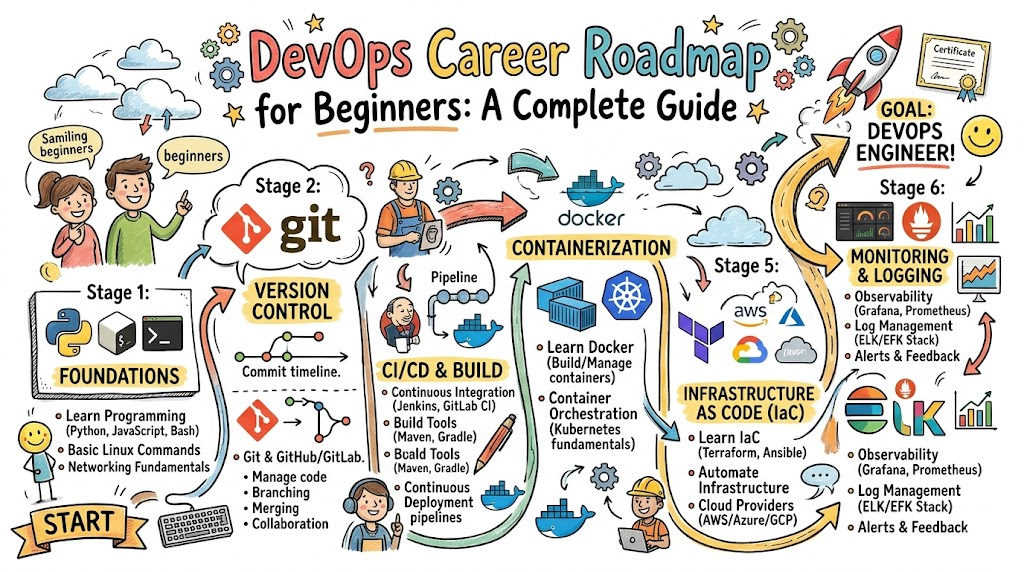
Step-by-Step DevOps Career Roadmap for Beginners
This roadmap is designed for longevity. Do not rush these stages. Spend time mastering the basics, as they will support you throughout your entire career.
| Stage | Skill Area | Goal |
| 1 | Linux Fundamentals | Master the command line and file system. |
| 2 | Networking Basics | Understand how machines communicate. |
| 3 | Scripting Basics | Automate simple tasks with code. |
| 4 | Git & Version Control | Manage your code history. |
| 5 | CI/CD | Automate the build and deployment process. |
| 6 | Containers | Package applications efficiently. |
| 7 | Kubernetes | Manage complex container deployments. |
| 8 | Cloud Platforms | Run infrastructure in the cloud. |
| 9 | Infrastructure as Code | Define infrastructure through files. |
| 10 | Monitoring | Track system health and performance. |
Stage 1: Learn Linux Fundamentals
Most servers on the internet run Linux. You need to be comfortable using the command line to manipulate files, manage users, and handle processes. Focus on navigation commands, permissions, and package management.
Stage 2: Learn Networking Basics
You need to understand how the internet works. Learn about IP addresses, DNS (how domain names resolve), ports (how services talk), and SSH (how you securely log into servers).
Stage 3: Learn Scripting Basics
Automation is the heart of DevOps. Bash scripting is essential for Linux administration. Python is excellent for building more complex automation tools and scripts.
Stage 4: Learn Git and Version Control
Git allows you to track changes in your code. Learn how to commit, branch, merge, and pull code. In a team setting, understanding branching strategies is non-negotiable.
Stage 5: Understand CI/CD
Continuous Integration and Continuous Delivery are the processes that keep software moving. Use tools like Jenkins or GitHub Actions to automate the testing and deployment of your code.
Stage 6: Learn Containers
Docker has revolutionized how we ship software. It wraps code and its dependencies into a “container.” Learn how to write a Dockerfile and run containers.
Stage 7: Learn Kubernetes
Once you have many containers, you need a way to manage them. Kubernetes is the standard for orchestration. Learn about Pods, Deployments, and Services.
Stage 8: Learn Cloud Platforms
Cloud providers like AWS, Azure, or GCP host your infrastructure. Pick one and learn its services: Compute (EC2), Storage (S3), and Networking (VPC).
Stage 9: Learn Infrastructure as Code (IaC)
Stop building servers manually. Use Terraform to write code that provisions your infrastructure. This makes your environment reproducible and version-controlled.
Stage 10: Learn Monitoring & Observability
You cannot fix what you cannot see. Learn how to use tools like Prometheus and Grafana to track metrics and visualize the health of your applications.
Recommended DevOps Tools for Beginners
To keep your learning focused, stick to these industry-standard tools.
| Category | Beginner Tool |
| Operating System | Linux (Ubuntu/CentOS) |
| Version Control | Git |
| CI/CD | Jenkins / GitHub Actions |
| Containerization | Docker |
| Orchestration | Kubernetes |
| Cloud | AWS |
| Infrastructure as Code | Terraform |
| Monitoring | Prometheus & Grafana |
Hands-On Projects for Beginners
Theory alone will not get you hired. You need proof of your skills.
- CI/CD Pipeline Setup: Create a simple web application, push it to GitHub, and use a CI/CD tool to automatically build and deploy it to a server.
- Dockerized Application: Take a simple Python or Node.js app, write a Dockerfile, and run it as a container.
- Cloud Deployment: Host a simple static website on an AWS S3 bucket.
- Monitoring Dashboard: Set up a Prometheus server to monitor your local machine’s CPU usage and visualize it in Grafana.
Certifications for DevOps Beginners
Certifications are a good way to validate your knowledge, but they are not a substitute for hands-on work.
- AWS Certified Cloud Practitioner: Great for understanding cloud concepts.
- Certified Kubernetes Application Developer (CKAD): Excellent for proving you understand container orchestration.
- Linux Foundation Certified System Administrator (LFCS): Validates your essential Linux skills.
Realistic Learning Timeline
- First Month: Focus entirely on Linux and Networking. Do not look at Kubernetes yet.
- Three Months: Master Git, Bash scripting, and basic Python.
- Six Months: Understand Docker and start working with CI/CD tools.
- One Year: Deepen your knowledge in Cloud, Kubernetes, and Terraform.
Common Beginner Mistakes
Avoid these pitfalls to save yourself time and frustration.
- Learning too many tools at once: Master one thing before moving to the next.
- Ignoring Linux fundamentals: If you do not understand the operating system, you will be lost in the cloud.
- Skipping networking: Networking errors are the cause of 50% of infrastructure problems.
- Only watching tutorials: You must type the commands yourself. Passive learning leads to false confidence.
Real-World Beginner Example
Imagine you want to deploy a website. A beginner might log into a server manually and copy files over. This is slow and error-prone. A DevOps approach is different: you write code for the server setup (Terraform), you write a script to build the app (CI/CD), and you package the app in a container (Docker). When you need to update the site, you simply push code to Git, and the pipeline handles the rest. This mindset shift is what transforms you from a “tech worker” to a “DevOps engineer.”
Role of DevOpsSchool in DevOps Career Growth
Learning DevOps requires a structured environment where you can practice without fear of breaking production systems. At DevOpsSchool, the focus is on providing hands-on labs and real-world scenarios. By practicing CI/CD workflows and cloud-native deployments in a supervised setting, you bridge the gap between theory and actual job readiness. Consistent mentorship helps you avoid the common mistakes that derail many beginners, allowing you to focus on the skills that actually matter in the industry today.
Career Opportunities in DevOps
The DevOps umbrella is wide, and your career can take several paths:
- Junior DevOps Engineer: Focuses on maintaining pipelines and basic infrastructure.
- Cloud Engineer: Specializes in cloud architecture and scaling.
- Site Reliability Engineer (SRE): Focuses on system availability, reliability, and incident response.
- Platform Engineer: Builds internal tools and platforms for other developers to use.
- Automation Engineer: Dedicated to writing scripts to remove manual tasks across the company.
Future of DevOps Careers
DevOps is not static. The future is moving toward Platform Engineering, where we build self-service internal developer platforms. We are also seeing a massive increase in DevSecOps, where security is integrated into the pipeline from the very first line of code. AI-assisted automation is also changing how we write infrastructure code, but the need for a human engineer to architect, debug, and oversee these systems will remain high.
FAQs
1. Can beginners learn DevOps? Yes, but you must be willing to learn the fundamentals first.
2. How long does it take to become a DevOps engineer? It typically takes 6 to 12 months of consistent study to become job-ready.
3. Is coding required? You do not need to be a software developer, but you must know how to write scripts (Bash/Python).
4. Should I learn Linux first? Absolutely. It is the single most important skill.
5. Is DevOps hard for beginners? It is challenging because of the breadth of technology, but it is manageable with a roadmap.
6. What cloud platform should I learn? AWS is the industry leader and has the most documentation.
7. Are certifications important? They help get interviews but do not replace practical experience.
8. How do I get my first DevOps job? Build projects, document them in a portfolio, and contribute to open source.
9. Do I need to be a developer? No, but understanding development workflows makes you a much better DevOps engineer.
10. Is DevOps purely about tools? No, it is about culture and processes.
11. Can I learn DevOps at home? Yes, all the tools are available on your laptop or the cloud.
12. Which scripting language should I choose? Python is the most versatile for DevOps automation.
13. What is the most important DevOps skill? The ability to learn and solve problems.
14. Does DevOps involve security? Yes, security (DevSecOps) is a critical part of modern DevOps.
15. How do I keep up with DevOps trends? Follow blogs, read documentation, and stay active in tech communities.
Final Thoughts
The path to becoming a DevOps engineer is a marathon, not a sprint. Do not be discouraged if a concept like Kubernetes seems difficult initially; everyone struggles with it at the start. Build your foundation on Linux and networking, embrace the automation mindset, and always keep your hands on the keyboard. By following a structured roadmap and continuously building projects, you will find yourself well-prepared for a successful and evolving career in this dynamic field.
